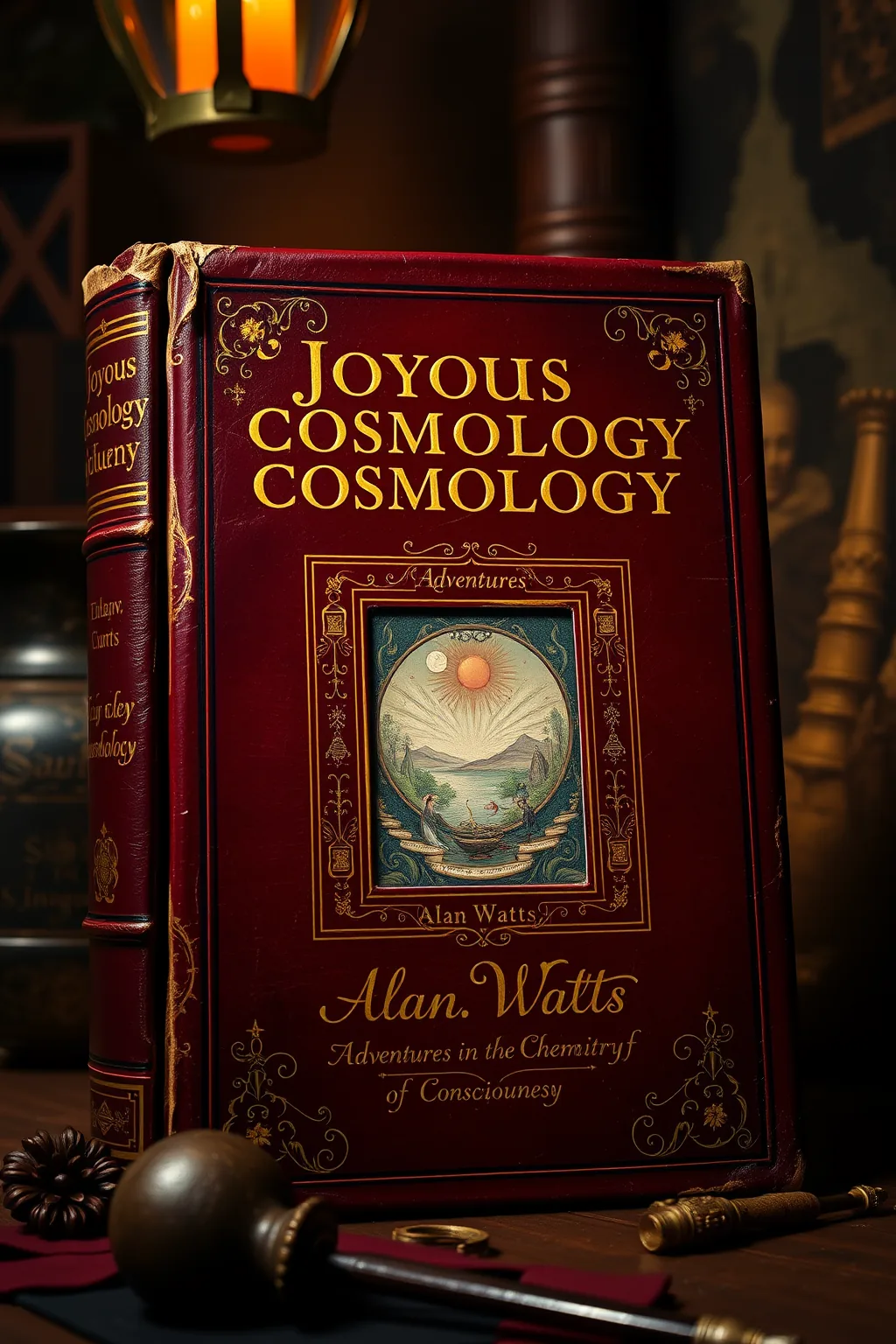
Joyous Cosmology by Alan Watts
 72
72

Joyous Cosmology by Alan Watts



Ophelia Vance (Mystical Literature Reviewer) — Alan Watts' 'Joyous Cosmology' remains a cornerstone for those investigating the esoteric dimensions of consciousness. Watts masterfully bridges the gap between philosophical inquiry and profound experiential revelation, presenting psychedelic exploration not as a mere chemical reaction, but as a sacred pathway to understanding the divine play of existence. His prose, as ever, is luminous, demystifying complex concepts and imbuing his personal accounts with both intellectual rigor and spiritual wonder. This book is essential reading for anyone drawn to the intersection of mysticism, phenomenology, and the transformative power of altered states, offering a potent antidote to the mundane.
📝 Description
72
In 'Joyous Cosmology,' Alan Watts detailed his 1960s LSD and mescaline experiences to examine consciousness.
Alan Watts' 'Joyous Cosmology' documents his experiments with LSD and mescaline in the 1960s, framed as 'Adventures in the Chemistry of Consciousness.' Watts, known for interpreting Eastern philosophy for Western audiences, uses these drug-induced states not as ends in themselves, but as tools to shift perception. He aims to show how altered awareness can break down the illusion of a separate self, revealing an underlying unity and inherent joy in the universe. The book is not a guide to drug use, but a philosophical inquiry into the nature of reality and the self, triggered by chemical stimuli.
Watts details his personal encounters with these substances, emphasizing the radical reorientation of perspective they enabled. He sought to demonstrate how such experiences could dismantle conventional ways of seeing the world, leading to a more direct apprehension of existence. The work invites readers to consider how consciousness itself can be expanded, and how this expansion might illuminate the interconnectedness of all things.
This book sits within the Western interpretation of Eastern mysticism, particularly Zen Buddhism and Vedanta, popular in the mid-20th century counterculture. Watts channels these traditions through the lens of psychedelic experience, seeking to validate subjective insights gained from altered states as akin to meditative epiphanies. It engages with the perennial philosophy's idea that underlying all diverse experiences is a single, unified reality, and uses psychedelics as a catalyst to bypass ordinary conceptual filters and access this perceived unity. The work connects these spiritual inquiries with the burgeoning scientific interest in the psychopharmacological effects on consciousness.
✍️ Author
Alan W. Watts explores the profound insig
Classic literature author · Public Domain
💡 Why Read This Book?
Unlock a profound shift in perception. 'Joyous Cosmology' offers an intellectual and spiritual guide to the transformative potential of altered consciousness, revealing the interconnectedness of all things. It's ideal for seekers, philosophers, and anyone curious about the deeper mysteries of reality and the self, providing a unique lens through which to re-examine existence.
⭐ Reader Reviews
Honest opinions from readers who have explored this book.
❓ Frequently Asked Questions
What is the primary focus of 'Joyous Cosmology'?
The book primarily explores the profound insights and transformative experiences that can arise from altered states of consciousness, particularly through the use of psychedelics, viewed through a philosophical and mystical lens.
Is this book a guide to psychedelic drug use?
No, while it details Watts' personal experiences, it's not a how-to guide. It uses these experiences as a springboard for philosophical reflection on consciousness and reality.
What philosophical traditions influence Alan Watts in this book?
Watts draws heavily from Eastern philosophies, particularly Zen Buddhism and Taoism, integrating their concepts of non-duality, impermanence, and the interconnectedness of all things.
Who is the intended audience for 'Joyous Cosmology'?
The book is for individuals interested in philosophy, spirituality, mysticism, and the nature of consciousness, including those curious about the potential of altered states for self-discovery.
What is the 'joyous' aspect of the cosmology Watts describes?
Watts posits that when the illusion of egoic separation dissolves, one experiences a fundamental unity with the universe, leading to a sense of profound joy and liberation.
🔮 Key Themes & Symbolism
The Nature of Consciousness and Reality
Watts looks at the fundamental question of what consciousness truly is, challenging conventional Western notions of a separate self. He argues that our ordinary state of awareness is merely a limited perception, and that through altered states, we can access a more expansive, unified, and interconnected understanding of reality. This theme explores the illusion of individuality and the profound realization of cosmic oneness, suggesting that the universe is a dynamic, pulsating whole, not a collection of discrete objects.
Psychedelics as Catalysts for Mystical Experience
While not advocating for recreational use, Watts presents psychedelics as potent tools capable of temporarily dissolving the ego's boundaries and facilitating direct, unmediated experiences of the divine or the fundamental nature of existence. He frames these experiences not as hallucinations, but as glimpses into a deeper, more authentic reality that is often obscured by our everyday conditioning. The book examines how these substances can break down mental barriers, leading to profound epiphanies about the self, the universe, and the nature of perception.
The Illusion of the Ego and the Joy of Non-Duality
A central tenet of Watts' philosophy is the critique of the ego as a constructed identity that creates a false sense of separation from the world. 'Joyous Cosmology' illustrates how transcending this egoic illusion leads to a state of 'joyous cosmology' – a recognition of inherent unity and interconnectedness. This theme explores the liberation that comes from realizing one is not a solitary entity but an intrinsic part of the cosmic dance, leading to a profound sense of peace and belonging.
💬 Memorable Quotes
Direct passages from the work, attributed to the author.
“This is the real secret of life -- to be completely engaged with what you are doing in the here and now.”
— Watts emphasizes the importance of full presence and immersion in the present moment, suggesting that true understanding and fulfillment lie not in past regrets or future anxieties, but in the vibrant reality of 'now'.
“Trying to manage things, trying to control things, is the greatest mistake.”
— Watts critiques the human tendency to micromanage and control external circumstances. He suggests that true wisdom lies in relinquishing the need for absolute control, allowing for a more natural unfolding of events.
“The universe is a process of becoming, not a fixed state of being.”
— Watts highlights the dynamic, ever-changing nature of existence. He challenges the idea of a static reality, proposing instead a continuous flow and transformation, mirroring the constant flux of life.
💡 Key Ideas
Editorial paraphrase of the work's core concepts — not direct quotes.
The only way to make sense out of change is to plunge into it, move with it, and join the dance.
This quote captures Watts' philosophy of embracing impermanence. Instead of resisting change, he encourages active participation, likening life's flux to a dance, suggesting that flow and adaptability lead to a deeper understanding.
Things are as they are. Looking more and more like nothing.
This quote points towards a profound realization of emptiness or 'sunyata' in Buddhist terms. It suggests that the ultimate nature of reality is beyond conceptualization and form, a state of pure potentiality.
🌙 Esoteric Significance
Tradition
Watts' work is deeply rooted in the non-dualistic traditions of Eastern philosophy, particularly Zen Buddhism and Taoism. These traditions emphasize the interconnectedness of all things, the illusion of the separate self (ego), and the direct experience of reality beyond conceptual thought. 'Joyous Cosmology' can be seen as an exploration of these principles through the lens of altered states, suggesting that the insights gained from such experiences align with the core tenets of these ancient esoteric paths, leading to a profound realization of unity and the divine play of existence.
Symbolism
The 'chemistry of consciousness' itself serves as a potent metaphor. The chemical interactions are symbolic of the mind's capacity to transform perception, mirroring alchemical processes of transmutation. The dissolution of ego boundaries symbolizes the breaking down of mental constructs to reveal the underlying unity of the cosmos. The 'joyous' aspect represents the liberation and profound contentment that arises from recognizing one's intrinsic connection to the universe, moving beyond the limitations of individualistic striving towards a state of harmonious participation.
Modern Relevance
In an era increasingly grappling with mental well-being, societal fragmentation, and the search for meaning, Watts' exploration of consciousness remains remarkably relevant. His insights into the illusory nature of the ego offer powerful tools for understanding and mitigating anxiety and depression. Furthermore, as scientific research continues to explore the therapeutic potential of psychedelics under controlled conditions, 'Joyous Cosmology' provides a crucial philosophical and spiritual framework for understanding these experiences, advocating for a conscious and integrated approach to expanding human awareness.
👥 Who Should Read This Book
This book beckons to the curious soul, the philosophical seeker, and the spiritual adventurer. For beginners, Watts offers an accessible yet profound introduction to complex ideas about consciousness and reality, explaining the esoteric. Scholars of philosophy, psychology, and comparative religion will find a unique perspective that bridges Eastern thought with Western experiential inquiry. Practitioners of mindfulness or those exploring meditative states will discover a kindred spirit in Watts' exploration of inner landscapes. Ultimately, anyone yearning to question the nature of their own perception and discover a more interconnected and joyous way of being will find immense value within these pages.
📜 Historical Context
Published in 1962, 'Joyous Cosmology' emerged during the height of the psychedelic revolution and the counterculture movement of the 1960s. Alan Watts, already a prominent figure for popularizing Eastern philosophies in the West, tapped into a burgeoning curiosity about altered states of consciousness and their potential for spiritual and philosophical exploration. The era was characterized by a questioning of traditional societal norms, a search for alternative spiritual paths, and a growing interest in mind-altering substances as tools for expanding perception. Watts' work resonated deeply with a generation seeking to break free from perceived limitations of Western materialism and rationalism, offering a bridge between ancient wisdom and contemporary exploration.
📔 Journal Prompts
Reflect on a moment when your perception of reality shifted dramatically. What triggered it, and what did you learn?
Consider the concept of the 'ego' as described by Watts. How does your own sense of self contribute to feelings of separation or connection?
If consciousness is fundamentally interconnected, what implications does this have for your daily interactions and responsibilities?
Describe a time you felt a profound sense of awe or wonder. How did this experience connect you to something larger than yourself?
Explore the idea of 'joining the dance' of change. In what areas of your life can you practice embracing flux rather than resisting it?
🗂️ Glossary
Ego
In Watts' context, the 'ego' refers to the constructed sense of individual self, often perceived as separate from the rest of the universe. He critiques it as an illusion that can lead to feelings of isolation and limitation.
Non-duality
A philosophical concept, prominent in Eastern traditions, asserting that reality is ultimately a single, undivided whole, and that apparent divisions (like self/other, mind/body) are illusory.
Altered States of Consciousness
Refers to any mental state that deviates from normal waking consciousness, often induced by meditation, psychedelics, dreams, or intense emotional experiences, leading to different ways of perceiving reality.
Cosmology
The study of the origin, evolution, and structure of the universe. In 'Joyous Cosmology,' Watts uses it to describe the fundamental nature and order of existence as perceived through an expanded consciousness.
Transcendence
The state or act of going beyond ordinary limits or constraints. In this context, it refers to transcending the limitations of the ego and ordinary perception to experience a higher or deeper reality.
This book appears in 2 collections
🔮 Readers Also Liked
Browse all →






From the “Witchcraft” Collection
View all →








More Free Witchcraft & Paganism Books
View all →