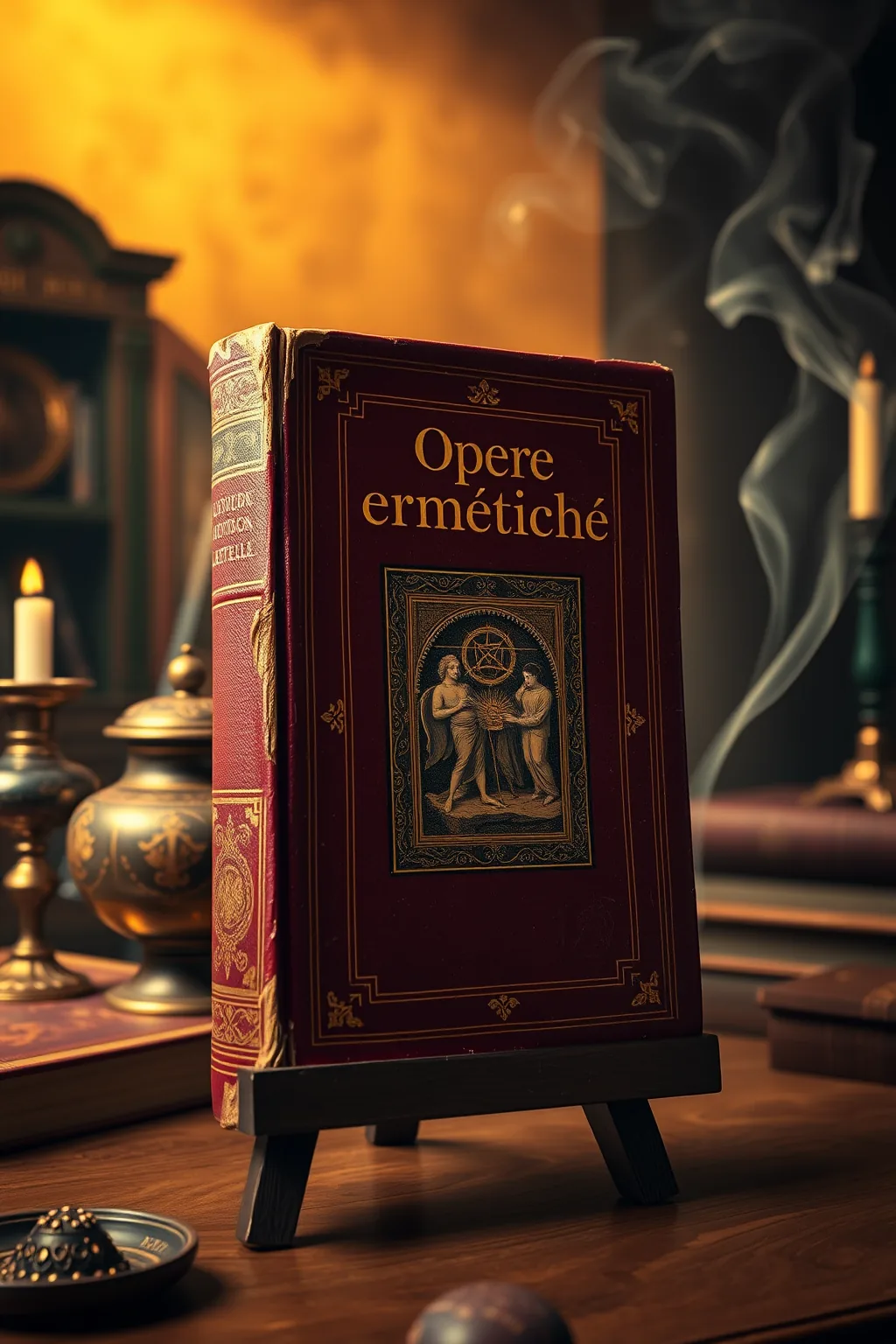
Opere ermetiche
 82
82

Opere ermetiche
Ludovico Lazzarelli's "Opere ermetiche" offers a rare glimpse into a specific, often overlooked, branch of Renaissance Hermeticism. The compilation, while scholarly, suffers from a lack of introductory material that might contextualize Lazzarelli's unique, sometimes idiosyncratic, blend of alchemy and Neoplatonism for a contemporary audience. His treatise "De septem mundi creaturis" presents a particularly dense but fascinating exploration of cosmogony, hinting at a personal system of thought. However, without extensive commentary on his obscure terminology, the reader is often left to decipher the text with minimal guidance. This volume is a valuable primary source for dedicated researchers, but its accessibility for broader esoteric study remains a challenge.
📝 Description
82
Ludovico Lazzarelli's alchemical and Neoplatonic writings from the Italian Renaissance are collected in this 2009 volume.
Opere ermetiche compiles the scattered writings of Ludovico Lazzarelli, an Italian Renaissance scholar active around the late 15th century. This collection brings together his treatises, dialogues, and poems, many of which were previously difficult to access. The book offers a view into a particular current of Renaissance Hermeticism, drawing on manuscript traditions that predate its 2009 publication. Lazzarelli's work engages with complex philosophical and alchemical ideas from his time.
This volume is geared towards dedicated students of Renaissance esotericism, alchemy, and Neoplatonism. Those familiar with the intellectual landscape that shaped figures such as Marsilio Ficino and Pico della Mirandola will find Lazzarelli's perspective valuable. It is intended as a resource for individuals already acquainted with these philosophical traditions, rather than an introductory text. Lazzarelli's writings reflect the period's intense interest in classical and esoteric texts.
Ludovico Lazzarelli (c. 1450-1500) wrote during a period marked by a significant resurgence of interest in classical and esoteric thought, especially following the rediscovery of the Corpus Hermeticum in 15th-century Florence. This revival fueled engagement with Hermetic philosophy across art, science, and religion. Lazzarelli's own contributions emerged from this intellectual climate, particularly in Northern Italy, where he interacted with Neoplatonic concepts and alchemical symbolism.
💡 Why Read This Book?
• Gain insight into the specific alchemical allegories Lazzarelli employed, differing from common Hermetic interpretations, to understand the evolving language of Renaissance magic. • Explore Lazzarelli's unique engagement with Neoplatonic cosmology as presented in "De septem mundi creaturis," a text reflecting his personal philosophical system from the late 15th century. • Understand the intellectual milieu of Renaissance Italy by examining Lazzarelli's work alongside contemporaries who also sought to revive ancient wisdom traditions.
⭐ Reader Reviews
Honest opinions from readers who have explored this book.
❓ Frequently Asked Questions
Who was Ludovico Lazzarelli and when did he live?
Ludovico Lazzarelli was an Italian Renaissance scholar, poet, and alchemist. He lived approximately from 1450 to 1500, a period marked by a renewed interest in classical and esoteric texts.
What is the 'prisca theologia' mentioned in Lazzarelli's work?
The 'prisca theologia,' or ancient theology, is a concept prevalent in Renaissance thought suggesting a single, ancient divine wisdom underlying all religions and philosophies, a theme Lazzarelli explored.
What is the significance of the Corpus Hermeticum for Lazzarelli?
The rediscovery and translation of the Corpus Hermeticum in the 15th century significantly influenced Renaissance thinkers, including Lazzarelli, who incorporated its themes of divine wisdom and cosmic understanding into his own alchemical and philosophical writings.
Does 'Opere ermetiche' contain original alchemical recipes?
While 'Opere ermetiche' explores alchemical symbolism and philosophy, it primarily focuses on Lazzarelli's theoretical and allegorical interpretations rather than providing practical, step-by-step alchemical recipes.
What is the historical period this book is most relevant to?
The book is most relevant to the Italian Renaissance, specifically the late 15th century, during which Lazzarelli composed his works on Hermetic philosophy and alchemy.
What are the main philosophical influences on Lazzarelli?
Lazzarelli's work is influenced by Neoplatonism, particularly its cosmological and spiritual ascent doctrines, and the Hermetic tradition revived during the Renaissance.
🔮 Key Themes & Symbolism
Renaissance Alchemical Allegory
Lazzarelli's "Opere ermetiche" showcases an allegorical approach to alchemy, moving beyond literal interpretations of metallic transmutation. He often employs alchemical processes as metaphors for spiritual purification and the soul's journey towards divine understanding. This perspective aligns with the intellectual climate of the late 15th century, where philosophical and mystical meanings were frequently ascribed to material transformations, reflecting a Neoplatonic worldview.
Neoplatonic Cosmology
The volume examines Lazzarelli's interpretation of Neoplatonic cosmology, particularly evident in "De septem mundi creaturis." This section explores concepts of emanation from the Divine Intellect (Nous) and the hierarchical structure of the cosmos. Lazzarelli's synthesis integrates these ancient Greek philosophical ideas with Christian theology and Hermetic notions, aiming to construct a comprehensive worldview accessible through intellectual and spiritual discipline.
The 'Prisca Theologia'
Lazzarelli engages with the Renaissance concept of the 'prisca theologia,' the idea that a single, ancient divine wisdom exists across various cultures and traditions. His works suggest a search for this primordial truth, attempting to reconcile Hermetic teachings, classical philosophy, and Christian doctrine. This theme reflects a broader intellectual movement of the era seeking unity and universality in religious and philosophical thought.
Spiritual Ascent and Purification
Central to Lazzarelli's philosophy is the notion of the soul's ascent towards the divine. This journey is often depicted through alchemical metaphors of purification, where the base elements of the soul are refined to achieve a higher spiritual state. The "Opere ermetiche" outlines a path of rigorous intellectual and moral discipline required for this transformation, echoing the spiritual exercises found in Neoplatonic and Christian mystical traditions.
💬 Memorable Quotes
Direct passages from the work, attributed to the author.
“The mind, when it contemplates the divine light, becomes divine.”
— This aphorism captures the Neoplatonic ideal of intellectual illumination leading to spiritual union. It suggests that through focused contemplation of the ultimate reality, the human intellect can partake in its essence, achieving a form of deification.
“Each metal carries within it the seed of perfection, awaiting the alchemist's art.”
— This expresses the alchemical belief in the inherent potential for transformation within matter. Lazzarelli uses this not just for physical substances but implies a similar latent spiritual perfection within the human soul.
“The seven worlds are but reflections of the seven celestial intelligences.”
— This statement reflects a key aspect of Lazzarelli's cosmological framework, linking the macrocosmic order of the spheres and their ruling intelligences to the structure of existence, a common theme in Renaissance Hermeticism.
“Wisdom is the key that unlocks the hidden harmonies of creation.”
— Here, wisdom is presented as the active principle enabling the understanding of the universe's underlying order. It implies that true knowledge reveals the interconnectedness and divine symphony of all things.
“To know the self is to approach the knowledge of the One.”
— This carries the Socratic imperative ('Know Thyself') infused with Neoplatonic thought, suggesting that introspective self-knowledge is a crucial step in the spiritual journey towards understanding the ultimate, unified source of all being.
🌙 Esoteric Significance
Tradition
Lazzarelli's work is firmly rooted in the Western Esoteric Tradition, specifically the Hermetic and Neoplatonic currents that flourished during the Renaissance. He sought to integrate the rediscovered Hermetic texts with established Christian theology and the philosophical system of Neoplatonism. His approach represents a distinct strand within Renaissance Hermeticism, characterized by a personal synthesis and a focus on alchemical allegory as a means to express philosophical and spiritual truths.
Symbolism
Key symbols in Lazzarelli's work include the seven celestial spheres, representing cosmic order and influence, and the alchemical metals, often used allegorically for stages of spiritual purification. The concept of the 'seed of perfection' within matter is also central, symbolizing the divine potential latent in both the material world and the human soul, awaiting activation through esoteric art and knowledge.
Modern Relevance
Contemporary practitioners of Hermeticism and Western Esotericism draw on Lazzarelli's writings for their unique perspective on the integration of alchemy and Neoplatonism. Scholars studying the history of Renaissance thought and the evolution of alchemical symbolism find his work essential for understanding the diversity of esoteric philosophies beyond the most commonly cited figures. His attempt at synthesis remains a point of reference for modern syncretic spiritual systems.
👥 Who Should Read This Book
• Students of Renaissance Esotericism: Those researching the intellectual history of the 15th century and the impact of Hermeticism and Neoplatonism on art, philosophy, and religion. • Aspiring Alchemists: Individuals interested in the philosophical and allegorical dimensions of alchemy, particularly how early modern thinkers interpreted its symbolic language. • Comparative Religion Scholars: Researchers examining the Renaissance concept of 'prisca theologia' and attempts to unify diverse spiritual and philosophical traditions.
📜 Historical Context
Ludovico Lazzarelli (c. 1450-1500) was a figure of the Italian Renaissance, a period characterized by the fervent revival of classical learning and esoteric traditions. The rediscovery and translation of the Corpus Hermeticum in the early 15th century, particularly by scholars like Marsilio Ficino, had ignited widespread interest in Hermetic philosophy. Lazzarelli's work emerged within this intellectual milieu, engaging directly with Neoplatonic ideas and alchemical symbolism prevalent in Northern Italian humanist circles. He operated in an era where thinkers sought to synthesize ancient pagan wisdom with Christian doctrine, a movement often termed the 'prisca theologia.' Contemporaries like Pico della Mirandola were also exploring similar syncretic paths. While Lazzarelli's personal manuscripts circulated, his works received limited publication during his lifetime, contributing to their obscurity until modern scholarship began to reassemble and analyze them.
📔 Journal Prompts
The concept of the 'prisca theologia' in Lazzarelli's writings.
Lazzarelli's allegorical use of alchemical metals.
The structure of the seven worlds as presented in 'De septem mundi creaturis'.
The relationship between intellectual contemplation and divine illumination.
The soul's purification through alchemical symbolism.
🗂️ Glossary
Hermeticism
A religious, philosophical, and esoteric tradition based primarily upon writings attributed to Hermes Trismegistus. It emphasizes divine wisdom, cosmology, and the interconnectedness of all things.
Neoplatonism
A philosophical system originating in the Roman Empire, based on the teachings of Plato and later elaborated by thinkers like Plotinus. It emphasizes the concept of 'The One' as the ultimate source of all reality.
Alchemy
An ancient tradition focused on the transformation of matter, often seeking to transmute base metals into gold and discover the elixir of life. It also carries significant spiritual and philosophical allegorical meanings.
Corpus Hermeticum
A collection of ancient Greek philosophical and religious writings that are attributed to Hermes Trismegistus, a legendary Hellenistic figure. It forms the core texts of Hermeticism.
Prisca Theologia
The concept of an ancient, universal theology or divine wisdom believed to be present in all religions and philosophies, particularly influential during the Renaissance.
Nous
In Neoplatonic philosophy, the divine intellect or mind, often considered the first emanation from 'The One,' serving as the source of all thought and form.
De septem mundi creaturis
A specific treatise by Ludovico Lazzarelli, likely dealing with cosmological themes, possibly related to the seven celestial spheres or creative principles.
🔮 Readers Also Liked
Browse all →









More by Ludovico Lazzarelli
All books →
More Free Alchemy & Hermeticism Books
View all →