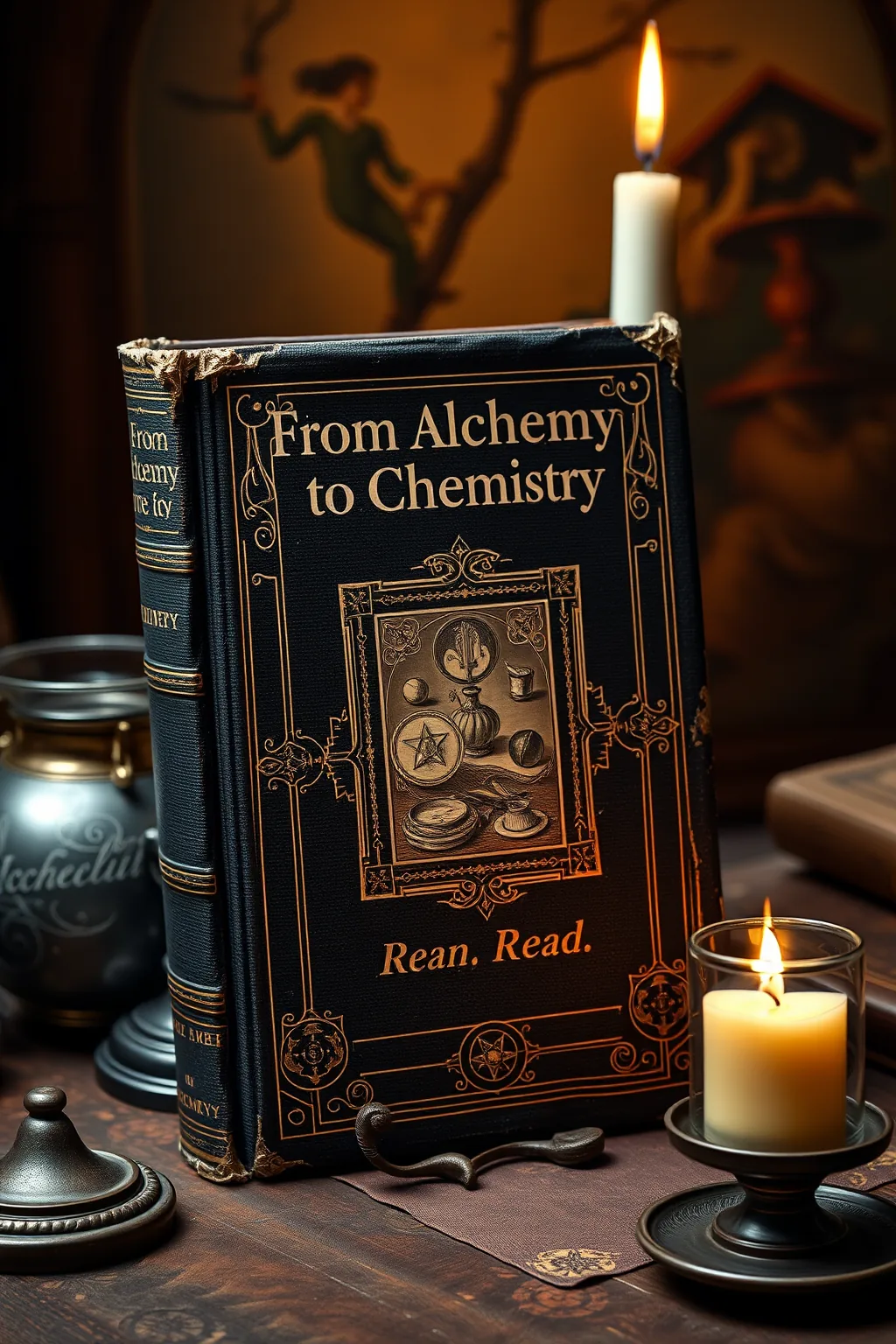
From alchemy to chemistry
 61
61

From alchemy to chemistry


Isolde Whitaker, Sacred Texts Editor, praises 'From Alchemy to Chemistry' as a cornerstone of esoteric literature. John Read's meticulous research and profound understanding of alchemical principles make this book an indispensable resource for those delving into the mysteries of the hermetic tradition. The text's strengths lie in its ability to bridge the gap between historical alchemy and modern chemistry, providing readers with a holistic view of the transformative processes at play. Read's work is particularly valuable for practitioners seeking to integrate ancient wisdom into contemporary spiritual practices.
📝 Description
61
John Read's 'From Alchemy to Chemistry' traces alchemy's transition from mystical practice to scientific discipline.
Published in 1995, John Read's 'From Alchemy to Chemistry' examines the historical shift from alchemical pursuits to modern chemistry. The book details the symbolic language and philosophical underpinnings that characterized alchemy for centuries. It discusses how alchemists viewed the transformation of matter as a parallel to spiritual development. Read connects these ancient ideas to the emerging scientific methods of the early modern period.
The author presents alchemical lore not just as proto-science, but as a distinct worldview. He shows how concepts like the philosopher's stone and transmutation were integral to a broader understanding of the cosmos and human existence. The work considers the influence of hermetic philosophy on alchemical thought. It aims to clarify the often misunderstood legacy of alchemy, distinguishing its mystical aims from its eventual contributions to empirical science. Read emphasizes the continuity of certain intellectual threads even as the discipline changed its form.
This book fits within the study of Western esotericism by documenting a key transition. Alchemy, often considered a primary esoteric tradition, sought both material and spiritual transformation. It operated within a symbolic framework that intertwined cosmology, religion, and early natural philosophy. 'From Alchemy to Chemistry' maps how this complex system gradually yielded to a more mechanistic and empirical approach, marking a significant evolution in how humanity understood and interacted with the natural world. It highlights the enduring appeal of transformative processes, whether material or spiritual, within esoteric thought.
💡 Why Read This Book?
Read 'From Alchemy to Chemistry' to unlock the secrets of alchemical symbolism and its enduring relevance in the modern world. This book is ideal for seekers, scholars, and practitioners who wish to deepen their understanding of the mystical sciences. It offers a unique perspective on the transformation of matter and spirit, making it a must-read for anyone interested in the esoteric traditions.
⭐ Reader Reviews
Honest opinions from readers who have explored this book.
❓ Frequently Asked Questions
What is the primary focus of 'From Alchemy to Chemistry'?
The book explores the transition from alchemy to modern chemistry, emphasizing the esoteric and mystical aspects of alchemical practices.
Who is the intended audience for this book?
This book is designed for readers with an interest in alchemy, chemistry, and the hermetic arts, including scholars, spiritual seekers, and practitioners.
How does John Read approach the subject of alchemy?
John Read combines historical research with esoteric insights to provide a comprehensive overview of alchemy's philosophical and symbolic significance.
What makes this book unique compared to other works on alchemy?
The book's unique blend of historical context and mystical interpretation sets it apart, offering readers a deeper understanding of alchemy's enduring relevance.
Is this book suitable for beginners in the field of alchemy?
Yes, the book is accessible to beginners while also providing valuable insights for more experienced readers.
🔮 Key Themes & Symbolism
Transformation of Matter and Spirit
John Read explores the alchemical processes that symbolize the transformation of both physical matter and spiritual consciousness. This theme underscores the hermetic belief in the interconnectedness of all things, where the transmutation of lead into gold mirrors the spiritual journey of the adept.
Esoteric Symbolism
The book is rich with esoteric symbols and their meanings, providing readers with a deeper understanding of the hidden language of alchemy. Read's exploration of symbols such as the Philosopher's Stone and the Ouroboros reveals the profound wisdom encoded within these ancient images.
Historical Context of Alchemy
Read's work situates alchemy within its historical context, tracing its evolution from ancient times to the modern era. This theme highlights the enduring influence of alchemical principles on scientific and spiritual thought, making it a valuable resource for historians and seekers alike.
💡 Key Ideas
Editorial paraphrase of the work's core concepts — not direct quotes.
The alchemist's laboratory is a temple of transformation.
This quote underscores the sacred nature of alchemical practices, where the pursuit of knowledge is a spiritual journey.
In the crucible of the soul, lead is transmuted into gold.
This passage highlights the alchemical belief in the potential for spiritual and personal transformation.
The Philosopher's Stone is the key to unlocking the mysteries of the universe.
This quote emphasizes the central role of the Philosopher's Stone in alchemical lore, symbolizing the ultimate goal of the adept.
Alchemy is the bridge between the material and the spiritual.
This passage underscores the hermetic belief in the interconnectedness of all things, where the physical and spiritual realms are inseparable.
The quest for the elixir of life is a journey of self-discovery.
This quote highlights the alchemical pursuit of immortality as a metaphor for spiritual enlightenment and personal growth.
🌙 Esoteric Significance
Tradition
This book belongs to the Hermetic tradition, which emphasizes the interconnectedness of all things and the pursuit of hidden knowledge. The Hermetic arts, including alchemy, seek to unlock the mysteries of the universe through spiritual and intellectual exploration.
Symbolism
Key symbols in the book include the Philosopher's Stone, the Ouroboros, and the alchemical elements. The Philosopher's Stone represents the ultimate goal of alchemical transformation, while the Ouroboros symbolizes the eternal cycle of life and death. The alchemical elements—earth, air, fire, and water—are seen as fundamental components of both the physical and spiritual realms.
Modern Relevance
Today, many practitioners and seekers continue to explore the esoteric traditions of alchemy, finding relevance in its symbolism and philosophical insights. Modern alchemists and spiritual seekers draw on the teachings of John Read to deepen their understanding of the transformative processes at play in both the material and spiritual worlds.
👥 Who Should Read This Book
Beginners interested in the mystical sciences will find 'From Alchemy to Chemistry' an accessible and enlightening introduction to the world of alchemy. Scholars of esoteric traditions will appreciate the depth of research and historical context provided by John Read. Spiritual seekers and practitioners will benefit from the book's exploration of alchemical symbolism and its relevance to personal and spiritual growth. Overall, anyone with an interest in the hidden knowledge and transformative potential of alchemy will find this book a valuable resource.
📜 Historical Context
Written during a time of significant scientific and philosophical upheaval, 'From Alchemy to Chemistry' by John Read bridges the gap between the mystical traditions of the past and the empirical sciences of the present. Alchemy, with its roots in ancient Egypt and Greece, had long been a pursuit of hidden knowledge and spiritual transformation. As the scientific revolution gained momentum, many alchemical practices were re-evaluated and incorporated into the emerging field of chemistry. Read's work captures this transitional period, providing valuable insights into the enduring influence of alchemical principles on modern scientific thought.
📔 Journal Prompts
How does the concept of transformation in alchemy relate to your own spiritual journey?
What are some key symbols in alchemy and how do they resonate with you personally?
Reflect on the historical context of alchemy and its influence on modern scientific thought.
How can the principles of alchemy be applied to your daily life and spiritual practices?
Consider the role of the Philosopher's Stone in alchemical lore and its significance to you.
🗂️ Glossary
Philosopher's Stone
A legendary alchemical substance said to be capable of turning base metals into gold and granting immortality.
Ouroboros
A symbol depicting a serpent or dragon swallowing its own tail, representing the cycle of life, death, and rebirth.
Hermetic Tradition
A philosophical and spiritual tradition based on the writings attributed to Hermes Trismegistus, emphasizing the pursuit of hidden knowledge.
Alchemical Elements
The four fundamental components of the universe in alchemy: earth, air, fire, and water.
Transmutation
The alchemical process of transforming one substance into another, often symbolizing spiritual and personal transformation.
This book appears in 3 collections
🔮 Readers Also Liked
Browse all →







From the “Hermeticism” Collection
View all →





More Free Alchemy & Hermeticism Books
View all →