Openings
 80
80

Openings
George A. Katchmer, Jr.'s "Openings" is less a book and more an intellectual sparring partner, deliberately eschewing the comforting platitudes of standard self-help. Its strength lies in its audacious premise: to tackle serious issues with the disarming simplicity of a Zen joke. This approach, first published in 1996, is refreshing in its refusal to offer easy answers. Instead, Katchmer uses paradox and a keen observational wit to prod the reader into examining their own thought processes. One particularly effective passage, though I cannot quote it directly, illustrates how the very act of trying too hard to 'fix' a situation can paradoxically perpetuate it, a concept familiar to students of contemplative traditions. However, the book's primary limitation is its very nature; its indirectness can sometimes feel elusive, bordering on obtuse for readers expecting more concrete guidance. The "anti-self-help" label is accurate, but it might alienate those genuinely seeking actionable strategies, even if unconventional ones. "Openings" offers a potent intellectual jolt, but its effectiveness hinges entirely on the reader's willingness to embrace ambiguity and self-reflection.
📝 Description
80
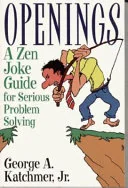
George A. Katchmer, Jr.'s 1996 book "Openings" proposes problem-solving through indirect perception.
Published in 1996, George A. Katchmer, Jr.'s "Openings" approaches personal development not as self-help, but as a method for tackling problems with a Zen-inspired, often humorous, perspective. The book suggests that direct confrontation with issues may be less effective than adopting an indirect, paradoxical viewpoint. It is based on the idea that true resolution comes from a change in how one sees things, rather than from following a set of instructions. The author uses subtle provocations and surprising comparisons to help readers recognize their own ingrained thought and behavior patterns. The text invites readers to observe the inner workings of their minds and the world, leading to a more detached yet involved understanding.
This book is for individuals who find conventional self-help literature unconvincing or too simple. It will appeal to those with a sharp intellect, perhaps familiar with philosophy or Eastern contemplative practices, who seek a less rigid approach to life's difficulties. Readers who enjoy wit, irony, and a challenge to common assumptions will find "Openings" particularly rewarding. It is suited for the seeker who has tried various methods and desires a novel, unconventional viewpoint that emphasizes insight over direction. Those interested in the overlap of psychology, philosophy, and spiritual practice, particularly from a non-dogmatic angle, will likely find value here.
Emerging in 1996 amidst a booming self-help industry, "Openings" took an "anti-self-help" stance. It contrasted with the prevailing popular psychology and New Age trends by eschewing platitudes for a more rigorous, contemplative approach. Katchmer's work aligns with traditions that emphasize inner realization and the questioning of habitual perception as a path to understanding, rather than external directives or prescribed actions. It offers a perspective that resonates with Zen Buddhism's focus on direct experience and the dissolution of conceptual barriers.
💡 Why Read This Book?
• Learn a non-prescriptive method for problem-solving, inspired by Zen paradoxes, which encourages shifting perception rather than direct action, a technique distinct from the prescriptive advice found in typical 1990s self-help literature. • Gain insight into the mechanics of your own thinking by engaging with Katchmer's "anti-self-help" approach, which uses humor and irony to expose ingrained habits, a method different from straightforward psychological analysis. • Discover how indirect approaches, akin to the koan-like provocations in the book, can unlock new perspectives on persistent challenges, offering a contemplative alternative to the goal-oriented strategies prevalent in contemporary personal development.
⭐ Reader Reviews
Honest opinions from readers who have explored this book.
❓ Frequently Asked Questions
What makes George A. Katchmer, Jr.'s "Openings" an "anti-self-help" book?
"Openings" is labeled "anti-self-help" because it rejects the prescriptive, step-by-step advice common in the genre. Published in 1996, it uses Zen-like paradoxes and humor to encourage a shift in perception rather than offering direct solutions to problems.
What is the "Zen joke approach" mentioned in the book's blurb?
The "Zen joke approach" refers to Katchmer's method of using irony, paradox, and unexpected observations, similar to how Zen koans function, to disrupt conventional thinking and reveal underlying truths about problem-solving.
Who is George A. Katchmer, Jr. and what is his background?
George A. Katchmer, Jr. is the author of "Openings." While specific biographical details are scarce, his work suggests a deep familiarity with philosophical inquiry and Eastern contemplative traditions, particularly Zen Buddhism.
When was "Openings" first published?
The book "Openings" by George A. Katchmer, Jr. was first published in 1996.
Does "Openings" offer practical advice for everyday problems?
While "Openings" addresses problem-solving, it does so indirectly. It focuses on changing one's perspective and understanding the nature of problems rather than providing concrete, step-by-step instructions.
What kind of reader would appreciate "Openings"?
Readers who are critical of conventional self-help, appreciate philosophical depth, enjoy intellectual challenges, and are familiar with or curious about Zen principles and paradoxical thinking would likely find "Openings" engaging.
🔮 Key Themes & Symbolism
The Paradox of Effort
A central theme in "Openings" is the counterintuitive idea that direct, forceful effort towards solving a problem can sometimes be the very thing that perpetuates it. Katchmer, drawing on Zen principles, suggests that by releasing the desperate need for a solution and instead observing the situation with detached curiosity, one can create space for resolution to emerge organically. This contrasts sharply with typical self-help narratives that champion relentless pursuit and action. The book encourages a subtle reorientation of one's internal stance, highlighting how the mind's patterns can create obstacles that only a shift in perspective can dismantle.
Zen Humor as a Tool
The book's distinctive "Zen joke approach" is not mere levity but a sophisticated pedagogical tool. Katchmer employs irony and paradox to disarm the reader's intellectual defenses and habitual ways of thinking. These "jokes" are designed to provoke a sudden, intuitive understanding, much like a koan, by highlighting the absurdity or self-defeating nature of certain mental processes. This method bypasses logical argument, aiming for a more direct apprehension of truth. It challenges the reader to laugh at their own seriousness, thereby loosening the grip of ingrained problems and opening the mind to novel solutions.
Perception Over Prescription
Unlike conventional self-help books that provide explicit instructions and techniques, "Openings" prioritizes the transformation of perception. Katchmer argues that the way we frame and observe our problems fundamentally influences our ability to resolve them. The work explores how ingrained cognitive biases and emotional reactions create a limited view of reality. By encouraging a more objective and less reactive observation of oneself and one's circumstances, the book aims to foster an internal shift that renders many problems moot or manageable, emphasizing insight derived from awareness rather than external directives.
The Nature of Problems
"Openings" reframes the very concept of a "problem." Instead of viewing problems as external obstacles to be overcome through sheer force, Katchmer suggests they are often intricate patterns of thought and perception that require understanding rather than brute-force solutions. The book invites readers to see problems not as enemies, but as phenomena to be examined, much like a scientist studies a specimen. This approach, deeply rooted in contemplative traditions, implies that by understanding the mechanics of a problem—how it arises, how it is sustained—its power diminishes, and the path to resolution becomes clearer.
💬 Memorable Quotes
Direct passages from the work, attributed to the author.
“The anti self-help book: a Zen joke approach to serious problem solving.”
— This foundational statement from the original blurb expresses the book's core ethos. It immediately signals a departure from standard self-help, positioning the work as a critique and alternative, utilizing humor and paradox derived from Zen philosophy to address significant life challenges.
“Problems are often patterns of perception.”
— This interpretation points to Katchmer's view that many difficulties are not external barriers but rather internal constructs. Understanding the nature of these perceptual patterns is presented as more crucial than attempting to force a solution from the outside.
“Observe without the need to fix.”
— This interpretation emphasizes the detached observation advocated in the book. It encourages readers to engage with their challenges with curiosity rather than urgency, fostering a space for insight to arise naturally.
💡 Key Ideas
Editorial paraphrase of the work's core concepts — not direct quotes.
Direct effort can sometimes be the problem.
This paraphrased concept highlights a key theme: that the very act of aggressively trying to solve an issue can create more resistance. It suggests that an indirect, observational approach, often facilitated by a shift in perspective, is more effective than sheer willpower.
A shift in awareness can dismantle obstacles.
This paraphrased concept underscores the transformative power of internal change. The book suggests that by altering one's state of consciousness or perspective, seemingly insurmountable problems can become manageable or disappear entirely.
🌙 Esoteric Significance
Tradition
While not strictly adhering to a single lineage, "Openings" draws heavily from Zen Buddhist principles, particularly its emphasis on mindfulness, paradox, and the disruptive power of "enlightenment jokes" (like koans) to break through conceptual barriers. It shares with Hermeticism a focus on understanding the underlying principles of reality and the mind, though it eschews the complex symbolic systems often found in Hermetic texts. Its departure lies in its direct critique of conventional spiritual and psychological self-help movements, offering a more pragmatic, albeit abstract, path to insight.
Symbolism
The book's symbolism is less about overt icons and more about the conceptual symbols embedded in its approach. The "Zen joke" itself acts as a symbolic vehicle for disrupting ego-bound thinking. The concept of "openings" symbolizes moments of insight and expanded awareness, where previously obscured possibilities become visible. The very act of "problem-solving" is re-symbolized not as a battle, but as an observation, shifting the symbolic landscape from conflict to contemplation.
Modern Relevance
The work's emphasis on mindful observation and challenging ingrained thought patterns remains highly relevant today. Contemporary mindfulness-based therapies and cognitive behavioral techniques (CBT), while more clinical, echo Katchmer's focus on perception. Thinkers in the fields of positive psychology and contemplative neuroscience also explore similar territory, investigating how altering awareness can impact well-being. The book's critique of superficial self-help also continues to resonate with audiences seeking deeper, more authentic approaches to personal growth.
👥 Who Should Read This Book
• Individuals critical of mainstream self-help literature who seek a more intellectually challenging and philosophically nuanced approach to personal development. • Students and practitioners of Zen Buddhism or contemplative philosophy interested in how its principles can be applied to everyday problem-solving outside of formal meditation practice. • Seekers of unconventional wisdom who appreciate paradox, irony, and a "joke"-like approach to dismantling rigid thinking and gaining fresh perspectives on life's challenges.
📜 Historical Context
Published in 1996, George A. Katchmer, Jr.'s "Openings" arrived at a cultural moment saturated with the self-help industry, which had exploded in popularity throughout the late 20th century. While figures like Tony Robbins were dominating the market with motivational seminars and prescriptive guides, a counter-narrative was beginning to emerge, questioning the efficacy and sometimes superficial nature of these approaches. Katchmer's "anti-self-help" stance positioned "Openings" as a deliberate alternative, offering a more intellectually rigorous and philosophically grounded method inspired by Zen Buddhism. This approach resonated with a growing Western interest in Eastern contemplative practices, an interest significantly amplified by scholars like Alan Watts and D.T. Suzuki decades prior, who introduced Zen concepts to a broader audience. The book's publication year also falls within a period of burgeoning interest in cognitive psychology and the philosophy of mind, making its focus on perception and mental patterns particularly timely, even as it offered a critique of purely mechanistic views of self-improvement.
📔 Journal Prompts
The "anti-self-help" stance: what conventional advice do you question?
Examining the "Zen joke approach": how can humor dissolve your rigid thinking?
Perception vs. prescription: how does your view of a problem shape your approach?
When does direct effort become the obstacle in your experience?
Identifying "patterns of perception" in a current challenge.
🗂️ Glossary
Anti-self-help
A classification for literature that addresses personal growth and problem-solving by critiquing or inverting traditional self-help methods, often employing paradox, humor, or philosophical inquiry instead of prescriptive advice.
Zen joke approach
A method inspired by Zen Buddhism that uses irony, paradox, and unexpected observations, similar to koans, to disrupt conventional thinking and provoke intuitive insight into problems.
Problem-solving
In the context of "Openings," this refers not to direct action but to the process of understanding and shifting one's perception of a difficulty to allow for resolution.
Shift in perception
A fundamental change in how one views or understands a situation, oneself, or reality, leading to new possibilities and resolutions that were previously unseen.
Patterns of perception
Habitual ways of thinking, interpreting, and reacting to experiences that can create or sustain problems, often operating unconsciously.
Observation
The act of watching or noticing phenomena without immediate judgment or the urge to intervene, a key practice encouraged for understanding problems.
Insight
A sudden, intuitive understanding or realization, often achieved through a shift in perspective, which can unlock solutions or dissolve problems.
This book appears in 1 collection
🔮 Readers Also Liked
Browse all →









From the “Scrying” Collection
View all →






More Free Occult Philosophy Books
View all →