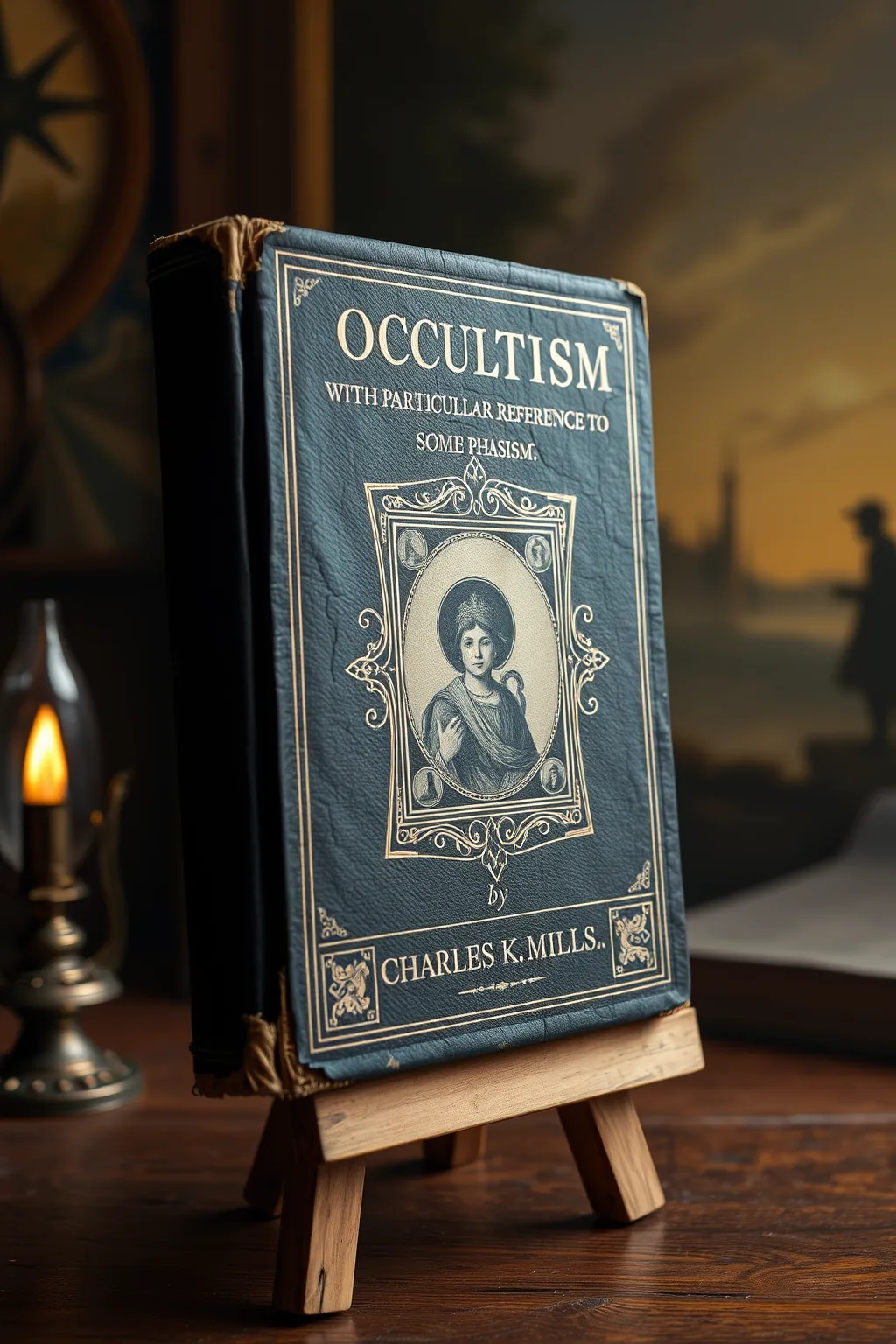
OCCULTISM WITH PARTICULAR REFERENCE TO SOME PHASES OF SPIRITISM.1
 71
71

OCCULTISM WITH PARTICULAR REFERENCE TO SOME PHASES OF SPIRITISM.1



Sophia Crane (Associate Editor) — Charles K. Mills' "Occultism with Particular Reference to Some Phases of Spiritism" stands as a lucid and insightful examination of the intersection between occult philosophy and the burgeoning spiritualist movements of its time. Mills' approach is both rigorous and intuitively sensitive, offering readers a foundational understanding of esoteric concepts often shrouded in mystery. The work excels in its clear exposition of complex ideas, making it an invaluable resource for those beginning their journey into occult studies or seeking to contextualize spiritualist phenomena within a broader metaphysical framework. Its enduring strength lies in its balanced perspective, encouraging critical thought while respecting the profound nature of the subjects explored. An essential read for serious students of the arcane.
📝 Description
71
Charles K. Mills' 1901 book examines spiritualism within the wider occult tradition.
Published in 1901, Charles K. Mills' "Occultism with Particular Reference to Some Phases of Spiritism" attempts to place spiritualist phenomena within a larger framework of occult thought. Mills, a neurologist, approached the subject with a clinical eye, seeking to understand the psychological and physiological aspects of reported spiritual experiences. He does not dismiss spiritualism outright but instead seeks to categorize and explain its manifestations through concepts drawn from various occult traditions.
The text considers how spiritualist séances, mediumship, and apparitions might relate to broader theories of psychic energy, subconscious activity, and esoteric symbolism prevalent at the turn of the century. Mills’ intention was to provide a reasoned analysis for those interested in the occult, moving beyond mere sensationalism to a more systematic consideration of the subject. The book is notable for its attempt to bridge scientific inquiry with an interest in the paranormal, a common endeavor among intellectuals of that era.
This work belongs to the late 19th and early 20th-century interest in spiritualism and occultism, a period when intellectuals and the public alike were fascinated by phenomena that challenged conventional scientific and religious understandings. It sits alongside other attempts to categorize and explain psychic experiences, often drawing from Theosophy, mesmerism, and earlier magical traditions. Mills' approach, influenced by his medical background, sought to integrate these esoteric interests with emerging psychological theories, differentiating it from purely mystical or purely skeptical accounts.
✍️ Author
CHARLES K. MILLS
This is a list of pen names used by notable authors of written work. A pen name or nom de plume is a pseudonym adopted by an author.
💡 Why Read This Book?
Unravel the intricate connections between occultism and spiritualism. This work offers a scholarly yet accessible gateway to understanding hidden energies, consciousness, and symbolic language. Ideal for seekers of deeper truth, philosophers of mind, and practitioners looking to enrich their comprehension of metaphysical phenomena and their historical context.
⭐ Reader Reviews
Honest opinions from readers who have explored this book.
❓ Frequently Asked Questions
What is the primary focus of this book?
The book primarily focuses on occult philosophy, with a specific emphasis on exploring various phases of Spiritism and how they relate to broader occult doctrines and practices.
Is this book suitable for beginners in occult studies?
Yes, while scholarly, Mills' work provides a foundational understanding that can benefit beginners by offering a structured introduction to complex occult concepts and their historical context.
Does the book discuss specific spiritualist mediums or phenomena?
The book examines phases of Spiritism, implying a discussion of its tenets and observable phenomena rather than an exhaustive biographical account of individual mediums.
What is the 'public domain' status mentioned?
This indicates that the copyright for the original work has expired in the USA, making it freely accessible and usable for reproduction and distribution within that jurisdiction.
What kind of 'esoteric' knowledge does it explore?
It delves into hidden knowledge concerning the nature of reality, consciousness, spiritual planes, and the underlying principles that govern both the material and unseen worlds.
🔮 Key Themes & Symbolism
The Interconnectedness of Occult Forces
Mills meticulously dissects the idea that occult phenomena are not isolated events but rather manifestations of a unified, underlying cosmic order. He explores how various esoteric traditions, including Spiritism, tap into and interpret these interconnected forces, suggesting a universal language of symbolism and energetic exchange that governs both the seen and unseen realms. This theme invites readers to perceive a grander set of existence where consciousness and matter are inextricably linked through hidden currents of influence and wisdom.
Symbolism as the Language of the Soul
A central pillar of Mills' discourse is the profound significance of symbolism in conveying esoteric truths. He posits that the divine, the spiritual, and the subtle aspects of reality communicate through archetypal imagery and symbolic narratives. This section illuminates how understanding these symbolic languages is crucial for deciphering the messages from higher planes and for engaging with occult principles on a deeper, intuitive level. It's presented not as mere metaphor, but as a fundamental mode of cosmic communication.
Spiritism as a Manifestation of Esoteric Principles
This theme critically examines Spiritism, not as a separate entity, but as a particular manifestation or 'phase' of broader occult doctrines. Mills analyzes how spiritualist experiences, mediumship, and the belief in communication with spirits can be understood through the lens of established esoteric frameworks. He seeks to clarify spiritualist claims by placing them within a context of universal laws governing consciousness, reincarnation, and the afterlife, offering a philosophical rather than purely anecdotal interpretation.
💬 Memorable Quotes
Direct passages from the work, attributed to the author.
“Spiritism, a whisper from the unseen realms.”
— This evocative phrase positions Spiritism as a channel through which subtle, often inaudible, communications from non-physical dimensions can be perceived and understood.
“Symbolism is the primordial tongue of the cosmos.”
— This highlights the fundamental role of symbols in conveying universal truths and spiritual concepts, suggesting that they are the earliest and most direct means of cosmic communication.
“Occultism seeks to bridge the chasm between knowledge and experience.”
— This points to the practical, experiential dimension of occult study, emphasizing its aim to integrate theoretical understanding with direct, personal encounters with the esoteric.
“The illuminated mind perceives the subtle currents of power.”
— This emphasizes that spiritual or intellectual enlightenment allows one to recognize and interact with the invisible energies and forces that influence reality.
💡 Key Ideas
Editorial paraphrase of the work's core concepts — not direct quotes.
The veiled truths of existence await the keen observer.
This quote suggests that profound knowledge about the universe and our place within it is not readily apparent but requires diligent study and a sharp intellect to perceive.
🌙 Esoteric Significance
Tradition
This work firmly situates itself within the Western Esoteric Tradition, particularly engaging with Hermeticism, Neoplatonism, and early forms of comparative occultism. It bridges the gap between academic philosophical inquiry and the practical, often experiential, concerns of occult practitioners, offering a synthesized view of ancient wisdom applied to modern spiritual phenomena.
Symbolism
Mills emphasizes the universal language of symbolism as the key to unlocking esoteric truths. He explores how symbols act as conduits for higher knowledge, representing abstract concepts of consciousness, spiritual planes, and cosmic forces. Understanding these archetypal images is presented as essential for interpreting phenomena from the unseen realms and for aligning oneself with universal laws.
Modern Relevance
In an age still grappling with the nature of consciousness, artificial intelligence, and the interconnectedness of global systems, Mills' exploration of unseen forces and symbolic communication remains remarkably relevant. His work encourages a holistic view of reality, urging readers to look beyond the purely material and consider the subtle energies and deeper meanings that shape our existence, offering tools for navigating contemporary mysteries.
👥 Who Should Read This Book
This book is a profound offering for the earnest seeker of hidden knowledge, the dedicated scholar of comparative religion and philosophy, and the seasoned practitioner of esoteric arts. Beginners in occult studies will find a lucid introduction to complex concepts, while advanced practitioners can glean a deeper historical and philosophical context for their work. Philosophers interested in the nature of consciousness and reality will appreciate its analytical depth. Ultimately, anyone yearning to understand the profound interplay between the material and the spiritual, and to explore the symbolic language of the universe, will find immense value within these pages.
📜 Historical Context
Published in an era of fervent intellectual curiosity and burgeoning interest in the unseen, Charles K. Mills' work emerges from the late 19th and early 20th centuries, a period marked by significant advancements in science alongside a parallel fascination with spiritualism, mesmerism, and occult philosophies. This was a time when traditional religious frameworks were being questioned, and individuals sought alternative explanations for life's mysteries, often turning to esoteric traditions for answers. The rise of spiritualism, with its claims of communication with the departed, sparked widespread debate and investigation. Mills' paper, appearing within this dynamic intellectual landscape, sought to provide a reasoned, philosophical examination of these phenomena, situating Spiritism within the broader context of occult thought and contributing to the ongoing discourse on consciousness, the soul, and the nature of reality.
📔 Journal Prompts
Reflect on a personal experience that felt 'occult' or deeply symbolic. How might Mills' ideas help you interpret it?
Consider the concept of 'symbolism as the language of the soul.' What common symbols do you encounter daily, and what deeper meanings might they hold?
How does the idea of Spiritism as a 'phase' of occultism challenge or affirm your current understanding of spiritual phenomena?
If consciousness is an 'unseen realm,' what 'subtle currents of power' might be influencing your thoughts and actions?
What ethical considerations arise when exploring or attempting to communicate with 'unseen realms'?
🗂️ Glossary
Occultism
The study of hidden or secret knowledge, particularly concerning the supernatural, magic, and the mystical forces believed to govern the universe and human existence.
Spiritism
A belief system and practice centered on the idea that spirits of the deceased can communicate with the living, often through mediums, and that these spirits possess knowledge and can offer guidance.
Esoteric
Intended for or likely to be understood by only a small number of people with a specialized knowledge or interest; relating to secret or mysterious knowledge.
Metaphysical
Concerning the fundamental nature of reality, including the relationship between mind and matter, the substance and properties of being, and the concepts of space and time.
Hermeticism
A philosophical and religious tradition based on writings attributed to Hermes Trismegistus, emphasizing divine knowledge, magic, alchemy, and the interconnectedness of all things.
This book appears in 1 collection
🔮 Readers Also Liked
Browse all →








From the “Occultism” Collection
View all →







More Free Occult Philosophy Books
View all →