Bunnicula
 74
74

Bunnicula
The charm of Bunnicula lies in its deceptively simple premise, which allows for a surprising amount of playful engagement with classic horror tropes. The family's gradual realization that their rabbit might be a creature of the night, specifically a vampire draining vegetables, is executed with a light touch and genuine humor. Chester the cat's dramatic pronouncements and Harold the dog's more grounded observations provide excellent narrative foils. The true strength of the book is its ability to anthropomorphize its animal characters so effectively, giving them distinct voices and motivations that drive the central mystery. Its limitation, however, is that the resolution to the central mystery feels somewhat abrupt, leaving a few threads loosely tied. The passage where Chester meticulously researches vampire lore in the family's books, convinced Bunnicula is a menace, perfectly encapsulates the book's blend of the mundane and the monstrous. Bunnicula offers a delightful, if brief, foray into the playfully macabre for younger audiences.
📝 Description
74
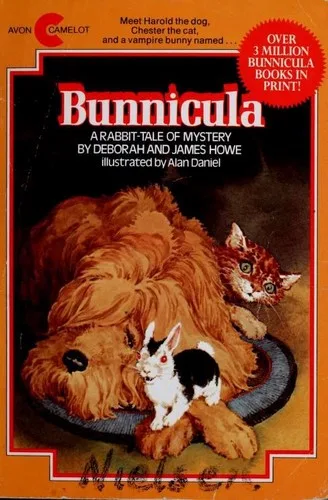
In 1979, James and Deborah Howe introduced a vampire rabbit named Bunnicula.
The Monroe family and their pets discover a strange, black rabbit in a movie theater. They name him Bunnicula, and soon notice that vegetables in their refrigerator begin to wilt. The rabbit exhibits unusual behaviors, leading the family's dog, Chester, to suspect him of vampirism. Chester, who reads a lot of horror novels, becomes convinced Bunnicula is a creature of the night, draining the life force from produce. The story unfolds through the alternating perspectives of Harold the dog, Chester the cat, and the family's younger son, Toby. This allows for a humorous exploration of misunderstandings and the pets' interpretations of human actions.
Bunnicula's mysterious affliction of vegetables and his odd habits create a lighthearted mystery. The family tries to understand the rabbit's behavior, while Chester actively tries to expose him. The narrative plays with gothic horror tropes in a way that is accessible to young readers. It examines how appearances can be deceiving and how assumptions are made based on limited information and a vivid imagination.
While ostensibly a children's book, Bunnicula gently nudges young readers toward contemplating the uncanny. The premise of a creature exhibiting vampiric traits, even towards vegetables, introduces a playful subversion of traditional horror tropes. It operates within a tradition of children's literature that began to incorporate darker humor and more complex themes in the late 20th century, allowing for an early, lighthearted encounter with the idea of the 'other' and the disruption of the ordinary by the extraordinary.
💡 Why Read This Book?
• You will learn about the playful subversion of classic horror tropes through the lens of a children's story, specifically how the 1979 publication of Bunnicula introduced vampire-like characteristics to a young audience in a humorous way. • You will experience the unique dynamic between anthropomorphized pets and their human family, particularly how Chester the cat and Harold the dog attempt to solve the mystery of the wilting vegetables. • You will gain an appreciation for the concept of mistaken identity and the uncanny, as exemplified by the central enigma surrounding Bunnicula's true nature and his peculiar dietary habits.
⭐ Reader Reviews
Honest opinions from readers who have explored this book.
❓ Frequently Asked Questions
What is the main plot of Bunnicula?
The Monroe family adopts a mysterious black rabbit named Bunnicula, who they discover is draining the life force from vegetables, leading their pets, Chester the cat and Harold the dog, to investigate.
Who are the main animal characters in Bunnicula?
The main animal characters are Bunnicula the rabbit, Chester the paranoid cat, and Harold the sensible dog. Their interactions drive the story's mystery.
When was Bunnicula first published?
Bunnicula was first published in 1979, marking its entry into children's literature with a unique blend of humor and mystery.
What makes Bunnicula a unique character?
Bunnicula is unique because he exhibits characteristics of a vampire, seemingly draining the life from vegetables, which is an unusual trait for a rabbit.
What is the role of Chester the cat in the story?
Chester the cat is highly suspicious of Bunnicula and takes on the role of the primary investigator, often drawing parallels to vampire lore.
Is Bunnicula a scary book for children?
No, Bunnicula is generally considered a humorous and lighthearted mystery rather than a scary book, despite its vampire-like premise.
🔮 Key Themes & Symbolism
The Uncanny Animal
Bunnicula introduces the concept of the uncanny by presenting a seemingly ordinary rabbit with decidedly extraordinary, almost supernatural, dietary habits. This challenges the reader's perception of familiar creatures. The narrative explores how the unexpected can disrupt the mundane, particularly through the eyes of the pets, Chester and Harold, who are forced to confront a being that defies their understanding of 'rabbit'.
Parody and Pastiche
The novel playfully parodies classic vampire lore, adapting its tropes to a domestic setting. Bunnicula's alleged habit of draining vegetables mirrors a vampire's blood-sucking, while Chester the cat acts as a dramatic, self-appointed vampire hunter. This use of pastiche allows for humorous commentary on familiar literary conventions, making the genre accessible to younger readers.
Perception vs. Reality
A central theme is the difference between how characters (especially Chester) perceive Bunnicula and his actual nature. The mystery hinges on deciphering Bunnicula's behavior, which is consistently misinterpreted through a lens of fear and suspicion. The book encourages readers to question assumptions and consider that appearances can be deceiving, even in the context of a family pet.
Domestic Mystery
The narrative frames a suburban household as the setting for a compelling mystery. The 'crime'—wilting vegetables—is low-stakes yet treated with dramatic seriousness by the animal characters. This domestic mystery structure grounds the more fantastical elements, making the story relatable and engaging for young readers accustomed to everyday environments.
💬 Memorable Quotes
Direct passages from the work, attributed to the author.
“Chester the cat was convinced Bunnicula was a vampire.”
— This simple statement captures the core conflict and humor of the book. It highlights Chester's paranoid perspective and sets up the narrative's playful engagement with vampire mythology within a domestic setting.
“Harold the dog's pragmatic view of the situation.”
— Harold often serves as the voice of reason, contrasting with Chester's dramatic theories. His perspective grounds the story, offering a counterpoint to the exaggerated fears about Bunnicula's supposed vampiric nature.
“The discovery of the peculiar, black rabbit.”
— This moment marks the inciting incident, introducing the enigmatic character of Bunnicula and setting the stage for the unfolding mystery of his strange effect on the family's produce.
“The wilting of the vegetables in the refrigerator.”
— This recurring phenomenon is the central evidence that fuels the suspicion surrounding Bunnicula, serving as the primary 'clue' in the domestic mystery that unfolds throughout the book.
“The family's initial bewilderment at Bunnicula's presence.”
— The human characters are largely unaware of the drama unfolding among the pets, highlighting the contrast between human perception and the animals' interpretation of events.
🌙 Esoteric Significance
Tradition
While Bunnicula is primarily a children's novel, its themes can be viewed through a lens of folk magic and cautionary tales. The idea of a creature draining vitality from its surroundings echoes ancient beliefs about negative energies or entities that feed on life force. It doesn't align directly with a specific esoteric school like Hermeticism or Gnosticism, but it touches upon the universal concept of unseen influences and the potential for the mundane to harbor the uncanny, a common thread in many folk traditions.
Symbolism
The rabbit itself can symbolize fertility, fear, or the unexpected. In this context, its black color and association with draining vegetables suggest a subversion of typical rabbit symbolism, leaning towards omens or creatures of ill-fortune, akin to folklore surrounding black cats. The wilting vegetables symbolize corrupted or drained life-force, a tangible manifestation of the negative energy attributed to Bunnicula.
Modern Relevance
Contemporary urban fantasy and paranormal fiction for young adults often feature creatures with hidden, supernatural natures interacting with the human world. Bunnicula can be seen as an early, accessible example of this genre, demonstrating how to introduce concepts of the supernatural and the uncanny to a broad audience without relying on complex occult doctrines.
👥 Who Should Read This Book
• Young readers (ages 8-12) who enjoy humorous mysteries and animal stories, particularly those intrigued by gentle takes on classic monster tropes. • Parents and educators seeking engaging chapter books that can spark conversations about perception, deception, and the nature of fear in a lighthearted context. • Aspiring writers of children's literature interested in how authors Howe and Howe blend the mundane with the subtly supernatural for a younger audience.
📜 Historical Context
Bunnicula, published in 1979, arrived at a vibrant moment in children's literature, a period characterized by authors increasingly willing to explore more complex or even slightly darker themes than previously common. While not explicitly occult, its premise—a rabbit exhibiting vampiric tendencies—offered a subtle subversion of typical children's story characters and relied on a playful engagement with established horror tropes. This was an era where authors like Roald Dahl (whose *The Witches* was published in 1983, but whose influential works were already established) were pushing boundaries in children's fiction, often incorporating elements of the grotesque or the macabre with dark humor. Bunnicula's blend of the ordinary suburban family with the extraordinary, the seemingly harmless pet with a monstrous secret, fit within this evolving landscape. Its reception was generally positive, with critics noting its humor and originality, and it avoided significant controversy or censorship challenges that some darker children's books faced, unlike, for instance, Maurice Sendak's *Where the Wild Things Are* which faced some backlash upon its 1963 release for its depiction of a child's temper.
📔 Journal Prompts
The concept of Bunnicula's vampiric vegetable draining.
Chester the cat's investigative methods and paranoia.
Harold the dog's role as the voice of reason.
The family's perception of Bunnicula versus the pets' suspicions.
The significance of the black rabbit's discovery.
🗂️ Glossary
Vampire
A mythical creature, often depicted as a reanimated corpse that feeds on the blood or life force of the living. In Bunnicula, this concept is humorously adapted to a rabbit draining vegetables.
Uncanny
The quality of being strangely familiar yet unsettling or strange. Bunnicula's presence and behavior evoke this feeling for the animal characters.
Anthropomorphism
The attribution of human characteristics or behavior to a god, animal, or object. Chester and Harold exhibit strong anthropomorphic traits, driving the narrative.
Misinterpretation
The action or result of explaining something wrongly. Chester consistently misinterprets Bunnicula's actions through a lens of fear and preconceived notions.
Domestic Mystery
A mystery story set within a household or familiar environment, often involving ordinary characters and low-stakes crimes.
Pastiche
An artistic work in a style that imitates that of another work, artist, or period. Bunnicula uses pastiche by imitating vampire lore.
Inciting Incident
The event or character that triggers the main plot of a story. The discovery of Bunnicula serves as this for the novel.
🔮 Readers Also Liked
Browse all →






More by Deborah Howe, James Howe
All books →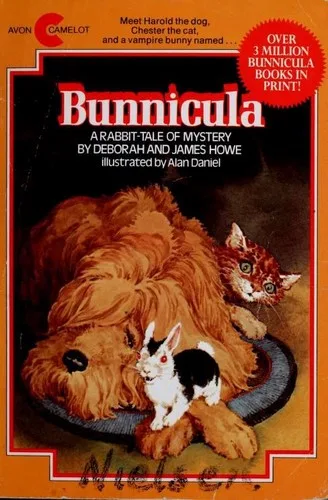
More Free Occult Philosophy Books
View all →