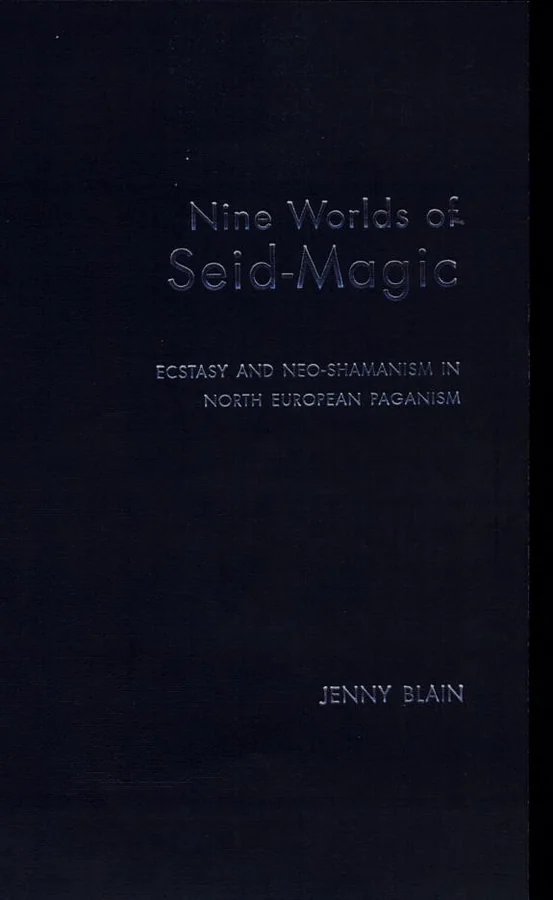
Nine Worlds of Seid-magic
 79
79

Nine Worlds of Seid-magic
Jenny Blain's "Nine Worlds of Seid-magic" provides a much-needed scholarly lens on the modern revival of seidr. Its strength lies in its grounded approach, detailing how specific groups in Europe and North America have actively reconstructed and practiced this ancient Norse shamanic art. Blain avoids romanticizing the past, instead focusing on the living traditions. A particular passage discussing the reconstruction of the 'seidr-staff' by contemporary practitioners clearly illustrates the book's analytical rigor. However, the academic tone, while a strength for scholarly engagement, might present a barrier for absolute beginners seeking purely practical instruction. The work's exploration of seidr's connection to the nine worlds, though fascinating, sometimes feels more descriptive than deeply analytical of the transformative potential for the individual practitioner. Overall, it serves as an essential, if sometimes dry, primer on the modern practice of seidr.
📝 Description
79
Published in 2002, Jenny Blain's book examines seidr, a Northern European shamanistic practice.
Jenny Blain's "Nine Worlds of Seid-magic" investigates seidr, a form of Northern European shamanistic practice. The book, released in 2002, looks at how contemporary groups have reinterpreted and brought back ancient Norse belief systems, especially those concerning shamanic journeying and divination. It acts as a study, showing the active connection between historical spiritual traditions and modern occult and neopagan movements.
This work is suitable for students and practitioners of shamanism, neopaganism, and Northern European esoteric traditions. It will also interest scholars of religious studies, anthropology, and comparative mythology who study the changes in spiritual practices. Readers wanting to grasp the historical origins and current forms of seidr, separate from general 'shamanism,' will find its content valuable. The book situates seidr studies within the wider revival of Northern European spiritual traditions, acknowledging earlier scholarship while concentrating on how these elements are being reconstructed and practiced now. It engages with academic discussions on the authenticity and interpretation of such reconstructed traditions.
This book sits within the study of Northern European esoteric traditions, specifically focusing on seidr. It connects to the broader resurgence of interest in Norse mythology and shamanic practices seen in the late 20th and early 21st centuries. Blain's work addresses how historical beliefs and practices are being actively reconstructed and lived by modern groups, moving beyond purely academic interpretations to acknowledge contemporary engagement with these traditions.
💡 Why Read This Book?
• Gain understanding of seidr's historical roots and contemporary practice, differentiating it from generalized shamanism, by examining Blain's analysis of Norse cosmology. • Learn about the practical reconstruction of ancient practices, such as the use of the 'seidr-staff', to understand how historical elements are re-embodied today. • Discover how modern groups interpret and utilize altered states of consciousness within seidr, as explored in Blain's case studies from the late 20th century.
⭐ Reader Reviews
Honest opinions from readers who have explored this book.
❓ Frequently Asked Questions
What is seidr and how does Jenny Blain define it in "Nine Worlds of Seid-magic"?
Seidr is defined as a form of Northern European shamanistic practice, specifically associated with ancient Norse belief systems. Blain's book explores its rediscovery and reinvention by contemporary groups, focusing on divination and ecstatic trance states.
When was "Nine Worlds of Seid-magic" first published and what is its academic context?
The book was first published in 2002. It serves as an accessible case study within academic circles, examining the intersection of historical Norse spirituality and modern neopagan and esoteric movements.
Does the book offer practical instructions for performing seidr rituals?
While "Nine Worlds of Seid-magic" discusses the practices and reconstructions of seidr, it functions primarily as an analytical case study rather than a step-by-step instructional manual for beginners.
What are some of the key concepts explored in relation to Norse cosmology?
The book explores the significance of the nine worlds of Norse cosmology, such as Asgard and Midgard, and how these concepts are interpreted and integrated into modern seidr practices by various groups.
Who are the main groups or types of practitioners discussed in the book?
The book examines groups in Europe and North America who are actively rediscovering and reinventing ancient Norse belief systems, particularly focusing on those engaging with shamanistic practices and seidr.
What is the significance of the 'seiðkona' and 'seiðmaðr' in the context of the book?
These terms refer to female ('seiðkona') and male ('seiðmaðr') practitioners of seidr. Blain discusses their roles and how these ancient designations are understood and applied within contemporary seidr traditions.
🔮 Key Themes & Symbolism
Modern Seidr Reconstruction
This theme centers on how contemporary groups in Europe and North America are actively engaging with and rebuilding the practice of seidr. Blain's work details the process of taking ancient Norse shamanistic elements, such as divination and ecstatic trance, and adapting them for modern ritual and personal spiritual development. It highlights the challenges and methodologies involved in reviving a tradition that has long been dormant, focusing on the deliberate reconstruction of practices, symbols, and cosmologies.
Norse Cosmology and Nine Worlds
The book deeply explores the significance of the Nine Worlds within Norse cosmology (e.g., Asgard, Midgard, Niflheim) as a framework for understanding seidr. These realms are not just abstract concepts but are seen as integral to the shamanic journey and the practitioner's worldview. Blain examines how modern adherents interpret and interact with these different planes of existence in their magical and spiritual work, often using them as symbolic landscapes for inner exploration and divination.
Shamanic Practice and Altered States
Central to "Nine Worlds of Seid-magic" is the exploration of shamanic techniques, particularly those leading to altered states of consciousness. Blain investigates how seidr practitioners achieve these states, often through drumming, chanting, or focused intent, to access spiritual insights and perform divinatory acts. The work emphasizes the experiential aspect of seidr, focusing on the practitioner's journey and the direct engagement with spiritual forces and entities within the Norse framework.
Seidr Practitioners: Seiðkona and Seiðmaðr
The roles of the 'seiðkona' (female practitioner) and 'seiðmaðr' (male practitioner) are crucial components of the book's analysis. Blain examines how these ancient designations are understood and embodied by modern adherents. The focus often lies on the female practitioner, historically associated with prophecy and fertility magic, and how these archetypes are reinterpreted and given new life in contemporary spiritual contexts, reflecting evolving gender roles and spiritual expression.
💬 Memorable Quotes
Direct passages from the work, attributed to the author.
“The work explores the way ancient Norse belief systems have been rediscovered and reinvented by groups in Europe and North America.”
— This foundational statement from the original blurb highlights the book's central thesis: it's not just about ancient history, but about the active, modern engagement with and transformation of old spiritual practices.
“This accessible case study of Northern European shamanistic practice, or seidr...”
— This phrase emphasizes the book's dual nature: academically rigorous as a 'case study' yet approachable ('accessible') for a wider audience interested in esoteric traditions.
“The book examines the practice of 'seiðkona' (female seid-worker) and 'seiðmaðr' (male seid-worker).”
— This points to the specific roles and gendered aspects of seidr practitioners as analyzed by Blain, indicating a focus on the human element and historical roles within the tradition.
“It explores the significance of the nine worlds of Norse cosmology.”
— This highlights the cosmological framework that underpins seidr, suggesting the book explores the symbolic geography and spiritual landscape relevant to these practices.
“The book scrutinizes how ancient Norse belief systems related to shamanic journeying and divination have been reinterpreted.”
— This interpretation focuses on the active process of reinterpretation, suggesting the book is concerned with how modern practitioners make sense of and apply ancient techniques like spirit journeys and fortune-telling.
🌙 Esoteric Significance
Tradition
This work fits within the broader lineage of modern esoteric and neopagan studies, specifically focusing on the reconstruction and practice of Northern European shamanism. It departs from purely academic analyses by engaging with the lived experiences and practical applications of seidr adherents. It bridges the gap between historical ethnography and contemporary spiritual movements, offering a lens through which to view the evolution of shamanic practices outside their original cultural contexts.
Symbolism
Key symbols include the 'seidr-staff', often reconstructed by modern practitioners as a focus for channeling energy and connecting with spirits. The 'Nine Worlds' of Norse cosmology serve as a symbolic map for shamanic journeys, representing different planes of existence and spiritual realms accessible to the practitioner. Other motifs may include runes, symbols of deities like Odin and Freyja, and animal spirit guides, all interpreted within the context of ecstatic ritual.
Modern Relevance
Contemporary thinkers and practitioners in fields like neopaganism, Ásatrú, and modern shamanism draw heavily on works like Blain's to inform their understanding and practice of seidr. It provides a reference point for those seeking to connect with ancestral spiritual traditions in a meaningful way. The book's exploration of spiritual reconstruction and the adaptation of ancient practices remains relevant for understanding the ongoing development of esoteric traditions in the 21st century.
👥 Who Should Read This Book
• Students of Northern European esoteric traditions and Norse mythology seeking to understand the practical application of ancient beliefs. • Comparative religion scholars interested in the phenomenon of spiritual reconstruction and the evolution of shamanic practices in the modern era. • Practitioners of neopaganism or modern shamanism looking for an accessible academic overview of seidr and its contemporary manifestations.
📜 Historical Context
Published in 2002, "Nine Worlds of Seid-magic" emerged during a period of significant growth and academic interest in neopaganism and esoteric studies. The late 20th century saw numerous attempts to reconstruct pre-Christian European traditions, including Norse spirituality. Blain's work contributed to this discourse by providing a focused, accessible case study of seidr, distinguishing it from broader shamanic practices. Contemporaries like Neil Price were also publishing influential works on Viking Age religion and magic around this time, though Blain's focus is more explicitly on modern reconstruction. While not a subject of major censorship, academic reception often involved debates about the authenticity of reconstructed traditions versus historical evidence, a tension inherent in the field of modern pagan studies.
📔 Journal Prompts
The reconstruction of the seiðr-staff as a tool for channeling spiritual energy.
Modern interpretations of the Nine Worlds of Norse cosmology.
The practice of altered states of consciousness within contemporary seidr.
The roles of seiðkona and seiðmaðr in modern spiritual contexts.
Comparing Blain's observations of groups in Europe and North America with local spiritual practices.
🗂️ Glossary
Seidr
A form of Northern European shamanistic practice associated with ancient Norse belief systems, often involving divination, ecstatic trance, and spirit journeying.
Seiðkona
An ancient Norse term for a female practitioner of seidr, often associated with prophecy and magic.
Seiðmaðr
An ancient Norse term for a male practitioner of seidr.
Nine Worlds
The cosmological framework of Norse mythology, comprising various realms such as Asgard, Midgard, and Helheim, which serve as spiritual landscapes for seidr practitioners.
Shamanistic Journeying
A core shamanic practice involving entering altered states of consciousness to travel to spiritual realms for information, healing, or guidance.
Divination
The practice of seeking knowledge of the future or the unknown by supernatural means, a key element of seidr.
Neopaganism
A contemporary religious movement characterized by the revival of ancient polytheistic, pagan, or nature-based religions.
This book appears in 1 collection
🔮 Readers Also Liked
Browse all →





From the “Neopaganism” Collection
View all →




More Free Witchcraft & Paganism Books
View all →