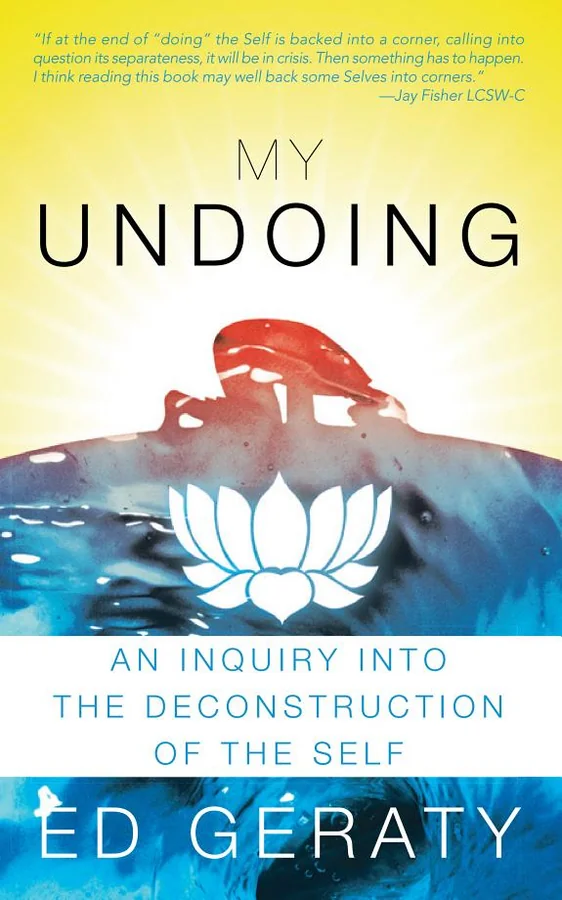
My Undoing
 78
78

My Undoing
Ed Geraty’s "My Undoing" is a stark, unflinching look at the nature of the self. The book’s central thesis—that our perceived identity is a construct ripe for dissolution—is not presented as a gentle unfolding but a necessary demolition. Geraty’s strength lies in his directness; he avoids the often-sweetened language found in many contemporary spiritual texts, opting instead for a raw articulation of the ego’s illusory nature. A particularly potent passage describes the realization that "what you always thought reality was, isn’t." This bluntness, while effective, can also be its limitation. For readers unaccustomed to such direct confrontation, the text might feel abrasive rather than illuminating, lacking the scaffolding that some might need to process such a radical reorientation. Despite this, the book serves as a potent catalyst for those ready to question the very foundations of their being. It is a call to a fundamental, if potentially unsettling, awakening.
📝 Description
78
Ed Geraty's 2013 book, My Undoing, proposes a dismantling of the perceived self.
My Undoing challenges the reader's fundamental sense of identity. It argues that the ego, the 'I' we construct, is an illusion. The book suggests that by deconstructing this false self, one can experience an awakening to a reality beyond the body and mind. This is not a guide for superficial changes but a call for a complete existential reorientation.
The work is for those dissatisfied with common views on selfhood and reality. It will appeal to individuals seeking spiritual or philosophical freedom, especially those familiar with non-duality or egolessness concepts. The process described is destabilizing and requires a willingness to face fear and uncertainty. Readers should be prepared for a rigorous examination of their mental structures.
Published in 2013, My Undoing engages with non-dual teachings and concepts of egolessness. Geraty's approach is direct, drawing from traditions that emphasize stark confrontation with the constructed self. Its philosophical roots connect to advaita Vedanta and similar traditions that highlight the illusory nature of individual identity and the direct experience of a unified reality. The book offers a path toward ego dissolution that bypasses gentler, mediated interpretations.
💡 Why Read This Book?
• Understand the concept of "ego-death" not as a metaphor but as a direct experiential possibility, as explored in Geraty's discussion of the "undoing" process. • Challenge your fundamental assumptions about reality and selfhood, moving beyond the limitations of the body-mind ego state described in the book. • Gain a stark, unvarnished perspective on spiritual realization, distinct from more common, gentler approaches, as presented in the book's direct call to confront fear.
⭐ Reader Reviews
Honest opinions from readers who have explored this book.
❓ Frequently Asked Questions
What does Ed Geraty mean by an "undoing experience"?
An "undoing experience" refers to a profound realization where one understands that the perceived self, the ego or body-mind identity, is an illusion and not the true reality.
Is "My Undoing" a self-help book?
While it can lead to personal transformation, "My Undoing" is not a typical self-help book. It focuses on deconstruction of the self rather than improvement of the ego.
What ancient texts or philosophies influence "My Undoing"?
The book draws from ancient spiritual and philosophical traditions that point towards the illusory nature of the ego and the realization of a deeper awareness.
How does the book address fear related to this "undoing"?
Geraty acknowledges that the experience may seem scary initially but encourages readers to set fear aside temporarily to engage with the concepts presented.
What is the primary goal of reading "My Undoing"?
The primary goal is to facilitate an "undoing" experience in the reader, leading to the realization that the ego-based self is an illusion and that perceived reality is not what it seems.
When was "My Undoing" by Ed Geraty first published?
Ed Geraty's "My Undoing" was first published on July 10, 2013.
🔮 Key Themes & Symbolism
The Ego as Illusion
The central tenet of "My Undoing" is the radical assertion that the "I" we identify with—our ego, our sense of self constructed from memories, beliefs, and physical sensations—is a grand illusion. Geraty argues that this body-mind ego state is not the ultimate reality but a temporary, fabricated construct. The book guides the reader toward recognizing this illusion not as an intellectual exercise but as a fundamental shift in perception, leading to an "undoing" of deeply ingrained self-concepts.
The Nature of Reality
Complementing the deconstruction of the self is an exploration of reality itself. Geraty suggests that our everyday perception of reality, filtered through the lens of the ego, is fundamentally mistaken. The "undoing" experience reveals a different, more authentic reality that lies beyond the limitations of ordinary consciousness. This shift involves questioning what we take for granted about existence, opening the door to a potentially destabilizing yet liberating new understanding.
Confronting Fear and Awakening
The process of "undoing" is acknowledged as potentially frightening, as it challenges our most basic sense of security and identity. Geraty's approach is not to dismiss this fear but to encourage the reader to move through it. By temporarily setting aside apprehension, the reader can engage more directly with the profound realization of egolessness. This confrontation is positioned as a crucial step toward genuine spiritual awakening and freedom from the constraints of the illusory self.
💬 Memorable Quotes
Direct passages from the work, attributed to the author.
“You realize you are not who you thought you were.”
— This statement captures the core experience of "undoing." It signifies a fundamental shift in self-perception, moving away from the egoic identity towards a recognition of a deeper, perhaps universal, consciousness.
“You see that what you always thought reality was, isn’t.”
— This points to a radical re-evaluation of existence. The "undoing" prompts a realization that the world as perceived through the ego's limited framework is a distorted view, implying a more authentic reality awaits discovery.
“Put your mind and your fear aside for the time being.”
— This is a practical instruction for engaging with the book's challenging concepts. Geraty acknowledges the inherent fear in questioning one's identity and advises a temporary suspension of these faculties to allow for direct insight.
“Ancient spiritual and philosophical texts point to this undoing.”
— This grounds Geraty's personal exploration within a broader historical and traditional context, suggesting that the experience he describes is not novel but a recognized path within various wisdom traditions.
💡 Key Ideas
Editorial paraphrase of the work's core concepts — not direct quotes.
This body-mind ego state is an illusion.
Geraty directly challenges the solidity of our perceived self. This quote highlights the book's central argument that the self we identify with is a temporary, constructed phenomenon, not the ultimate truth of our being.
🌙 Esoteric Significance
Tradition
Geraty's work aligns most closely with the non-dual traditions, particularly within the framework of Advaita Vedanta and certain Mahayana Buddhist philosophies that emphasize emptiness (shunyata) and the illusory nature of the self. It departs from more ceremonial or ritualistic esoteric practices, focusing purely on the experiential realization of egolessness. It can be seen as a modern, secularized expression of paths that aim for direct experience of ultimate reality, bypassing the need for intermediaries or complex symbolic systems.
Symbolism
While "My Undoing" is less about overt symbolism and more about direct conceptual deconstruction, the core 'symbol' is the 'ego-self' itself, presented as an illusionary construct. The 'undoing' acts as a metaphorical process, akin to shattering a mirror that reflects a false image. The 'body-mind' itself functions as a symbol for the phenomenal, impermanent world that obscures the true, formless awareness Geraty points towards.
Modern Relevance
The work finds resonance with contemporary seekers drawn to direct paths of awakening, often found in online communities and teachings focusing on non-duality, consciousness studies, and radical self-inquiry. Thinkers and practitioners who explore concepts like the 'hard problem of consciousness' or advocate for experiential rather than intellectual spiritual understanding may find Geraty's direct approach compelling. It speaks to a modern hunger for authenticity and a desire to move beyond superficial spiritual platitudes.
👥 Who Should Read This Book
• Advanced practitioners of meditation and mindfulness seeking to dismantle the last vestiges of egoic identification, moving beyond simple awareness to a complete dissolution. • Students of comparative philosophy and religion interested in direct, unmediated experiential paths to understanding non-duality, as presented in ancient traditions. • Individuals experiencing existential dissatisfaction or questioning their perceived identity who are prepared for a challenging, potentially destabilizing, but ultimately liberating exploration of self.
📜 Historical Context
Ed Geraty's "My Undoing," published in 2013, entered a spiritual landscape increasingly influenced by mindfulness and secularized Eastern philosophies. While many contemporary works focused on integrating spiritual concepts into daily life or improving well-being, Geraty's book offered a starker, more direct confrontation with the ego. Its approach carries the radical non-dual teachings found in advaita Vedanta and certain Buddhist traditions, often presented in a more accessible, Westernized format in the early 21st century. Unlike authors who might soften these teachings, Geraty’s 2013 publication stands out for its unvarnished presentation. It engaged with the perennial philosophical question of "Who am I?" by proposing a complete dissolution of the perceived self, a concept that, while ancient, was often presented in a less confrontational manner by contemporaries. The book's directness positions it as a challenging, albeit niche, contribution to the ongoing discourse on consciousness and selfhood.
📔 Journal Prompts
The concept of the body-mind ego state as an illusion: what is the strongest argument for its illusory nature?
The "undoing" experience: describe the initial fear, then the potential freedom.
Identify one belief about reality you hold that might be challenged by the book's premise.
How does the idea of "not who you thought you were" apply to your daily life?
Consider the ancient spiritual and philosophical texts mentioned; how do they inform the idea of undoing?
🗂️ Glossary
Undoing
A process of spiritual or existential realization where the perceived egoic self is understood as an illusion, leading to a fundamental shift in awareness and identity.
Body-mind ego state
The sense of self that is identified with the physical body, mental processes, thoughts, emotions, and personal history; considered by the book to be a construct and ultimately illusory.
Illusion
In the context of the book, refers to the perceived reality of the ego and the phenomenal world as being ultimately separate and solid, when in fact they are seen as transient or non-existent from a higher perspective.
Awareness
The fundamental state of consciousness that is believed to exist prior to and beyond the formation of the ego and the body-mind complex; the true nature of being.
Reality
The ultimate nature of existence, which the book suggests is distinct from the everyday, ego-filtered perception of the world.
Fear
An emotional response often associated with the potential loss of the egoic self, which the book suggests must be temporarily set aside to facilitate the "undoing" experience.
Ancient spiritual and philosophical texts
Works from various historical traditions that explore concepts of self-realization, non-duality, and the illusory nature of the ego, providing a foundation for the book's thesis.
This book appears in 1 collection
🔮 Readers Also Liked
Browse all →








From the “Ego Death” Collection
View all →






More Free Sacred Texts & Gnosticism Books
View all →