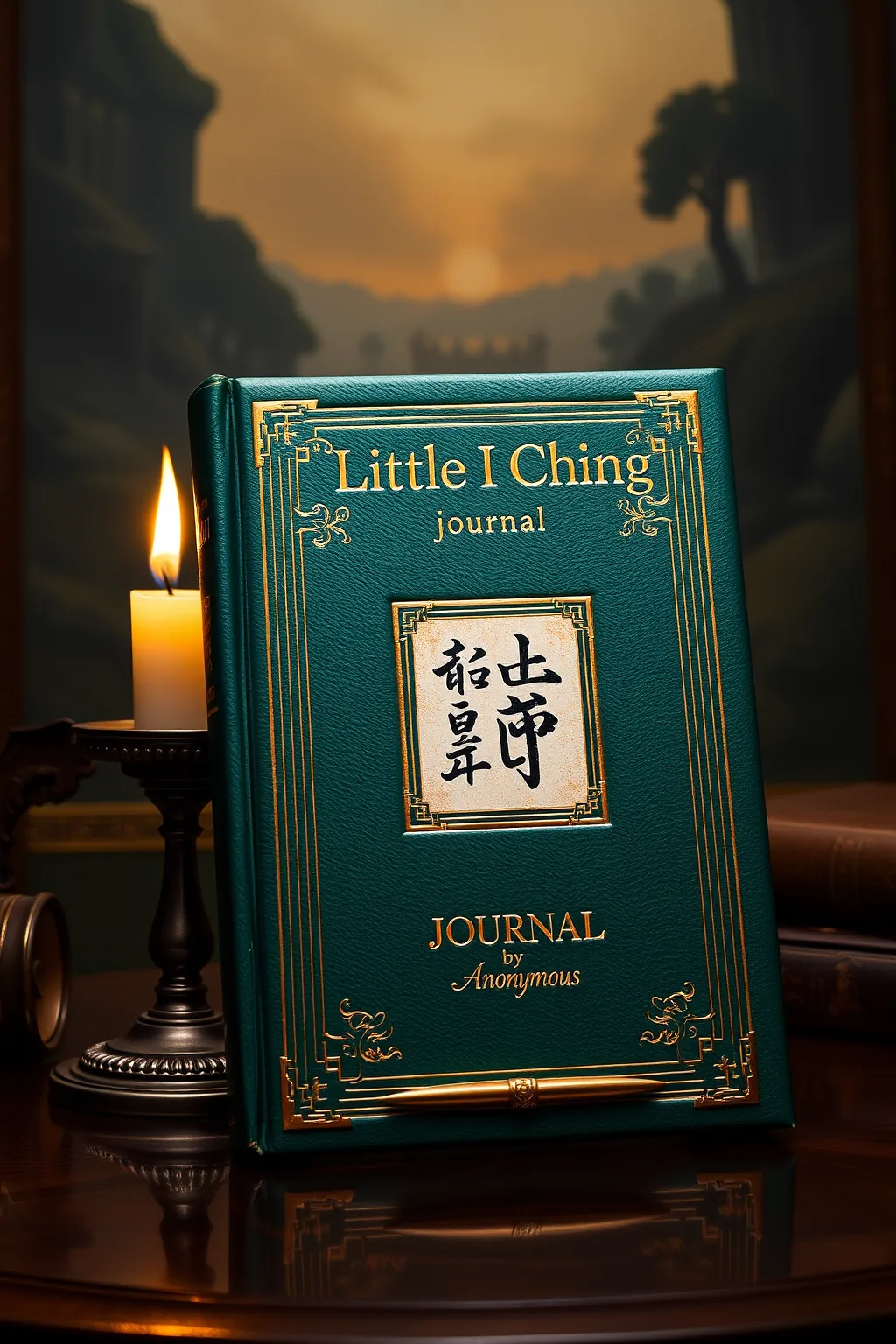
Little I Ching Journal
 61
61

Little I Ching Journal



Sophia Crane (Associate Editor) — The 'Little I Ching Journal' is an indispensable companion for anyone seeking to unlock the profound wisdom of the ancient Chinese oracle. Anonymous, the author, guides readers through the intricate symbolism of the hexagrams with a clarity that belies the depth of the material. This journal doesn't just present information; it fosters a dialogue with the I Ching, encouraging personal revelation and spiritual growth. Its strength lies in its ability to bridge the gap between abstract philosophy and practical application, making the 'Book of Changes' accessible and relevant for modern practitioners and curious minds alike. A truly illuminating work.
📝 Description
61
The 'Little I Ching Journal' appeared around 2023, offering a personal space for engaging with the Book of Changes.
This journal provides a dedicated space for users to record their interactions with the I Ching. It presents the hexagrams not just as predictive symbols but as representations of universal patterns. The text encourages users to reflect on the meaning of each symbol and its changing lines in relation to their own experiences.
It is intended for individuals who are studying or practicing with the I Ching. The journal's design facilitates a personal dialogue with the oracle, aiming to foster self-awareness and a more profound connection to symbolic thought. It serves as a tool for contemplation, guiding users through the interpretation of the I Ching's wisdom.
The 'Little I Ching Journal' fits within the long tradition of engaging with the I Ching as a system of wisdom and divination. For centuries, practitioners have used the I Ching's sixty-four hexagrams to gain insight into personal situations and the broader workings of the cosmos. This journal continues that practice, offering a modern format for personal engagement with the text's symbolic language and its underlying philosophy of change.
💡 Why Read This Book?
This journal is an essential portal for seekers of ancient wisdom and practitioners of divination. It offers a unique space to engage directly with the I Ching's profound symbolism, fostering self-discovery and intuitive development. Ideal for those drawn to esoteric knowledge, it provides a practical, contemplative approach to understanding life's ever-changing patterns and unlocking hidden potentials. Dive in to cultivate deeper insight and a more harmonious connection with the cosmic flow.
⭐ Reader Reviews
Honest opinions from readers who have explored this book.
❓ Frequently Asked Questions
What is the I Ching?
The I Ching, or 'Book of Changes,' is an ancient Chinese divination text and philosophical classic, believed to be the oldest of the Chinese classics. It comprises 64 hexagrams, each representing a specific situation or transformation, offering guidance through symbolic interpretation.
How can I use this journal?
This journal is designed for personal reflection and I Ching practice. Record your questions, cast your hexagrams, and use the provided space to interpret the resulting symbols and their relevance to your life's inquiries. Meditate on the insights gained.
Is prior knowledge of the I Ching required?
While prior knowledge can enhance the experience, this journal is accessible to beginners. The intuitive layout and focus on personal interpretation make it a welcoming entry point into the world of the I Ching.
What is the philosophical significance of the I Ching?
The I Ching's philosophy centers on the concept of continuous change and the balance of opposing forces (yin and yang). It teaches that understanding these dynamics allows one to adapt, make wise decisions, and live in harmony with the natural order of the universe.
Can this journal be used for everyday guidance?
Absolutely. The 'Little I Ching Journal' is an excellent tool for seeking clarity on daily decisions, understanding relationship dynamics, navigating career challenges, and fostering personal growth. It offers a framework for mindful living.
🔮 Key Themes & Symbolism
The Dance of Yin and Yang
This journal looks at the fundamental principle of the I Ching: the interplay of yin and yang. These primordial forces, representing darkness and light, passivity and activity, femininity and masculinity, are the architects of all change. Understanding their dynamic balance is key to comprehending the cyclical nature of existence, from the smallest personal struggle to the grandest cosmic shifts. The journal encourages contemplation on how these forces manifest in your life, fostering an awareness that promotes harmony and wise navigation through periods of flux and stillness.
Symbolic Language of the Cosmos
The I Ching speaks in a wide range of symbols, embodied by its 64 hexagrams. Each hexagram is a complex ideogram, a distillation of universal archetypes and situational energies. This journal provides a contemplative space to decode this symbolic language, recognizing how these ancient pictograms resonate with contemporary experiences. By engaging with the imagery and nuanced meanings of each hexagram, readers can unlock hidden truths about themselves and the world, developing a profound appreciation for the interconnectedness of all things and the subtle messages woven into the fabric of reality.
Reading through the River of Change
Life is a perpetual state of transformation, a concept central to the I Ching's philosophy. The 'Little I Ching Journal' serves as a compass for navigating this ceaseless flow. It encourages a mindset of adaptability and acceptance, teaching that by understanding the patterns of change, one can align their actions with the opportune moments, rather than resisting the inevitable. Through consistent practice with the journal, users cultivate the wisdom to discern the 'right time' for action, to embrace challenges as opportunities for growth, and to find peace and efficacy amidst life's unfolding narrative.
💬 Memorable Quotes
Direct passages from the work, attributed to the author.
“Embrace the flux, for in change, true wisdom lies.”
— This emphasizes the core philosophy of the I Ching: that accepting and understanding the constant nature of change is the pathway to deeper knowledge and effective living.
“Each line a whisper from the cosmic loom.”
— This evocative phrase speaks to the subtle, interconnected nature of the I Ching's wisdom, suggesting that every element within the hexagrams carries a profound message from the universe.
“Consult the oracle, and find your own true north.”
— This suggests that the I Ching is not merely a predictive tool but a guide for self-discovery, helping individuals to find their authentic direction and purpose.
💡 Key Ideas
Editorial paraphrase of the work's core concepts — not direct quotes.
The hexagrams are mirrors reflecting the soul's journey.
This quote highlights the I Ching's role as a tool for introspection, suggesting that the symbolic representations of the hexagrams offer useful insights into one's inner landscape and spiritual path.
From stillness to storm, the patterns remain.
This quote points to the underlying, unchanging principles and archetypes that govern all phenomena, regardless of their outward appearance or intensity.
🌙 Esoteric Significance
Tradition
The I Ching is a central to Taoist and Confucian philosophies, deeply embedded within Chinese esoteric traditions. It is viewed as a living text, a cosmic map that reveals the underlying order and principles governing both the celestial realm and the human experience. Its esoteric significance lies in its ability to act as a bridge between the visible and invisible worlds, offering a framework for understanding karma, destiny, and the unfolding of universal patterns through symbolic language and divinatory practice.
Symbolism
The core symbolism of the I Ching resides in its 64 hexagrams, each composed of six lines, which are either solid (yang) or broken (yin). These lines and their combinations represent fundamental archetypes, natural phenomena, and human situations. The trigrams (three-line figures) are foundational, symbolizing heaven, earth, thunder, water, mountain, wind, fire, and lake. The interaction and transformation of these trigrams into hexagrams create a complex symbolic language that speaks to the dynamic interplay of forces and the ever-present nature of change.
Modern Relevance
In the modern era, the I Ching continues to offer profound relevance as a tool for mindfulness, self-reflection, and ethical decision-making. Its emphasis on adaptability, balance, and understanding the cyclical nature of life provides a valuable counterpoint to the often chaotic and fast-paced modern world. Esoterically, it serves as a powerful archetypal system for psychological exploration, spiritual guidance, and intuitive development, empowering individuals to navigate personal challenges and find greater harmony with the universe.
👥 Who Should Read This Book
This 'Little I Ching Journal' is a valuable collection for a diverse range of individuals. For the absolute beginner, it offers an accessible and intuitive entry point into the ancient wisdom of the I Ching, explaining its symbols and encouraging direct engagement. Dedicated practitioners and scholars will find it an invaluable companion for deepening their study, providing a structured yet personal space for recording insights and tracking their divinatory journey. Seekers of spiritual growth and self-understanding will be drawn to its contemplative nature, using it as a tool to explore life's mysteries and uncover hidden potentials. Ultimately, anyone yearning for a richer, more meaningful connection with the subtle energies of the universe will find profound value within its pages.
📜 Historical Context
The I Ching, or 'Book of Changes,' boasts a lineage stretching back over three millennia, making it one of the world's oldest and most enduring philosophical and divination systems. Its origins are shrouded in myth and legend, attributed to figures like Fu Hsi and King Wen. Over centuries, it was refined by scholars like Confucius, who added commentary that elevated its status from a mere oracle to a profound guide for ethical living and governance. During the Han Dynasty (206 BCE – 220 CE), the I Ching solidified its place as one of the Five Classics of Confucianism, influencing Chinese thought, art, and culture profoundly. Its concepts of yin and yang, cyclical change, and the interconnectedness of all things have permeated East Asian philosophy, and its influence has, in more recent times, extended globally through translations and scholarly interpretations, resonating with modern seekers of spiritual depth and symbolic understanding.
📔 Journal Prompts
When faced with a decision, what subtle energies are at play, as revealed by the lines of the hexagram?
Reflect on a recent period of significant change in your life. Which hexagrams best represent this transition, and what lessons did they offer?
How does the interplay of yin and yang manifest in your daily interactions and personal habits?
What archetypal energies are currently most dominant in your life, and how can you best align with them?
Consider a challenge you are currently facing. How does the wisdom of the I Ching offer a new perspective or a path forward?
🗂️ Glossary
Hexagram
A figure composed of six stacked horizontal lines, each line being either solid (yang) or broken (yin). There are 64 unique hexagrams in the I Ching, each representing a specific situation or concept.
Trigram
A figure composed of three stacked horizontal lines, either solid or broken. There are eight basic trigrams (Pa Kua), which are the building blocks of the hexagrams.
Yin
The passive, feminine, dark, receptive, and yielding principle in Chinese philosophy, often represented by a broken line in the I Ching.
Yang
The active, masculine, light, creative, and assertive principle in Chinese philosophy, often represented by a solid line in the I Ching.
Divination
The practice of seeking knowledge of the future or the unknown by supernatural means, in this context, through the casting and interpretation of I Ching hexagrams.
This book appears in 3 collections
🔮 Readers Also Liked
Browse all →








More by Anonymous
All books →
![The secrets of black arts!: A key note to witchcraft, devination [sic], omens, forwarnings, apparitions, sorcery, dæmonology, dreams, predictions, visions, and the Devil's legacy to earth mortals, compacts with the Devil! With the most authentic history of Salem witchcraft](/img/thumb/the-secrets-of-black-arts-b-a-key-note-to-witchcraft-devination-sic-omens-forwarnings-apparitions-sorcery-d-monology-dreams-predictions-visions-and-the-devil-s-legacy-to-earth-mortals-compacts-with-th.webp)
From the “Tarot” Collection
View all →









More Free Divination & Tarot Books
View all →