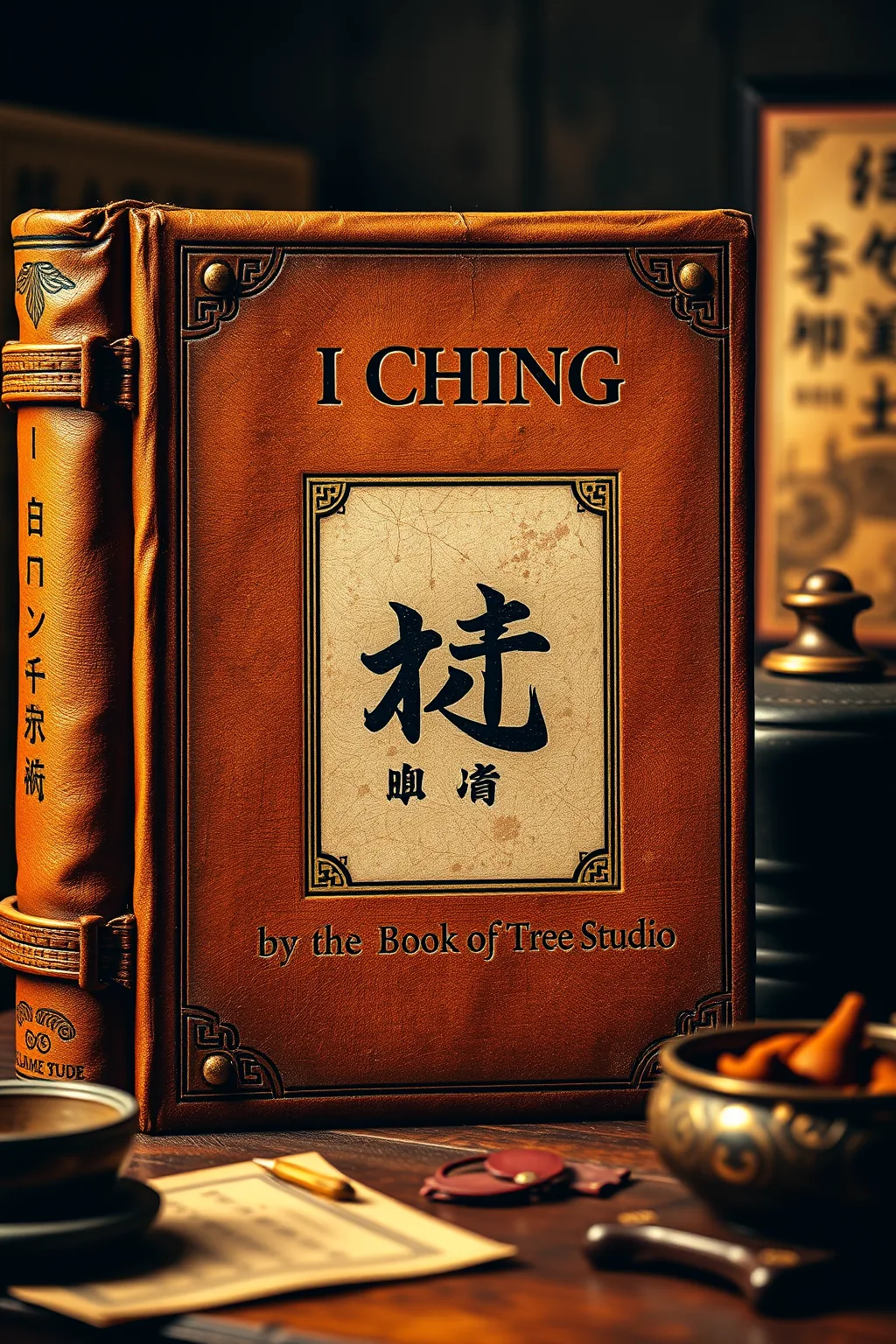
I Ching
 61
61

I Ching



Marcus Thorne, Esoteric Sciences Reviewer: Flame Tree Studio's rendition of the I Ching is a masterful offering for those who delve into the arcane. This edition breathes life into the ancient text, emphasizing its profound philosophical underpinnings and its potent divinatory applications. The clarity of presentation allows the intricate symbolism of the hexagrams to resonate deeply, providing unparalleled guidance for practitioners and scholars alike. It serves not merely as a tool for prediction, but as a profound philosophical treatise on change, balance, and the cosmic dance. An essential acquisition for any serious student of Eastern mysticism and divination.
📝 Description
61
Flame Tree Studio presents the I Ching, a foundational text for understanding change.
This edition of the I Ching, the 'Book of Changes,' details its 64 hexagrams. Each hexagram combines Yin and Yang to represent specific situations and their potential developments. The text functions as a system for divination and a philosophical guide, examining the cyclical nature of time and the principles that shape human experience. It aims to reveal underlying patterns in life's perceived disorder. The book is intended for those who seek deeper understanding of esoteric knowledge and universal principles. Its evocative language and symbolism have influenced thinkers for centuries.
The I Ching is a core text in Chinese cosmology and philosophy, predating many Western esoteric traditions. Its system of divination, based on the interaction of trigrams and hexagrams, influenced Taoist thought and continues to be a subject of study for those interested in ancient oracular practices and philosophical systems. It is considered a guide to understanding the flow of events and aligning oneself with natural patterns.
💡 Why Read This Book?
Embark on a journey of self-discovery and cosmic understanding. The I Ching offers a unique lens through which to perceive the ebb and flow of life, providing profound guidance for decision-making and personal growth. Ideal for seekers of ancient wisdom, scholars of Eastern philosophy, and practitioners of divination seeking to deepen their connection to universal principles.
⭐ Reader Reviews
Honest opinions from readers who have explored this book.
❓ Frequently Asked Questions
What is the primary purpose of the I Ching?
The I Ching's primary purpose is to offer wisdom and guidance on navigating life's changes and challenges by revealing underlying patterns and potentials through symbolic interpretation of hexagrams.
How does one use the I Ching for divination?
Divination is typically performed by casting yarrow stalks or coins to generate hexagrams, which are then interpreted using the text's explanations and commentaries to understand the present situation and potential future.
What is the philosophical significance of the I Ching?
Philosophically, it emphasizes the constant flux of reality, the interplay of complementary forces (Yin and Yang), and the importance of adaptability and ethical conduct in aligning with the Tao or the Way.
Is the I Ching suitable for beginners?
Yes, this edition is designed to be accessible to beginners while offering depth for experienced practitioners, providing clear explanations and evocative imagery.
What is a hexagram in the I Ching?
A hexagram is a symbol composed of six stacked lines, each being either solid (Yang) or broken (Yin). There are 64 unique hexagrams, representing a comprehensive spectrum of life's situations and transformations.
🔮 Key Themes & Symbolism
The Dynamics of Change
Fundamentally, the I Ching is a profound exploration of change as the fundamental nature of existence. It posits that nothing is static and that understanding the cyclical patterns of transformation is key to navigating life harmoniously. Through its 64 hexagrams, it illustrates the myriad ways in which situations evolve, offering insights into the opportune moments for action, patience, or reflection. This theme encourages adaptability, resilience, and a deep appreciation for the impermanence that shapes our reality, guiding us to align with the natural flow of the universe rather than resist it.
The Interplay of Yin and Yang
The fundamental duality of Yin and Yang is the energetic bedrock of the I Ching. These complementary, opposing forces – the passive and active, dark and light, feminine and masculine – are not seen as in conflict but as interdependent elements in a constant dance of creation and dissolution. Each line of a hexagram represents either Yin or Yang, and their dynamic combination creates the vast spectrum of experiences and archetypes described within the text. Understanding this interplay is crucial for achieving balance, harmony, and a holistic perspective on all phenomena.
Symbolic Language and Archetypal Wisdom
The I Ching employs a rich and evocative symbolic language, where each hexagram and its constituent trigrams are imbued with archetypal imagery drawn from nature and human experience. These symbols act as potent metaphors, transcending literal interpretation to convey deeper truths about the human condition and the cosmic order. By engaging with these symbols, readers can access a universal reservoir of wisdom, fostering intuition and revealing hidden connections between the macrocosm and the microcosm, the outer world and the inner field of the soul.
💬 Memorable Quotes
Direct passages from the work, attributed to the author.
“Stillness makes the wise man clear.”
— Highlights the virtue of inner peace and contemplation as the path to true understanding and clarity, essential for discerning the subtle shifts of life.
“When the stream is dammed, it will flow again.”
— An analogy for overcoming obstacles and the inherent cyclical nature of progress, suggesting that perseverance will eventually lead to the release of stagnation.
“The superior man, in his deep and quiet mind, is like the water.”
— This metaphor equates the ideal state of being with the yielding yet powerful nature of water, emphasizing adaptability, clarity, and the ability to nourish.
“What is in the mind, is in the world.”
— A profound statement on the power of consciousness and perception to shape our reality, suggesting an intimate connection between our inner state and external circumstances.
💡 Key Ideas
Editorial paraphrase of the work's core concepts — not direct quotes.
The superior man acts, but does not take credit for his actions.
This quote speaks to selfless action and detachment from outcomes, a core part of Taoist philosophy and effective leadership, emphasizing the importance of aligning with natural processes.
🌙 Esoteric Significance
Tradition
The I Ching is a foundational text within the Taoist and Confucian esoteric traditions, deeply entwined with ancient Chinese cosmology. It serves as a practical manual for understanding the Tao, the fundamental principle of the universe, and for aligning one's actions with its natural flow. Esoterically, it's viewed as a living oracle, a symbolic representation of the cosmic order, and a guide for spiritual cultivation, offering pathways to harmony, wisdom, and self-realization through its intricate system of divination and philosophical reflection.
Symbolism
The core symbolism of the I Ching revolves around the sixty-four hexagrams, each a unique combination of six lines, either solid (Yang) or broken (Yin). These lines form eight trigrams, representing fundamental elements and concepts like Heaven, Earth, Thunder, and Water. The hexagrams themselves are symbolic archetypes, depicting the dynamic interplay of forces and the potential outcomes of various situations. Images and judgments associated with each hexagram offer profound allegorical meanings, revealing the hidden nature of change and the forces that govern existence.
Modern Relevance
In contemporary times, the I Ching remains remarkably relevant, offering a timeless framework for working through the complexities of modern life. Its emphasis on adaptability, balance, and understanding the inherent flux of situations provides invaluable guidance for personal growth, decision-making, and fostering resilience in an ever-changing world. For practitioners of various spiritual paths, it serves as a profound contemplative tool and a source of esoteric wisdom, encouraging introspection and a deeper connection to universal patterns and cosmic intelligence.
👥 Who Should Read This Book
This edition of the I Ching is a treasure for a diverse range of seekers. **Beginners** will find clear explanations and accessible language to grasp its fundamental concepts. **Scholars** of Eastern philosophy and comparative religion will appreciate its depth and historical significance. **Spiritual seekers** yearning for ancient wisdom and clear insights into the nature of reality will discover a powerful guide. **Practitioners of divination**, including those familiar with Tarot or other oracle systems, will find a rich and complementary practice. Anyone interested in understanding the principles of change, balance, and cosmic harmony will benefit immensely.
📜 Historical Context
The I Ching, or 'Book of Changes,' boasts a lineage stretching back over three millennia, originating in ancient China. Its earliest layers are believed to be divinatory practices from the Shang Dynasty (c. 1600–1046 BCE), evolving into a philosophical and ethical text during the Zhou Dynasty (c. 1046–256 BCE) with the addition of commentaries by Confucius and his disciples, known as the Ten Wings. During the Han Dynasty (206 BCE–220 CE), it was established as one of the Five Classics of Confucianism, cementing its status as a canonical text. Its influence permeated Chinese thought, impacting philosophy, politics, military strategy, medicine, and art. The I Ching's enduring appeal lies in its universal principles, which resonated across various epochs and continue to offer clear insights into the human condition and the nature of reality.
📔 Journal Prompts
Reflect on a recent significant change in your life. Which hexagram might best represent this transition, and what lessons does it offer?
Consider a current challenge. How might the principles of Yin and Yang offer a new perspective on balancing opposing forces in this situation?
Meditate on the symbolism of a favorite hexagram. What deeper truths does its imagery reveal about your inner or outer world?
How can the concept of 'acting without taking credit' be applied to your daily interactions and aspirations?
Explore the idea of 'stillness making the wise man clear.' In what areas of your life could cultivating stillness lead to greater clarity and understanding?
🗂️ Glossary
Hexagram
A symbol composed of six stacked lines, each representing either Yin (broken) or Yang (solid). There are 64 unique hexagrams in the I Ching, each symbolizing a distinct situation or stage of transformation.
Trigram
A basic three-line symbol, formed by three consecutive lines of a hexagram. There are eight trigrams (Heaven, Earth, Thunder, Wind, Water, Fire, Mountain, Lake), each representing fundamental elements and concepts.
Yin
The passive, receptive, dark, feminine, and yielding principle in the I Ching. Represented by a broken line (--).
Yang
The active, creative, light, masculine, and assertive principle in the I Ching. Represented by a solid line (—).
Tao (Dao)
The fundamental, ineffable principle that underlies and governs all existence; the 'Way' of the universe. The I Ching is a guide to understanding and aligning with the Tao.
This book appears in 3 collections
🔮 Readers Also Liked
Browse all →









More by Flame Tree Studio
All books →
From the “Tarot” Collection
View all →








More Free Divination & Tarot Books
View all →