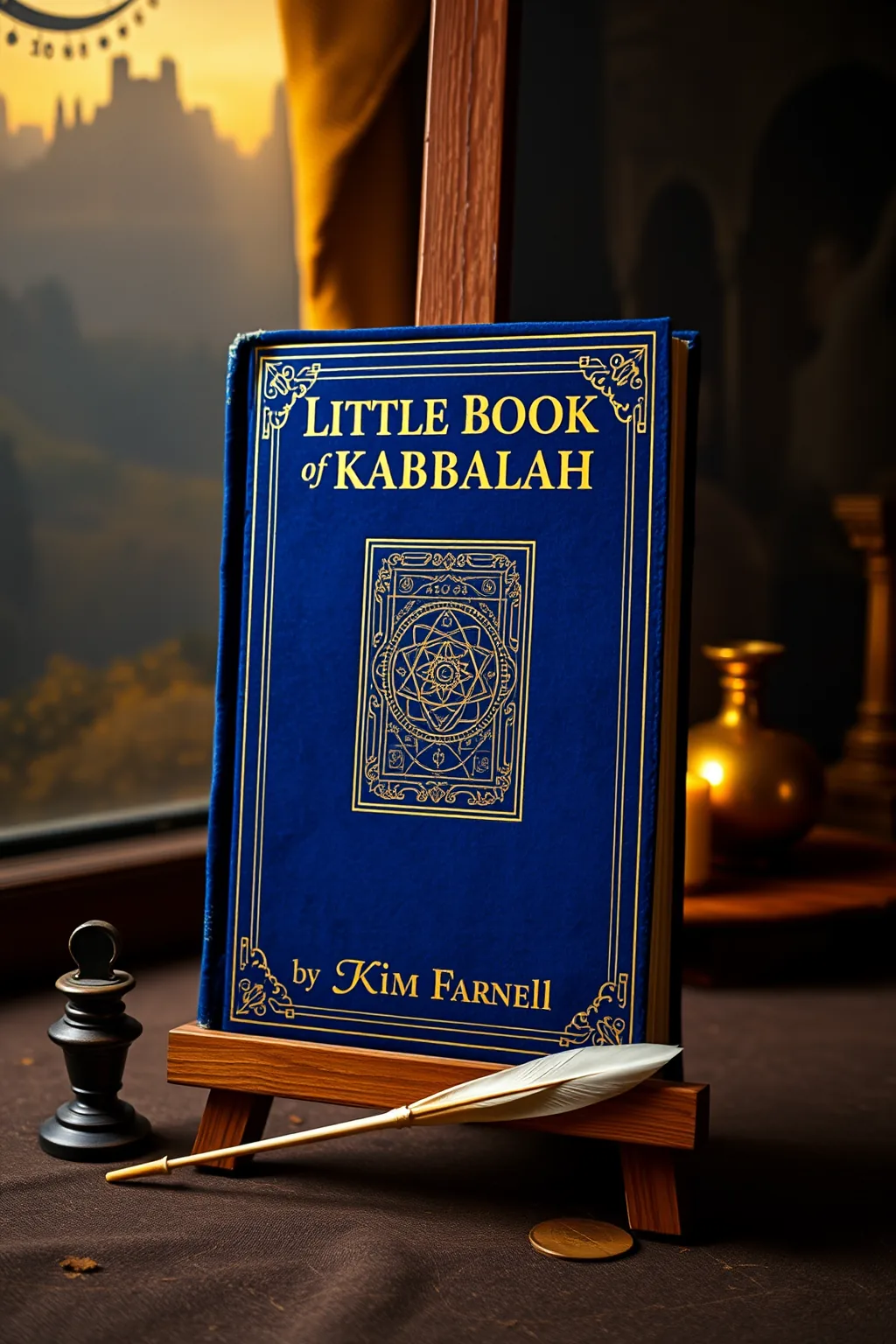
Little Book of Kabbalah
 61
61

Little Book of Kabbalah


By Sophia Crane (Associate Editor) — Kim Farnell's 'Little Book of Kabbalah' is an illuminating beacon for anyone drawn to the profound mysteries of Jewish mysticism. Farnell's accessible yet authoritative prose demystifies complex Kabbalistic concepts, making them tangible for the modern seeker. She expertly navigates the intricate symbolism of the Tree of Life, offering profound insights into divine emanations and the human soul's ascent. This work is an essential companion for those yearning to connect with ancient wisdom, providing a clear and inspiring pathway into the esoteric heart of Kabbalah. An indispensable addition to the Esoteric Library.
📝 Description
61
Kim Farnell's 'Little Book of Kabbalah' explains the Tree of Life and its pathways for students of Jewish mysticism.
Kim Farnell's 'Little Book of Kabbalah' aims to clarify the core concepts of Jewish mysticism for a broad audience. The book addresses the symbolism and structures central to Kabbalistic thought, such as the Tree of Life. Farnell breaks down these complex ideas, making them accessible to individuals new to the subject as well as those with prior experience. The text covers the nature of creation, human consciousness, and the divine. It also touches on the interconnectedness of existence and the universe's hidden aspects. The goal is to provide readers with a better understanding of Kabbalistic principles and their potential to alter perception.
The author’s approach focuses on deciphering the symbolic language used by Kabbalists. This includes explaining the divine architecture and the various paths within the Tree of Life. The book is structured to guide readers through these mystical depths. It encourages an appreciation for the philosophical ideas developed by ancient mystics. Farnell's work presents Kabbalah not just as a system of belief but as a framework for understanding reality on a deeper level.
This book engages with Kabbalah, a system of Jewish mysticism that originated in medieval Europe. It is concerned with the divine nature, the creation of the universe, and the relationship between the human and the divine. Kabbalistic texts often employ symbolic language, allegories, and complex numerological systems, such as gematria. Central to many Kabbalistic traditions is the concept of the Sefirot, a series of divine emanations often represented visually as the Tree of Life. This framework is used to understand God's interaction with the world and the path to spiritual enlightenment.
💡 Why Read This Book?
This book is essential for anyone seeking to understand the foundational principles of Kabbalah, its rich symbolism, and its profound philosophical implications. Ideal for spiritual seekers, students of comparative mysticism, and practitioners looking to deepen their esoteric practice. It offers a clear, engaging entry point into a complex tradition, promising transformative insights into the nature of reality and the self.
⭐ Reader Reviews
Honest opinions from readers who have explored this book.
❓ Frequently Asked Questions
What is Kabbalah?
Kabbalah is an ancient Jewish mystical tradition that seeks to understand the nature of God, the universe, and humanity's place within it through esoteric teachings and symbolic interpretation.
Is this book suitable for beginners?
Yes, 'Little Book of Kabbalah' is thoughtfully designed to be accessible to beginners while still offering depth for those with prior knowledge.
What is the Tree of Life?
The Tree of Life is a central symbol in Kabbalah, representing the divine emanation of God into the universe and the pathways of spiritual ascent.
Does the book cover practical Kabbalistic exercises?
While focusing on foundational understanding and symbolism, the book provides insights that can inform and inspire practical application of Kabbalistic principles.
What is the primary goal of studying Kabbalah?
The primary goal is often to achieve a deeper understanding of the divine, one's own spiritual nature, and the interconnectedness of all existence.
🔮 Key Themes & Symbolism
The Tree of Life: Divine Architecture
Examine the profound symbolism of the Kabbalistic Tree of Life, a sacred diagram representing the ten divine emanations (Sephiroth) and the interconnected pathways of creation. This section illuminates how each Sephirah embodies a unique aspect of the Divine and how understanding their relationships offers a map for spiritual ascent and a deeper comprehension of the universe's underlying structure. Explore the dynamic interplay between these divine energies and their manifestation in the material world.
Gematria and Numerical Symbolism
Uncover the ancient art of Gematria, the system of assigning numerical values to Hebrew letters, and its important role in Kabbalistic interpretation. This theme explores how numbers and letter combinations reveal hidden meanings within sacred texts, offering useful insights into divine names, cosmic principles, and the interconnectedness of all things. Understand how this symbolic language acts as a key to unlock deeper layers of mystical knowledge.
The Soul's Journey and Spiritual Ascent
This theme guides the reader through the Kabbalistic understanding of the human soul and its journey towards spiritual perfection. Explore the concepts of divine sparks, reincarnation, and the process of Tikkun (rectification). Farnell illuminates the esoteric practices and philosophical insights that facilitate spiritual growth, enabling individuals to connect with their higher selves and align with the divine will, ultimately leading to a more profound understanding of existence.
💬 Memorable Quotes
Direct passages from the work, attributed to the author.
“Within every letter lies a universe of meaning.”
— Highlights the Kabbalistic belief in the profound symbolic power of Hebrew letters and their capacity to hold cosmic secrets.
“The Tree of Life is the blueprint of reality.”
— Emphasizes the Tree of Life's central role as a schematic representation of divine creation and spiritual structure.
“Seek the light within, for it is the divine spark.”
— A reminder of the inherent divinity within each individual and the path of introspection for spiritual realization.
“Understanding the microcosm reveals the macrocosm.”
— Points to the Kabbalistic principle that by studying the individual (microcosm), one can gain insight into the greater universe (macrocosm).
💡 Key Ideas
Editorial paraphrase of the work's core concepts — not direct quotes.
The universe is a reflection of the divine.
This quote expresses the core Kabbalistic tenet that the material world is not separate from the spiritual realm but rather a manifestation of it.
🌙 Esoteric Significance
Tradition
Kabbalah is the primary esoteric tradition explored, representing the mystical dimension of Judaism. It looks at the hidden aspects of God, the universe, and the human soul, utilizing a symbolic language and a complex system of correspondences to facilitate spiritual understanding and connection with the divine.
Symbolism
Central to Kabbalah is its strong symbolism, most notably the Tree of Life, which maps divine emanations and spiritual pathways. Other key symbols include Hebrew letters, numbers (Gematria), sacred names, and cosmological diagrams, all employed to convey profound metaphysical truths and guide the practitioner's inner journey.
Modern Relevance
In contemporary times, Kabbalah continues to resonate deeply, offering useful insights into consciousness, the nature of reality, and the human search for meaning. Its principles are applied in spiritual growth, personal development, and interfaith dialogue, providing a timeless framework for understanding the interconnectedness of all beings and the pursuit of spiritual enlightenment.
👥 Who Should Read This Book
This 'Little Book of Kabbalah' is an invaluable resource for a diverse audience. Beginners starting their spiritual journey will find a clear and accessible introduction to a complex subject. Scholars of religion and mysticism will appreciate its concise yet insightful overview of core concepts and historical context. Seekers of esoteric knowledge will discover a gateway to profound metaphysical truths and ancient wisdom. Practitioners of meditation and spiritual disciplines will find inspiration and practical guidance for deepening their understanding and connection to the divine.
📜 Historical Context
The origins of Kabbalah are ancient, with its most influential developments emerging in medieval Europe, particularly in Spain and Germany, during the 12th and 13th centuries. This era was marked by a rich intellectual and spiritual ferment, influenced by Neoplatonism, Gnosticism, and Jewish philosophical traditions. The Zohar, a foundational Kabbalistic text, emerged in 13th-century Spain, profoundly shaping the mystical landscape. Later, the Lurianic Kabbalah, developed by Isaac Luria in 16th-century Safed, introduced new cosmological concepts like 'Tzimtzum' (contraction) and 'Shevirat HaKelim' (shattering of the vessels), which became central to subsequent Kabbalistic thought. This tradition has continuously evolved, influencing Jewish practice, philosophy, and Western esotericism.
📔 Journal Prompts
Reflect on the concept of divine emanation as represented by the Sephiroth on the Tree of Life. How does this concept resonate with your understanding of the universe?
Consider the power of Hebrew letter symbolism. If you were to assign a symbolic meaning to a letter in your own language, what would it be and why?
Explore the idea of the soul's journey. What steps do you feel you are currently taking on your own spiritual path?
How does the concept of interconnectedness, as taught in Kabbalah, influence your perception of your relationships with others and the world around you?
Imagine you are at the beginning of your Kabbalistic studies. What is the most compelling question you have about this tradition, and what do you hope to discover?
🗂️ Glossary
Sephiroth
The ten divine emanations or attributes of God, forming the structure of the Kabbalistic Tree of Life. Each Sephirah represents a distinct aspect of the divine and its manifestation in creation.
Tree of Life
A central diagram in Kabbalah, consisting of ten Sephiroth connected by 22 paths, symbolizing the divine creation process and the pathways of spiritual ascent.
Gematria
A system of Jewish mysticism that assigns numerical values to Hebrew letters, used to interpret the hidden meanings of words and phrases in sacred texts.
Tikkun
The concept of rectification or repair, referring to the cosmic process of restoring divine harmony and wholeness to the universe, often involving human action and spiritual development.
Ein Sof
The Kabbalistic term for God in His absolute, unknowable essence, beyond all comprehension or description. It represents the infinite, primordial Godhead before manifestation.
This book appears in 1 collection
🔮 Readers Also Liked
Browse all →








More by Kim Farnell
All books →





From the “Kabbalah” Collection
View all →







More Free Kabbalah & Jewish Mysticism Books
View all →