The Qabalah course
 61
61

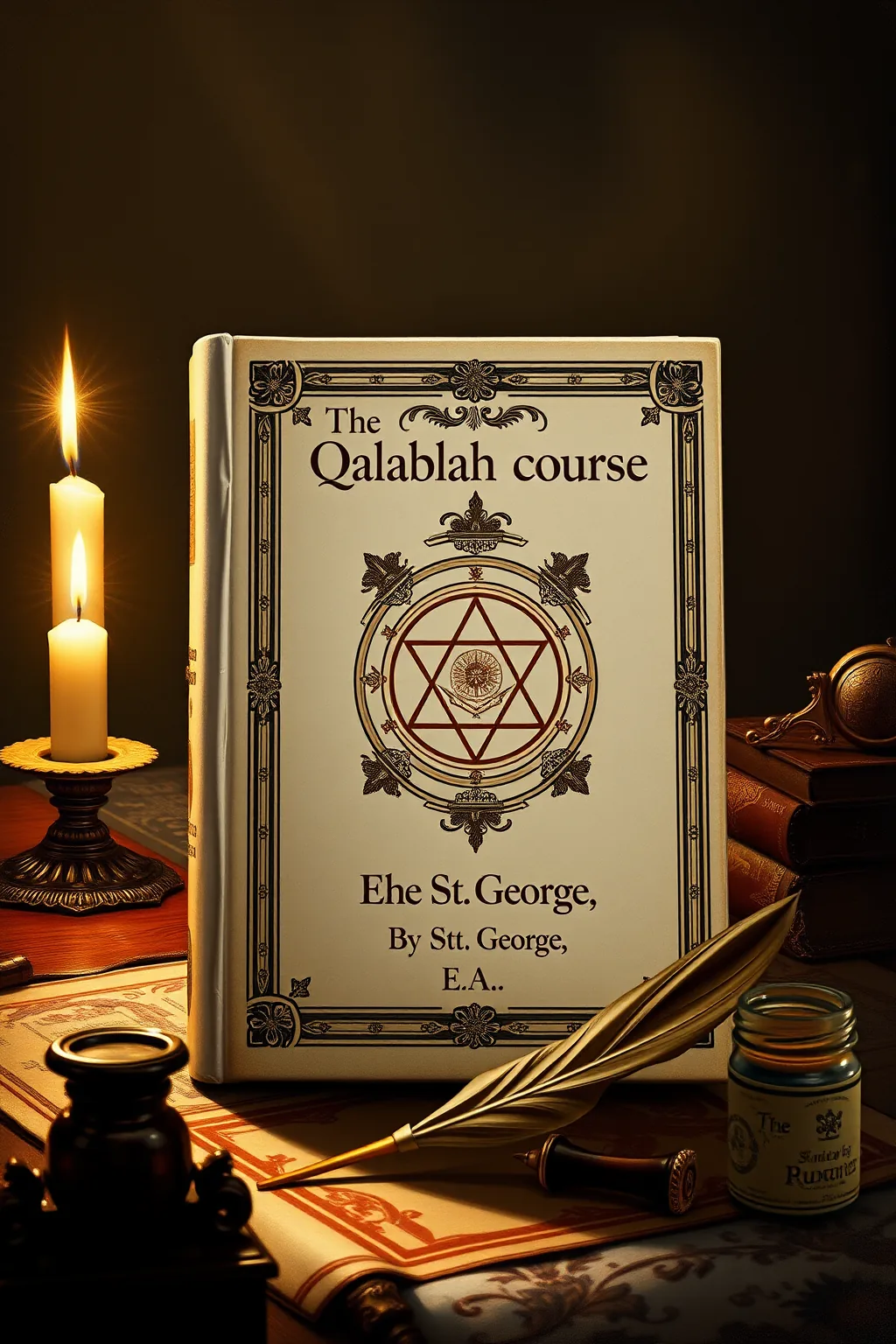
The Qabalah course


Celeste Moreau (Divination & Symbolism Reviewer) — E. A. St. George's 'The Qabalah Course' is an indispensable compendium for serious students of Kabbalah. St. George possesses a rare gift for translating complex mystical concepts into accessible, yet deeply resonant, language. The work excels in its lucid exposition of the Sephiroth, the Paths, and the overarching cosmology, offering profound esoteric insights that resonate with ancient traditions. This is not a superficial glance; it demands thoughtful engagement from the reader. Ideal for those committed to a rigorous study of Jewish mysticism and its application in spiritual practice, this course offers a solid foundation for advanced exploration.
📝 Description
61
E. A. St. George's 'The Qabalah Course' was published to explain Kabbalistic thought.
This book explains the Kabbalistic system as presented by E. A. St. George. It focuses on the symbolism of the Tree of Life, detailing its structure and the divine emanations. The text aims to guide practitioners toward spiritual understanding and self-mastery.
The author approaches the subject with reverence and intellectual seriousness. The course is designed for those interested in the philosophical aspects of Jewish mysticism. It seeks to provide both comprehension of the concepts and a potential for personal transformation. Readers can expect to engage with ideas about universal principles and inner spiritual growth.
E. A. St. George's work situates itself within the Western esoteric tradition, specifically focusing on Kabbalah. It draws from the established Kabbalistic framework, particularly the Tree of Life, which is a central diagram in many Kabbalistic schools. The book attempts to make these complex ideas accessible to students, connecting them to broader concepts of existence and personal spiritual development. It follows a lineage of authors who sought to systematize and teach Kabbalistic principles.
💡 Why Read This Book?
Unlock the ancient secrets of the Tree of Life and the fundamental principles of Jewish mysticism. 'The Qabalah Course' offers a clear, structured approach to understanding Kabbalistic cosmology, symbolism, and its profound spiritual implications. It is essential for seekers of hidden knowledge, practitioners aiming to deepen their esoteric practice, and scholars desiring a foundational text for advanced study.
⭐ Reader Reviews
Honest opinions from readers who have explored this book.
❓ Frequently Asked Questions
What is the Qabalah?
The Qabalah, or Kabbalah, is an esoteric tradition within Judaism that seeks to understand the divine nature and the structure of the universe through mystical interpretation of religious texts and symbolic systems, primarily the Tree of Life.
Who is E. A. St. George?
E. A. St. George was an author and scholar dedicated to the study and dissemination of esoteric and mystical traditions, with a particular focus on Kabbalistic teachings and their practical application.
Is this book suitable for beginners?
While comprehensive, the course is structured to guide newcomers through its complex concepts. However, a genuine interest and willingness to engage with challenging material are recommended for optimal understanding.
What is the Tree of Life?
The Tree of Life is the central symbolic diagram in Kabbalah, representing the ten Sephiroth (divine emanations) and the 22 paths connecting them, illustrating the process of creation and the pathways of spiritual ascent.
Can I practice Qabalah without being Jewish?
The Qabalah's universal principles of cosmology and spiritual development can be studied and applied by individuals of any background who approach the subject with respect and a genuine desire for wisdom.
🔮 Key Themes & Symbolism
The Tree of Life as Cosmic Blueprint
This theme examines the Qabalah's central diagram, the Tree of Life, presenting it not merely as a symbolic construct but as a profound map of creation. It explores the ten Sephiroth, the divine emanations that represent different aspects of God and the universe, and the 22 Paths that connect them, symbolizing the journey of the soul. The text illuminates how this intricate structure provides a framework for understanding cosmic forces, psychological states, and the very nature of existence, offering practitioners a guide for spiritual ascent and self-discovery.
Symbolism and Mystical Interpretation
Central to 'The Qabalah Course' is the deep dive into the body of Qabbalistic symbolism. The book emphasizes that these symbols are not arbitrary but are keys to unlocking hidden truths about the divine and the material worlds. It explores how traditional Jewish texts, Hebrew letters, and numerical values (Gematria) are imbued with layers of esoteric meaning. Readers are encouraged to move beyond literal interpretation to grasp the deeper, mystical significance, revealing a universe alive with divine communication and interconnectedness.
Spiritual Ascent and Self-Mastery
This theme focuses on the practical application of Qabbalistic knowledge for personal transformation and spiritual growth. 'The Qabalah Course' guides the reader through the concept of ascending the levels of consciousness represented by the Sephiroth, fostering a deeper understanding of their own inner landscape. It presents the Qabalah as a path to self-awareness, ethical development, and ultimately, union with the divine. The emphasis is on the practitioner's active role in their spiritual evolution through study, meditation, and contemplation.
💬 Memorable Quotes
Direct passages from the work, attributed to the author.
“Within each Sephiroth lies a divine spark awaiting recognition.”
— This highlights the immanent divine presence within all aspects of existence, urging the reader to seek and acknowledge the sacred within themselves and the world.
“The Paths are the rivers connecting the oceans of consciousness.”
— This evocative metaphor illustrates the dynamic interplay between different states of awareness, emphasizing how the interconnected paths facilitate the flow of spiritual energy and understanding.
“The microcosm mirrors the macrocosm.”
— This fundamental hermetic principle posits that the individual human being (microcosm) contains the same essential patterns and forces as the entire universe (macrocosm).
💡 Key Ideas
Editorial paraphrase of the work's core concepts — not direct quotes.
The Tree of Life is the alphabet of the universe.
This quote suggests that the fundamental structure of existence, as represented by the Tree of Life, contains all the essential elements and principles from which reality is constructed and understood.
True wisdom is found not in knowing, but in becoming.
This quote underscores the transformative nature of Qabbalistic study, emphasizing that genuine spiritual insight arises from lived experience and personal integration, rather than mere intellectual accumulation.
🌙 Esoteric Significance
Tradition
This work is firmly rooted in the esoteric tradition of Kabbalah, a mystical interpretation of Judaism that explores the divine nature, the creation of the universe, and the human soul's journey. It draws heavily from foundational texts like the Zohar and Sefer Yetzirah, reinterpreting their complex symbolism for a wider audience seeking deeper spiritual understanding and practical application of these ancient teachings.
Symbolism
The core of the book's esoteric significance lies in its elucidation of Qabbalistic symbolism, most notably the Tree of Life. St. George meticulously decodes the meanings of the ten Sephiroth, the paths, Hebrew letters, and numerical correspondences. These symbols are presented not as mere decorative elements but as potent keys that unlock clear insights into cosmic order, divine emanations, and the hidden forces that govern reality.
Modern Relevance
In an age often characterized by materialism and spiritual seeking, 'The Qabalah Course' offers a timeless framework for understanding consciousness, the interconnectedness of all things, and the path to inner transformation. Its emphasis on self-awareness, personal growth, and the exploration of deeper existential questions resonates powerfully with contemporary spiritual seekers, providing a robust and ancient system for working through the complexities of modern life.
👥 Who Should Read This Book
This comprehensive course is useful for several distinct groups. Beginners in esoteric studies will find a clear and structured entry point into the profound world of Kabbalah. Scholars of comparative religion and mysticism will appreciate its rigorous approach and detailed explanations. Spiritual seekers yearning for a deeper understanding of the universe and their place within it will discover a rich source of wisdom and guidance. Practitioners of various mystical paths will find the Qabbalistic framework an essential tool for enhancing their meditation, ritual, and personal development.
📜 Historical Context
Written during a period of burgeoning interest in esoteric traditions and occult philosophy, 'The Qabalah Course' by E. A. St. George emerged as a significant contribution to the popularization and study of Kabbalah in the Western world. The late 19th and early 20th centuries saw a revival of mystical thought, influenced by movements like Theosophy and Hermeticism, which sought to synthesize ancient wisdom with contemporary understanding. St. George's work stands as a proof of this era's intellectual curiosity, offering a structured yet deeply spiritual approach to a tradition often shrouded in mystery. Its enduring relevance lies in its ability to bridge the gap between historical esoteric teachings and the modern seeker's quest for meaning.
📔 Journal Prompts
Reflect on the concept of divine emanation as described in the Sephiroth. How do these principles manifest in your own life?
Consider the symbolism of one of the Paths on the Tree of Life. What personal insights or challenges does it reveal to you?
How can the principle of 'as above, so below' be applied to your daily actions and perceptions?
Meditate on the interconnectedness of all things as suggested by the Qabbalistic cosmology. What does this interconnectedness mean for your relationships?
Identify a personal aspiration or challenge and explore how it might correspond to a particular Sephiroth or Path.
🗂️ Glossary
Sephiroth
The ten divine emanations or attributes of God, forming the structure of the Tree of Life and representing stages of creation and consciousness.
Tree of Life
The central symbolic diagram in Kabbalah, composed of ten Sephiroth connected by 22 Paths, illustrating the structure of the universe and the pathways of spiritual ascent.
Kether
The first Sephirah, often translated as 'Crown,' representing the highest, most abstract divine will and the primordial point of creation.
Malkuth
The tenth Sephirah, often translated as 'Kingdom,' representing the material world, the physical plane of existence, and the Earth.
Gematria
A system of Jewish numerology where Hebrew letters are assigned numerical values, used to interpret the hidden meanings of words and phrases in religious texts.
This book appears in 1 collection
🔮 Readers Also Liked
Browse all →








More by St. George, E. A.
All books →
From the “Kabbalah” Collection
View all →







More Free Kabbalah & Jewish Mysticism Books
View all →