Life After Life
 74
74

Life After Life
Kate Atkinson’s *Life After Life* begins with a startling premise: a woman reliving her life countless times. The strength of the novel lies in its masterful execution of this concept. Atkinson doesn't merely repeat; she subtly alters circumstances, revealing the butterfly effect of choices. Ursula Todd’s existence, from her initial stillbirth during a 1910 snowstorm to her survival through various iterations of the 20th century, becomes a canvas for exploring fate and agency. A particularly striking passage involves Ursula’s experiences during the Blitz, where her repeated brushes with death highlight both her resilience and the fragility of existence. However, the novel’s relentless repetition, while thematically crucial, can at times feel structurally monotonous, occasionally obscuring the emotional arc of its protagonist. Despite this, the cumulative effect is a powerful meditation on what it means to live. *Life After Life* is a remarkable literary achievement that reimagines the very fabric of narrative.
📝 Description
74
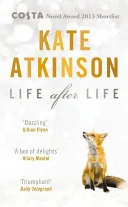
Kate Atkinson's 2014 novel, *Life After Life*, imagines a woman born repeatedly to alter her fate.
Kate Atkinson's *Life After Life* (2014) follows Ursula Todd, a woman who dies moments after birth only to be reborn and live again. The novel replays Ursula's life through numerous variations, each starting with a different outcome to her initial demise. These altered paths demonstrate how seemingly small changes and different choices can lead to vastly different life trajectories. The narrative structure itself mirrors the concept of cyclical existence, presenting not a single, linear story but a series of branching possibilities.
This literary experiment examines determinism and free will. Atkinson uses Ursula's repeated lives as a vehicle to explore how external factors, such as societal conditions and historical events like the outbreak of World War II, influence an individual's destiny. The novel is for readers who enjoy philosophical fiction that moves beyond conventional storytelling and questions the nature of identity when confronted with alternate realities and the impact of chance.
Published in 2014, *Life After Life* engages with speculative traditions that explore the nature of time and existence. Atkinson's narrative, which revisits a character's life through different possibilities, echoes concepts found in philosophical discussions of fate, parallel universes, and the potential for altered realities. The novel's structure, a series of variations on a single life, invites contemplation on how choices, both personal and historical, interact with predetermined circumstances, a theme present in various occult and mystical thought.
💡 Why Read This Book?
• You will explore the philosophical implications of infinite chances, understanding how the smallest deviation, like Ursula's survival of a childhood illness in one iteration, can lead to vastly different life outcomes. • You will experience a unique narrative structure that mimics cyclical time, allowing you to witness the impact of historical events, such as the lead-up to World War II, on a single life across multiple realities. • You will gain an appreciation for how the concept of fate and free will are examined not through abstract debate, but through the lived, repeated experiences of Ursula Todd, offering a profound perspective on personal agency.
⭐ Reader Reviews
Honest opinions from readers who have explored this book.
❓ Frequently Asked Questions
What year was Kate Atkinson's 'Life After Life' first published?
Kate Atkinson's 'Life After Life' was first published in 2014. This novel won the Costa Novel Award in the year of its release.
What is the central premise of 'Life After Life' by Kate Atkinson?
The central premise of 'Life After Life' is that the protagonist, Ursula Todd, gets to live her life over and over again. Each time, she experiences different events and makes different choices, exploring the concept of infinite possibilities.
What historical events are depicted in 'Life After Life'?
The novel depicts significant historical events of the 20th century, including the lead-up to and the experience of World War II, particularly the London Blitz. Ursula's life unfolds against this backdrop across its many iterations.
How does the structure of 'Life After Life' relate to its themes?
The novel's structure, which involves Ursula dying and being reborn numerous times, directly mirrors its themes of reincarnation, causality, and the exploration of alternate paths. It allows Atkinson to demonstrate the ripple effects of decisions and circumstances.
Is 'Life After Life' a science fiction novel?
While 'Life After Life' utilizes speculative elements like reincarnation and alternate timelines, it is primarily considered literary fiction with philosophical underpinnings. It explores human experience and existential questions rather than focusing on technological advancement.
What is the significance of the snowstorm in 'Life After Life'?
The snowstorm in 1910 is a recurring motif that marks Ursula Todd's initial birth and death. It serves as the pivotal starting point from which her multiple lives diverge, symbolizing both the fragility of new beginnings and the cyclical nature of her existence.
🔮 Key Themes & Symbolism
Cyclical Existence and Reincarnation
The novel is built around the concept of Ursula Todd living her life repeatedly. This isn't a simple loop, but an exploration of how variations in birth, upbringing, and important decisions can lead to drastically different life paths. Each death is a new beginning, allowing Ursula to learn from past experiences and attempt to alter her fate, questioning whether a 'right' way to live exists or if understanding life comes from experiencing its myriad forms.
Determinism vs. Free Will
Atkinson uses Ursula's repeated lives to question the extent to which our destinies are predetermined versus shaped by our own choices. While certain events and historical contexts, like World War II, seem inevitable, Ursula's agency within these confines shifts dramatically with each iteration. The novel probes whether knowledge gained from previous lives can truly grant control, or if external forces and inherent personality traits always guide the outcome.
The Impact of Choice and Chance
Every small decision, every chance encounter, is amplified in 'Life After Life'. A seemingly minor event in one life might lead to a vastly different outcome in another, highlighting the intricate web of causality. The novel demonstrates how the path not taken, the alternative reality, is always present, prompting reflection on the significance of our own life choices and the role of serendipity in shaping our personal histories.
Historical Consciousness and Personal Fate
Ursula’s lives are inextricably linked to the tumultuous history of the 20th century, particularly the period leading up to and during World War II. The novel explores how grand historical narratives intersect with individual destinies, and how personal survival and choices play out against a backdrop of global conflict. The repetition allows Atkinson to show how the same historical forces can impact individuals in fundamentally different ways depending on their specific life's trajectory.
💬 Memorable Quotes
Direct passages from the work, attributed to the author.
“What if you had the chance to live your life again and again, until you finally got it right?”
— This question, posed early in the novel, captures the central speculative conceit. It invites the reader to consider the nature of perfection, second chances, and the possibility of learning from cumulative experience to achieve an ideal existence.
“During a snowstorm in England in 1910, a baby is born and dies before she can take her first breath. During a snowstorm in England in 1910, the same baby is born and lives to tell the tale.”
— This striking repetition immediately establishes the novel's unique structure and thematic concern with alternate beginnings. It highlights the precariousness of life and the potential for radically different outcomes stemming from the very moment of birth.
“She had lived a life, and then she had lived another, and then another.”
— This simple statement underscores the narrative's core mechanism. It emphasizes the cumulative nature of Ursula's experiences, suggesting that each life, while distinct, contributes to a broader understanding or a recurring pattern of existence.
“It was the year 1910. The place was England. The world was at peace.”
— This seemingly straightforward declaration sets the stage for the profound disruption that follows. Its repetition, often followed by variations that introduce conflict or change, emphasizes how fragile peace can be and how quickly circumstances can shift.
💡 Key Ideas
Editorial paraphrase of the work's core concepts — not direct quotes.
She could have been anyone, but she was Ursula.
This quote speaks to the tension between potential and actuality. Despite the infinite possibilities presented by her repeated lives, Ursula remains a distinct identity, suggesting an underlying core self or a fate that, while mutable, is ultimately hers.
🌙 Esoteric Significance
Tradition
While not explicitly tied to a single esoteric lineage, *Life After Life* strongly echoes concepts found in Eastern philosophies, particularly Hinduism and Buddhism, concerning reincarnation (samsara) and karma. The idea of learning lessons through repeated cycles of existence to eventually achieve liberation or a perfected state aligns with these traditions. It also touches upon Western occult ideas of soul progression and the learning process inherent in multiple incarnations, though without adhering to a specific doctrine like Theosophy or Hermeticism.
Symbolism
The recurring snowstorm serves as a potent symbol of both the fragility of life at its inception and the cyclical nature of Ursula's existence. It marks the threshold between non-existence and life, and its repeated presence signifies the endless potential for new beginnings. The concept of 'getting it right' suggests a karmic or spiritual goal, implying that each life is a lesson or a test, aiming towards a resolution or a more evolved state of being.
Modern Relevance
The novel's exploration of alternate realities and the interconnectedness of choices speaks to contemporary interests in quantum mechanics, multiverse theories, and existential psychology. Thinkers and practitioners in fields ranging from narrative therapy to consciousness studies might find its depiction of malleable timelines and the subjective experience of reality particularly relevant. Its questioning of fate versus free will continues to be a central philosophical debate in modern self-help and personal development circles.
👥 Who Should Read This Book
• Readers fascinated by philosophical explorations of time and causality, who enjoy contemplating 'what if' scenarios and the intricate nature of fate. • Students of literary modernism and postmodernism, particularly those interested in narrative experimentation and unconventional storytelling structures. • Individuals seeking a character-driven novel that uses speculative elements to examine the human condition, historical impact, and the search for meaning across different life paths.
📜 Historical Context
Published in 2014, Kate Atkinson’s *Life After Life* arrived during a period of robust experimentation in literary fiction, where authors were increasingly exploring non-linear narratives and speculative concepts. While the novel’s structure of a protagonist reliving her life is reminiscent of earlier works, such as W. Somerset Maugham's *The Magician* or Vladimir Nabokov's *Lolita* (though with vastly different subject matter), Atkinson's iteration gained significant attention for its unique execution and its engagement with 20th-century history. The novel was awarded the Costa Novel Award in 2013, marking its critical reception. It tapped into a cultural zeitgeist interested in ideas of parallel universes and quantum possibilities, though Atkinson grounds these concepts firmly in character and historical context rather than hard science. Her work stands distinct from the more overtly genre-focused speculative fiction of the era, offering a literary exploration of fate, choice, and the impact of world events.
📔 Journal Prompts
Ursula Todd's repeated births and deaths offer a unique perspective on consequence.
Consider the impact of a single, seemingly minor decision on the trajectory of a life.
Reflect on the balance between predetermined fate and personal agency in your own life.
Explore the concept of 'getting it right' through the lens of cyclical experience.
Examine how historical events shape individual lives across different possibilities.
🗂️ Glossary
Reincarnation
The philosophical or religious concept that the non-physical essence of a living being starts a new life in a different physical form or body after biological death.
Causality
The relationship between cause and effect; the principle that every event has a cause and a reason for occurring.
Alternate Timelines
Hypothetical sequences of events that differ from the actual historical or personal timeline, often explored in speculative fiction.
Determinism
The philosophical position that every event, including human cognition, decision, and action, is causally determined by an unbroken chain of prior occurrences.
Free Will
The capacity of agents to choose between different possible courses of action unimpeded. It is often contrasted with determinism.
The Blitz
The sustained bombing of Britain by Nazi Germany between 7 September 1940 and 11 May 1941, during World War II.
Costa Novel Award
An annual award given to the best novel written in English and published in the UK. 'Life After Life' won this award in 2013.
This book appears in 1 collection
🔮 Readers Also Liked
Browse all →







From the “Reincarnation” Collection
View all →





More Free Occult Philosophy Books
View all →