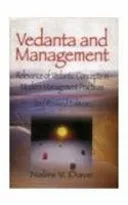
Vedanta and Management
 81
81

Vedanta and Management
N.V. Dave's "Vedanta and Management" attempts to bridge an immense philosophical chasm, offering the ancient wisdom of Vedanta as a balm for the modern executive's soul. The ambition is commendable; the execution, however, feels less like a seamless integration and more like an academic exercise. Dave highlights the concept of 'Nishkama Karma' – selfless action – as a potent antidote to workplace stress, a notion that certainly holds practical appeal. Yet, the transition from abstract philosophical discourse to actionable managerial advice can be abrupt. While the book provides a valuable theoretical grounding, it occasionally falters in illustrating concrete, step-by-step applications for the harried manager facing quarterly targets. The work is strongest when it elucidates Vedantic principles, but it could benefit from more specific, contemporary case studies to solidify its unique proposition. It offers a contemplative pause in a frantic world, but its practical utility remains somewhat theoretical.
📝 Description
81
Published in 2002, Vedanta and Management connects ancient Indian philosophy with modern business leadership.
N.V. Dave's book, Vedanta and Management, proposes that principles from Vedanta, an Indian philosophical tradition, can inform contemporary business practices. It suggests that understanding the self and reality, as taught in Vedanta, offers a path to more balanced and effective decision-making in management roles. The work is intended for professionals facing workplace stress and conflicts between personal goals and organizational demands.
It is particularly useful for those looking beyond standard business psychology and management theories. Readers interested in applying Indian philosophical thought to secular life will find value here. The book also appeals to individuals questioning the sufficiency of purely materialistic approaches to leadership and personal development. It provides a different perspective for those seeking integrated approaches to professional life.
Vedanta and Management enters a conversation that gained traction in Western business circles by the early 2000s, building on earlier integrations of Eastern thought. While Western management often relies on empirical data and behavioral models, this book draws from Vedanta, a philosophical current that has developed over two millennia. Its publication reflects a broader interest in mindfulness and spirituality as complements to rationalist business paradigms, offering ancient wisdom for modern challenges.
💡 Why Read This Book?
• Gain practical stress-reduction techniques by understanding the Vedantic principle of 'Nishkama Karma', allowing you to act without undue attachment to outcomes, a concept explored in relation to modern business pressures. • Reframe leadership challenges through the lens of the 'Atman' (the true Self), moving beyond egoic identification to foster more authentic and less conflict-driven decision-making, as discussed in the book's philosophical sections. • Apply the concept of the 'Gunas' (Sattva, Rajas, Tamas) to analyze workplace dynamics and personal behavioral patterns, drawing insights from traditional Indian philosophy to enhance self-awareness and team management from the 2002 publication.
⭐ Reader Reviews
Honest opinions from readers who have explored this book.
❓ Frequently Asked Questions
What specific Vedantic concepts does N.V. Dave apply to management?
The book applies core Vedantic concepts such as 'Nishkama Karma' (action without attachment to results), the nature of the 'Atman' (true Self), the influence of the 'Gunas' (Sattva, Rajas, Tamas), and the pursuit of 'Moksha' (liberation) as metaphors for achieving inner peace and effective leadership.
When was Vedanta and Management first published and by whom?
Vedanta and Management was first published in September 2002. The author is N.V. Dave.
How does Vedanta and Management address the conflict between individual and organizational goals?
It suggests that by understanding the 'Atman' as distinct from the ego and by practicing 'Nishkama Karma', individuals can harmonize personal aspirations with organizational objectives, reducing internal conflict and stress.
Is this book suitable for someone new to Vedanta?
Yes, the book aims to explain Vedantic principles in a way that is accessible to modern professionals, even those with no prior knowledge of Indian philosophy, by linking them directly to management challenges.
What are the 'Gunas' and how are they relevant to management, according to the book?
The 'Gunas' (Sattva, Rajas, Tamas) are the three fundamental qualities of nature that influence behavior. The book uses them to analyze personality types, team dynamics, and decision-making processes, offering a framework for understanding and improving workplace interactions.
What is the primary benefit of applying Vedantic principles to management, as presented in this book?
The primary benefit is the potential for reduced stress, enhanced decision-making, and a more balanced approach to leadership by fostering self-awareness, detachment from outcomes, and a deeper understanding of the self beyond the organizational role.
🔮 Key Themes & Symbolism
Nishkama Karma for Executives
The book posits that the Vedantic concept of 'Nishkama Karma', or selfless action performed without attachment to its fruits, is directly applicable to the high-pressure environment of modern management. By detaching from the anxiety of outcomes—whether project success, promotion, or profit margins—executives can achieve greater clarity, reduce stress, and perform more effectively. Dave suggests this principle liberates individuals from the cycle of desire and disappointment, fostering a more resilient and centered approach to leadership challenges encountered in business operations.
The Atman Beyond Ego
A central theme is the exploration of the 'Atman', the true, unchanging Self, as distinct from the transient ego. The work argues that much of the conflict and stress experienced by managers stems from an identification with the ego—its needs, fears, and ambitions. By understanding and realizing the 'Atman', leaders can transcend petty concerns, foster greater empathy, and make decisions from a place of deeper wisdom and equanimity, ultimately leading to more ethical and sustainable organizational practices.
The Gunas in Workplace Dynamics
Vedanta and Management examines the three 'Gunas'—Sattva (purity, harmony), Rajas (activity, passion), and Tamas (inertia, ignorance)—as fundamental forces influencing individual behavior and group dynamics within organizations. The book explores how an imbalance of these qualities can lead to specific management challenges, such as indecisiveness (Tamas), burnout (Rajas), or a lack of focus. Understanding these inherent energies, it suggests, allows managers to cultivate Sattva, leading to more balanced decision-making and harmonious team interactions.
Vedantic Principles as Stress Management Tools
The overarching aim is to present Vedanta not merely as abstract philosophy but as a practical toolkit for managing the inherent stresses of the corporate world. Concepts like 'Moksha' (liberation) are reinterpreted not as literal spiritual release, but as a state of inner freedom from the anxieties of performance, competition, and organizational politics. This perspective offers a profound shift from conventional stress-reduction techniques, grounding well-being in a deeper understanding of consciousness and reality.
💬 Memorable Quotes
Direct passages from the work, attributed to the author.
“Modern day executives... face a conflict between individual goals and organisational goals. This creates stress and tension.”
— This foundational statement from the original blurb clearly articulates the core problem the book seeks to address, framing the internal and external pressures faced by managers as a central point of inquiry.
“Recognize the Self beyond the role.”
— This interpretation emphasizes the Vedantic concept of the 'Atman' in contrast to the ego or social persona, suggesting that true leadership emanates from a stable, inner identity rather than external validation or position.
“True success lies in inner equilibrium, not just external achievement.”
— This interpretation reflects the book's core philosophy, suggesting that sustainable effectiveness and well-being in management stem from achieving a state of internal balance, inspired by Vedantic ideals of detachment and self-awareness.
💡 Key Ideas
Editorial paraphrase of the work's core concepts — not direct quotes.
Action without attachment to results is the key.
This paraphrased concept expresses the essence of 'Nishkama Karma', highlighting its potential as a practical strategy for managers to mitigate stress and improve performance by focusing on duty rather than reward.
The interplay of Sattva, Rajas, and Tamas shapes our decisions.
This paraphrased insight points to the application of the 'Gunas' in understanding workplace behavior and decision-making, offering a traditional framework for analyzing the subtle influences on human action.
🌙 Esoteric Significance
Tradition
This work aligns with the Advaita Vedanta tradition, a prominent school of Hindu philosophy emphasizing non-dualism – the oneness of the individual soul (Atman) and the ultimate reality (Brahman). It reinterprets core Vedantic concepts for a secular audience, seeking to extract their practical, ethical, and psychological implications rather than focusing on purely soteriological (salvation-oriented) aspects. While not strictly esoteric in the sense of secret rituals, it draws from a profound metaphysical system to offer transformative insights.
Symbolism
Key symbolic concepts include the 'Atman' representing the unconditioned, eternal self, a core symbol of immutable consciousness that transcends the limitations of the ego and professional identity. 'Karma' functions symbolically as the universal law of cause and effect, governing actions and their consequences in the business realm. 'Moksha', typically liberation from the cycle of rebirth, is symbolically re-envisioned as achieving inner freedom and detachment from the stresses and anxieties of the corporate world.
Modern Relevance
Contemporary thinkers in positive psychology and leadership studies, particularly those exploring mindfulness-based interventions (MBIs) and secularized spiritual philosophies, echo themes found in "Vedanta and Management." The emphasis on self-awareness, emotional regulation, and finding meaning in work speaks to modern corporate wellness programs and the growing field of contemplative leadership, suggesting a continued interest in integrating ancient wisdom traditions with contemporary professional life.
👥 Who Should Read This Book
• Business leaders and managers experiencing high levels of stress and seeking alternative frameworks for decision-making and personal well-being, who will gain practical applications of Vedantic principles like 'Nishkama Karma'. • Students and academics of comparative philosophy and religious studies interested in the cross-cultural application of Eastern thought to Western contexts, particularly the integration of Vedanta into secular fields. • Entrepreneurs and innovators looking for foundational principles to build resilient and ethically grounded organizations, benefiting from the book's insights on self-awareness and detachment from outcomes.
📜 Historical Context
Published in 2002, N.V. Dave's "Vedanta and Management" arrived at a time when the business world was increasingly open to incorporating Eastern philosophies, a trend building on earlier influences like the New Age movement and the popularization of mindfulness. While management literature traditionally drew from Western psychology and economics, Dave's work tapped into a growing interest in spirituality as a source of practical wisdom. This period saw a divergence from purely rationalist approaches, with thinkers like Daniel Goleman popularizing emotional intelligence (1995), and a broader societal search for meaning beyond material success. The book's engagement with Vedanta, a tradition with roots extending back to the Upanishads (circa 800-200 BCE), offered a stark contrast to contemporary, often secular, management theories. It positioned itself against purely utilitarian or behavioralist models, drawing from a philosophical lineage that had seen extensive commentary by scholars like Swami Vivekananda in the late 19th and early 20th centuries.
📔 Journal Prompts
The conflict between individual and organizational goals, as presented.
Your personal experience with the 'Gunas' (Sattva, Rajas, Tamas) in decision-making.
The concept of 'Nishkama Karma' applied to a recent professional challenge.
Identifying your 'Atman' beyond your current job title.
Achieving 'Moksha' from workplace anxieties through detachment.
🗂️ Glossary
Vedanta
A school of Hindu philosophy based on the Upanishads, exploring the nature of reality, consciousness, and the self (Atman), often emphasizing non-dualism (Advaita).
Atman
The individual soul or true Self, considered in Vedanta to be eternal, unchanging, and ultimately identical with Brahman (Ultimate Reality).
Nishkama Karma
Action performed without attachment to the fruits or results of the action; selfless duty, a key concept for stress reduction in management.
Gunas
The three fundamental qualities or modes of nature: Sattva (purity, harmony), Rajas (activity, passion), and Tamas (inertia, ignorance), which influence all phenomena.
Moksha
Liberation or release from the cycle of birth and death (samsara); in this context, symbolically interpreted as achieving inner freedom and peace.
Ego
The sense of self derived from identification with the body, mind, and external roles, often contrasted with the deeper, true Self (Atman).
Brahman
The ultimate, unchanging reality or consciousness that underlies all existence in Advaita Vedanta.