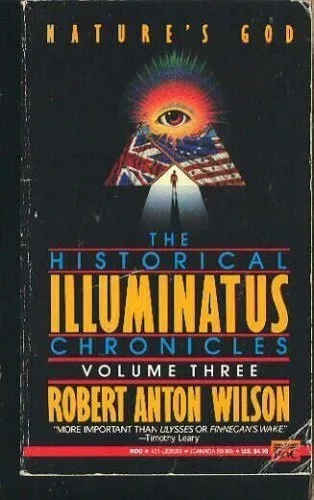
Nature's God - Historical Illuminatus Chronicles - Volume III
 74
74

Nature's God - Historical Illuminatus Chronicles - Volume III
Robert Anton Wilson's Nature's God is less a narrative and more a sprawling intellectual landscape, characteristic of his 'Illuminatus' series. The book excels at presenting a dizzying array of ideas, from Gnosticism to quantum physics, as facets of a single, albeit chaotic, cosmic joke. A particularly potent section examines the concept of 'gods' not as external deities but as projected psychological constructs, a core tenet of Wilson's non-dualistic worldview. However, the sheer density of references and the lack of a clear narrative through-line can make sustained engagement a challenge. The 2018 publication date, long after Wilson's most prolific period, lends it a retrospective air, though its ideas remain remarkably prescient. It is a challenging but rewarding exploration for dedicated seekers of unconventional wisdom.
📝 Description
74
Nature's God, Volume III of Robert Anton Wilson's Historical Illuminatus Chronicles, appeared in 2018.
This installment continues Robert Anton Wilson's complex narrative, picking up the sprawling saga initiated in earlier volumes. It examines conspiracy, consciousness, and the esoteric currents shaping history. The book constructs a dense, multi-layered argument designed to challenge conventional views of reality. Readers will encounter Wilson's characteristic blend of humor, skepticism, and intellectual playfulness. The work demands patience and a willingness to grapple with paradox.
Nature's God is best suited for those already familiar with Wilson's wider bibliography or individuals seriously interested in Discordianism, conspiracy theory as a literary device, and the philosophical implications of altered states of consciousness. It builds upon Wilson's engagement with counter-cultural movements and mid-to-late 20th-century intellectual debates. The book reflects his discussions with figures like Timothy Leary and his interest in parapsychology.
Nature's God engages with the esoteric traditions Wilson explored throughout his career, particularly those surrounding the Illuminati mythos. He presents this not as a literal historical conspiracy, but as a conceptual tool for analyzing power and hidden knowledge. The book draws on themes found in Discordianism, a parody religion that critiques established orders, and Wilson's own concept of 'reality tunnels.' These tunnels represent how individual subjective experiences shape our understanding of the world, often influenced by religious, political, or mystical belief systems. Wilson uses these ideas to dissect the hidden structures and subjective realities that underpin human history and consciousness.
💡 Why Read This Book?
• Learn about the concept of 'reality tunnels' as described by Wilson, offering a framework for understanding how personal beliefs shape perception, distinct from generic discussions of perspective. • Grasp the Discordian perspective on chaos and order, as Wilson presents it, providing a unique lens on societal structures that differs from conventional political science. • Explore Wilson's interpretation of Gnostic myths and their relation to modern power structures, offering a specific historical and philosophical engagement absent in general occult texts.
⭐ Reader Reviews
Honest opinions from readers who have explored this book.
❓ Frequently Asked Questions
What is the significance of 'Nature's God' in Robert Anton Wilson's larger body of work?
Nature's God, Volume III of the Historical Illuminatus Chronicles, continues Wilson's signature blend of conspiracy, humor, and philosophical inquiry. It deepens themes of reality tunnels and the nature of belief systems, serving as a vital piece for understanding his overarching meta-narrative.
When was Robert Anton Wilson's 'Nature's God' first published?
Nature's God was first published in 2018, extending the Historical Illuminatus Chronicles series.
Does 'Nature's God' require reading the previous volumes of the Illuminatus Chronicles?
While not strictly mandatory, prior knowledge of the first two volumes is highly recommended. Nature's God builds upon established characters, concepts, and narrative threads, making it more accessible to those familiar with Wilson's established mythology.
What are some core philosophical ideas explored in 'Nature's God'?
The book delves into concepts like reality tunnels, Discordianism, Gnosticism, and the psychological construction of deities. Wilson probes the nature of belief and how it shapes our perception of reality and historical events.
Is 'Nature's God' a historical account or a work of fiction?
It is best understood as a work of speculative philosophy and meta-fiction. Wilson uses historical events and figures as springboards for exploring esoteric ideas, blending fact, fiction, and satire into a unique synthesis.
What is Discordianism as presented in Wilson's work?
Discordianism, as explored by Wilson, is a modern religion/parody that worships Eris, the Greek goddess of chaos. It emphasizes the inherent disorder in the universe and often uses humor and paradox to challenge conventional thought.
🔮 Key Themes & Symbolism
Reality Tunnels
Wilson posits that individuals operate within subjective 'reality tunnels,' shaped by personal experiences, beliefs, and cultural conditioning. Nature's God explores how these tunnels are constructed and reinforced, influencing our perception of everything from historical events to the nature of divinity. It suggests that what we perceive as objective reality is often a consensus hallucination, manipulated by various social and informational forces. This concept is central to understanding Wilson's critique of dogma and his encouragement of epistemological skepticism.
Discordianism and Cosmic Play
As a prominent figure in Discordianism, Wilson infuses Nature's God with its characteristic embrace of chaos, humor, and paradox. The book treats the disorder inherent in the universe not as something to be feared, but as a fundamental creative force. It critiques rigid systems of order and control, suggesting that true understanding comes from embracing ambiguity and the playful, often absurd, nature of existence. This perspective challenges traditional religious and political structures.
The Myth of the Illuminati
Nature's God continues the exploration of the Illuminati, not necessarily as a literal historical conspiracy, but as a potent archetype representing hidden knowledge, manipulation, and secret power. Wilson uses the mythos to examine how narratives of control and hidden influence pervade human history and consciousness. The book questions who controls the narrative and how these controlling myths serve to maintain existing power structures, inviting readers to deconstruct such narratives.
Gnostic Dualism and Liberation
The work engages with Gnostic themes, particularly the idea of a flawed creator god (the Demiurge) and the search for liberation from a material world perceived as a prison. Wilson reinterprets these ancient ideas through a modern, often psychedelic, lens, suggesting that liberation comes not from escaping the material world, but from understanding the illusory nature of its perceived limitations and the 'reality tunnels' that bind us. It critiques dogmatic certainty from a Gnostic perspective.
💬 Memorable Quotes
Direct passages from the work, attributed to the author.
“The most dangerous form of ignorance is the ignorance of ignorance.”
— This highlights Wilson's emphasis on meta-cognition and the importance of recognizing the limits of one's own knowledge. True understanding begins with acknowledging what one doesn't know, a central to his epistemological skepticism.
“Reality is whatever resists you.”
— A concise articulation of the 'reality tunnel' concept. It suggests that our subjective perceptions are constantly being tested and potentially reshaped by the external world, implying that reality possesses an objective component that pushes back against our beliefs.
“Order is just a temporary agreement among the forces of chaos.”
— This expresses the Discordian worldview presented in the book. It suggests that stable structures and systems are fragile constructs, ultimately subservient to the fundamental, creative principle of chaos.
“Belief is the enemy of knowledge.”
— Wilson consistently advocated for skepticism and the open-minded questioning of all beliefs, even those held dear. This statement underscores his view that firm convictions can blind individuals to new information and alternative perspectives.
💡 Key Ideas
Editorial paraphrase of the work's core concepts — not direct quotes.
The universe is a hologram and we are all just projections.
This paraphrased concept reflects Wilson's interest in interconnectedness and the idea that perceived separateness might be an illusion. It aligns with ideas found in quantum physics and certain mystical traditions regarding the unified nature of existence.
🌙 Esoteric Significance
Tradition
Nature's God significantly engages with Gnostic and Hermetic traditions, reinterpreting their core tenets through a modern, often satirical, lens. Wilson draws parallels between the Gnostic Demiurge and contemporary power structures, viewing the material world as a construct that can be understood and potentially transcended. He applies Hermetic principles of correspondence and mentalism to analyze how belief systems shape perceived reality, aligning with Western esotericism's focus on hidden laws and consciousness.
Symbolism
The book frequently utilizes the symbol of the Eye of Providence, not just as a Masonic emblem, but as a representation of surveillance, hidden knowledge, and divine (or artificial) oversight. The serpent, a recurring motif in Gnosticism and Hermeticism, appears as a symbol of both wisdom and temptation, embodying the dual nature of knowledge and the potential for deception within esoteric traditions. The concept of the 'Illuminatus' itself functions as a potent symbol of hidden manipulation and the search for ultimate truth.
Modern Relevance
Contemporary thinkers in fields ranging from psychedelic research to digital consciousness studies find resonance in Wilson's exploration of reality tunnels and belief systems. His work informs discussions on meme theory, artificial intelligence ethics, and the nature of simulated realities. Modern Discordian practitioners and chaos magicians continue to draw inspiration from his playful yet profound approach to challenging established paradigms and fostering critical thinking about information and control.
👥 Who Should Read This Book
• Seekers of unconventional philosophical frameworks: Individuals interested in exploring concepts like reality tunnels and subjective epistemology beyond mainstream thought will find a unique perspective. • Students of conspiracy and counter-culture: Readers fascinated by the historical and psychological dimensions of conspiracy theories, particularly those emerging from the 1960s and 70s, will appreciate Wilson's meta-commentary. • Practitioners of Discordianism or those interested in its philosophy: This volume offers a deep dive into the principles and humor central to Discordianism, as articulated by one of its most prominent proponents.
📜 Historical Context
Published in 2018, Nature's God emerges decades after Robert Anton Wilson’s most influential period, yet it revisits the intellectual ferment of the late 20th century. Wilson’s work consistently engaged with the counterculture, psychedelics, and esoteric philosophies, often in dialogue with figures like Timothy Leary and the burgeoning field of parapsychology. This volume continues his exploration of conspiracy narratives and consciousness, themes prevalent in the 1970s and 80s. Unlike more traditional historical accounts, Wilson’s approach was highly syncretic, blending Gnosticism, Discordianism, and quantum physics. His work often drew fire from mainstream academia, which viewed his methods as unscholarly, yet found a devoted following among those exploring alternative epistemologies. The 2018 publication suggests a consolidation of his ideas or posthumous material, placing it in conversation with contemporary interest in simulation theory and meta-narratives.
📔 Journal Prompts
The nature of your own reality tunnel and its construction.
Discordianism's perspective on a recent societal conflict.
The role of 'hidden knowledge' in contemporary information flow.
How Gnostic concepts of liberation apply to modern anxieties.
The potential for 'gods' to be psychological projections.
🗂️ Glossary
Reality Tunnel
A subjective framework of beliefs, experiences, and conditioning through which an individual perceives and interprets reality. Wilson used this to explain differing viewpoints and the construction of personal truths.
Discordianism
A modern, often parodic, religion or philosophy centered on Eris, the Greek goddess of chaos. It embraces disorder, paradox, and humor as fundamental aspects of existence.
Illuminatus
In Wilson's context, refers to a mythical or symbolic secret society (or network of societies) often associated with conspiracy theories, representing hidden knowledge and control.
Gnosticism
An ancient religious and philosophical movement emphasizing personal spiritual knowledge (gnosis) for salvation. Wilson frequently referenced its dualistic worldview and critique of a flawed material creation.
23 Enigma
A concept popularized by Wilson, observing the recurrence of the number 23 in various contexts, suggesting synchronicity or a playful cosmic pattern.
Synchronicities
Meaningful coincidences, events that appear related through meaning rather than causality. Wilson saw these as evidence of interconnectedness or playful cosmic design.
Epistemology
The branch of philosophy concerned with the theory of knowledge, exploring its nature, scope, and justification. Wilson heavily engaged with epistemological skepticism.
🔮 Readers Also Liked
Browse all →









More by Robert Anton Wilson
All books →





More Free Occult Philosophy Books
View all →