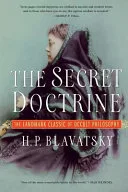
The Secret Doctrine
 78
78

The Secret Doctrine
Helena Blavatsky’s "The Secret Doctrine" is less a book to be read and more a cosmic event to be weathered. Its sheer scale and ambition are staggering, attempting to synthesize a universal cosmology and anthropology from esoteric traditions across the globe. The 1888 publication date itself signals its intent to offer an alternative to the burgeoning scientific materialism of the late Victorian era. The work's strength lies in its audacious attempt to connect ancient wisdom with modern inquiry, presenting a vision of humanity's deep past and spiritual destiny that still captivates. However, its density and often convoluted prose present a formidable barrier. The "Stanzas of Dzyan," the alleged source material, are cryptic to the point of opacity, demanding extensive interpretation that can feel subjective. One passage, detailing the "Sevenfold Man" and the progression of consciousness through various stages, exemplifies both the work's potential for profound spiritual mapping and its tendency to become lost in its own intricate terminology. "The Secret Doctrine" remains a foundational text for Theosophy, a challenging but essential document for understanding modern esoteric thought.
📝 Description
78
Helena Petrovna Blavatsky published "The Secret Doctrine" in 1888, detailing a universal cosmology.
"The Secret Doctrine," first published in 1888, presents Helena Petrovna Blavatsky's sweeping cosmological and anthropological narrative. She aimed to show the continuity of universal laws from the primordial "Absolute" to human development. The work uses ancient verses, the "Stanzas of Dzyan," which Blavatsky claimed to translate from an archaic text. These stanzas form the basis for her commentary on the evolution of worlds, life, and consciousness across cosmic cycles.
This text is for dedicated students of esoteric philosophy, comparative religion, and occult history. It demands intellectual stamina and a willingness to engage with complex metaphysical concepts. Readers should expect a dense exposition that challenges conventional scientific and religious views. Those seeking a rigorous examination of theosophical thought and its roots in Eastern traditions will find it a significant resource. It is not a casual read but a deep study of esoteric cosmology.
Published in 1888, "The Secret Doctrine" responded to Victorian interest in Eastern spirituality and occultism. Blavatsky offered an alternative spiritual science, engaging with contemporary scientific theories like Darwinism and reinterpreting them through a spiritual framework. The book draws heavily from Hindu scriptures, Buddhism, and Hermetic philosophy, attempting to synthesize them into a universal doctrine. Its publication polarized opinions, with followers viewing it as revelatory and critics dismissing it as pseudoscientific.
💡 Why Read This Book?
• Understand the foundational Theosophical concept of "Root Races," exploring Blavatsky's framework for human evolution across vast epochs and its divergence from Darwinian theory. • Engage with the "Stanzas of Dzyan," the book's core text, to grasp Blavatsky's interpretation of ancient cosmogenesis and the cyclical nature of existence, as presented in her 1888 masterwork. • Grasp the intricate "Seven Planes" of existence, a hierarchical model of reality that informs much of subsequent esoteric literature and offers a non-materialist view of the cosmos.
⭐ Reader Reviews
Honest opinions from readers who have explored this book.
❓ Frequently Asked Questions
When was Helena Blavatsky's "The Secret Doctrine" originally published?
Helena Blavatsky's "The Secret Doctrine" was first published in two volumes in 1888 by the Theosophical Society, making it a product of the late Victorian era's esoteric revival.
What are the "Stanzas of Dzyan" mentioned in "The Secret Doctrine"?
The "Stanzas of Dzyan" are a set of cryptic verses that Blavatsky claimed to have translated from an ancient Eastern text. They form the symbolic basis for her extensive cosmological and anthropological explanations in the book.
What does "The Secret Doctrine" propose about human evolution?
It proposes a complex evolutionary scheme involving "Root Races" and "Rounds," suggesting humanity has evolved through multiple distinct stages over vast cosmic periods, a concept differing significantly from standard evolutionary biology.
Is "The Secret Doctrine" considered a scientific text?
No, "The Secret Doctrine" is considered an esoteric or occult text. While it engages with contemporary scientific ideas of the late 19th century, it presents a spiritual science and cosmology, not empirical scientific findings.
What is the relationship between "The Secret Doctrine" and Theosophy?
"The Secret Doctrine" is considered the foundational magnum opus of the Theosophical movement, authored by one of its principal founders, Helena Blavatsky. It outlines the core philosophical and cosmological tenets of Theosophy.
Where can I find the original "The Secret Doctrine"?
The original "The Secret Doctrine" (1888) is in the public domain and can be found online through various digital libraries and esoteric archives, as well as in print editions.
🔮 Key Themes & Symbolism
Cosmic Cycles
The work details a vast cyclical view of existence, proposing that the universe and its inhabitants undergo continuous cycles of manifestation and dissolution. These "Manvantaras" (periods of activity) and "Pralayas" (periods of rest) govern the unfolding of worlds and life across immense timescales, challenging linear conceptions of time and progress found in Western thought. This cyclical cosmology is foundational to understanding the grand evolutionary sweep Blavatsky outlines.
Sevenfold Constitution of Man
Blavatsky elaborates on the ancient concept of a sevenfold spiritual and physical constitution of humanity. This framework posits that human beings are composed of seven principles or planes of existence, ranging from the physical body to the highest spiritual monad. Understanding this intricate structure is key to grasping theosophical ideas about consciousness, reincarnation, and the stages of spiritual development across different "Root Races."
Root Races and Rounds
A central tenet is the doctrine of "Root Races," distinct evolutionary stages of humanity, each inhabiting different continents and possessing unique physical and psychic attributes. These races appear in sequential "Rounds" of planetary evolution. Blavatsky's description of the seven Root Races, including the Lemurian and Atlantean, offers a radical reinterpretation of human history and prehistory, positioning them within a grand cosmic evolutionary plan.
Esoteric Interpretation of Religions
Blavatsky sought to demonstrate a hidden unity underlying all world religions and mythologies. "The Secret Doctrine" argues that these diverse traditions are fragmented expressions of a single, ancient, universal wisdom. By analyzing creation myths, scriptures, and symbols from Hinduism, Buddhism, Zoroastrianism, and other traditions, she aimed to reveal their common esoteric origins and underlying philosophical principles.
💬 Memorable Quotes
Direct passages from the work, attributed to the author.
“The "Secret Doctrine" is the one unbroken chain of continuity which links the last sister of the "Races" to the first, the infant world to the old.”
— This highlights Blavatsky's aim to present a unified, unbroken lineage of cosmic and human evolution, connecting all stages of development from the earliest beginnings to the present, emphasizing a holistic, continuous process.
“Man is the microcosm of the macrocosm.”
— This aphorism expresses the Hermetic principle that the human being mirrors the structure and laws of the universe. It suggests that by studying humanity's constitution and evolution, one can understand the greater cosmic order.
“The universal law is that of cycles.”
— This statement expresses the book's core cosmological view, asserting that all phenomena, from planetary formation to the rise and fall of civilizations, occur within recurring cycles of manifestation and dissolution.
“Every star is a sun, and every sun is a world, teeming with its own systems of "planetary" chains.”
— This reflects Blavatsky's vast cosmological vision, positing a universe filled with countless inhabited worlds, challenging the anthropocentric view and suggesting a plurality of life and evolutionary paths across the cosmos.
“Evolution is the great law.”
— This signifies the pervasive nature of evolution as presented in the book, not merely biological but spiritual and cosmic. It frames the entire unfolding of existence, from primordial matter to perfected consciousness, as a continuous process of development.
🌙 Esoteric Significance
Tradition
The work is foundational to the Theosophical tradition, which Blavatsky co-founded. It draws heavily upon, and seeks to synthesize, elements from various esoteric lineages, including Hinduism (Advaita Vedanta, Yoga), Buddhism (Mahayana and Tibetan schools), Hermeticism, Kabbalah, and Gnosticism. It positions itself as a modern exegesis of an ancient, universal wisdom that underlies all these traditions, offering a unique syncretic framework.
Symbolism
Key symbols include the Serpent, representing eternity, cyclical motion, and wisdom; the Egg, symbolizing the primordial universe and potentiality before manifestation; and the Triangle, often representing divine triads or the interplay of spirit, soul, and body. The "Stanzas of Dzyan" themselves are presented as the ultimate symbolic cipher, requiring deep meditation and intuitive understanding to unlock their cosmological and anthropological secrets.
Modern Relevance
Contemporary esoteric thinkers, New Age movements, and certain branches of comparative mythology continue to draw upon "The Secret Doctrine." Its concepts of cyclical evolution, the sevenfold nature of consciousness, and the underlying unity of religions have influenced a wide range of spiritual philosophies and practices seeking alternatives to materialistic worldviews.
👥 Who Should Read This Book
• Students of comparative religion and mythology will find a unique framework for understanding the alleged common roots of global spiritual traditions. • Aspiring practitioners of Western Esotericism will encounter foundational Theosophical concepts that have influenced subsequent movements and magical systems. • Researchers into the history of occultism and late 19th-century spiritual movements will find a primary source document detailing the intellectual currents of the era.
📜 Historical Context
Published in 1888, "The Secret Doctrine" emerged at a key moment in Western intellectual history. The late 19th century witnessed a surge of interest in spiritualism, the occult, and Eastern religions, partly as a reaction against the perceived limitations of scientific materialism and orthodox Christianity. Helena Blavatsky, a central figure in this milieu, aimed to present a "universal religion" or ancient wisdom that predated all current faiths and sciences. The work drew heavily from Hindu philosophy, Tibetan Buddhism, and Hermeticism, seeking to synthesize them into a cohesive, ancient cosmology. It engaged directly with contemporary scientific debates, reinterpreting Darwinian evolution and cosmology through a spiritual lens. The Theosophical Society, founded in 1875, became the vehicle for disseminating these ideas. While hailed by followers, the book faced considerable criticism from scientists and religious figures, with figures like the Christian Apologist Society in London actively denouncing its teachings.
📔 Journal Prompts
The initial "Stanzas of Dzyan" and their interpretation concerning cosmic evolution.
The concept of "Root Races" and its implications for understanding human history.
The "Sevenfold Constitution of Man" as a model for spiritual development.
The synthesis of Eastern and Western esoteric traditions within the work.
The cyclical nature of "Manvantaras" and "Pralayas" in cosmic history.
🗂️ Glossary
Stanzas of Dzyan
The alleged ancient text from which Blavatsky claims to have translated the core verses of "The Secret Doctrine." These stanzas are cryptic and serve as the basis for her extensive commentary on cosmology and evolution.
Root Races
Distinct evolutionary stages of humanity described in Theosophy. Each Root Race possesses unique physical, mental, and spiritual characteristics and emerges during specific periods of planetary development over vast epochs.
Rounds
A series of planetary evolutionary cycles through which a planet passes. Humanity, in its various "Root Races," evolves through seven Rounds on a single planet.
Manvantara
A period of cosmic manifestation or activity, representing a "day of Brahma" in Hindu cosmology. In Theosophy, it refers to a vast cycle during which a planetary system or a specific chain of worlds is active.
Pralaya
A period of cosmic dissolution or rest, a "night of Brahma," following a Manvantara. It is a state of latency before the next cycle of manifestation begins.
Seven Planes
The hierarchical levels of existence or consciousness described in Theosophy, ranging from the physical plane to the highest spiritual or divine planes. Each plane has its own laws and forms of consciousness.
Absolute
The unmanifest, undifferentiated, infinite, and eternal principle that is the ultimate source of all existence. It is beyond human comprehension and description, representing the primordial, unconditioned reality.