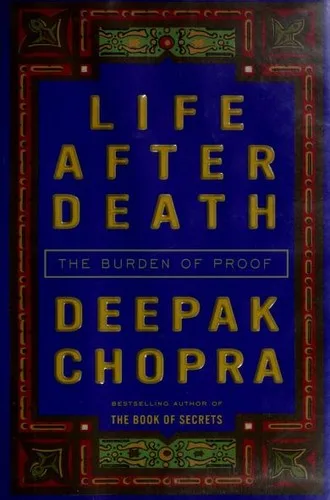
Life After Death
 79
79

Life After Death
Chopra's 2008 exploration of consciousness beyond the physical body, "Life After Death," offers a compelling, if sometimes repetitive, synthesis of scientific speculation and spiritual tradition. He adeptly uses concepts from quantum physics, such as entanglement, to posit that consciousness might not be a product of the brain but rather a fundamental aspect of the universe. A particular strength lies in his ability to translate complex ideas into accessible language, making the notion of a non-local self understandable to a broad audience. However, the work occasionally falters by presenting speculative theories as established facts without sufficient critical distance, particularly when discussing anecdotal evidence of an afterlife. The chapter on the "Quantum-Mechanical Model of Consciousness" provides a fascinating, though challenging, perspective. Despite its occasional overreach, "Life After Death" remains a significant contribution for those seeking to bridge the perceived divide between material science and spiritual experience.
📝 Description
79
Deepak Chopra's 2008 book 'Life After Death' examines consciousness beyond physical existence.
Published in 2008, Deepak Chopra's 'Life After Death' investigates consciousness and existence after the body ceases to function. Chopra combines insights from quantum physics, neuroscience, and various ancient traditions with personal stories. He aims to build a model for understanding reality and the continuation of the self. The book addresses readers who ponder mortality, the soul, and the possibility of an afterlife. It is particularly suited for those who wish to connect scientific investigation with spiritual beliefs, especially those familiar with Chopra's prior work on consciousness and wellness. It will also interest anyone curious about how different philosophical and religious concepts align with modern science on life's ultimate questions.
Chopra's work addresses the idea that consciousness is not limited to the brain and may exist independently. He discusses how phenomena such as near-death experiences might suggest a reality beyond the physical realm. The book also considers how intention, memory, and an energetic aspect of the self influence our current lives and whatever may follow. It suggests a fundamental connection between all things, positing that individual awareness is part of a larger, universal consciousness.
Chopra's 'Life After Death' aligns with a long history of metaphysical and spiritual inquiry, touching upon themes found in Theosophy and New Age thought. It seeks to bridge ancient spiritual concepts with contemporary scientific discourse, offering an alternative to strictly materialistic or dogmatic religious views. The book engages with the idea that consciousness is fundamental and may persist beyond the physical body, a notion explored across many esoteric traditions throughout history.
💡 Why Read This Book?
• Gain an understanding of how quantum physics concepts like entanglement are applied to theories of consciousness, offering a unique scientific lens on existence beyond the physical body, as discussed in the "Quantum-Mechanical Model of Consciousness" section. • Explore the potential for personal consciousness to persist after physical death by examining Chopra's synthesis of ancient yogic philosophy and modern neuroscience, a core tenet of the book's argument. • Discover how the concept of the 'non-local self' challenges conventional notions of identity, providing a framework for contemplating a larger, interconnected awareness, a central theme throughout the 2008 publication.
⭐ Reader Reviews
Honest opinions from readers who have explored this book.
❓ Frequently Asked Questions
What is Deepak Chopra's core argument in "Life After Death" regarding consciousness?
Chopra's central argument, presented in his 2008 book, is that consciousness is not merely a byproduct of the brain but a fundamental, non-local aspect of the universe. He suggests that awareness can exist independently of the physical body, implying a continuity of self beyond death.
How does "Life After Death" connect quantum physics to the afterlife?
The book posits that principles like quantum entanglement, where particles remain connected regardless of distance, can serve as a metaphor or even a mechanism for how consciousness might transcend physical limitations. This is explored in sections discussing the quantum-mechanical model of consciousness.
What ancient traditions does Deepak Chopra reference in "Life After Death"?
Chopra frequently draws upon ancient Indian traditions, particularly yogic philosophy and Vedanta, to support his theories on consciousness and the soul's journey. These are contrasted with Western scientific perspectives throughout the 2008 text.
Does "Life After Death" offer scientific proof of an afterlife?
The book does not offer definitive scientific proof but rather presents speculative theories and interpretations of scientific concepts, such as quantum physics and neuroscience, alongside spiritual insights. It aims to create a plausible framework for belief.
Who is the intended audience for "Life After Death"?
The book is intended for individuals interested in exploring the nature of consciousness, the possibility of life after death, and the intersection of spirituality and science. It appeals to those familiar with Chopra's work and New Age philosophies.
When was Deepak Chopra's "Life After Death" first published?
Deepak Chopra's "Life After Death" was first published in 2008, placing it within a period of significant public discourse on consciousness and spirituality.
🔮 Key Themes & Symbolism
Non-Local Consciousness
Chopra argues that consciousness is not confined to the physical brain but is a fundamental, pervasive field. Drawing parallels with quantum mechanics, he suggests that awareness exists independently of the body, much like energy is conserved. This concept, explored extensively in the 2008 publication, implies that our individual consciousness is part of a universal consciousness and can persist beyond the cessation of biological functions.
The Energetic Self
The book posits that our true identity is not our physical form but an energetic pattern or consciousness. This energetic self, composed of thoughts, memories, and intentions, is believed to be immortal and capable of transitioning to different states of being after death. This idea aligns with concepts found in various esoteric traditions that speak of soul or spirit bodies.
Bridging Science and Spirituality
A central theme is the attempt to reconcile scientific discoveries, particularly in quantum physics and neuroscience, with spiritual and mystical beliefs about life after death. Chopra uses scientific frameworks to lend credibility to ancient wisdom, suggesting that modern science is beginning to validate concepts previously relegated to faith or metaphysics.
The Nature of Reality
The work challenges the reader's perception of reality, suggesting that the physical world is a projection of consciousness. It proposes that death is not an end but a transformation, a shift in awareness from one plane of existence to another, influenced by our beliefs and intentions during life.
💬 Memorable Quotes
Direct passages from the work, attributed to the author.
“Consciousness is not a product of the brain; it is the source of the brain.”
— This statement captures Chopra's core thesis that awareness precedes and generates physical matter, rather than being a mere emergent property of biological processes. It reframes the mind-body problem by prioritizing consciousness.
“Death is a transition, not an end.”
— This interpretation suggests that the cessation of physical life is merely a change of state for consciousness. It offers a comforting perspective on mortality, aligning with many spiritual beliefs about the soul's continued existence.
“The universe is not made of atoms; it is made of stories.”
— This evocative phrase highlights the power of narrative and consciousness in shaping our perceived reality. It suggests that our understanding and experience of the universe are fundamentally constructed through our interpretations and beliefs.
“We are not human beings having a spiritual experience; we are spiritual beings having a human experience.”
— This widely cited interpretation emphasizes the primacy of our spiritual essence over our physical incarnation. It implies that our true nature is eternal and divine, with human life being a temporary phase for spiritual growth.
“The boundary between life and death is a belief, not a fact.”
— This challenges the absolute finality of death as commonly understood. It suggests that our perception of death is influenced by cultural conditioning and limited understanding, hinting at possibilities beyond physical dissolution.
🌙 Esoteric Significance
Tradition
Chopra's work aligns broadly with the Advaita Vedanta tradition, emphasizing the non-dual nature of reality where consciousness is the ultimate ground of being. It also echoes elements of Theosophy and New Age thought, which frequently sought to interpret spiritual concepts through the lens of contemporary science, particularly physics. While departing from traditional religious dogma, it fits within the modern esoteric lineage that seeks to universalize spiritual truths and present them as compatible with scientific understanding.
Symbolism
The book often employs the symbol of the ocean and waves to represent the universal consciousness (ocean) and individual souls or experiences (waves). The wave arises from the ocean, takes form, and eventually merges back into it, symbolizing the cycle of birth, death, and rebirth or the individual's return to the cosmic source. Another motif is light, representing consciousness itself, which is seen as eternal and all-pervading, unaffected by the physical forms it illuminates.
Modern Relevance
Chopra's exploration of consciousness as fundamental and potentially non-local continues to influence contemporary discussions in transpersonal psychology and consciousness studies. Thinkers and practitioners interested in quantum mysticism, the mind-body connection, and the philosophical implications of neuroscience often reference his work. His ideas resonate with modern meditation movements and mindfulness practices that emphasize awareness and the interconnectedness of all beings.
👥 Who Should Read This Book
• Individuals grappling with existential questions about mortality and the nature of consciousness, seeking to bridge scientific curiosity with spiritual inquiry. • Students and practitioners of Eastern philosophies, particularly Vedanta and yogic traditions, who are interested in modern interpretations and scientific correlations. • Readers familiar with Deepak Chopra's previous works on mind-body medicine and spirituality, looking for a deeper exploration of consciousness beyond the physical realm.
📜 Historical Context
Published in 2008, Deepak Chopra's "Life After Death" emerged within a vibrant intellectual landscape where the boundaries between science, spirituality, and popular psychology were increasingly blurred. This era saw a surge in interest in consciousness studies, with figures like Daniel Dennett and Antonio Damasio exploring the neurological basis of mind, often from a materialist perspective. Chopra's work offered a counterpoint, drawing heavily on Eastern philosophical traditions, particularly Vedanta and yogic thought, which posit consciousness as primary. His approach was influenced by earlier New Age thinkers and movements like Theosophy, which sought to integrate spiritual insights with emerging scientific theories. While not subject to significant censorship, Chopra's work often faced criticism from the scientific establishment for what some perceived as a misapplication or oversimplification of quantum physics to metaphysical claims. His contemporaries included authors like Eckhart Tolle and Marianne Williamson, who also explored spiritual themes for a mass audience, but Chopra distinguished himself by consistently attempting to frame these ideas within a scientific paradigm, a strategy that garnered both widespread following and academic scrutiny.
📔 Journal Prompts
The concept of the non-local self and its implications for your personal identity.
Reflecting on the 'ocean and waves' analogy for universal consciousness.
How does the idea of consciousness as the 'source of the brain' challenge your current beliefs?
Exploring the energetic self and its potential continuity beyond physical death.
Your personal interpretation of 'death is a transition, not an end'.
🗂️ Glossary
Non-local consciousness
The idea that consciousness is not confined to a specific physical location (like the brain) but exists as a fundamental field that permeates all space and time, potentially connecting all beings.
Quantum entanglement
A phenomenon in quantum physics where two or more particles become linked in such a way that they share the same fate, regardless of the distance separating them. Chopra uses this as an analogy for interconnected consciousness.
Energetic self
The concept that an individual's true essence or identity is composed of energy, thought patterns, and consciousness rather than a physical body, and this energetic form can persist after death.
Advaita Vedanta
A school of Hindu philosophy that emphasizes the oneness of reality, asserting that the individual soul (Atman) is identical with the ultimate reality (Brahman).
Mind-body problem
The philosophical problem concerning the relationship between the mind (consciousness, thoughts, feelings) and the body (physical matter, brain), questioning whether they are separate entities or different aspects of the same substance.
Transpersonal psychology
A branch of psychology that studies transpersonal phenomena, such as mystical experiences, altered states of consciousness, and the spiritual dimensions of human experience.
Brahman
In Hinduism, the ultimate reality or absolute cosmic spirit that underlies all phenomena in the universe. It is considered the source and sustainer of all existence.
🔮 Readers Also Liked
Browse all →









More by Deepak Chopra
All books →


More Free Occult Philosophy Books
View all →