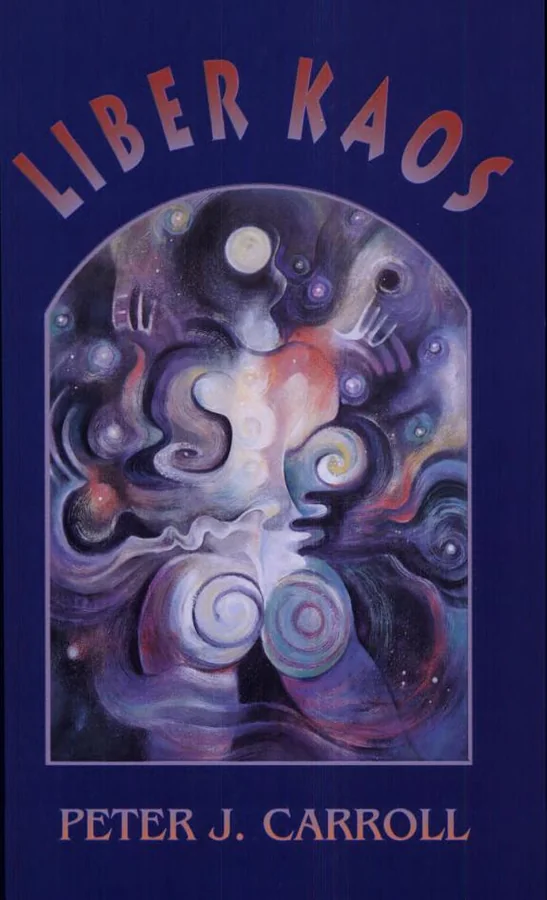
Liber Kaos
 72
72

Liber Kaos
Peter J. Carroll’s Liber Kaos arrived in 1992 not as a gentle introduction but as a demanding treatise on the mechanics of Chaos Magic. Its strength lies in its unwavering commitment to presenting magic as a science, dissecting spells into their constituent parts and proposing systems for their repeatable application. The sections detailing the establishment of a magical order and temple protocols, for instance, offer a rare glimpse into the structural elements Carroll deemed essential for serious practitioners. However, the very technicality that defines its power can also be a barrier. The dense theoretical exposition, particularly concerning aeonics and cosmogenesis, sometimes overshadows the practical guidance it promises, demanding significant prior knowledge or intense study to fully grasp. A passage discussing the application of mathematical principles to sigil creation illustrates this dual nature: intellectually rigorous, yet potentially opaque to the uninitiated.
Liber Kaos remains a foundational text for those seeking a systematic, almost engineering approach to the magical arts.
📝 Description
72
Published in 1992, Liber Kaos is a manual for Chaos Magic, detailing its theory and practice.
Peter J. Carroll's Liber Kaos functions as a practical guide to Chaos Magic, published in 1992. The book lays out methods for both individual and group magical work, including how to set up a ritual space and perform ceremonies. Carroll structures these operations within a technical framework designed for magical effectiveness. The text is aimed at dedicated practitioners of magic who want a structured yet adaptable system for their occult studies. It assumes some familiarity with esoteric ideas and presents advanced methods for individuals or groups looking to refine their magical practices. The work emerged from the occult revival of the late 20th century and contributed to the formalization of Chaos Magic. Its 1992 release coincided with growing interest in unconventional magical systems and the spread of occult information through books. While it draws on earlier practical magic techniques, Liber Kaos distinguishes itself with a precise, technically oriented approach.
Emerging from the late 20th-century occult revival, Liber Kaos codified aspects of Chaos Magic. It follows a lineage of practical occultism but emphasizes a systems-based, technical approach. The book's focus on treating magical formulas as precise tools aligns with a contemporary trend in esoteric thought that sought to demystify and systematize magical operations. Carroll builds on earlier magical explorations, distinguishing his work through its rigorous, almost scientific, methodology applied to altered states of consciousness and belief manipulation.
💡 Why Read This Book?
• You will learn the foundational principles of Chaos Magic as outlined by Peter J. Carroll, including specific techniques for ritual construction and temple setup, as detailed in the 1992 edition. • You will gain an understanding of advanced esoteric concepts like aeonics and cosmogenesis, as presented within the technical framework of Chaos Magic, offering a unique perspective not found in simpler occult texts. • You will explore the technical aspects of spellcraft and magical equations, providing a structured method for creating and executing magical operations that moves beyond purely symbolic or intuitive approaches.
⭐ Reader Reviews
Honest opinions from readers who have explored this book.
❓ Frequently Asked Questions
What is Chaos Magic according to Liber Kaos?
Liber Kaos defines Chaos Magic as a practical, results-oriented system that utilizes belief as a tool. It emphasizes flexibility, adaptability, and the technical application of magical principles, often drawing parallels to scientific methodologies and equations.
Who is Peter J. Carroll and what is his role in Chaos Magic?
Peter J. Carroll is a prominent figure in modern occultism, co-founding the Illuminates of Thanateros (IOT). Liber Kaos, first published in 1992, is considered one of his seminal works, laying out many of the core tenets and practices associated with Chaos Magic.
Does Liber Kaos provide practical exercises?
Yes, Liber Kaos includes practical training exercises for individuals and groups. It details how to set up a temple, conduct essential rituals, and apply technical spellcraft, serving as a complete advanced magical training course.
What esoteric subjects are covered in Liber Kaos?
The book covers advanced subjects such as aeonics (the study of aeons or cosmic ages), cosmogenesis (the origin and development of the universe), auric magic, and shadow time, all interpreted through the lens of Chaos Magic.
Is Liber Kaos suitable for beginners in magic?
While it contains fundamental principles, Liber Kaos is generally considered an advanced text. Its technical language and complex concepts are best suited for practitioners with some existing background in esoteric studies or a strong willingness to engage with challenging material.
What makes the rituals described in Liber Kaos unique?
The rituals in Liber Kaos are often characterized by their emphasis on technical precision and the manipulation of belief. They are designed to be adaptable and effective, incorporating principles Carroll outlines for spell equations and energetic manipulation.
🔮 Key Themes & Symbolism
Technical Spellcraft
Liber Kaos treats magic as a science, offering technical specifications for spell construction. It details the use of sigils, magical equations, and precise ritualistic procedures designed for repeatable results. The emphasis is on understanding the mechanics of magical operations, moving beyond purely symbolic interpretation to a more systematic, almost engineering approach to altering consciousness and reality.
Chaos Magic Systematization
This work is instrumental in codifying Chaos Magic, presenting it as a structured discipline rather than a disparate collection of techniques. It outlines methodologies for establishing magical orders, setting up temples, and conducting formal training, providing a blueprint for practitioners seeking to organize their practice and develop a coherent magical worldview.
Esoteric Science and Cosmology
Carroll explores complex esoteric concepts, including aeonics and cosmogenesis, reinterpreting them through the lens of Chaos Magic. The book provides a unique cosmology that informs its magical practices, treating these grand theories not as abstract philosophy but as foundational elements for practical occult work.
The Role of Belief
A central tenet explored is the function of belief as a malleable tool within magic. Liber Kaos posits that belief systems can be adopted and discarded as needed to achieve specific magical outcomes, a concept crucial to the flexible and adaptive nature of Chaos Magic practice. This allows practitioners to engage with diverse mythologies and paradigms without being rigidly bound to any single one.
💬 Memorable Quotes
Direct passages from the work, attributed to the author.
“Magic is the science and art of causing change to occur in conformity with will.”
— This foundational definition frames magic as a practical discipline with a clear objective: enacting change according to the practitioner's intent. It underscores the active, volitional nature of magical practice as presented in the text.
“The magician is an artist of the real, a sculptor of the possible.”
— This interpretation highlights the creative agency of the magician. It suggests that magical work involves shaping perception and reality through skillful application of will and technique, akin to an artist shaping their medium.
“Belief is a tool, not a master.”
— This concise statement expresses a core principle of Chaos Magic as presented by Carroll. It emphasizes that beliefs should be employed instrumentally to achieve magical goals, rather than being adhered to dogmatically.
“The universe is a magical experiment.”
— This perspective frames existence itself as a grand, ongoing magical process. It encourages practitioners to view their own lives and the world around them as fields for experimentation and exploration of magical principles.
“Chaos is the source of all order.”
— This paradoxical statement points to the generative potential of chaos. It suggests that true creation and innovation arise from a state of flux, and that order is not static but emerges dynamically from underlying potentiality.
🌙 Esoteric Significance
Tradition
Liber Kaos is a foundational text of Chaos Magic, a modern esoteric tradition that emerged in the latter half of the 20th century. While drawing inspiration from various esoteric currents, including Tantra, Gnosticism, and quantum physics, Chaos Magic critically reinterprets them through a pragmatic, results-oriented lens. It departs from rigid dogma, emphasizing the practitioner's will and the subjective nature of belief as primary magical tools.
Symbolism
The work frequently employs symbols representing flux, potentiality, and the intersection of consciousness with reality. Geometric forms, particularly those suggesting dynamic processes or paradoxes, are common. Concepts like the 'Void' or 'Chaos' itself function symbolically, representing the unmanifest source from which all phenomena arise, a recurring motif in many creation myths but recontextualized here as a practical field for magical operation.
Modern Relevance
Contemporary practitioners of Chaos Magic, digital occultists, and those exploring post-modern approaches to spirituality frequently reference Liber Kaos. Its emphasis on technical application, adaptability, and the critique of rigid belief systems continues to influence modern magical theory and practice, particularly among those seeking flexible and personalized spiritual paths.
👥 Who Should Read This Book
• Experienced occult practitioners seeking to systematize their magical work and explore advanced theoretical frameworks beyond traditional ceremonial magic. • Students of comparative religion and esoteric history interested in the development and codification of modern magical movements like Chaos Magic. • Individuals drawn to a rational, technical, and results-driven approach to magic, who appreciate a methodology that treats belief as a functional tool rather than dogma.
📜 Historical Context
Peter J. Carroll's Liber Kaos, first published in 1992, emerged during a vibrant period for modern occultism, particularly the burgeoning field of Chaos Magic. This movement, which gained significant traction in the late 20th century, offered a radical departure from older, more rigid magical traditions like ceremonial magic or the Golden Dawn system. Carroll, a co-founder of the Illuminates of Thanateros (IOT), was a key architect of this new paradigm. The book arrived at a time when counter-cultural and post-modern ideas were influencing esoteric thought, challenging established hierarchies and dogmas. While figures like Austin Osman Spare had explored earlier forms of magical innovation, Liber Kaos provided a more systematic and technical framework, influencing a generation of practitioners. Its reception was notable within specialized occult circles, solidifying Chaos Magic's distinct identity and offering a challenging alternative to more established schools of thought.
📔 Journal Prompts
The structure of a magical temple as outlined in Liber Kaos.
Applying the concept of 'belief as a tool' to a current personal challenge.
The technical specifications for a sigil or spell equation.
Reflecting on the relationship between Chaos and Order in personal experience.
The implications of aeonics for understanding historical magical currents.
🗂️ Glossary
Aeonics
The study of aeons or ages, often referring to distinct periods in cosmic or historical development characterized by specific dominant energies or worldviews. In Liber Kaos, it relates to the cyclical unfolding of universal consciousness.
Cosmogenesis
The theory or origin and development of the universe. Carroll's approach interprets this through the lens of Chaos Magic, viewing creation as an ongoing process driven by consciousness and will.
Auric Magic
Magic focused on the manipulation or perception of auric fields – the energetic envelopes surrounding living beings. This can involve healing, protection, or influencing others through their aura.
Sigil
A symbol created to represent a magical intention, often formed by condensing a statement of desire into a unique glyph. In Chaos Magic, sigils are typically charged and then forgotten to allow subconscious activation.
Chaos Magic
A magical paradigm characterized by its pragmatic, results-oriented approach, emphasis on belief manipulation, and rejection of rigid dogma. It draws upon a wide range of symbols and techniques from various traditions.
Shadow Time
A concept referring to periods or states of consciousness associated with hidden potentials, subconscious influences, or marginalized aspects of reality. It is a domain for specific types of magical exploration.
Illuminates of Thanateros (IOT)
A magical order co-founded by Peter J. Carroll and others, significantly influential in the development and dissemination of Chaos Magic principles and practices.
This book appears in 1 collection
🔮 Readers Also Liked
Browse all →






From the “Chaos Magic” Collection
View all →






More Free Magic & Ritual Books
View all →