Chaos Magic

 82
82

Chaos Magic
Rollandson's *Chaos Magic* offers a refreshing, no-nonsense entry into a practice often shrouded in mystique. The strength of this work lies in its directness; it strips away the ornate ceremonialism of older traditions, presenting magic as a malleable tool for personal change. The assertion that 'belief is a tool, not a truth' (interpretation) is particularly potent, liberating practitioners from the pressure of adhering to rigid doctrines. However, the book occasionally suffers from a lack of depth in its historical grounding. While it correctly identifies the late 20th-century origins of the movement, a deeper exploration of the philosophical underpinnings that informed figures like Carroll might have enriched the context. The section on sigil creation, while clear, could benefit from more varied examples beyond the standard alphanumeric sigil. Despite this limitation, *Chaos Magic* succeeds as a practical, empowering manual for the modern occultist.
📝 Description
82
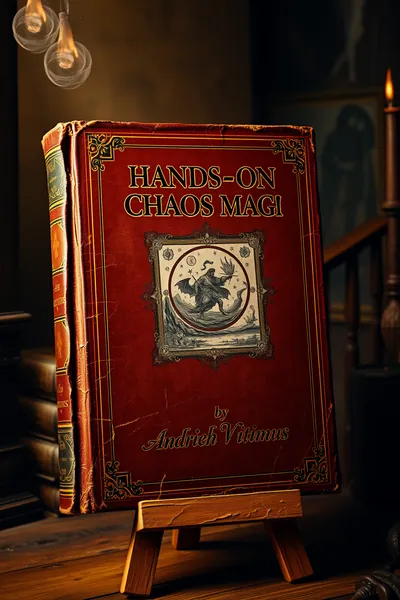
Astrid Rollandson's 2023 book, Chaos Magic, treats belief as a malleable tool for altering reality.
Chaos Magic, by Astrid Rollandson, approaches magical practice outside of fixed, traditional systems. The book argues that belief itself is a flexible instrument, capable of shaping the world through focused intention. Rollandson presents magic not as a secret art but as a human ability anyone can access through experimentation. The work encourages practitioners to question existing doctrines and develop their own operational methods based on effectiveness. This guide is for individuals dissatisfied with the rigid structures of conventional spiritual paths, including established magical groups or religious teachings. It appeals to those desiring a more individual and evidence-based form of spirituality. Readers interested in philosophical thought, hands-on experimentation, and a do-it-yourself attitude in occult studies will find Chaos Magic useful for creating their own unique magical systems. It is especially suitable for those with some prior knowledge of magic who feel limited by current frameworks.
Rollandson's 2023 publication continues the lineage of Chaos Magic, a movement that emerged in the late 20th century. This approach, influenced by figures like Peter J. Carroll and Ray Sherwin, emphasized adaptability, experimentation, and the psychological elements of belief. The book builds on these foundational ideas, providing contemporary views on their application in today's interconnected world. It engages with the history of occultists who valued personal insight over strict adherence to ancient rituals.
Chaos Magic emerged in the late 20th century, particularly in the UK, as a reaction against the perceived rigidity of older magical traditions like ceremonial magic or Wicca. Figures like Peter J. Carroll and Ray Sherwin were central to its development, emphasizing a pragmatic, results-oriented approach. This movement champions the idea that magical results are achieved through the practitioner's belief and intent, rather than adherence to specific, ancient rituals or complex cosmologies. It incorporates ideas from psychology, cybernetics, and quantum physics, viewing belief systems as adaptable paradigms that can be adopted and discarded as needed to achieve specific magical effects. Rollandson's work engages with this lineage, applying its principles to contemporary practice.
💡 Why Read This Book?
• You will learn to treat belief systems as adaptable tools, a concept central to Chaos Magic, allowing you to bypass rigid dogma and experiment with what works for your personal magical goals, as explored in the 'belief as a tool' section. • Discover practical methods for altering consciousness, such as inducing gnosis, a core technique described in the book, to enhance focus and achieve desired magical states without relying on traditional ceremonial frameworks. • Gain the ability to construct your own magical paradigms, moving beyond prescribed rituals to develop personalized practices that reflect your unique worldview and yield tangible results, a key takeaway from the emphasis on self-created systems.
⭐ Reader Reviews
Honest opinions from readers who have explored this book.
❓ Frequently Asked Questions
What is the primary difference between Chaos Magic and traditional magical systems?
Chaos Magic emphasizes flexibility, personal belief, and experimental results over adherence to established traditions or dogmas. Unlike older systems with fixed pantheons and rituals, it allows practitioners to adopt and discard beliefs as tools to achieve specific goals.
Is Chaos Magic suitable for complete beginners with no prior occult experience?
Yes, Astrid Rollandson's *Chaos Magic* is designed as a guide for beginners. It introduces core concepts like sigil magic and gnosis in an accessible manner, encouraging a practical, results-oriented approach rather than requiring extensive prior knowledge.
What is a 'sigil' in the context of Chaos Magic?
A sigil is a symbol created to represent a magical intention. In Chaos Magic, sigils are typically formed by condensing a statement of desire into a unique glyph, which is then charged with energy, often through altered states of consciousness, and forgotten.
How does Chaos Magic view the concept of 'belief'?
Chaos Magic views belief as a psychological tool that can be consciously adopted and manipulated. Instead of seeking absolute truth, practitioners temporarily 'believe' in specific ideas or systems to achieve magical effects, then abandon them when no longer useful.
When was Chaos Magic first developed as a distinct practice?
Chaos Magic emerged as a distinct movement in the United Kingdom during the 1970s. Key figures like Peter J. Carroll and Ray Sherwin were instrumental in articulating its principles, which Astrid Rollandson builds upon in her 2023 publication.
Does Chaos Magic involve specific deities or spirits?
While some practitioners may invoke deities or spirits as part of their personalized systems, Chaos Magic does not mandate it. The focus is on the practitioner's will and belief, meaning deities can be utilized as archetypes or psychological constructs if they serve the magical purpose.
🔮 Key Themes & Symbolism
Belief as a Tool
This work fundamentally reframes belief not as an immutable truth, but as a malleable instrument for magical work. Rollandson argues that the efficacy of a belief lies not in its objective validity, but in its power to influence consciousness and manifest desired outcomes. This pragmatic approach liberates practitioners from the constraints of dogma, encouraging the adoption of temporary belief systems—whether they be religious, mythological, or entirely personal constructs—solely for their utility in magical operations. The book explores how consciously shifting one's belief can directly impact one's reality and internal state.
Sigil Magic and Intent
Sigil magic is presented as a cornerstone technique for focusing intent within Chaos Magic. The process involves condensing a desire or statement of purpose into a unique symbolic form, often derived from alphabetic characters or abstract designs. Rollandson details methods for creating and charging these sigils, emphasizing the importance of reaching an altered state of consciousness, or 'gnosis,' during the charging process. The subsequent 'forgetting' of the sigil is crucial, allowing the subconscious mind to work towards manifestation without conscious interference.
Gnosis and Altered States
Achieving 'gnosis'—a state of heightened awareness or altered consciousness—is central to potent magical practice in Chaos Magic. Rollandson explains that gnosis facilitates the bypassing of the conscious, critical mind, allowing magical intentions to be impressed upon the subconscious more effectively. Various techniques are discussed, ranging from ecstatic movement and sensory deprivation to intense focus or meditative practices. The aim is to disrupt ordinary consciousness, creating a mental state receptive to magical influence and the manifestation of sigils or other workings.
Personal Paradigm Construction
Rejecting conformity, Chaos Magic champions the creation of individual magical systems or 'paradigms.' Rollandson encourages readers to synthesize elements from diverse sources—mythology, science fiction, personal experiences—into a coherent framework that appeals to their unique worldview. This personalized approach ensures that magical practices are deeply relevant and effective for the individual practitioner, moving away from the one-size-fits-all models found in many traditional esoteric paths. The book provides guidance on how to build and refine such personal systems.
💬 Memorable Quotes
Direct passages from the work, attributed to the author.
“Belief is a tool, not a truth.”
— This concise statement captures the pragmatic core of Chaos Magic. It suggests that the power of belief lies in its utility for achieving specific goals, rather than its inherent factual accuracy. Practitioners can therefore adopt and discard beliefs as needed for their magical work.
“The results are what matter, not the dogma.”
— This emphasizes the experimental and results-oriented nature of Chaos Magic. It prioritizes observable effects and practical outcomes over adherence to any particular set of rules or doctrines, encouraging a focus on efficacy in practice.
“Forget the sigil after it is charged.”
— This refers to a key technique in sigil magic, where consciously forgetting the created symbol allows the subconscious to process the intention without the interference of doubt or overthinking, thereby increasing its potential for manifestation.
“Your will is the engine of magic.”
— This highlights the central role of the practitioner's intent and determination in Chaos Magic. Personal will is seen as the primary force that drives magical operations and shapes reality according to the magician's desires.
“Embrace paradox to break limitations.”
— This suggests that confronting and integrating contradictory ideas or concepts can help shatter psychological barriers and rigid thinking patterns, opening new avenues for magical creativity and effectiveness.
🌙 Esoteric Significance
Tradition
Chaos Magic represents a significant departure from established Western esoteric lineages like Hermeticism, Kabbalah, or ceremonial magic. It can be seen as a post-modern interpretation of magick, prioritizing psychological manipulation and subjective experience over adherence to ancient cosmologies or prescribed rites. While it draws inspiration from earlier figures like Austin Osman Spare, its core innovation lies in systematizing the concept of belief as a fluid, operational tool, moving away from the need for a consistent, underlying metaphysical framework.
Symbolism
While Chaos Magic is less reliant on fixed symbolic systems than traditional paths, certain motifs hold significance. The sigil, a personalized glyph representing an intention, is paramount. The 'chaos star' (a symbol associated with Peter J. Carroll) represents the practitioner's will imposing order on chaos. Additionally, practitioners often adopt or create symbols from diverse sources—pop culture, science, personal experiences—infusing them with magical intent, thereby transforming mundane objects or images into potent foci.
Modern Relevance
Chaos Magic remains highly relevant in contemporary esoteric circles, particularly influencing areas like modern witchcraft, digital occultism, and psychological approaches to magic. Thinkers and practitioners exploring meme magic, internet-based rituals, and the application of quantum physics concepts to consciousness draw heavily on its principles. Its emphasis on personal experimentation and adaptability makes it a fertile ground for innovation, resonating with a generation seeking personalized spiritual paths outside traditional institutions.
👥 Who Should Read This Book
• Aspiring practitioners seeking a practical, results-oriented introduction to magic, who are perhaps intimidated by the complexity of traditional systems and prefer a DIY approach. • Individuals disillusioned with dogmatic spiritual paths or established magical orders, looking for a framework that validates personal experimentation and subjective experience. • Skeptics and critical thinkers interested in exploring the psychological and cognitive aspects of belief and consciousness manipulation through a magical lens.
📜 Historical Context
Chaos Magic emerged in the late 1970s and early 1980s, primarily in the UK, as a radical departure from established Western esoteric traditions. Influenced by the work of figures like Austin Osman Spare, Aleister Crowley's magickal philosophy, and cybernetics, it was notably articulated by Peter J. Carroll and Ray Sherwin through their publications and the Illuminates of Thanateros (IOT) group. This movement reacted against what it perceived as the rigid, often dogmatic structures of older magical orders, emphasizing personal gnosis, experimentalism, and the idea that belief itself is a malleable tool. Unlike Hermeticism or ceremonial magic, Chaos Magic rejected adherence to fixed pantheons and complex rituals in favor of adaptable, results-oriented techniques. While not subject to widespread censorship, its unconventional approach and anti-establishment stance positioned it outside mainstream occult discourse, fostering a subculture of independent practitioners and experimentalists. Rollandson's 2023 book continues this legacy, offering contemporary perspectives on these foundational principles.
📔 Journal Prompts
The concept of belief as a tool: Identify a belief you hold that might be hindering your progress and consider how you could temporarily adopt an opposing belief for a specific magical goal.
Sigil creation: Design a sigil for a simple, achievable intention, focusing on condensing the statement and visualizing its form.
Gnosis techniques: Experiment with one method of inducing altered states described in the book, noting the subjective experience and any perceived shifts in awareness.
Personal paradigm elements: List three disparate concepts or symbols from your life that could form the basis of a unique magical paradigm.
Magical laziness: Analyze a ritual or practice you currently perform and identify ways to achieve the same outcome with greater efficiency and less effort.
🗂️ Glossary
Chaos Magic
A contemporary magical practice emphasizing belief as a tool, experimentation, and the creation of personal paradigms rather than adherence to fixed traditions.
Sigil
A symbolic representation of a magical intention, created by condensing a statement of desire into a unique glyph, often charged during an altered state.
Gnosis
An altered state of consciousness, characterized by intense focus or dissociation from ordinary awareness, used to bypass the critical factor and impress magical intentions upon the subconscious.
Belief as a Tool
The core principle in Chaos Magic that any belief system can be temporarily adopted for its practical utility in achieving magical results, irrespective of its objective truth.
Paradigm
A personal magical system or framework constructed by the practitioner, often synthesizing elements from various sources to create a unique approach to magic.
Magical Laziness
An approach that prioritizes efficiency and effectiveness in magical workings, seeking the simplest and most direct methods to achieve desired outcomes.
Will
The focused intent and determination of the practitioner, considered the primary driving force behind magical operations in Chaos Magic.
This book appears in 1 collection
🔮 Readers Also Liked
Browse all →







From the “Chaos Magic” Collection
View all →







More Free Magic & Ritual Books
View all →