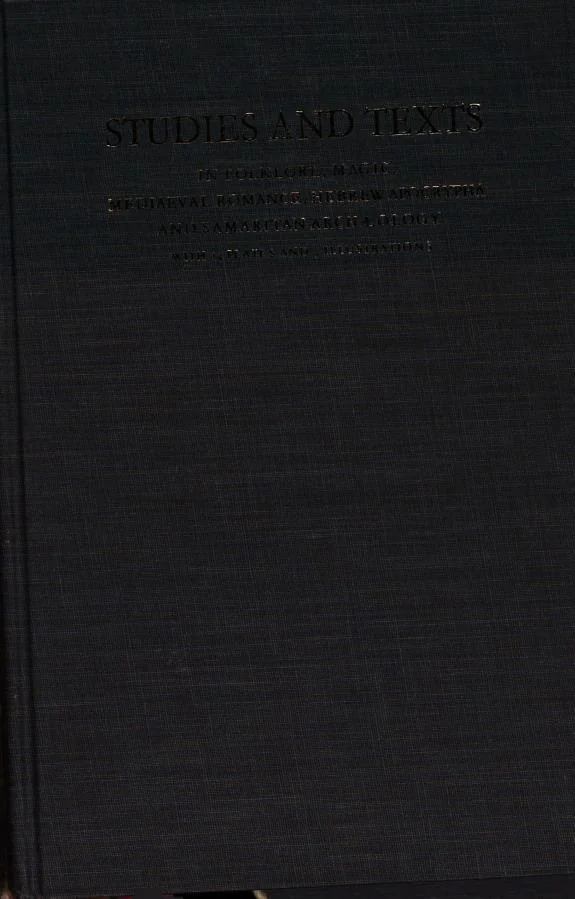
Studies and Texts in Folklore, Magic, Mediaeval Romance, Hebrew Apocrypha, and Samaritan Archaeology
 75
75

Studies and Texts in Folklore, Magic, Mediaeval Romance, Hebrew Apocrypha, and Samaritan Archaeology
Moses Gaster’s compendium, *Studies and Texts in Folklore, Magic, Mediaeval Romance, Hebrew Apocrypha, and Samaritan Archaeology*, presents a formidable assemblage of scholarly material. Its strength lies in the sheer breadth and depth of Gaster’s research, bringing together disparate fields under one academic roof. The sections on the Hebrew Apocrypha and Samaritan texts, in particular, offer access to material that remains foundational for specialists. However, the collection's academic density can be a barrier; it is a work for dedicated study rather than casual perusal. The 1971 publication date means the scholarship, while rigorous, reflects the perspectives and methodologies of its time. A specific passage detailing the variants in the Samaritan Pentateuch, for instance, highlights the meticulous textual work involved but requires significant reader investment. This book is an invaluable resource for specialists, though its accessibility for a general audience is limited.
📝 Description
75
Moses Gaster's 1971 compilation gathers studies on folklore, magic, medieval romance, Hebrew apocrypha, and Samaritan archaeology.
This volume assembles scholarly articles on a range of esoteric and historical subjects. It brings together research from fields including folklore, occult practices, medieval romance, ancient Hebrew texts, and Samaritan archaeological findings. The collection presents detailed analyses and textual examinations, granting readers access to primary source material alongside critical commentary. It functions as a compendium of research rather than a narrative.
The work is suited for serious students and researchers interested in comparative religion, folklore, occult history, and textual criticism. Scholars focused on the transmission of esoteric knowledge across different cultures and historical eras will find particular value here. It appeals to those who appreciate careful scholarship and are prepared to engage with complex, often archaic, material. The book best fits individuals with a background in humanities research or a focused interest in its specific topics.
Published in 1971, this collection reflects mid-20th-century academic interest in occult and historical subjects, drawing on scholarship that often predates its release. It follows a tradition of textual scholarship influenced by figures like Gershom Scholem, who advanced the academic study of Kabbalah and Jewish mysticism. This era saw a rise in academic attention to previously overlooked areas of religious and cultural history, moving beyond purely theological or strictly historical accounts to examine belief and ritual as lived experiences.
💡 Why Read This Book?
• Gain direct exposure to primary texts from the Hebrew Apocrypha, allowing for independent analysis of ancient religious literature beyond canonical scriptures. • Understand the specific scholarly debates surrounding Samaritan traditions and archaeology as presented in the mid-20th century, offering a distinct historical perspective. • Explore how Gaster connects seemingly disparate fields like medieval romance and folk magic, revealing interdisciplinary approaches to cultural studies from his era.
⭐ Reader Reviews
Honest opinions from readers who have explored this book.
❓ Frequently Asked Questions
What is the significance of the Hebrew Apocrypha discussed in Gaster's book?
The Hebrew Apocrypha refers to ancient Jewish texts not included in the standard Hebrew Bible. Gaster's work provides scholarly analysis and textual explorations of these significant writings, illuminating diverse aspects of ancient Jewish religious thought and literature.
Who were the Samaritans as presented in this study?
The book examines the Samaritans, an ethnoreligious group with ancient origins, focusing on their unique traditions and archaeological findings. It sheds light on their distinct religious practices and historical development, separate from mainstream Judaism and Christianity.
What kind of folklore does Moses Gaster analyze?
Gaster's work touches upon various aspects of folklore, examining its transmission and symbolic meanings within cultural contexts. The book treats folklore not just as stories but as vital elements of societal beliefs and practices.
Is this book suitable for beginners interested in magic?
While the book includes discussions on magic, it does so from a historical and scholarly perspective rather than as a practical guide. Beginners seeking introductory material on magical practices might find it dense; it is more suited for academic study.
What is the historical period covered by the medieval romance sections?
The medieval romance sections typically cover literature from the European Middle Ages, exploring narrative structures, cultural values, and themes prevalent in that era. Gaster uses these texts to understand broader cultural currents.
When was the original publication of Moses Gaster's collected works?
The collection of Moses Gaster's studies was first published in 1971, bringing together his extensive research across various academic disciplines and esoteric subjects.
🔮 Key Themes & Symbolism
Hebrew Apocrypha Texts
This collection offers deep dives into the Hebrew Apocrypha, a corpus of ancient Jewish writings crucial for understanding Second Temple Judaism and the broader context of early Christianity. Gaster's meticulous analysis provides scholars with critical examinations of these texts, often considered apocryphal by later traditions. The work explores their theological content, literary styles, and historical significance, revealing layers of esoteric thought and narrative that shaped religious discourse.
Samaritan Traditions and Archaeology
Gaster’s research extensively covers Samaritan traditions and archaeological findings, positioning the Samaritans as a distinct and ancient ethnoreligious community. The book explores their unique scriptural interpretations, religious practices, and historical narrative, offering a counterpoint to mainstream Jewish and Christian histories. This section is vital for understanding minority religious groups and their preservation of ancient lore and identity.
Folklore and Cultural Transmission
The volume treats folklore not merely as quaint stories but as carriers of cultural memory, belief systems, and symbolic language. Gaster examines how folk traditions are transmitted across generations and geographical boundaries, often revealing underlying esoteric motifs or shared human experiences. This perspective highlights the scholarly approach to understanding the organic development and enduring power of popular beliefs and narratives.
The Study of Magic Historically
Magic is approached as a subject of serious historical and anthropological inquiry. Gaster's work analyzes magical practices and beliefs within their specific cultural and historical contexts, avoiding sensationalism. The focus is on understanding the function of magic in societies, its relationship to religion, and the evolution of magical thought and its practitioners throughout history.
💬 Memorable Quotes
Direct passages from the work, attributed to the author.
“The Samaritan Chronicle II preserves traditions concerning the Tabernacle and the Temple.”
— This highlights the book's focus on textual evidence for understanding ancient religious practices and historical narratives from groups like the Samaritans, emphasizing their unique continuities and divergences.
“The Book of Enoch contains apocalyptic visions and cosmological descriptions.”
— This points to the inclusion and analysis of significant apocryphal texts, showcasing their role in early Jewish and Christian thought, particularly concerning eschatology and divine revelation.
“Folklore motifs often reveal a shared substratum of human imagination across cultures.”
— This interpretation emphasizes Gaster's view of folklore as a universal language of symbolism and narrative, suggesting an underlying connection in the collective human psyche that transcends specific traditions.
“Medieval romances frequently encode social hierarchies and chivalric ideals.”
— This interpretation focuses on the analytical approach to medieval literature, viewing romantic tales not just as stories but as reflections of societal structures, values, and aspirations of their time.
“The study of ancient amulets provides insight into popular magic and belief.”
— This interpretation underscores the book's engagement with material culture as evidence for understanding magical practices and the everyday beliefs of people in antiquity.
🌙 Esoteric Significance
Tradition
This work fits within the broad tradition of Western Esotericism, particularly its scholarly engagement with Jewish mysticism, Gnosticism, and folklore. While Gaster's approach is primarily academic and textual, his focus on texts like the Hebrew Apocrypha and the analysis of magical practices touches upon themes central to Kabbalistic and Hermetic thought. The book serves as a bridge, offering rigorous academic scrutiny to subjects often relegated to the fringes of mainstream religious and intellectual history.
Symbolism
Key symbolic motifs include the Tetragrammaton (though implicitly, through discussion of Samaritan traditions related to the Divine Name) and various apocalyptic imagery found in the Apocrypha. The Samaritan Pentateuch itself, as a variant textual tradition, symbolizes a divergent yet connected path of ancient Israelite religion. The analysis of amulets and folk charms points to symbols used for protection and influence in daily life, representing a more immanent form of esoteric practice.
Modern Relevance
Contemporary scholars of esoteric traditions, comparative religion, and folklore continue to reference Gaster's foundational work. Researchers exploring the history of Jewish mysticism, the development of early Christian texts, and the cultural significance of Samaritanism find his textual analyses indispensable. Modern practitioners of Western Esotericism may also engage with this work to understand the historical roots and textual lineages of certain magical and mystical concepts.
👥 Who Should Read This Book
• Advanced students of comparative religion and ancient Near Eastern studies seeking foundational texts on the Hebrew Apocrypha and Samaritan traditions. • Researchers in folklore and cultural history interested in Gaster's methodical approach to analyzing narrative transmission and symbolic meaning. • Scholars of Western Esotericism investigating the historical underpinnings of magical practices and mystical literature from a rigorous academic standpoint.
📜 Historical Context
Published in 1971, *Studies and Texts* emerged during a period of burgeoning academic interest in previously marginalized fields of study, including folklore, occult history, and comparative religion. This era saw scholars like Gershom Scholem revitalizing the academic study of Jewish mysticism and related traditions, creating a climate where works like Gaster's could find an audience. The book's approach reflects mid-20th-century scholarship, characterized by meticulous textual analysis and a desire to contextualize esoteric beliefs within broader historical and cultural frameworks. While Gaster's research often predates the 1971 publication, its compilation speaks to the ongoing relevance of his findings. Contemporary scholars of the time, such as Mircea Eliade, were also exploring the phenomenology of religion and myth, contributing to a wider academic acceptance of studying magical and folkloric phenomena seriously.
📔 Journal Prompts
The Samaritan Pentateuch’s textual variations, how do they illuminate distinct religious development?
Reflect on the concept of 'folklore' as presented by Gaster, considering its role in cultural continuity.
Analyze the significance of apocalyptic visions within the Hebrew Apocrypha studied here.
Consider the historical context of magic as a practice examined in this volume.
Explore the relationship between medieval romance narratives and their socio-historical settings.
🗂️ Glossary
Hebrew Apocrypha
A collection of ancient Jewish religious writings not included in the Hebrew Bible (Tanakh) but present in some Christian canons (often called Deuterocanonical). These texts offer insights into Second Temple Judaism.
Samaritan Archaeology
The study of material remains related to the Samaritans, an ethnoreligious group with ancient roots, focusing on their settlements, artifacts, and religious sites.
Mediaeval Romance
A genre of prose or verse narrative popular in medieval Europe, typically focusing on chivalric adventures, courtly love, and heroic deeds.
Folklore
The traditional beliefs, customs, and stories of a community, passed through the generations by word of mouth, practice, or art.
Magic
The practice of invoking supernatural powers, often through rituals or spells, to influence events or people. Gaster examines it historically.
Textual Criticism
The analysis and comparison of textual variations to establish the most authentic or original version of a written work.
Apocalypse
A genre of revelatory literature, often featuring symbolic imagery, divine revelation, and prophecies concerning the end times or cosmic events.
This book appears in 1 collection
🔮 Readers Also Liked
Browse all →








From the “Folklore Magic” Collection
View all →


More Free Magic & Ritual Books
View all →