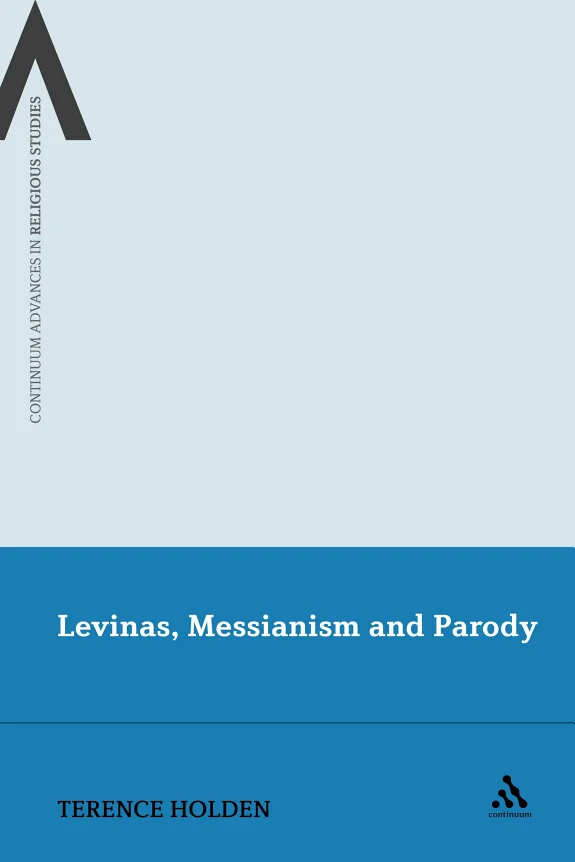
Levinas, Messianism and Parody
 75
75

Levinas, Messianism and Parody
Holden’s "Levinas, Messianism and Parody" offers a sharp, if demanding, dissection of how messianic thought permeates Continental philosophy. By focusing intently on Levinas, the book achieves a rare clarity regarding the philosophical architecture of messianism. Holden is particularly adept at unpacking the ethical implications of messianic expectation, as seen in his analysis of Levinas’s concept of the "trace" of the Other. The work’s strength lies in its systematic approach, refusing easy answers and instead meticulously tracing philosophical arguments. A limitation, however, is the book's dense prose, which can make extended passages feel like an academic exercise rather than an accessible exploration. The detailed examination of Levinas's "Otherwise than Being or Beyond Essence" provides a compelling instance of how messianic undertones shape philosophical discourse. It is an essential text for specialists, offering a precise philosophical lens on a complex tradition.
📝 Description
75
Terence Holden's 2011 book examines messianism through Emmanuel Levinas's philosophy.
Published in 2011, Terence Holden's "Levinas, Messianism and Parody" offers a detailed philosophical examination of messianism, using Emmanuel Levinas's work as a central case study. The book aims to clarify the philosophical underpinnings of messianic thought, moving beyond purely religious or historical interpretations. Holden investigates how messianic ideas operate within complex philosophical systems that address ethics, the concept of the Other, and the divine.
This study is primarily for advanced philosophy students and scholars, particularly those focused on post-war French thought, phenomenology, and ethics. It will also interest readers investigating the intersection of theology and philosophy, especially the writings of Emmanuel Levinas. Those exploring 20th-century philosophical currents of messianism will find a thorough, non-polemical analysis.
This work engages with a specific strain of 20th-century Continental philosophy that sought to re-examine traditional theological concepts through secular philosophical lenses. It appears within a period of renewed interest in the "theological turn" in French thought, building on figures like Jean-Luc Marion and the ongoing reception of Levinas. Holden's approach connects to broader inquiries into Jewish mysticism and messianic traditions, as seen in the work of Gershom Scholem, by seeking a precise philosophical articulation of these ideas, separate from purely historical or devotional interpretations. It situates these concepts within a framework concerned with hope and redemption.
💡 Why Read This Book?
• Gain a precise understanding of how messianism functions as a philosophical concept, not just a religious one, by analyzing its treatment in Emmanuel Levinas's work, as detailed in Holden's examination of "philosophical intelligibility." • Explore the ethical dimensions of messianic thought through the lens of Levinas's concept of the "Other," learning how the expectation of redemption is tied to our responsibility to the other person. • Appreciate the critical use of "parody" as a philosophical method, understanding how Holden employs it to reveal underlying structures and tensions within Continental philosophy, referencing his analysis of the subject in the early 21st century.
⭐ Reader Reviews
Honest opinions from readers who have explored this book.
❓ Frequently Asked Questions
What is the primary focus of Holden's "Levinas, Messianism and Parody"?
The book focuses on analyzing the concept of 'messianism' within Continental philosophy, using Emmanuel Levinas's ethical and metaphysical writings as a central case study to understand its philosophical underpinnings.
When was "Levinas, Messianism and Parody" first published?
Terence Holden's "Levinas, Messianism and Parody" was first published on September 22, 2011.
Who is the central philosopher examined in this book?
The central philosopher examined is Emmanuel Levinas, a key figure in 20th-century French philosophy known for his work on ethics and the Other.
What philosophical movement or tradition does this book engage with?
The book engages with Continental philosophy, specifically phenomenology and post-war French thought, exploring themes related to ethics, metaphysics, and theology.
What does the term 'parody' signify in the context of Holden's work?
In Holden's work, 'parody' is used as a critical philosophical tool to expose, analyze, and understand the underlying logic or deviations within messianic themes in philosophical discourse.
What is the main goal of analyzing messianism through Levinas?
The main goal is to uncover the 'philosophical intelligibility' of messianism, demonstrating how it can be understood as a structural element within philosophy, beyond purely religious or historical interpretations.
🔮 Key Themes & Symbolism
Messianism as Philosophical Structure
Holden reframes messianism not solely as a theological concept but as a potent philosophical structure. The work meticulously unpacks how messianic ideas—concerning redemption, absolute justice, and future orientation—operate within the logical frameworks of thinkers like Levinas. It argues that these structures are integral to philosophical discourse, shaping ethical imperatives and metaphysical inquiries. By examining the 'philosophical intelligibility' of messianism, Holden seeks to reveal its pervasive influence on Western thought, particularly in the post-war era.
The Ethical Significance of the Other
Central to the book's analysis is Emmanuel Levinas's concept of the 'Other.' Holden explores how messianic expectation is intrinsically linked to ethical responsibility towards the Other. This connection suggests that the anticipation of a redemptive future is not abstract but is grounded in the immediate ethical encounter with the face of another person. The work investigates how this ethical imperative, deeply rooted in Levinas's philosophy, finds expression and resonance within messianic thought.
Parody as Critical Method
The concept of 'parody' is employed by Holden not for humor, but as a sophisticated analytical tool. It serves to highlight and critique the ways in which messianic themes are adopted, adapted, or even distorted within philosophical arguments. By analyzing these 'parodic' instances, the book aims to expose the underlying assumptions, internal tensions, and philosophical stakes involved in discussing messianic ideas. This method allows for a critical engagement with the very intelligibility of messianism in secular philosophy.
Intelligibility Beyond Theology
A core objective of the book is to demonstrate the 'philosophical intelligibility' of messianism. Holden argues that these concepts can be understood and analyzed within the parameters of secular philosophy, independent of specific religious dogma. This approach seeks to bridge the perceived gap between theological discourse and philosophical inquiry, showing how ideas like redemption and the absolute can be articulated and examined through rigorous philosophical methods, particularly within the context of 20th-century French thought.
💬 Memorable Quotes
Direct passages from the work, attributed to the author.
“Messianism functions as a philosophical structure concerning hope and redemption.”
— This interpretation highlights Holden's central argument that messianic ideas possess a philosophical logic and architecture that can be analyzed within secular thought, independent of their theological origins.
“Parody reveals the underlying philosophical intelligibility of messianic themes.”
— This interpretation captures Holden's methodological use of parody as a critical lens to expose how messianic concepts are employed and understood within philosophical arguments, clear their deeper structures.
“The work seeks the philosophical intelligibility of messianism.”
— This statement expresses the book's primary goal: to demonstrate that concepts associated with messianism can be rigorously analyzed and understood through philosophical inquiry, moving beyond purely religious or historical contexts.
“Levinas's philosophy serves as a key case study for messianic analysis.”
— This highlights the specific focus on Emmanuel Levinas, indicating that his unique contributions to ethics and metaphysics provide a crucial framework for understanding the philosophical dimensions of messianism.
💡 Key Ideas
Editorial paraphrase of the work's core concepts — not direct quotes.
The ethical demand of the Other is tied to messianic expectation.
This paraphrased concept emphasizes the Levinasian link between our responsibility to other individuals and the anticipation of a future redemptive state, suggesting a profound ethical core to messianic thought.
🌙 Esoteric Significance
Tradition
While not explicitly belonging to a single esoteric lineage, Holden's work intersects with traditions that emphasize immanent redemption and ethical transformation. It draws parallels with Gnostic thought's focus on overcoming worldly structures for a higher state and Kabbalistic concepts of Tikkun Olam (repair of the world), particularly in its ethical implications. The book's exploration of messianism as a philosophical structure can be seen as a modern attempt to articulate enduring themes of hope and transformation within a secularized intellectual framework, echoing ancient esoteric quests for meaning and liberation.
Symbolism
The concept of the 'Other,' central to Levinas and Holden's analysis, functions as a profound symbol. It represents the irreducible alterity of the human subject, a point of ethical encounter that can be interpreted esoterically as the divine spark within each individual or the gateway to higher consciousness. 'Messianism' itself symbolizes the potential for radical transformation and the arrival of a perfected state, a theme recurrent in many esoteric traditions' narratives of apocalypse and renewal. The 'trace' of the Other can be understood as an esoteric signifier, an indirect mark of the sacred or the absolute within the mundane.
Modern Relevance
Contemporary thinkers exploring the philosophy of religion, post-structuralist ethics, and critical theory continue to draw on Holden's rigorous analysis. His work is relevant to scholars investigating the ethical turn in philosophy and those seeking to understand the persistent influence of theological concepts in secular thought. Practices within some modern esoteric movements that focus on social justice, intersubjectivity, and the ethical imperative for collective transformation may find resonance with the ideas presented, particularly the intersection of messianic hope and concrete ethical action.
👥 Who Should Read This Book
• Advanced philosophy students and scholars focusing on Emmanuel Levinas, phenomenology, or Continental philosophy, who seek a deep dive into the philosophical underpinnings of messianic thought. • Researchers in comparative religion and theology interested in how theological concepts are secularized and reinterpreted within philosophical discourse, particularly concerning concepts of redemption and eschatology. • Intellectual historians studying 20th-century French thought and the 'theological turn,' seeking to understand the specific ways messianism structured philosophical arguments during that era.
📜 Historical Context
Published in 2011, "Levinas, Messianism and Parody" emerged during a period of renewed interest in the theological turn within Continental philosophy. This intellectual current, influenced by thinkers like Jean-Luc Marion and the ongoing scholarly engagement with Emmanuel Levinas, sought to re-evaluate the role of theological concepts in secular philosophical discourse. Holden's work fits within this trend by meticulously dissecting the philosophical intelligibility of messianism, moving beyond purely religious interpretations. It engages with the legacy of scholars like Gershom Scholem, whose work on Jewish mysticism provided foundational historical context for messianic studies, but shifts the focus to philosophical structure. While not directly engaging in polemics with specific competing schools, the book implicitly addresses a tendency to either dismiss messianism as purely theological or to oversimplify its philosophical implications. The reception within academic circles, while not marked by major public events, positioned it as a significant contribution to Levinasian studies and the philosophy of religion.
📔 Journal Prompts
Levinas's concept of the Other and its connection to messianic themes.
The function of 'parody' as a critical philosophical tool in analyzing messianism.
How does the search for 'philosophical intelligibility' shape the understanding of messianic ideas?
Reflect on the ethical implications of messianic expectation as presented through Levinas.
The structural role of messianism in Continental philosophy, beyond religious doctrine.
🗂️ Glossary
Messianism
In this context, refers to philosophical and theological concepts related to a future redeemer or a redemptive era, analyzed for its structural role in thought rather than solely its religious dogma.
Continental Philosophy
A broad tradition of philosophy originating in mainland Europe in the 19th and 20th centuries, encompassing movements like phenomenology, existentialism, and post-structuralism.
Emmanuel Levinas
A Lithuanian-born French philosopher whose work is central to contemporary ethics and Jewish philosophy, known for his concept of the Other.
Philosophical Intelligibility
The quality of being understandable and rationally coherent within the framework of philosophical inquiry, as applied by Holden to the concept of messianism.
The Other
A key Levinasian concept denoting the irreducible subjectivity and alterity of another person, fundamentally encountered as an ethical demand.
Parody (as philosophical method)
Used by Holden not as mockery, but as a critical technique to analyze the structure, logic, and potential distortions of concepts like messianism within philosophical discourse.
Theological Turn
A movement in late 20th and early 21st-century Continental philosophy that re-engaged with theological concepts and traditions within secular philosophical frameworks.
This book appears in 1 collection
🔮 Readers Also Liked
Browse all →









From the “Messianism” Collection
View all →








More Free Sacred Texts & Gnosticism Books
View all →