I Ching
 74
74

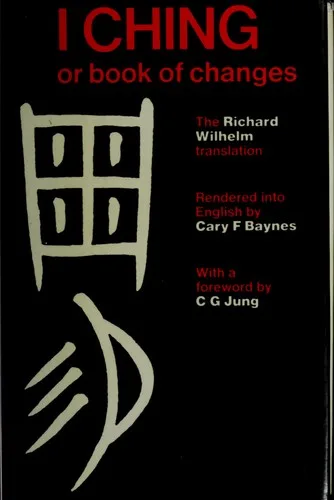
I Ching



Isolde Whitaker, Sacred Texts Editor: Richard Wilhelm's I Ching is an indispensable cornerstone for any serious student of Eastern mysticism and esoteric philosophy. This rendition transcends simple translation, offering a deeply resonant exegesis that captures the profound spiritual and psychological depth of the original work. Wilhelm's scholarly yet accessible prose illuminates the complex symbolism and philosophical underpinnings, making the I Ching's oracular power palpable. It is an essential guide for those seeking to understand the intricate dance of yin and yang, the principles of cosmic harmony, and the practical application of ancient wisdom for personal transformation. A truly masterful presentation.
📝 Description
74
Richard Wilhelm's 1924 German translation of the I Ching remains a key English edition.
Richard Wilhelm's translation of the I Ching, or 'Book of Changes,' presents this ancient Chinese text as more than a divination system. It functions as a guide to understanding the patterns of change in the cosmos and human life. The book details sixty-four hexagrams, each formed by six lines, which represent fundamental archetypes and universal forces. Wilhelm's work includes his interpretations of the lines and trigrams, offering insights that have influenced thinkers for centuries.
This edition brings to life the philosophical dialogues and terse pronouncements within the I Ching. It shows the text as a source for understanding the Tao, the cyclical nature of time, and how to align oneself with natural processes. Readers can find guidance for personal reflection and a framework for observing the larger currents of destiny. The translation aims to reveal the deeper wisdom contained within this foundational text.
The I Ching is a central text in Chinese cosmology and philosophy, with a history stretching back over two millennia. It was traditionally used for divination and understanding the forces of change. Wilhelm's translation introduced this complex system to a Western audience, framing it within a broader philosophical and esoteric context. It connects the text's principles to concepts like the Tao and archetypal forces, making it accessible to those interested in comparative religion and esoteric traditions.
💡 Why Read This Book?
For those who seek to understand the fundamental forces shaping reality, the I Ching offers unparalleled insight. Read this book to gain a profound understanding of cyclical change, develop intuitive wisdom, and learn to navigate life's challenges with clarity and foresight. It is an essential text for practitioners of divination, students of Chinese philosophy, and anyone yearning for a deeper connection to universal patterns.
⭐ Reader Reviews
Honest opinions from readers who have explored this book.
❓ Frequently Asked Questions
What is the I Ching?
The I Ching, or 'Book of Changes,' is an ancient Chinese divination text and philosophical classic. It comprises 64 hexagrams, each formed by six lines, representing fundamental archetypes and situations encountered in life.
Who was Richard Wilhelm?
Richard Wilhelm was a German sinologist and scholar renowned for his translations of Chinese classics, most notably the I Ching. His work is celebrated for its depth, accuracy, and preservation of the original spirit.
How is the I Ching used for divination?
Divination is performed by casting coins or yarrow stalks to generate hexagrams, which are then interpreted using the text's commentary to offer guidance on specific questions or situations.
What is the philosophical significance of the I Ching?
Philosophically, the I Ching explores themes of change, balance (yin and yang), harmony with nature, the cyclical nature of existence, and the importance of mindful action in accordance with cosmic principles.
Is the I Ching only for divination?
While widely used for divination, the I Ching is also a profound philosophical and ethical text, offering insights into human nature, governance, and the art of living wisely.
🔮 Key Themes & Symbolism
The Principle of Change
Fundamentally, the I Ching is a proof of the immutable nature of flux. It posits that all phenomena are in a constant state of transformation, influenced by the interplay of complementary forces. Understanding and embracing this principle allows one to navigate life's vicissitudes with equanimity and wisdom, recognizing that challenges are temporary and opportunities lie within every shift. This theme encourages a flexible and adaptable approach to existence, fostering resilience and inner peace.
The Dance of Yin and Yang
The fundamental duality of Yin (passive, receptive, feminine) and Yang (active, creative, masculine) is the engine of all change within the I Ching. Their dynamic interplay, a constant push and pull, generates the sixty-four hexagrams and all of existence. This theme highlights the interconnectedness and interdependence of seemingly opposing forces, revealing that true harmony arises not from their elimination, but from their balanced and dynamic union. It offers a profound lens for understanding relationships and natural processes.
Cosmic Harmony and Human Action
The I Ching serves as a guide to aligning human actions with the natural order of the cosmos. It teaches that by understanding the underlying patterns of change and the interplay of Yin and Yang, individuals can make choices that foster harmony and prosperity. This involves acting with intention, awareness, and a deep respect for the Tao, the ultimate principle of the universe. The text provides wisdom for ethical conduct, effective leadership, and personal cultivation, emphasizing the lasting impact of mindful decisions.
💬 Memorable Quotes
Direct passages from the work, attributed to the author.
“When the seasons change, the dragon and the tiger, which are the symbols of Yin and Yang, are in motion.”
— This poetic line illustrates the fundamental forces of Yin and Yang as active agents driving the cyclical transformations of nature, from the smallest moments to the grandest shifts.
“What is called the Great Whole is the whole of the world.”
— This profound statement points to the interconnectedness of all things, suggesting that the universe is a unified, integrated system where every part reflects the entirety.
“The Book of Changes is not a mere manual of divination, but rather a book of wisdom.”
— This highlights the I Ching's dual nature, asserting that its true value lies not just in predicting the future, but in providing profound philosophical guidance for living a meaningful life.
💡 Key Ideas
Editorial paraphrase of the work's core concepts — not direct quotes.
The superior man understands the changes of the days.
This quote emphasizes the importance of awareness and foresight, suggesting that wise individuals are attuned to the natural progression of events and adapt their actions accordingly.
Everything that happens is a part of the Great Whole.
Reinforcing the theme of cosmic unity, this quote underscores that no event is isolated; all occurrences are integral components of the universal collection.
🌙 Esoteric Significance
Tradition
The I Ching is a foundational text within the esoteric traditions of Taoism and ancient Chinese mysticism. It represents a sophisticated system of understanding the universe as a dynamic, interconnected web of energies, governed by principles of change and balance. Its practice is deeply rooted in the contemplative observation of natural cycles and the cultivation of inner harmony, aligning the individual with the Tao, the ultimate cosmic order.
Symbolism
The core symbolism of the I Ching lies in its hexagrams, each composed of six lines representing Yin (broken) and Yang (unbroken). These sixty-four hexagrams are archetypal representations of all possible situations and states of being. The trigrams, formed by three lines, further break down these archetypes into elemental forces (Heaven, Earth, Thunder, Water, Mountain, Wind, Fire, Lake), creating a rich symbolic language for interpreting cosmic and personal dynamics.
Modern Relevance
In the modern era, the I Ching's relevance endures as a profound tool for self-reflection, decision-making, and spiritual growth. Its emphasis on adaptability, understanding cyclical patterns, and acting in harmony with natural forces offers invaluable guidance in our rapidly changing world. It provides a framework for navigating personal challenges, fostering creativity, and developing a more intuitive and balanced approach to life, connecting contemporary seekers with timeless wisdom.
👥 Who Should Read This Book
The I Ching, in Richard Wilhelm's translation, is a treasure for a diverse readership. **Beginners** seeking an introduction to ancient Eastern wisdom will find a profound yet accessible entry point into philosophical thought and divination. **Scholars** of Chinese philosophy, religion, and linguistics will appreciate the meticulous scholarship and nuanced interpretations. **Seekers** of spiritual guidance and self-understanding will discover a powerful oracle for introspection and personal growth. **Practitioners** of divination and esoteric arts will find an indispensable resource for deepening their practice and expanding their interpretive skills.
📜 Historical Context
The I Ching, or 'Book of Changes,' emerged from ancient Chinese shamanistic traditions and early philosophical inquiry, with its core text dating back to the Zhou Dynasty (c. 1046–256 BCE). Initially used for divination by royalty and priests, it gradually evolved into a profound philosophical and ethical treatise, deeply influencing Confucianism and Taoism. Its ideas on change, balance, and cosmic order resonated through centuries of Chinese history, shaping governance, personal conduct, and spiritual practices. Richard Wilhelm's 20th-century translation brought this ancient wisdom to the Western world, interpreting its esoteric layers for a new audience, thereby bridging millennia of cultural and intellectual exchange.
📔 Journal Prompts
Reflect on a recent significant change in your life. How might the principles of Yin and Yang be at play in this transformation?
Consider a decision you are currently facing. How would consulting the I Ching's archetypes inform your perspective?
What does 'cosmic harmony' mean to you in your daily life? How can you cultivate it more consciously?
Explore the concept of 'change' as a constant. What fears or opportunities does this realization present?
How can the wisdom of the I Ching help you to act with greater intention and awareness in your relationships?
🗂️ Glossary
Hexagram
A symbol in the I Ching composed of six stacked horizontal lines, each either solid (Yang) or broken (Yin), representing a complex situation or archetype.
Trigram
A foundational symbol of the I Ching consisting of three lines, which are combined in pairs to form hexagrams. There are eight primary trigrams representing elemental forces.
Yin
The passive, receptive, dark, and feminine principle in Chinese philosophy, often associated with the moon, earth, and water.
Yang
The active, creative, light, and masculine principle in Chinese philosophy, often associated with the sun, heaven, and fire.
Tao (Dao)
The fundamental principle of the universe in Taoism; the 'Way' or the natural order of things, which is ineffable and guides all existence.
This book appears in 3 collections
🔮 Readers Also Liked
Browse all →









More by Richard Wilhelm
All books →





From the “Tarot” Collection
View all →






More Free Divination & Tarot Books
View all →