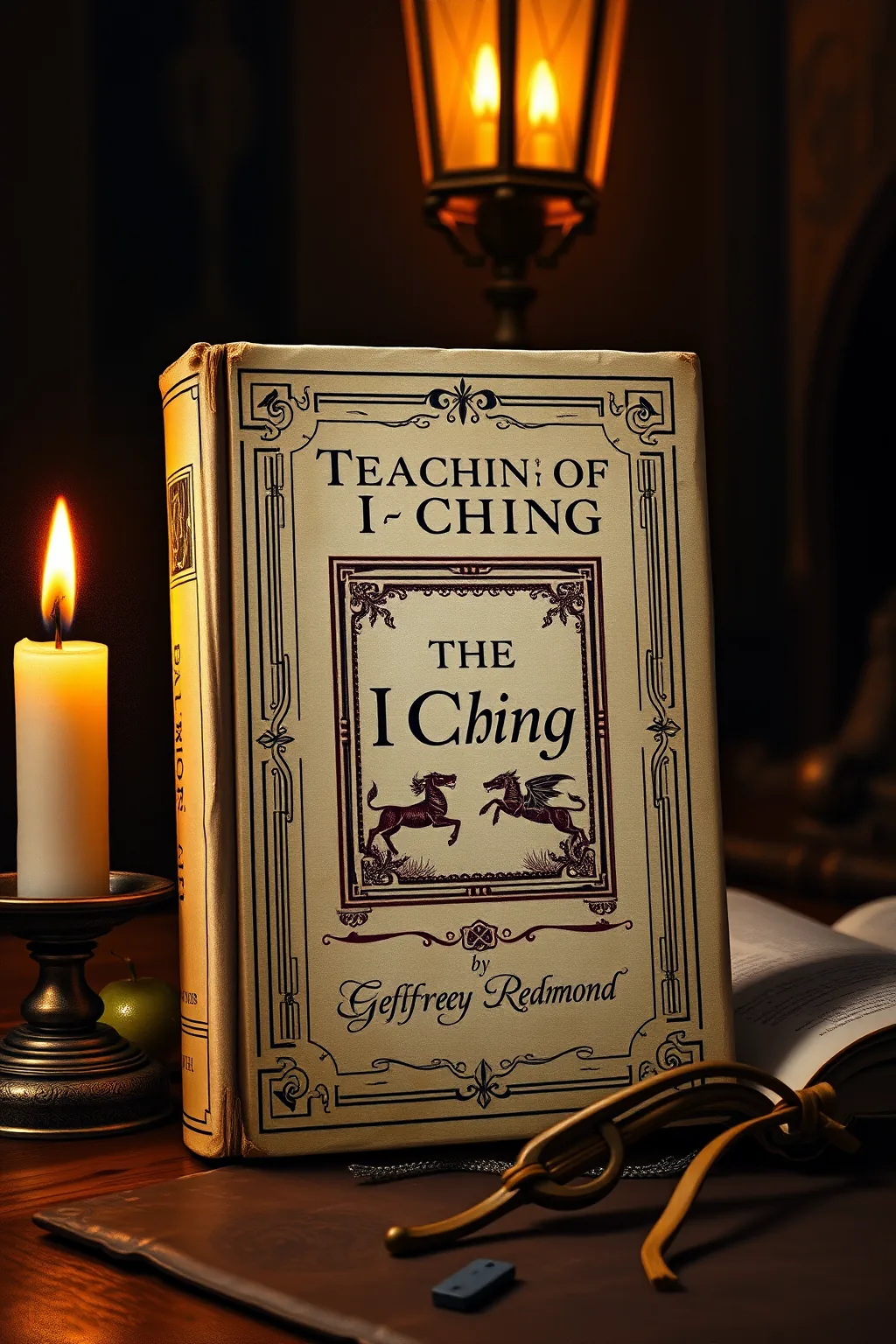
Teaching the I Ching (Book of Changes)
 61
61

Teaching the I Ching (Book of Changes)



Alaric Kestrel, reviewing for Metaphysical Studies Reviewer, hails Geoffrey Redmond's 'Teaching the I Ching' as a monumental contribution to the field of divinatory arts. Redmond's approach is both scholarly and deeply intuitive, demystifying the complex structure of the I Ching while preserving its profound esoteric essence. He masterfully guides readers through the symbolic language of the hexagrams, revealing their deep philosophical significance and practical applications for self-understanding and life navigation. This work is indispensable for serious practitioners and students of Eastern mysticism seeking to move beyond superficial interpretations. Its clarity and depth make it a cornerstone for anyone wishing to engage authentically with this ancient oracle.
📝 Description
61
Geoffrey Redmond's 'Teaching the I Ching' (1997) explains the Book of Changes beyond simple fortune-telling.
Geoffrey Redmond's 1997 book, 'Teaching the I Ching,' approaches the ancient Chinese text not as a tool for divination alone, but as a system of philosophy and self-cultivation. Redmond breaks down the hexagrams, explaining their symbolic meanings and philosophical foundations. The text discusses the interplay of Yin and Yang, presenting them as fundamental forces that can be understood to gain insight.
This guide is intended for those seriously interested in esoteric studies. It aims to help readers grasp the cyclical patterns of existence, develop intuition, and find ways to live more harmoniously. The book invites readers to engage with the I Ching as a source of guidance, drawing parallels between its ancient teachings and the challenges faced by people today. It encourages a deeper awareness of consciousness and connection to broader patterns.
The I Ching, or Book of Changes, is a core text in Chinese philosophy and has been used for divination and wisdom for over three millennia. Its philosophical development is linked to Taoism and Confucianism, influencing East Asian thought significantly. The text's structure, based on 64 hexagrams formed by combinations of six lines (solid Yang or broken Yin), provides a framework for understanding cosmic processes and human affairs. Many esoteric traditions have adapted or studied the I Ching, seeing it as a map of universal principles and a method for aligning oneself with natural cycles.
💡 Why Read This Book?
Unlock the secrets of the 3,000-year-old Book of Changes with Geoffrey Redmond's insightful 'Teaching the I Ching.' This book offers a profound exploration of divination as a philosophical tool for self-discovery and wisdom. Ideal for spiritual seekers, esoteric scholars, and practitioners of ancient arts who desire a deeper, more nuanced understanding of life's ebb and flow.
⭐ Reader Reviews
Honest opinions from readers who have explored this book.
❓ Frequently Asked Questions
What is the I Ching?
The I Ching, or Book of Changes, is an ancient Chinese divination text and philosophical classic. It comprises 64 hexagrams, each representing a fundamental situation or state of being, offering guidance through symbolic imagery and associated texts.
Who is Geoffrey Redmond?
Geoffrey Redmond is an esteemed author and scholar specializing in esoteric traditions and ancient wisdom. His works are recognized for their depth, clarity, and ability to bridge the gap between complex philosophical concepts and practical application.
Is this book suitable for beginners?
Yes, 'Teaching the I Ching' is structured to guide both novice and experienced practitioners. Redmond's clear explanations make the foundational principles accessible while offering layers of depth for those already familiar with the text.
How does the I Ching work as a divination tool?
The I Ching works by consulting its hexagrams, which are generated through a method of random selection (traditionally yarrow stalks or coins). The resulting hexagram and its changing lines are interpreted to provide insight into a situation and potential future developments.
What are the core philosophical concepts presented?
The book explores core Taoist principles, including the dynamic balance of Yin and Yang, the concept of cyclical change, the importance of adaptability, and the interconnectedness of all things. It emphasizes understanding patterns to navigate life effectively.
🔮 Key Themes & Symbolism
The Philosophy of Change
At its heart, 'Teaching the I Ching' unravels the profound Taoist philosophy of perpetual flux. It illustrates how understanding the inherent nature of change – its cycles, its dualities, and its inevitability – is paramount to navigating life with wisdom and resilience. Redmond illuminates the I Ching's teachings as a map of transformative processes, encouraging readers to embrace fluidity, adapt to shifting circumstances, and recognize opportunities for growth within apparent instability. This theme looks at the dynamic interplay of forces that govern the universe and our individual paths, offering a framework for living in harmony with the natural order.
Symbolism and Archetypal Meanings
This book offers a deep dive into the collection of symbolism woven into the I Ching's 64 hexagrams and their constituent trigrams. Redmond meticulously deciphers the archetypal images, such as Heaven, Earth, Water, and Fire, revealing their layered meanings and their connection to universal human experiences. Readers will learn to interpret the visual language of the hexagrams, understanding how these ancient symbols act as mirrors reflecting the subtle energies and dynamics of any given situation. This exploration empowers individuals to tap into a deeper intuitive understanding, moving beyond literal interpretations to grasp the profound, often subconscious, messages conveyed by the oracle.
Divination as a Path to Self-Knowledge
'Teaching the I Ching' redefines divination not as mere fortune-telling, but as a sophisticated spiritual practice aimed at fostering self-awareness and personal evolution. Redmond guides readers to view the I Ching as a reflective dialogue with their own inner wisdom and the cosmic consciousness. By learning to pose insightful questions and interpret the oracle's responses, individuals can gain clarity on their motivations, identify unconscious patterns, and make more conscious, aligned choices. This theme emphasizes the I Ching's role as a catalyst for introspection, helping users to understand their present circumstances within a broader context and to cultivate a path of intentional personal growth.
💬 Memorable Quotes
Direct passages from the work, attributed to the author.
“Observe the patterns, and you shall understand the currents.”
— This emphasizes the I Ching's function as a guide to discerning underlying principles and interconnectedness, urging the reader to seek wisdom not just in isolated events but in the larger flow and recurring motifs of life.
“The oracle speaks not of fate, but of possibilities.”
— This vital interpretation clarifies the I Ching's purpose: to illuminate potential paths and influences, empowering the user to make informed choices and actively shape their destiny, rather than passively accepting a predetermined future.
💡 Key Ideas
Editorial paraphrase of the work's core concepts — not direct quotes.
The universe is a grand collection of unfolding change.
This quote captures the central tenet of the I Ching, emphasizing that existence is not static but in a constant state of flux, offering a profound perspective on life's impermanence and dynamic nature.
Within every ending lies the seed of a new beginning.
Highlighting the cyclical aspect of existence, this quote speaks to the I Ching's message of hope and renewal, suggesting that transitions, even those that seem final, are integral to the ongoing process of creation and transformation.
Wisdom is found in embracing the duality of existence.
This quote points to the fundamental concept of Yin and Yang, suggesting that true understanding comes from acknowledging and integrating opposing forces, rather than favoring one over the other.
🌙 Esoteric Significance
Tradition
The I Ching is deeply rooted in the esoteric traditions of Taoism and ancient Chinese cosmology. It represents a sophisticated system of symbolic divination and philosophical inquiry that views the universe as a dynamic, interconnected web of energy governed by the interplay of Yin and Yang. Its esoteric significance lies in its ability to act as a microcosm of universal principles, offering insights into the fundamental forces that shape both the cosmos and the human psyche. It is a key text for understanding principles of cosmic harmony, cyclical change, and the subtle energetic flows that influence destiny.
Symbolism
The core symbolism of the I Ching revolves around its 64 hexagrams, each composed of six lines that are either solid (Yang) or broken (Yin). These hexagrams, formed from combinations of eight trigrams (representing fundamental elements like Heaven, Earth, Water, Fire), are rich with archetypal imagery drawn from nature and human experience. Each symbol carries layers of meaning, from the elemental forces to complex social dynamics. Understanding this symbolic language is crucial for unlocking the oracle's profound messages, revealing the underlying patterns and energies at play in any given situation.
Modern Relevance
In the modern era, the I Ching offers a vital counterpoint to materialism and a fragmented worldview. Its emphasis on interconnectedness, adaptability, and the wisdom of natural cycles resonates deeply with contemporary seekers grappling with uncertainty and a desire for meaning. It provides a framework for intuitive decision-making, personal growth, and cultivating a sense of inner balance amidst the chaos of modern life. The I Ching's ancient wisdom continues to serve as a profound guide for navigating personal challenges, fostering self-awareness, and aligning oneself with the deeper currents of existence.
👥 Who Should Read This Book
This comprehensive guide to the I Ching is essential for a diverse audience. **Beginners** will find Redmond's clear explanations a welcoming entry point into this complex oracle, clarifying its structure and core concepts. **Scholars of Eastern philosophy and comparative religion** will appreciate the depth of historical and cultural context provided. **Spiritual seekers and practitioners of divination** will discover a rich resource for deepening their understanding and practice, moving beyond superficial interpretations to engage with the I Ching's profound wisdom. **Anyone interested in self-discovery, decision-making, and understanding life's cyclical nature** will find invaluable insights and practical guidance within these pages.
📜 Historical Context
The I Ching, or Book of Changes, emerged from ancient Chinese shamanistic practices and cosmology, with its earliest layers dating back to the Western Zhou Dynasty (c. 1046–771 BCE). Initially used for divination, it evolved over centuries, attracting the attention of philosophers like Confucius and his disciples, who attributed moral and philosophical commentary to its hexagrams and lines. By the Han Dynasty (206 BCE–220 CE), the I Ching was firmly established as one of the Five Classics of Confucianism, elevating its status from a purely divinatory tool to a foundational text for understanding governance, ethics, and the natural order. Its transmission across East Asia and later to the West has profoundly influenced diverse fields, from philosophy and literature to psychology and art, cementing its role as a timeless source of wisdom and a proof of the enduring human quest for meaning and guidance.
📔 Journal Prompts
Reflect on a recent significant change in your life. How did the I Ching's principles of flux and transformation apply?
Consider the concept of Yin and Yang. Where do you see these complementary forces in balance or imbalance in your daily life?
Choose a hexagram that speaks to you currently. What archetypal imagery does it evoke, and how might it relate to your personal journey?
How can you integrate the I Ching's wisdom into your decision-making process to foster greater clarity and intuition?
Explore a situation where you felt resistance to change. How could understanding the I Ching's message of adaptability have offered a different perspective?
🗂️ Glossary
Hexagram
A symbol composed of six stacked lines, either solid (Yang) or broken (Yin). There are 64 unique hexagrams in the I Ching, each representing a fundamental situation or state of being.
Trigram
A symbol composed of three stacked lines. There are eight basic trigrams (e.g., Heaven, Earth, Water, Fire), which are the building blocks for the 64 hexagrams.
Yin
The passive, receptive, feminine principle in Chinese philosophy, often associated with darkness, coolness, and the moon. It is represented by a broken line (--) in the I Ching.
Yang
The active, creative, masculine principle in Chinese philosophy, often associated with light, warmth, and the sun. It is represented by a solid line (—) in the I Ching.
Tao
The fundamental principle of the universe in Taoism, often translated as 'The Way.' It represents the natural order and flow of existence, which the I Ching seeks to illuminate.
This book appears in 2 collections
🔮 Readers Also Liked
Browse all →









More by Geoffrey Redmond
All books →

From the “I Ching” Collection
View all →









More Free Divination & Tarot Books
View all →