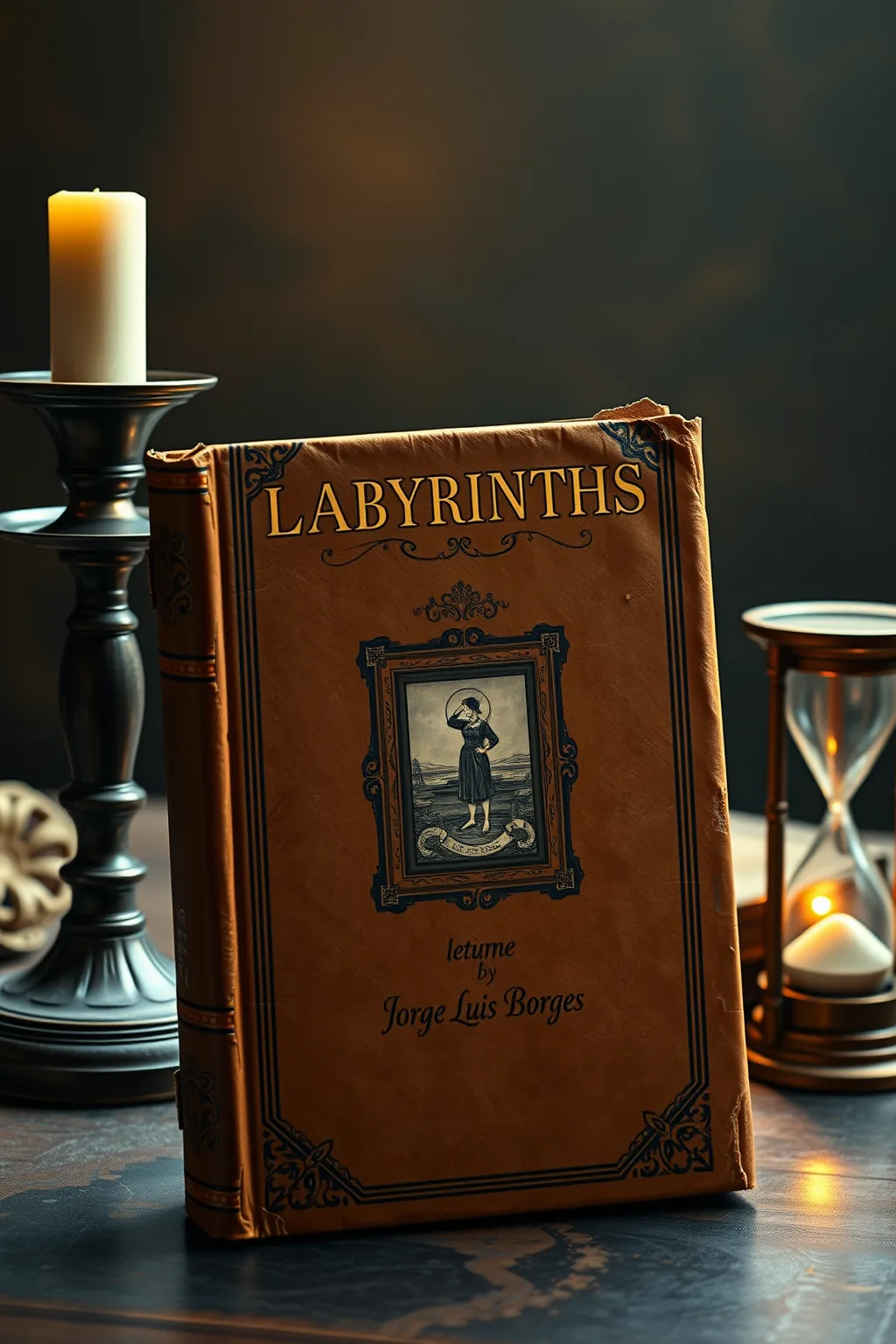
Labyrinths

 75
75

Labyrinths
Borges's Labyrinths is less a collection of stories and more a series of meticulously constructed philosophical thought experiments rendered in prose. The sheer audacity of concepts like the Library of Babel, which contains every possible book, remains staggering. Borges’s prose, even in translation, possesses a crystalline precision that belies the dizzying complexity of his ideas. He masterfully uses narrative to explore the paradoxes inherent in language, memory, and the universe itself. A notable strength is his ability to imbue abstract concepts with a palpable sense of wonder and dread. However, the relentless intellectualism can, at times, feel arid; the human element, while present in the narrator's search for meaning, occasionally recedes behind the sheer force of the metaphysical puzzles. The story 'The Garden of Forking Paths,' with its exploration of time as a branching series of possibilities, exemplifies both the brilliance and the potential coldness of his approach. It is a work that demands engagement, rewarding the persistent reader with a unique perspective on existence. Ultimately, Labyrinths serves as a powerful, if challenging, exploration of the mind's capacity to grapple with the infinite.
📝 Description
75
Jorge Luis Borges's Labyrinths, first compiled in its final form in 1986, presents narratives exploring philosophical paradoxes and the nature of reality.
This collection gathers short stories by Jorge Luis Borges, each a carefully constructed intellectual puzzle. The narratives often feature conceptual engines that question time, identity, and the limits of human comprehension. Borges crafts worlds where infinite libraries exist, where mirrors show alternate lives, and where dreams blur into waking states. The stories act as literary experiments, drawing readers into mental architectures as complex as any physical maze. They are suited for readers who appreciate untangling difficult ideas and contemplating fundamental questions about existence. Those interested in philosophy, logic, and speculative fiction will find the collection engaging. Readers who value precise prose, challenging plots, and narratives that defy simple answers will discover much to consider. The work blends intellectual rigor with imaginative storytelling, favoring deeper inquiry over easy conclusions.
Published posthumously in its definitive arrangement in 1986, Labyrinths draws from Borges's earlier collections, *Ficciones* (1944) and *El Aleph* (1949). These stories emerged from a mid-20th century intellectual environment influenced by analytic philosophy, logical positivism, and existentialism. Borges himself interacted with thinkers like Bertrand Russell and Alfred North Whitehead, whose work in logic and mathematics directly informed his own investigations into abstract concepts. The collection reflects a deep engagement with formal systems, paradoxes, and the construction of reality through language and thought, aligning with traditions that explore consciousness and perception.
💡 Why Read This Book?
• Understand the conceptual architecture of the "Library of Babel," a powerful symbol for the overwhelming nature of information and the search for meaning within it. • Experience Borges's unique method of exploring time through the "Garden of Forking Paths," offering a literary perspective on causality and alternate realities distinct from scientific models. • Contemplate the philosophical implications of infinite possibility as presented in "The Aleph," gaining a new appreciation for the limits of human perception and the nature of perception itself.
⭐ Reader Reviews
Honest opinions from readers who have explored this book.
❓ Frequently Asked Questions
What is the central theme of Jorge Luis Borges's Labyrinths?
The central theme revolves around the exploration of metaphysical and philosophical paradoxes, particularly concerning infinity, time, identity, and the nature of reality. Borges uses intricate narratives to question our understanding of these concepts.
When was Labyrinths first published?
While individual stories appeared earlier, the collection Labyrinths, as widely known, was first published in its definitive form in 1986, following Borges's death, though it compiled works from earlier collections like *Ficciones* (1944).
What literary style does Borges employ in Labyrinths?
Borges utilizes a style characterized by intellectual rigor, erudition, precise prose, and a playful engagement with philosophical and theological concepts. His narratives often resemble complex logical or metaphysical puzzles.
Are the stories in Labyrinths meant to be taken literally?
No, the stories are largely allegorical and conceptual. They serve as vehicles for exploring abstract ideas and philosophical questions rather than presenting realistic narratives or literal events.
How does Labyrinths relate to esoteric thought?
While not strictly an esoteric text, Labyrinths engages with themes common in esoteric traditions, such as the nature of reality, consciousness, infinity, and the search for hidden knowledge, often through symbolic and allegorical means.
What is the significance of the labyrinth metaphor in Borges's work?
The labyrinth serves as a potent metaphor for the complexities of existence, the human mind, the search for knowledge, and the often-bewildering paths of life and thought. It represents both confinement and the possibility of discovery.
🔮 Key Themes & Symbolism
The Infinite and the Finite
Borges confronts the concept of infinity in myriad forms, from the infinite library containing all possible books in 'The Library of Babel' to the infinite regression of mirrors or time. These narratives explore the human struggle to comprehend or contain the boundless, often highlighting the limitations of our perception and knowledge. The stories suggest that while the universe may be infinite, our ability to grasp it is inherently finite, leading to a sense of cosmic vertigo and existential questioning about our place within such vastness.
Identity and the Double
The theme of identity is frequently destabilized in Labyrinths. Characters encounter doubles, alternate selves, or are confronted with the possibility that their reality is a dream or a fabrication. This motif questions the solidity of the self and explores the nature of consciousness. Is identity fixed, or is it fluid, subject to external forces or internal fragmentation? Borges uses these narrative devices to probe the philosophical problem of personal identity, suggesting that the self may be as elusive and constructed as any labyrinthine path.
Time and Determinism
Borges radically re-imagines the nature of time, moving beyond a linear progression. In 'The Garden of Forking Paths,' time is presented as a branching structure, a multiplicity of potential futures and pasts. This concept challenges deterministic views, suggesting a universe where all possibilities coexist. The stories question whether fate is predetermined or if our choices truly create divergent realities, engaging with complex ideas from metaphysics and quantum theory in a literary context.
Knowledge and the Labyrinth of Meaning
The act of seeking knowledge is often depicted as entering a labyrinth. Whether through the vastness of a library or the intricate plots of history, the pursuit of understanding is fraught with dead ends and overwhelming complexity. Borges questions the very possibility of complete knowledge and the reliability of the texts and systems we use to organize it. The labyrinth becomes a metaphor for the elusive nature of truth and the inherent difficulty in finding definitive answers within the vastness of information.
💡 Key Ideas
Editorial paraphrase of the work's core concepts — not direct quotes.
The Library is a sphere whose center is any one of its hexagons and whose circumference is infinite.
This quote from 'The Library of Babel' captures the paradoxical nature of the infinite library. It suggests a universe where every point is simultaneously central and boundless, reflecting Borges's fascination with geometric and cosmological impossibilities.
Time is the essence of the universe.
A paraphrased concept reflecting Borges's frequent exploration of temporal paradoxes. This idea underscores how central the concept of time, in its non-linear and complex forms, is to his understanding of reality.
There are no black flowers, no opium-tainted sunflowers, no beasts that devour their own tails, no towers that rise and fall symmetrically.
This line, likely from 'The Garden of Forking Paths,' serves to establish the boundaries of the 'real' world before introducing the fantastical elements that challenge those boundaries. It highlights the contrast between ordinary perception and the infinite possibilities Borges explores.
A man sets himself the task of drawing a map of the world. [...] On the face of that land there is an image of the land, and on the face of the land there is an image of the land.
This is a paraphrased concept related to the self-referential nature of Borges's labyrrinths, akin to the idea of infinite regression seen in cartography or mirrors. It speaks to the recursive structures that define his fictional universes.
I do not know which of us has seen a dream.
A paraphrased concept reflecting the blurred lines between reality and dreams in many of Borges's stories, such as 'The Circular Ruins.' It questions the certainty of waking experience and the nature of consciousness itself.
🌙 Esoteric Significance
Tradition
While Borges was not formally affiliated with any single esoteric tradition, his work frequently touches upon themes resonant within Gnosticism, Hermeticism, and Kabbalism. The concept of the infinite library mirrors the Kabbalistic notion of the Ein Sof (the Infinite) and the potential contained within divine thought. His exploration of illusory realities and the search for true knowledge aligns with Gnostic ideas of escaping a flawed material world. The labyrinth itself is a symbol found across many mystical traditions, representing the soul's journey or the complex paths to enlightenment.
Symbolism
The primary symbol is the labyrinth, representing the intricate, often confusing, paths of existence, knowledge, and the human mind. Mirrors are another recurring motif, symbolizing self-reflection, alternate realities, and the deceptive nature of appearance. The library, particularly in 'The Library of Babel,' symbolizes the totality of knowledge, both comprehensible and incomprehensible, acting as a metaphor for the universe itself and the human quest for meaning within it.
Modern Relevance
Borges's conceptual frameworks continue to influence contemporary thought, particularly in postmodern philosophy, literary theory, and speculative fiction. Thinkers and writers exploring simulation theory, the nature of consciousness in digital realms, and the philosophical implications of artificial intelligence often find traces of Borges's ideas. His work provides a literary foundation for contemplating infinite possibilities, the constructed nature of reality, and the limits of human understanding in an increasingly complex world.
👥 Who Should Read This Book
• Students of comparative literature and philosophy seeking to understand the intersection of abstract thought and narrative artistry. • Readers interested in metaphysical concepts like infinity, time paradoxes, and the nature of reality, presented through engaging fictional scenarios. • Speculative fiction enthusiasts who appreciate intellectually rigorous storytelling that challenges conventional perceptions of the world and the self.
📜 Historical Context
Labyrinths, as a collected work, draws heavily from Jorge Luis Borges's seminal Argentinian collections *Ficciones* (1944) and *El Aleph* (1949). These stories emerged during a period when Latin American literature was gaining international recognition, yet Borges’s unique intellectual style set him apart. He engaged with philosophical currents like logical positivism and analytic philosophy, particularly the works of Bertrand Russell and Alfred North Whitehead, whose ideas on logic and infinity found fertile ground in Borges's imagination. While not part of the magical realism movement that would later flourish, his work shares a speculative quality. His intellectual sparring partner, Adolfo Bioy Casares, was a close collaborator and fellow writer whose own fantastical tales echo Borges's explorations. Borges's erudition and his ability to synthesize complex philosophical ideas into compelling narratives made his work a touchstone for subsequent generations of writers exploring speculative fiction and philosophical themes.
📔 Journal Prompts
The Library of Babel's infinite permutations of text.
Reflections on the 'Garden of Forking Paths' and causality.
The nature of identity as explored through doubles.
Contemplating the center and circumference of the Library.
The labyrinth as a metaphor for a personal search.
🗂️ Glossary
Aleph
In Borges's work, 'The Aleph' refers to a point in space that contains all other points, allowing simultaneous vision of everything in the universe. It symbolizes ultimate knowledge and the totality of existence.
Ficciones
Meaning 'Fictions' in Spanish, this was one of Borges's early and highly influential collections of short stories, published in 1944, containing many of the works now found in Labyrinths.
Labyrinth
A complex network of paths or passages, typically designed to confuse. In Borges's context, it metaphorically represents intricate philosophical problems, the complexities of existence, or the structure of the universe itself.
Paradox
A statement or proposition that, despite sound (or apparently sound) reasoning from acceptable premises, leads to a conclusion that seems logically unacceptable or self-contradictory. Borges frequently employs paradoxes to explore philosophical concepts.
Time
Borges treats time not as a linear progression but as a complex, often cyclical or branching, phenomenon. His stories explore concepts like eternal recurrence and parallel timelines.
Infinity
The concept of endlessness or limitlessness, explored by Borges through ideas like infinite libraries, infinite regressions, and the boundless nature of the universe.
Double
A motif representing a second self or an alternate identity. In Borges's stories, doubles often serve to question the uniqueness and stability of individual identity.
🔮 Readers Also Liked
Browse all →









More by Jorge Luis Borges
All books →


![The Widow Ching Pirate [5 stories]](/img/thumb/the-widow-ching-pirate-5-stories-jorge-luis-borges.webp)
More Free Alchemy & Hermeticism Books
View all →