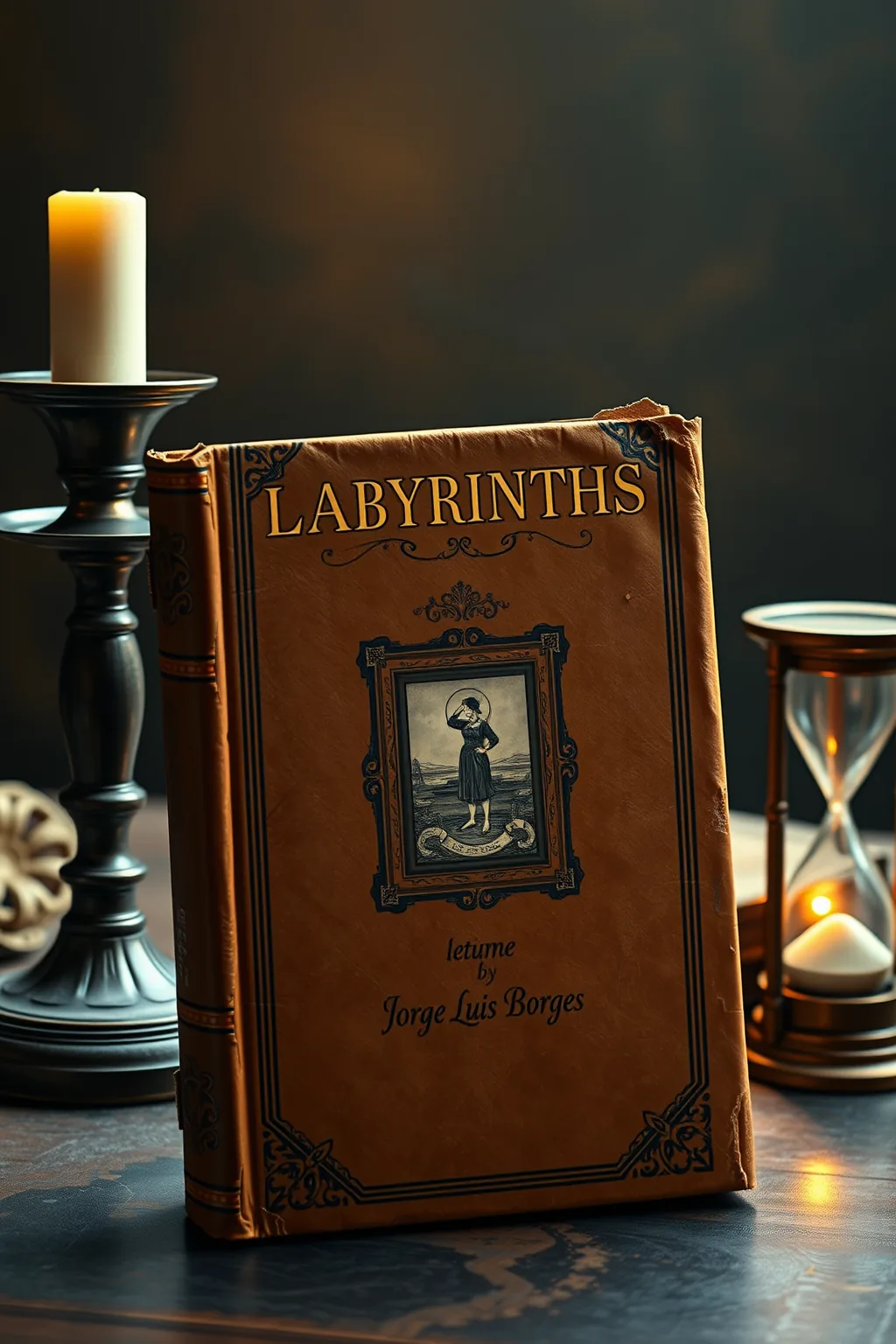
Labyrinths
 78
78

Labyrinths
Borges's "Labyrinths" presents a series of intellectual challenges disguised as fiction. The stories, particularly those that gained wider recognition after their original publication, operate less as traditional narratives and more as condensed philosophical propositions. The sheer density of ideas packed into such economical prose is remarkable. For instance, the concept of a universal library in "The Library of Babel" serves as a potent metaphor for the overwhelming nature of knowledge and the human attempt to find order within it. However, the collection's strength—its intellectual rigor—can also be its limitation. Some pieces verge on pure abstraction, demanding significant reader investment to glean their intended meaning, occasionally at the expense of narrative engagement. The thematic consistency, while a hallmark of Borges's oeuvre, might feel repetitive to those unaccustomed to his specific philosophical fascinations. It is a collection that rewards careful, deliberate reading, offering glimpses into profound existential quandaries through meticulously constructed, often dizzying, literary structures.
📝 Description
78
First published in 1986, Jorge Luis Borges's 'Labyrinths' is a collection of stories and parables.
This compilation is not a single narrative but a series of short fiction and parables. Borges, an Argentine writer, frequently used these texts as thought experiments. They pose complex questions about existence and knowledge through concise, often paradoxical, frameworks. The stories grapple with ideas of infinity, time, identity, and the nature of reality. Readers who appreciate intellectual puzzles and narrative experimentation will find this collection appealing. It suits those interested in the links between literature and philosophy, particularly concerning existentialism, metaphysics, and consciousness. Those who prefer straightforward plots might find its abstract nature demanding, but readers who enjoy contemplating the universe through complex literary designs will discover ample material.
Borges drew from a literary tradition that included authors like Kafka and Chesterton, whom he admired for their allegorical depth. His work, with its self-reflexive and meta-fictional elements, engaged with philosophical ideas often presented through fictional constructs. This collection emerged during a period when postmodernism was questioning grand narratives, and Borges's style predated and influenced many of its key tenets. His approach positioned him as a unique voice in 20th-century literature, blending philosophical inquiry with fictional form.
💡 Why Read This Book?
• Gain a unique perspective on the nature of infinity and knowledge through Borges's concept of the "Library of Babel," first presented in its original form and explored in 'Labyrinths'. • Contemplate the structure of reality and time as depicted in stories like "The Garden of Forking Paths," understanding how Borges uses narrative to model complex philosophical ideas. • Engage with the concept of the "labyrinth" as a metaphor for human existence and the search for meaning, as examined throughout the collection's various tales.
⭐ Reader Reviews
Honest opinions from readers who have explored this book.
❓ Frequently Asked Questions
When was "Labyrinths" by Jorge Luis Borges first published?
The collection "Labyrinths" was first published in 1986, bringing together many of Jorge Luis Borges's seminal short stories and parables for a wider audience.
What are the main themes explored in Borges's "Labyrinths"?
Major themes include infinity, time (especially cyclical and forking paths), the nature of reality, identity, dreams, and the structure of knowledge, often explored through labyrinths and libraries.
Is "Labyrinths" a single story or a collection?
"Labyrinths" is a collection of short stories and fables, not a single continuous narrative, designed to present a series of interconnected philosophical explorations.
What is the significance of the labyrinth motif in the book?
The labyrinth serves as a central metaphor for the complexities of existence, the search for meaning, the structure of the universe, and the often-confusing paths of knowledge and time.
Who was Jorge Luis Borges?
Jorge Luis Borges (1899-1986) was a highly influential Argentine poet, essayist, and short-story writer, celebrated for his imaginative fiction and philosophical depth.
Where can I find 'The Library of Babel' by Borges?
'The Library of Babel' is one of the most famous stories included in the 'Labyrinths' collection, making this book the primary source for that specific work.
🔮 Key Themes & Symbolism
The Infinite and the Library
The concept of the infinite manifests powerfully through the metaphor of the "Library of Babel," a boundless repository of all possible books. This theme reflects an exploration of cosmic order and chaos, the overwhelming nature of total information, and humanity's futile yet persistent search for meaning and a definitive text within an endless expanse. The library becomes a microcosm of the universe, reflecting its inherent complexity and our limited capacity to comprehend it fully.
Time and Determinism
Borges frequently interrogates the linearity of time, proposing instead concepts of cyclicality, fragmentation, and "forking paths" as seen in "The Garden of Forking Paths." This challenges deterministic views, suggesting a multiverse where all possibilities unfold simultaneously. The exploration questions free will and fate, presenting time not as a river flowing in one direction, but as a complex, branching structure that can be traversed or perceived in myriad ways.
Identity and Illusion
The nature of personal identity is consistently questioned, often blurring the lines between reality and dreams, or self and other. Characters grapple with the elusive essence of who they are, finding their identities mutable or even illusory. This theme explores existential quandaries about consciousness and self-perception, suggesting that our sense of a stable 'self' might be a construction, as fragile and complex as the labyrinths themselves.
The Labyrinth as Metaphor
The titular "labyrinths" are more than just architectural structures; they are potent symbols for the human condition. They represent the intricate paths of thought, the search for knowledge, the challenges of life, and the ultimate unknowability of the universe. Navigating these fictional labyrinths mirrors the reader's own journey through the text, a process of discovery, confusion, and eventual, perhaps incomplete, understanding.
💬 Memorable Quotes
Direct passages from the work, attributed to the author.
“The universe (which others call the Library)...”
— This iconic phrase from "The Library of Babel" expresses Borges's view of the cosmos as an infinitely complex, text-based structure, where every possible combination of letters exists, rendering meaning both universal and impossibly dispersed.
“I have found the "Garden of Forking Paths"...”
— This refers to a narrative that explores multiple, branching timelines simultaneously, questioning the linear progression of events and suggesting that all potential futures exist concurrently, a complex model of time and decision-making.
“There are three hundred thousand million Decembers; nine hundred and thirty-two thousand, billion, *billion* Decembers...”
— This illustrates Borges's fascination with vast, almost incomprehensible numbers and the concept of cyclical time, presenting a universe where temporal cycles repeat with an overwhelming, almost terrifying, frequency.
“To dream of a man is to create him.”
— This short, impactful statement probes the nature of creation and reality, suggesting that the act of imagination or dreaming can bring entities into existence, blurring the lines between the internal world of thought and external reality.
“A library is a sphere whose perfect center is any hexagon and whose circumference is inaccessible.”
— This definition of the library from "The Library of Babel" elegantly combines the infinite (inaccessible circumference) with the finite and the notion of infinite potentiality (any hexagon as the center), reflecting the paradoxes of the universe.
🌙 Esoteric Significance
Tradition
While not explicitly part of a single esoteric lineage, Borges's work resonates deeply with Hermetic and Gnostic traditions. His exploration of intricate, often paradoxical realities, the idea of hidden knowledge within vast texts (like the Library of Babel), and the questioning of perceived reality echo Gnostic concerns with illusion and the search for true gnosis. The labyrinthine structures themselves can be seen as symbolic journeys of initiation or the arduous path toward understanding fundamental truths.
Symbolism
The "Library" serves as a potent symbol, representing the totality of existence, divine knowledge, or the human mind's attempt to catalog the universe. The "Labyrinth" itself symbolizes the complex journey of life, the search for meaning, or the intricate, often confusing, nature of reality and consciousness. The "Mirror" motif, appearing frequently, signifies reflection, illusion, and the potentially infinite regress of self-awareness or duplicated realities.
Modern Relevance
Borges's ideas continue to influence contemporary thinkers in fields ranging from philosophy and literary theory to computer science and artificial intelligence. His conceptualization of infinite systems, information theory, and the nature of simulated realities finds echoes in discussions on digital consciousness, virtual worlds, and the philosophical implications of advanced algorithms. Thinkers exploring post-humanism and digital metaphysics often draw upon his prescient explorations of consciousness and reality.
👥 Who Should Read This Book
• Students of comparative literature and philosophy interested in how narrative can embody complex metaphysical ideas. • Readers drawn to existential themes and the exploration of consciousness, identity, and the nature of reality. • Aspiring writers and thinkers seeking to understand innovative narrative structures and the use of metaphor to explore abstract concepts.
📜 Historical Context
Published in 1986, 'Labyrinths' compiles stories that were largely written and circulated throughout the mid-20th century, a period of significant intellectual ferment. Borges's work engaged with philosophical traditions such as Neoplatonism and existentialism, while simultaneously diverging from them through his unique literary style. He shared a certain intellectual kinship with contemporaries like Albert Camus and Samuel Beckett in their exploration of the absurd, yet Borges's approach was distinctly more metaphysical and less overtly political. His writings were also influenced by and, in turn, influenced the development of postmodern literature. Critical reception during his career often lauded his erudition and imaginative scope, with scholars like Emir Rodríguez Monegal analyzing his complex relationship with literary modernism and his innovative use of fictional constructs to explore abstract concepts.
📔 Journal Prompts
The Library of Babel's infinite nature and the search for meaning.
Reflecting on the 'Garden of Forking Paths' and the concept of multiple realities.
The labyrinth as a symbol for personal challenges and exploration.
Considering the fluidity of identity as presented in Borges's tales.
Examining the role of dreams and illusion in shaping perceived reality.
🗂️ Glossary
Labyrinth
A complex network of paths or passages, often designed to confuse or trap. In Borges, it symbolizes the intricate and often bewildering nature of existence, knowledge, and time.
The Library of Babel
A fictional, infinite library containing every possible book. It represents the universe itself, a symbol of overwhelming information and the human quest for order and meaning within it.
Forking Paths
A concept where time branches into multiple possibilities, suggesting a multiverse or a non-linear experience of temporal events, as explored in "The Garden of Forking Paths."
Gnosis
From Greek, meaning 'knowledge.' In esoteric traditions, it refers to intuitive or spiritual knowledge, often of a divine or mystical nature, leading to salvation or enlightenment.
Metaphysics
A branch of philosophy that deals with the fundamental nature of reality, including the relationship between mind and matter, substance and attribute, and potentiality and actuality.
Determinism
The philosophical position that every event, including human cognition, decision, and action, is causally determined by an unbroken chain of prior occurrences. Borges often plays with or challenges this idea.
Hermeticism
A philosophical and religious tradition based primarily upon writings attributed to Hermes Trismegistus. It emphasizes esoteric knowledge, the interconnectedness of all things, and the potential for human spiritual transformation.
🔮 Readers Also Liked
Browse all →








More by Jorge Luis Borges
All books →


![The Widow Ching Pirate [5 stories]](/img/thumb/the-widow-ching-pirate-5-stories-jorge-luis-borges.webp)

More Free Kabbalah & Jewish Mysticism Books
View all →