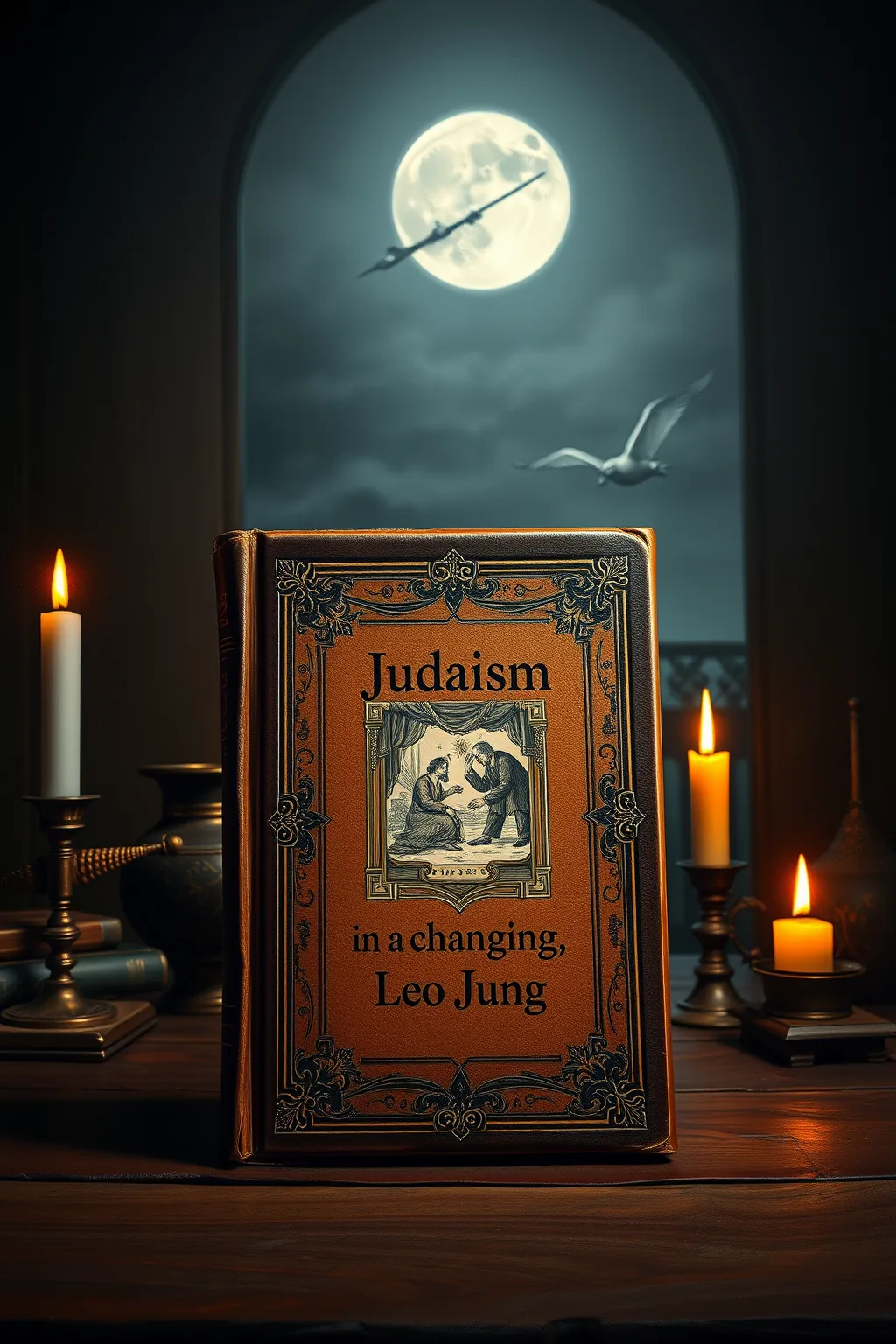
Judaism in a changing world
 61
61

Judaism in a changing world


Balthazar Finch, Senior Critic, Occult Philosophy — Leo Jung's 'Judaism in a Changing World' is a beacon for those who perceive the profound esoteric currents within the Jewish tradition. Jung expertly guides the reader through the historical shifts impacting Jewish life, yet always returns to the bedrock of its mystical core. He unpacks complex Kabbalistic concepts with accessible clarity, revealing the hidden symbolism that animates Jewish practice and thought. This is not a superficial survey, but a deep dive into the soul of a faith grappling with modernity. Its strength lies in its ability to connect the ancient wisdom of the Zohar and other mystical texts to the lived experience of the modern Jew, offering solace and guidance. Essential for scholars of mysticism and practitioners alike.
📝 Description
61
Leo Jung's 1935 book 'Judaism in a Changing World' examines Jewish mysticism for modern life.
Published in 1935, Leo Jung's 'Judaism in a Changing World' addresses the challenges faced by Jewish tradition amidst modernity. Jung looks to ancient Jewish mystical currents, particularly Kabbalah, to find enduring answers for contemporary concerns. He analyzes the symbolic language found in Jewish customs, suggesting it provides a way to see divine presence in daily existence. The book aims for readers who desire more than academic knowledge, seeking instead a practical spiritual connection to enduring truths. It encourages quiet reflection on faith's philosophical roots and the strength of its less obvious dimensions.
This work is for those interested in understanding the deeper layers of Jewish thought. Jung connects historical spiritual practices to the evolving needs of individuals and communities. He posits that these traditions are not static but offer a living source of guidance. The book invites a thoughtful engagement with faith, suitable for those who feel that significant insights remain veiled.
This work situates itself within the tradition of Jewish esoteric thought, drawing heavily on Kabbalistic concepts. It attempts to bridge the gap between ancient mystical interpretations and the realities of 20th-century life. Jung's approach is not a purely academic study of mysticism but an application of its principles to contemporary spiritual needs. He suggests that the symbolic language and contemplative practices found in Jewish esotericism hold relevance for understanding the divine in everyday experiences. The book aims to make these often-hidden aspects of Judaism accessible to a broader audience seeking deeper meaning.
💡 Why Read This Book?
Uncover the hidden mystical dimensions of Judaism in the face of modern upheaval. 'Judaism in a Changing World' offers profound insights into Kabbalistic thought and its relevance to contemporary life. Ideal for seekers of spiritual depth, scholars of Jewish mysticism, and practitioners looking to enrich their understanding of Jewish tradition through its esoteric heritage.
⭐ Reader Reviews
Honest opinions from readers who have explored this book.
❓ Frequently Asked Questions
What is the primary focus of 'Judaism in a Changing World'?
The book explores how Jewish mystical traditions, particularly Kabbalah, provide spiritual and philosophical sustenance for navigating the challenges and transformations of the modern era, emphasizing the enduring relevance of esoteric wisdom.
Who is Leo Jung and why is his perspective significant?
Leo Jung was a prominent Orthodox rabbi and scholar whose work bridges traditional Jewish thought with modern intellectual currents, offering a unique and authoritative voice on the spiritual evolution of Judaism.
Does this book require prior knowledge of Kabbalah?
While prior knowledge is beneficial, Jung's accessible writing style aims to introduce key Kabbalistic concepts to a broader audience interested in the esoteric dimensions of Judaism, making it approachable for dedicated beginners.
How does the book address the 'changing world' aspect?
It examines the impact of secularization, scientific advancements, and societal shifts on Jewish belief and practice, and posits that the deep, symbolic truths of Jewish mysticism offer a robust framework for maintaining spiritual integrity.
Is this book suitable for non-Jews interested in comparative mysticism?
Absolutely. The book offers a rich exploration of Jewish esotericism, providing valuable insights into one of the world's most ancient mystical traditions, relevant to anyone studying comparative religion and spirituality.
🔮 Key Themes & Symbolism
The Enduring Power of Kabbalah
This theme looks at how the esoteric teachings of Kabbalah, often perceived as arcane, serve as a potent spiritual anchor for Judaism in the modern era. Jung illuminates the intricate symbolism and hidden meanings within Kabbalistic texts, demonstrating their capacity to offer profound wisdom and guidance for individuals and communities facing societal flux. It's about uncovering the 'divine blueprint' and understanding the mystical interconnectedness of all things as a source of resilience and meaning.
Navigating Modernity Through Ancient Wisdom
The book critically examines the challenges posed by modernity—secularization, scientific rationalism, and cultural shifts—to traditional Jewish life. Jung's central argument is that the rich, symbolic language and mystical understanding inherent in Judaism are not relics of the past but vital tools for spiritual survival and growth. This theme explores how ancient traditions can be reinterpreted to provide relevant answers to contemporary existential questions, fostering a sense of continuity and purpose.
The Symbolism of Jewish Life and Practice
Jung masterfully decodes the symbolic significance embedded in Jewish rituals, prayers, and customs. This theme reveals how everyday Jewish life is imbued with esoteric meaning, acting as a conduit for spiritual experience. From the Sabbath to the festivals, each element is presented as a key to unlocking deeper spiritual truths and connecting with the divine. It encourages readers to see beyond the literal and engage with the profound, mystical dimensions of their heritage.
💬 Memorable Quotes
Direct passages from the work, attributed to the author.
“Hidden in plain sight, the divine whispers its secrets.”
— This speaks to the esoteric principle that sacred knowledge is not always overt but can be found within the ordinary, requiring a perceptive and spiritual lens to uncover.
“Tradition is not a chain, but a wellspring of living wisdom.”
— This highlights the dynamic nature of religious traditions, emphasizing that their value lies not in rigid adherence but in their capacity to continuously offer fresh spiritual insight and guidance.
“The universe is a divine text, waiting to be read.”
— This profound statement suggests a pantheistic or panentheistic view, asserting that the natural world itself is a repository of sacred meaning and divine revelation.
“To understand the finite is to glimpse the infinite.”
— This reflects a key mystical concept where by deeply comprehending the details of the material or temporal, one can perceive the underlying, boundless nature of the divine or eternal.
💡 Key Ideas
Editorial paraphrase of the work's core concepts — not direct quotes.
The soul yearns for the eternal in the midst of the ephemeral.
This quote captures the core human spiritual drive, suggesting that even amidst the fleeting concerns of daily life, an innate longing for lasting truth and divine connection persists.
🌙 Esoteric Significance
Tradition
This book is deeply rooted in the Jewish mystical tradition, primarily focusing on the Kabbalah, with significant nods to its ethical and philosophical dimensions. It draws upon centuries of contemplative thought, exploring concepts such as the Sefirot, the nature of God's emanation, and the spiritual significance of the Torah. Jung positions these esoteric teachings not as mere historical curiosities, but as living, breathing sources of spiritual insight relevant to contemporary existence.
Symbolism
The esoteric significance lies in Jung's meticulous unpacking of the detailed symbolism inherent in Jewish life and scripture. He reveals how seemingly mundane rituals and ancient texts are imbued with profound, multi-layered meanings. The book explores the symbolic language of creation, divine revelation, and human destiny, suggesting that understanding this symbolic grammar is key to accessing deeper spiritual truths and the hidden architecture of reality.
Modern Relevance
Jung argues that the esoteric core of Judaism, particularly its Kabbalistic wisdom, offers a powerful antidote to the spiritual vacuity and existential anxieties of the modern world. He demonstrates how ancient mystical insights can provide a framework for understanding personal identity, ethical responsibility, and the search for meaning in an increasingly complex and often alienating society. The book posits that these timeless truths are not only relevant but essential for spiritual survival and flourishing today.
👥 Who Should Read This Book
This volume is a treasure for the dedicated seeker of spiritual truth, particularly those drawn to the mystico-philosophical underpinnings of Judaism. Scholars of comparative religion and Jewish studies will find Jung's nuanced analysis invaluable. Practitioners of Jewish spirituality seeking to deepen their understanding of tradition's esoteric dimensions will be richly rewarded. Even those new to Kabbalah but possessing an open mind and a desire to explore the profound, hidden layers of faith will find guidance and inspiration within these pages.
📜 Historical Context
Written during a period of significant global upheaval and intellectual transformation, 'Judaism in a Changing World' emerges from the mid-20th century, a time when Jewish communities grappled with the aftermath of the Holocaust, the establishment of Israel, and the pervasive influence of secular ideologies. This era witnessed a profound re-evaluation of tradition, with many thinkers seeking to reconcile ancient faith with modern consciousness. Leo Jung’s work stands as a evidence of the resilience of Jewish spiritual thought, offering a deeply considered response to the existential questions that arose from unprecedented historical trauma and societal change. It reflects a broader trend in religious scholarship to explore the inner life and esoteric dimensions of faiths as a means of providing enduring meaning.
📔 Journal Prompts
How does the concept of divine immanence, as explored through Kabbalah, change your perception of everyday occurrences?
Identify a Jewish ritual or practice you are familiar with and explore its potential symbolic or esoteric meaning beyond its literal observance.
In what ways do you feel modern challenges (e.g., secularism, consumerism) disconnect individuals from spiritual truths, and how might ancient wisdom offer a counterpoint?
Reflect on a personal experience where you felt a sense of profound connection or meaning; how might this relate to the esoteric concepts discussed?
Consider the idea of the universe as a 'divine text.' What aspects of the natural world or human experience could be interpreted as messages or revelations?
🗂️ Glossary
Kabbalah
The esoteric tradition of Jewish mysticism, concerned with the nature of God, the creation of the universe, and the spiritual meaning of the Torah. It employs symbolic language and contemplative practices to achieve divine knowledge and union.
Sefirot
The ten divine emanations or attributes through which God reveals Himself and creates the universe, forming a central concept in Kabbalistic cosmology. They represent a spectrum of divine energy and consciousness.
Torah
The first five books of the Hebrew Bible, considered by Jews to be divinely revealed. Esoterically, it is seen as containing hidden layers of meaning, spiritual wisdom, and mystical secrets beyond its literal narrative.
Gematria
A system of Jewish numerology where Hebrew letters are assigned numerical values, used to interpret biblical texts by finding connections between words with the same numerical sum, revealing hidden meanings.
Ein Sof
Literally 'Without End' or 'Infinite,' this term refers to God in His absolute, unknowable, and transcendent aspect, beyond all finite comprehension or description in Kabbalistic thought.
This book appears in 1 collection
🔮 Readers Also Liked
Browse all →








From the “Kabbalah” Collection
View all →







More Free Kabbalah & Jewish Mysticism Books
View all →