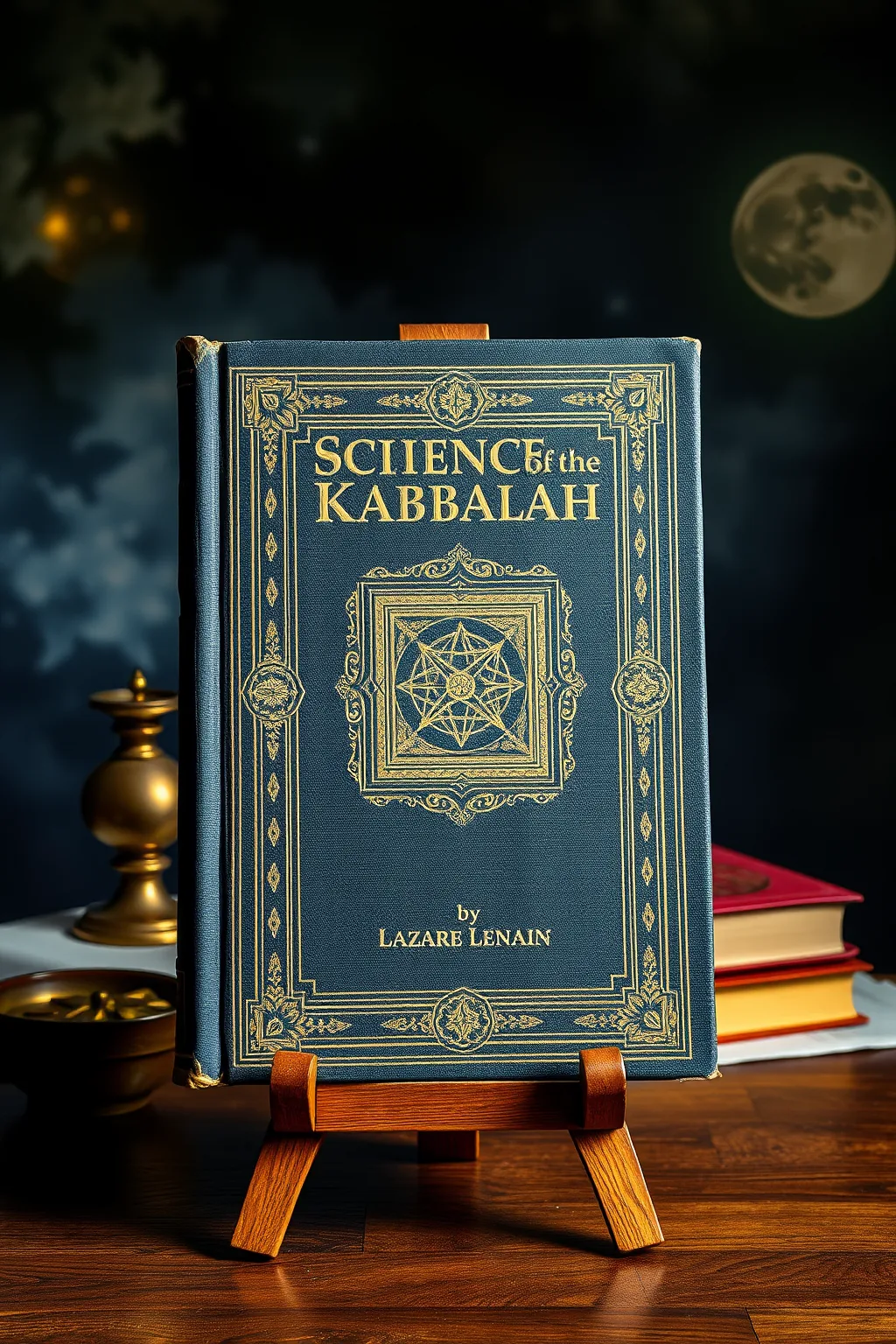
Science of the Kabbalah
 61
61

Science of the Kabbalah


Celeste Moreau (Divination & Symbolism Reviewer) — Lazare Lenain's "Science of the Kabbalah" is an essential beacon for anyone navigating the intricate labyrinth of Jewish mysticism. Lenain's exposition is both scholarly and deeply intuitive, illuminating the profound philosophical underpinnings of Kabbalistic thought. He masterfully unpacks complex concepts, rendering them accessible without sacrificing their esoteric essence. The book's strength lies in its ability to connect abstract principles to practical application, offering readers a roadmap for spiritual growth. It is an indispensable resource for serious students of Kabbalah, philosophers, and those seeking a deeper understanding of the mind-body-spirit connection through ancient wisdom.
📝 Description
61
Lazare Lenain's 1909 "Science of the Kabbalah" examines the Sefer Yetzirah and the Tree of Life.
Lazare Lenain's "Science of the Kabbalah," published in 1909, presents a structured approach to understanding Jewish mysticism. The book details the architecture of existence as conceived within Kabbalistic thought, focusing on the celestial spheres and the pathways of the Tree of Life. Lenain analyzes the symbolic language of Kabbalah, connecting it to human psychology and the broader cosmic structure.
The work encourages contemplation of divine emanations and the energies that link the universe. It aims to illuminate the relationship between the material and spiritual worlds, the microcosm and the macrocosm. Lenain provides a philosophical basis for personal change and a more thorough grasp of reality's hidden aspects. This text is more than a scholarly examination; it is an invitation to engage with the Kabbalistic worldview.
This book engages with the Kabbalah, a mystical tradition within Judaism. It draws on texts like the Sefer Yetzirah, one of the earliest Kabbalistic works, to explain concepts such as the 10 Sefirot (divine emanations) and the 22 Hebrew letters as foundational elements of creation. Lenain's work situates these ideas within a framework that connects them to universal principles and individual consciousness, reflecting a broader esoteric interest in mystical cosmologies during the early 20th century.
💡 Why Read This Book?
Embark on a transformative journey with "Science of the Kabbalah." This book offers a rare glimpse into the esoteric heart of Jewish mysticism, revealing the symbolic language that governs creation. Ideal for spiritual seekers, philosophical minds, and practitioners of ancient wisdom, it provides profound insights into the interconnectedness of all things and the potential for inner evolution. Uncover the secrets of divine manifestation and elevate your understanding of existence.
⭐ Reader Reviews
Honest opinions from readers who have explored this book.
❓ Frequently Asked Questions
What is the primary focus of "Science of the Kabbalah"?
The book primarily focuses on the esoteric principles and symbolic language of Kabbalah, exploring its metaphysical concepts and their application to understanding the universe and the human condition.
Is this book suitable for beginners?
While comprehensive, Lenain's clear prose makes it accessible to dedicated beginners willing to engage with complex philosophical ideas. Prior familiarity with Jewish mysticism is helpful but not strictly required.
What is the Tree of Life in Kabbalah?
The Tree of Life is a central diagram in Kabbalah, representing the ten emanations of God and the structure of the cosmos. It serves as a map for spiritual ascent and understanding divine processes.
How does this book relate to philosophy?
It bridges mystical inquiry with philosophical exploration, examining concepts of existence, consciousness, and the nature of reality through the lens of Kabbalistic cosmology and its ethical implications.
Can the concepts in this book be applied practically?
Yes, many readers find the Kabbalistic principles discussed can be integrated into personal spiritual practices, meditation, and self-understanding, fostering inner transformation and a deeper connection to the divine.
🔮 Key Themes & Symbolism
The Divine Emanations and the Tree of Life
This theme explores the Kabbalistic concept of divine emanation, tracing the flow of creative energy from the Infinite (Ein Sof) through the ten Sephiroth, visually represented by the Tree of Life. Lenain elucidates how this sacred diagram serves as a blueprint for the universe, a map of consciousness, and a pathway for spiritual realization. The intricate relationships between the Sephiroth reveal the divine attributes and the underlying order of all existence, offering a profound understanding of creation's genesis and structure.
Symbolism as a Cosmic Language
Lenain emphasizes the important role of symbolism in Kabbalah, presenting it not as mere allegory but as a fundamental language of the cosmos. He explores how Hebrew letters, gematria, and esoteric imagery act as keys to unlocking hidden meanings and divine truths. This section guides the reader in deciphering the multi-layered significations embedded within sacred texts and mystical practices, revealing how symbols bridge the gap between the visible and invisible realms and facilitate a direct communion with the divine.
The Interplay of Mind, Body, and Spirit
This theme explores the profound connection between the human being and the divine cosmos as understood through Kabbalistic philosophy. Lenain illustrates how the microcosm (humanity) mirrors the macrocosm (universe), and how understanding the principles of Kabbalah can lead to the integration and harmonization of one's physical, mental, and spiritual aspects. It highlights the potential for inner transformation and the realization of one's divine essence through the application of these ancient teachings.
💬 Memorable Quotes
Direct passages from the work, attributed to the author.
“Within the letter lies the echo of creation.”
— This highlights the Kabbalistic belief in the profound power and inherent meaning within the Hebrew alphabet, suggesting that each letter is a vessel of divine energy and cosmic information.
“To know the Self is to glimpse the Divine.”
— This emphasizes the introspective nature of Kabbalistic practice, asserting that self-knowledge is intrinsically linked to understanding the divine presence within and without.
“The universe breathes in unison with the soul.”
— This poignant statement illustrates the core Kabbalistic tenet of interconnectedness, suggesting a deep resonance and reciprocal relationship between the individual soul and the vast cosmic fabric.
“Wisdom is the illumination of the inner eye.”
— This defines true wisdom not just as intellectual accumulation, but as a form of spiritual insight and direct perception gained through inner contemplation and esoteric understanding.
💡 Key Ideas
Editorial paraphrase of the work's core concepts — not direct quotes.
The Tree of Life is the ladder to the Infinite.
This quote expresses the primary function of the Kabbalistic Tree of Life as a symbolic pathway for ascending from the mundane to the divine, representing stages of spiritual evolution.
🌙 Esoteric Significance
Tradition
This work is a significant contribution to the Western esoteric tradition, specifically examining Jewish Kabbalah. It serves as a gateway to understanding the Sephirotic system, gematria, and other hermeneutic methods used to unlock hidden meanings within sacred texts. Its esoteric significance lies in its potential to guide practitioners toward spiritual ascent and a deeper comprehension of divine consciousness.
Symbolism
The book meticulously unpacks the profound symbolism inherent in Kabbalah, focusing on the Tree of Life, the Hebrew alphabet, and numerical correspondences (gematria). These symbols are not merely decorative but are presented as keys to understanding the architecture of the cosmos, the nature of the divine, and the human soul's journey. Lenain illuminates how these symbolic systems offer a blueprint for creation and a language through which the divine communicates.
Modern Relevance
In an era seeking deeper meaning and connection, "Science of the Kabbalah" offers timeless wisdom. Its exploration of consciousness, the interconnectedness of all things, and pathways to inner transformation resonates deeply with contemporary spiritual seekers. The book provides a robust philosophical framework for understanding the mind-body-spirit dynamic, empowering individuals to cultivate greater self-awareness and a more profound sense of purpose in their lives.
👥 Who Should Read This Book
This useful work is a treasure for a diverse range of readers. Spiritual seekers will find a profound map for their inner journey, uncovering pathways to spiritual growth and divine connection. Scholars of comparative religion and philosophy will appreciate its rigorous exploration of complex metaphysical concepts and its historical context within Jewish mysticism. Practitioners of esoteric arts and meditation will discover potent symbolic keys and frameworks for deepening their practice. Even the intellectually curious beginner, willing to engage with profound ideas, will find "Science of the Kabbalah" to be an accessible yet deeply rewarding introduction to this ancient and powerful wisdom tradition.
📜 Historical Context
Lazare Lenain's "Science of the Kabbalah" emerges from a rich intellectual and spiritual milieu, drawing heavily from the vibrant currents of Jewish mysticism that flourished for centuries. While the precise era of Lenain's major contributions requires specific biographical context, the work itself speaks to traditions deeply rooted in the medieval period, particularly the Zohar and the teachings of Isaac Luria. These periods saw an intense focus on deciphering the divine mysteries, understanding the structure of the cosmos through the Tree of Life, and exploring the practical applications of Kabbalistic knowledge for spiritual attainment and world betterment. Lenain's work likely contributed to the dissemination and interpretation of these complex ideas in a more accessible format, bridging the gap between esoteric circles and a wider audience interested in the philosophical and metaphysical dimensions of Kabbalah.
📔 Journal Prompts
Reflect on the concept of divine emanation as described in the Sephiroth. How does this concept resonate with your understanding of creation and your own existence?
Consider the Hebrew letter that most intrigues you. Research its symbolic meanings and contemplate how they might apply to a current challenge or aspiration in your life.
Explore the idea of the microcosm mirroring the macrocosm. In what ways do you see the universe reflected within yourself, and vice versa?
Identify a personal 'ladder to the Infinite' – a practice, belief, or concept that helps you connect to something greater than yourself.
Meditate on a symbol from the book that has captured your attention. Journal about the feelings, thoughts, and insights it evokes.
🗂️ Glossary
Ein Sof
The Kabbalistic term for the Infinite, the unknowable, transcendent Godhead that exists beyond all comprehension or limitation. It represents the primordial, unmanifest aspect of the Divine.
Sephiroth
The ten divine emanations or attributes of God described in Kabbalah. They form the Tree of Life and represent stages of creation and divine revelation, acting as a bridge between the Infinite and the manifest world.
Tree of Life
A central diagram in Kabbalah consisting of ten interconnected circles (Sephiroth) and twenty-two paths. It symbolizes the structure of the universe, the divine plan, and the pathway for human spiritual ascent and self-understanding.
Gematria
A system of numerological interpretation in Kabbalah where Hebrew letters are assigned numerical values. It is used to find hidden connections and deeper meanings within words and phrases of sacred texts.
Sod
The deepest, most esoteric level of interpretation in Jewish tradition, referring to the hidden, mystical secrets of the Torah and the universe. Kabbalah is often considered the 'Sod' of the Torah.
This book appears in 1 collection
🔮 Readers Also Liked
Browse all →







From the “Kabbalah” Collection
View all →








More Free Kabbalah & Jewish Mysticism Books
View all →