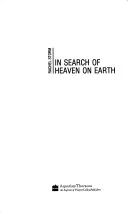
In Search of Heaven on Earth
 82
82

In Search of Heaven on Earth
Rachel Storm’s "In Search of Heaven on Earth" offers a panoramic view of humanity's persistent search for an ideal existence within the terrestrial realm. The book’s strength lies in its broad scope, drawing connections between seemingly disparate spiritual traditions and philosophical schools. Storm effectively synthesizes complex ideas without oversimplifying them, presenting a well-researched comparative study. However, the sheer breadth of topics covered can sometimes leave the reader yearning for deeper dives into specific traditions. A particular strength is the chapter discussing medieval Christian mysticism, which provides a focused lens on how internal spiritual states were perceived as a form of earthly paradise, contrasting intriguingly with more externalized utopian visions. While comprehensive, the book occasionally feels like an extensive survey rather than an in-depth analysis of any single path. Ultimately, it serves as an excellent primer for understanding the diverse expressions of a universal human longing.
📝 Description
82
Rachel Storm's 1992 book examines humanity's age-old pursuit of earthly paradise.
Published in 1992, Rachel Storm's "In Search of Heaven on Earth" maps the diverse ways humans have conceived of and strived for ideal states of being. The book is not a manual for achieving bliss, but a comparative study. It brings together a wide array of spiritual and philosophical traditions, showing how different cultures and individuals have envisioned transcendent experiences within the material world.
Storm's work is for those interested in comparative spirituality, mythology, and the history of utopian thought. It synthesizes perspectives from ancient philosophies to modern spiritual movements, examining the universal human desire for a better existence. Readers will find a scholarly yet approachable overview of cross-cultural spiritual aspirations.
Emerging in the early 1990s, "In Search of Heaven on Earth" appeared during a period of renewed interest in alternative spiritualities and comparative religious studies. It engages with the perennial human quest for transcendence and ideal realities, a theme common in esoteric philosophy. The book synthesizes diverse traditions, reflecting a broader intellectual current that sought connections between ancient wisdom and contemporary spiritual movements.
💡 Why Read This Book?
• Gain a nuanced understanding of how various traditions, from Gnosticism to Renaissance humanism, have defined and pursued earthly perfection, as explored in the book's comparative analysis. • Discover concrete examples of spiritual practices and philosophical concepts aimed at manifesting ideal states, such as the medieval concept of the "divine spark" within oneself. • Appreciate the historical evolution of utopian thought, tracing its roots and transformations across different centuries and cultures, as illuminated by Storm's research dating back to 1992.
⭐ Reader Reviews
Honest opinions from readers who have explored this book.
❓ Frequently Asked Questions
When was "In Search of Heaven on Earth" originally published?
Rachel Storm's "In Search of Heaven on Earth" was first published in 1992, a period marked by increased interest in comparative spirituality and alternative philosophies.
What are the main themes explored in Rachel Storm's book?
The book primarily explores the diverse human quests for ideal states of existence on Earth, examining concepts of paradise, enlightenment, and utopian visions across various historical and cultural contexts.
Is "In Search of Heaven on Earth" a practical guide for achieving enlightenment?
No, it is not a prescriptive guide. The book functions as a comparative study, offering insights into how different traditions have conceptualized and pursued spiritual ideals, rather than providing direct instructions.
Who would benefit most from reading this book?
Readers interested in comparative religion, mythology, the history of spiritual ideas, and utopian thought will find this book particularly rewarding due to its broad yet insightful examination.
What kind of spiritual traditions does Storm discuss?
Storm discusses a wide array of traditions, including elements from ancient philosophies, medieval mysticism, Renaissance humanism, and various expressions of esoteric thought that seek a form of 'heaven on earth'.
Does the book focus on a specific geographical region or culture?
No, the book takes a global and historical approach, examining concepts of earthly paradise and spiritual fulfillment across numerous cultures and time periods, not limited to a single region.
🔮 Key Themes & Symbolism
The Quest for Paradise
This theme examines the perennial human desire to find or create an ideal state of being on Earth. Storm traces this aspiration through various mythologies, religious doctrines, and philosophical systems, demonstrating how the concept of 'paradise' has been interpreted differently across cultures and eras. From ancient Edenic myths to Renaissance notions of the perfect society, the book illustrates the diverse forms this universal longing has taken, highlighting the common thread of seeking spiritual fulfillment within the material world.
Spiritual Traditions and Utopian Ideals
The work synthesizes insights from a broad spectrum of spiritual and philosophical traditions, including Gnosticism, Hermeticism, and various mystical paths. It analyzes how each tradition offers a unique framework for understanding and achieving an 'earthly heaven.' Storm explores the specific doctrines, practices, and cosmological views that underpin these utopian visions, showing how they often involve a transformation of consciousness or a reordering of societal structures to align with divine or ideal principles.
Inner vs. Outer Transformation
A central tension explored is the balance between internal spiritual realization and external societal change in the pursuit of an ideal world. The book contrasts approaches that emphasize individual enlightenment and inner transformation (e.g., through meditation or mystical experience) with those focused on creating perfect external conditions, such as communal living or political reform. Storm investigates how these two dimensions are often intertwined, with inner states influencing the perception of the outer world and vice versa.
Myth, Symbol, and Consciousness
Storm explores the role of myth and symbolism as vehicles for conveying and enacting spiritual aspirations. She examines how archetypal narratives and symbolic language within different traditions help individuals conceive of and strive towards transcendent states. The book suggests that understanding these symbolic systems is crucial for grasping the underlying psychological and spiritual dynamics that drive the search for a heaven on Earth, impacting collective consciousness and individual belief.
💬 Memorable Quotes
Direct passages from the work, attributed to the author.
“The dream of a perfected Earth is as old as humanity itself.”
— This statement underscores the enduring nature of the utopian impulse. It suggests that the desire for an ideal existence, a 'heaven on Earth,' is not a modern invention but a fundamental aspect of the human condition, manifesting across all recorded history and cultures.
“Each age and culture reinterprets paradise through its own lens.”
— This highlights the dynamic and evolving nature of spiritual and utopian concepts. It implies that while the aspiration for an ideal state might be universal, its specific form, expression, and perceived location (inner or outer) are shaped by the prevailing worldview and socio-historical context.
“True transcendence often begins with a shift in perception.”
— This concept points towards the internal nature of achieving ideal states. It suggests that rather than solely relying on external changes or circumstances, the realization of a 'heaven on Earth' is fundamentally an internal transformation of consciousness and perspective.
“The search for a divine realm on Earth is reflected in both individual seeking and collective movements.”
— This interpretation emphasizes the dual nature of the quest for an ideal existence. It acknowledges that the pursuit of spiritual or utopian goals can manifest both in personal, introspective spiritual practices and in broader social, political, or communal endeavors aimed at collective betterment.
“Mythology provides the blueprints for our imagined perfect worlds.”
— This suggests that the stories and narratives passed down through generations, particularly those found in religious and cultural myths, serve as foundational structures for conceiving of and striving towards ideal realities. These myths offer archetypes and frameworks for what a perfected existence might entail.
🌙 Esoteric Significance
Tradition
This work engages broadly with the perennial philosophy, drawing connections between various esoteric lineages that posit the possibility of realizing divine or ideal states within earthly existence. It touches upon Gnostic ideas of inherent divinity and the potential for liberation from material illusion, as well as Hermetic principles concerning the correspondence between the inner and outer worlds. It doesn't strictly adhere to one tradition but acts as a comparative bridge, highlighting shared aspirations across different mystical and philosophical schools that seek a form of immanent transcendence.
Symbolism
The book frequently explores the concept of the 'divine spark' within the human being, a symbol common in Gnostic and mystical traditions, representing an inherent connection to the divine that can be awakened. Another significant motif is the 'earthly paradise' itself, which functions symbolically not just as a literal place but as a state of consciousness characterized by harmony, unity, and spiritual fulfillment, often depicted through archetypal imagery of a perfected garden or a golden age.
Modern Relevance
Contemporary movements focused on integral spirituality, conscious living, and the manifestation of personal and collective utopias can find resonance in Storm's synthesis. Thinkers exploring the intersection of psychology, spirituality, and social change, as well as communities dedicated to building intentional living spaces or practicing mindfulness for societal benefit, draw upon the historical and philosophical groundwork presented. The book's emphasis on diverse pathways to spiritual fulfillment remains relevant in today's pluralistic spiritual landscape.
👥 Who Should Read This Book
• Students of comparative religion and mythology seeking to understand the cross-cultural expressions of utopian ideals and spiritual fulfillment. • Individuals interested in the history of esoteric thought and alternative spiritual movements, particularly those active around the late 20th century. • Philosophers and cultural critics examining the perennial human quest for perfection and its manifestation in various societal and individual contexts.
📜 Historical Context
When "In Search of Heaven on Earth" was released in 1992, the intellectual climate was vibrant with explorations of spirituality outside mainstream religious structures. The New Age movement, though past its peak, had normalized discussions of esoteric philosophies, Eastern religions, and holistic wellness. Academically, scholars like Mircea Eliade had already laid groundwork in comparative mythology and the history of religions, fostering an environment where works synthesizing diverse spiritual traditions were met with interest. Contemporary authors like Fritjof Capra, with his fusion of physics and Eastern mysticism in "The Tao of Physics" (1975), exemplified a similar cross-disciplinary approach. While not directly engaged with Storm, the intellectual currents influenced by figures such as Carl Jung, who explored archetypes and the collective unconscious, provided a conceptual backdrop for understanding the universal human search for meaning and ideal states that Storm's book addresses. The book emerged in a period that valued personal spiritual exploration and cross-cultural understanding.
📔 Journal Prompts
The concept of the 'divine spark' as presented in the book: how might this inner potential shape your perception of earthly existence?
Reflect on a historical 'earthly paradise' ideal discussed in the text and its relevance to contemporary societal aspirations.
Analyze the tension between inner spiritual transformation and external societal change as depicted in the book's exploration of utopian goals.
Consider the symbolic meaning of the 'perfected garden' motif and its connection to your personal spiritual journey.
How do the various esoteric traditions mentioned in the book offer different frameworks for achieving ideal states on Earth?
🗂️ Glossary
Perennial Philosophy
The philosophical view that all religions and spiritual traditions share a common source or underlying truth, despite their differing exoteric expressions. It suggests a universal spiritual core to human experience.
Gnosticism
An ancient set of religious ideas and systems, originating in the first to fourth centuries AD, that held the material world to be the flawed creation of a lesser divinity, and salvation to be achieved through secret knowledge (gnosis).
Hermeticism
A religious, philosophical, and esoteric tradition based on writings attributed to Hermes Trismegistus, a syncretic combination of Greek Hermes and Egyptian Thoth. It emphasizes the principle of 'as above, so below,' linking the macrocosm and microcosm.
Utopia
An imagined community or society that possesses highly desirable or nearly perfect qualities for its citizens. The term was coined by Sir Thomas More for his 1516 book Utopia, describing a fictional island society.
Earthly Paradise
A concept referring to an ideal state of existence, often characterized by harmony, spiritual fulfillment, and perfection, believed to be attainable or present within the material world, rather than solely in an afterlife.
Immanent Transcendence
The idea that spiritual or divine qualities are present within the material world and can be realized through direct experience, rather than being exclusively external or otherworldly.
Archetype
In Jungian psychology, a universal, archaic pattern and image that derive from the collective unconscious and are the psychic counterpart of an instinct. They play a role in shaping myths and symbols.
This book appears in 1 collection
🔮 Readers Also Liked
Browse all →









From the “Thelema” Collection
View all →








More Free Occult Philosophy Books
View all →