Spooky Michigan

 74
74

Spooky Michigan
S. E. Schlosser and Paul G. Hoffman's "Spooky Michigan" presents a well-researched compendium of the state's spectral lore. Its strength lies in its thoroughness, cataloging a wide range of apparitions, curses, and unexplained events across various Michigan locales. The book effectively grounds these tales in historical context, often linking them to specific events or documented historical periods, such as the purported hauntings at the Michigan State Capitol. However, the sheer volume of stories, while impressive, can sometimes lead to a somewhat repetitive structure, making it feel more like an encyclopedia than a narrative exploration. A particularly memorable section details the legend of the "Black Lady of Michigan Avenue," offering a detailed account that highlights the best of the book's investigative approach. Ultimately, "Spooky Michigan" serves as a comprehensive and accessible guide for anyone seeking to explore the darker, more mysterious side of the Great Lakes State.
📝 Description
74
Spooky Michigan collects over 100 ghost stories and local legends from the state.
Authored by S. E. Schlosser and Paul G. Hoffman, Spooky Michigan gathers a wide range of folklore, urban legends, and ghost tales specific to the state of Michigan. The book functions as a record of spectral sightings, strange events, and enduring mysteries that contribute to Michigan's reputation for the unusual. It goes beyond simple ghost narratives to examine the cultural foundations of these stories, showing them as expressions of local concerns, historical occurrences, and lasting community beliefs.
This work is suited for anyone curious about the connection between place and the supernatural. Readers interested in American folklore, particularly how it appears in the Great Lakes area, will find plenty of material here. It appeals to amateur historians, paranormal researchers, and those who appreciate regional ghost stories told with a measure of thoughtful consideration. Individuals seeking to grasp how local legends form and persist will also find it valuable.
This collection fits within the long-standing tradition of folklore gathering, which gained significant attention in the late 19th and early 20th centuries. As the United States developed, there was a greater interest in documenting regional oral histories and legends. Spooky Michigan taps into this persistent fascination with the local and the spectral, placing Michigan's specific stories within the larger American context of ghost lore and unexplained events. The compilation represents a modern continuation of this folkloric documentation.
💡 Why Read This Book?
• Gain an understanding of specific Michigan hauntings, such as the spectral occurrences documented at the Michigan State Capitol, providing a focused regional perspective on paranormal phenomena. • Discover how local history and geography shape supernatural narratives, illustrated through tales of specific locations that have become focal points for ghost stories. • Explore the enduring power of folklore in preserving collective memory, as seen in the detailed accounts of legends that have been passed down through generations within Michigan communities.
⭐ Reader Reviews
Honest opinions from readers who have explored this book.
❓ Frequently Asked Questions
What is the oldest documented ghost story featured in Spooky Michigan?
While the book compiles numerous tales, specific dating of the absolute oldest story can be complex as folklore evolves. However, the work often references events from the 19th century, such as those connected to early Michigan settlements and historical figures.
Does Spooky Michigan include stories about haunted lighthouses?
Yes, the book features accounts of spectral activity in and around Michigan's numerous historic lighthouses, often linking the phenomena to the tragic events or solitary lives of former keepers.
Are there any stories related to the automotive industry in Spooky Michigan?
The book explores various facets of Michigan's history, and while not solely focused on industry, it may include tales tied to factories or historical sites that played a role in the state's industrial past.
What kind of historical context is provided for the ghost stories?
The authors often link the spectral accounts to specific historical events, figures, or the general social conditions of the era in which the stories originated, offering a grounded perspective.
Is Spooky Michigan suitable for paranormal investigators?
Absolutely. The book provides numerous locations and detailed accounts that can serve as starting points for paranormal research within Michigan.
Where did the authors, S. E. Schlosser and Paul G. Hoffman, gather their information?
Schlosser and Hoffman draw from a wide range of sources including historical archives, local newspapers, oral traditions, and previous folklore collections to compile their accounts.
🔮 Key Themes & Symbolism
Localized Hauntings
The collection meticulously details hauntings tied to specific Michigan locales, ranging from the renowned Michigan State Capitol to lesser-known roadside attractions and private residences. These stories underscore the belief that certain places retain traces of past events or energies. The work emphasizes how geographic features and historical incidents contribute to the formation and persistence of these spectral narratives, treating each location as a potential nexus of the supernatural.
Folklore as Oral History
Spooky Michigan positions many of its tales as a form of unofficial, yet potent, oral history. These legends, passed down through generations, often serve to remember significant events, individuals, or societal anxieties that might otherwise be overlooked in formal historical records. The book highlights how the spectral element can imbue these stories with a lasting impact, ensuring their transmission and cultural significance.
The Uncanny in the Everyday
A central theme is the presence of the uncanny within the seemingly ordinary fabric of Michigan life. The book demonstrates how everyday locations—roads, buildings, natural landmarks—can become sites of extraordinary, often unsettling, phenomena. This theme explores the human tendency to perceive the supernatural in the familiar, transforming mundane settings into places of mystery and fear.
Regional Identity and the Supernatural
The collection illustrates how supernatural folklore contributes to the unique cultural identity of Michigan. The specific stories and figures featured are intrinsically linked to the state's history, geography, and development. By cataloging these tales, the book suggests that the shared belief in or fascination with these spooky occurrences forms a distinct element of the regional consciousness.
💬 Memorable Quotes
Direct passages from the work, attributed to the author.
“The Michigan State Capitol building is reported to be one of the most haunted locations in Lansing.”
— This statement points to the historical layering of events within significant public buildings, suggesting that places of power and governance can also become sites of spectral activity due to intense human experiences.
“Many ghost stories in Michigan are tied to maritime tragedies along the Great Lakes.”
— This highlights the wide impact of the Great Lakes on Michigan's folklore, suggesting that the unforgiving nature of the waters has imprinted tragic narratives onto the landscape and its surrounding areas.
“The legend of the Black Lady of Michigan Avenue involves a spectral figure seen near a specific stretch of road.”
— This illustrates how specific, often visually striking, apparitions become associated with particular geographic markers, embedding the supernatural into the mundane routes of daily life.
“Abandoned asylums and hospitals are frequent settings for ghost stories in the state.”
— This points to a common trope in ghost lore where institutions associated with suffering, confinement, or death become focal points for supernatural occurrences, reflecting societal anxieties about mental health and mortality.
“Local folklore often preserves the memory of historical events or figures through spectral tales.”
— This concept underscores the function of ghost stories as a form of informal historical record-keeping, where the supernatural element serves to make the narrative memorable and enduring.
🌙 Esoteric Significance
Tradition
While not explicitly a work of esoteric doctrine, "Spooky Michigan" taps into the broader hermeneutic tradition of seeking hidden meanings and spiritual residues within the material world. The collection implicitly operates within a folk magic or animistic framework, where places and objects are believed to retain energetic imprints of past events and emotions. It aligns with a popular, less formalized approach to the occult, focusing on anecdotal evidence of spiritual persistence rather than codified ritual or philosophy.
Symbolism
The book frequently employs symbols of transition and liminality. Abandoned buildings, such as asylums or old homesteads, symbolize the decay of the physical world and the potential for spiritual echoes to linger. Water, particularly the Great Lakes, serves as a powerful symbol of both life and death, a boundary between worlds, and a repository of tragic events that fuel spectral narratives. Roads and pathways, like Michigan Avenue, often represent journeys, both physical and spiritual, where encounters with the uncanny are most likely.
Modern Relevance
Contemporary paranormal investigation groups and urban exploration communities draw heavily on the types of localized, historically-rooted stories found in "Spooky Michigan." The book's detailed accounts provide potential 'hotspots' for modern ghost hunters and researchers. Furthermore, its appeal to regional pride and historical curiosity speaks to a growing interest in local history and the preservation of unique cultural narratives, even those tinged with the supernatural.
👥 Who Should Read This Book
• Enthusiasts of American regional folklore seeking to understand the specific spectral narratives of the Great Lakes. • Amateur paranormal investigators interested in documented hauntings and historically significant locations within Michigan. • Local historians and cultural geographers interested in how collective memory and supernatural beliefs shape a region's identity.
📜 Historical Context
Published in 2017, "Spooky Michigan" arrives in an era where regional folklore and paranormal investigation have seen a resurgence in popular culture, fueled by television programs and online communities. This interest often contrasts with the more academic folkloric studies that flourished in the mid-20th century, exemplified by scholars like Wayland D. Hand, who meticulously cataloged supernatural beliefs. While "Spooky Michigan" is a popular collection, it benefits from the groundwork laid by such researchers. The book's focus on Michigan places it within a tradition of state-specific folklore compilations, a genre that gained momentum throughout the 20th century as a means of documenting regional identity. Unlike purely academic works, Schlosser and Hoffman's book aims for broader accessibility, tapping into the public's enduring fascination with the uncanny without necessarily engaging in deep theoretical debates.
📔 Journal Prompts
The spectral occurrences at the Michigan State Capitol, reflecting on its history.
The symbolism of water in Great Lakes ghost stories.
The role of abandoned institutions in Michigan's folklore.
How specific locations become imbued with supernatural narratives.
The transmission of ghost stories across generations in Michigan.
🗂️ Glossary
Apparition
A ghost or ghostlike image of a person. In folklore, these are often described as visual manifestations of deceased individuals.
Urban Legend
A modern folklore genre, typically consisting of stories believed by the teller to be true, often with a cautionary or humorous element, and widely circulated.
Folklore
The traditions, customs, and stories of a community, typically passed on by word of mouth or in practice, and which form the beliefs of the community.
Loch Ness Monster
A cryptid that is said to inhabit Loch Ness in the Scottish Highlands. While not specific to Michigan, it represents a well-known example of a legendary creature often discussed in folklore.
Ghost Story
A narrative that tells of a supernatural occurrence involving a ghost or spirit, often intended to frighten or intrigue the reader.
Local Legend
A story or myth specific to a particular place or community, often featuring local landmarks or historical events.
Spectral
Of or like a ghost; relating to or of the nature of a specter.
🔮 Readers Also Liked
Browse all →









More by S. E. Schlosser, Paul G. Hoffman
All books →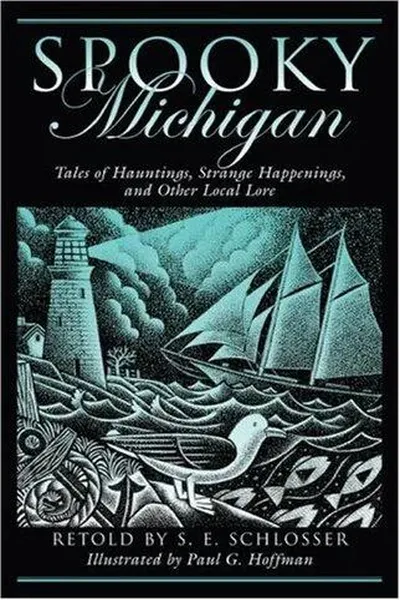
More Free Occult Philosophy Books
View all →