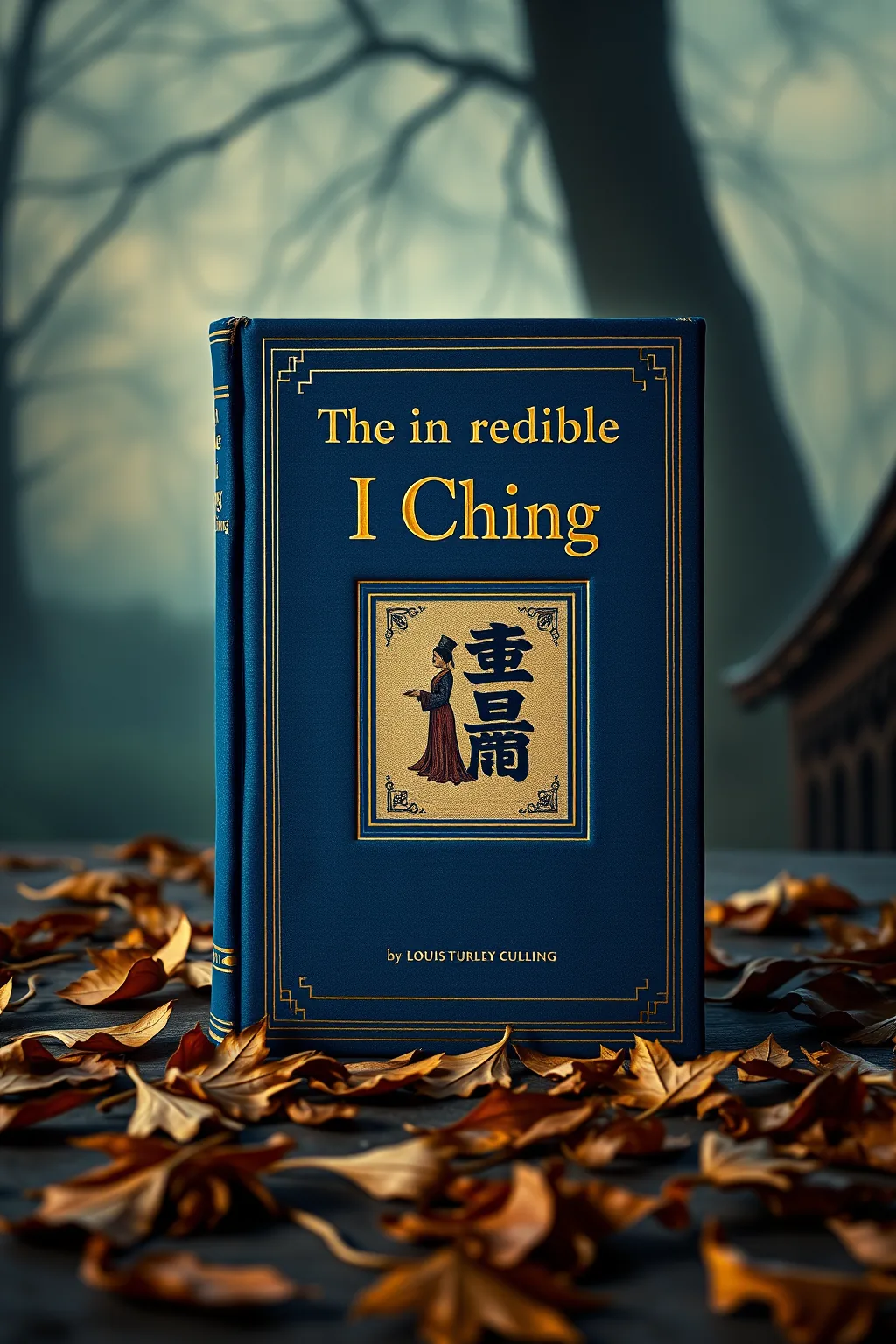
The in redible I Ching
 61
61

The in redible I Ching



Isolde Whitaker (Sacred Texts Editor) — Louis Turley Culling’s 'The Incredible I Ching' is a masterful unveiling of China’s most revered divinatory classic. Culling’s approach is both scholarly and deeply intuitive, illuminating the I Ching’s esoteric layers with remarkable clarity. He moves beyond simplistic interpretations, presenting the hexagrams as profound philosophical and psychological archetypes. This work is indispensable for serious students of divination, offering a nuanced understanding of the Book of Changes that resonates with contemporary seekers. Its strengths lie in its eloquent prose and its ability to connect the ancient wisdom to the modern human condition. A truly essential addition to any esoteric library.
📝 Description
61
Louis Turley Culling's 'The Incredible I Ching' (1994) reinterprets the ancient Chinese oracle beyond simple divination.
Published in 1994, Louis Turley Culling's 'The Incredible I Ching' approaches the classic Chinese oracle with a focus on its philosophical and spiritual dimensions. Culling moves beyond the common perception of the I Ching as solely a tool for fortune-telling. Instead, he emphasizes the hexagrams as dynamic representations of life's constant changes and underlying patterns. The book examines the symbolic language within the hexagrams, connecting them to deeper philosophical concepts and spiritual understanding.
This work invites readers to engage with the I Ching's layered meanings, seeing it as a system that reflects universal principles. Culling's interpretation aims to reveal the esoteric connections within the text, suggesting a framework for understanding reality and personal growth. The approach is designed for those interested in the I Ching's potential for self-reflection and aligning with natural principles.
The I Ching, a foundational text in Chinese thought, has long been studied within esoteric traditions for its cosmological insights and predictive methods. Its sixty-four hexagrams are seen not just as random arrangements but as a symbolic map of universal processes and human experience. Esoteric interpretations often focus on the trigrams, their relationships, and the changing lines as keys to understanding subtle energies and the flow of events. Culling's work engages with this tradition by highlighting the I Ching's capacity for revealing deeper connections and facilitating a more conscious engagement with the world.
💡 Why Read This Book?
Uncover the profound, cyclical wisdom of the I Ching, a timeless oracle for navigating life's myriad transformations. Louis Turley Culling’s insightful interpretation reveals the philosophical depth and spiritual guidance embedded within its ancient symbols. Ideal for spiritual seekers, practitioners of esoteric arts, and anyone yearning for a deeper understanding of cosmic interconnectedness and personal destiny. This book offers not just answers, but a path to wisdom.
⭐ Reader Reviews
Honest opinions from readers who have explored this book.
❓ Frequently Asked Questions
What is the I Ching?
The I Ching, or Book of Changes, is an ancient Chinese divination text and philosophical classic. It consists of 64 hexagrams, each formed by six lines, which symbolize fundamental principles of the universe and human experience.
How does one use the I Ching for divination?
Traditionally, one uses yarrow stalks or coins to generate a hexagram, then consults the text for interpretation. Culling's work provides the necessary keys to understand these interpretations, offering guidance on specific situations.
Is this book suitable for beginners?
Yes, while rich in esoteric depth, Culling's engaging prose makes the I Ching accessible to newcomers. It serves as an excellent starting point for those new to this ancient wisdom tradition.
What makes this edition 'incredible'?
'Incredible' refers to the profound and often surprising insights Culling unearths. His interpretation reveals the dynamic, transformative nature of the hexagrams, offering a fresh perspective on their ancient meanings.
What is the philosophical significance of the I Ching?
The I Ching is deeply philosophical, exploring concepts of change, balance, causality, and the interconnectedness of all things. It encourages harmonious alignment with natural principles and the flow of life.
🔮 Key Themes & Symbolism
The Dynamics of Change
Fundamentally, the I Ching is a philosophy of constant transformation. Culling emphasizes that nothing is static; life is a perpetual cycle of waxing and waning, growth and decay. Understanding these inherent rhythms allows one to navigate challenges with wisdom and embrace opportunities with clarity. This theme explores how the hexagrams act as maps of these shifting energies, providing guidance on how to adapt and flow with the universal currents of change, rather than resisting them.
Cosmic Correspondences and Symbolism
This book explores the profound symbolism embedded within the I Ching's sixty-four hexagrams. Culling reveals how these symbols are not arbitrary but represent fundamental cosmic principles and their interplay in human affairs. From the Yin and Yang dynamics to the elemental forces, each line and trigram carries a wealth of meaning, mirroring the macrocosm in the microcosm. Understanding these correspondences offers a deeper perception of reality and one's place within the grand cosmic order.
The Oracle of Self-Knowledge
Beyond mere prediction, the I Ching serves as a powerful tool for introspection and self-discovery. Culling presents the oracle as a mirror to the soul, reflecting inner states and potential outcomes based on present circumstances. By engaging with the I Ching, readers are encouraged to confront their own motivations, understand their paths, and make conscious choices aligned with wisdom and integrity. It is a journey into the self, guided by ancient, useful insights.
💬 Memorable Quotes
Direct passages from the work, attributed to the author.
“Change is the only constant; wisdom lies in understanding its flow.”
— This highlights the central tenet of the I Ching: the inevitability of transformation. True wisdom comes not from resisting change, but from developing the capacity to perceive and adapt to its ever-shifting nature.
“The hexagrams are not pronouncements, but dialogues with the universe.”
— This redefines the I Ching from a rigid fortune-telling tool to a dynamic interactive process, encouraging a deeper, more personal engagement with its wisdom for guidance.
“Within every ending lies the seed of a new beginning.”
— A concise expression of the cyclical nature of existence, emphasizing hope and renewal even in the face of apparent conclusions or difficulties.
“The oracle reflects the present, clear the path forward.”
— This emphasizes the I Ching's role as a guide for present action, using insight into current energies to inform future choices and work through the unfolding of events.
💡 Key Ideas
Editorial paraphrase of the work's core concepts — not direct quotes.
Align your actions with the natural order, and find harmony.
This quote underscores the ethical and practical application of I Ching wisdom, suggesting that true peace and success are found in living in accordance with universal principles.
🌙 Esoteric Significance
Tradition
The I Ching is a central to Chinese esoteric and philosophical traditions, deeply intertwined with Taoism and, to a lesser extent, Confucianism. It is considered a fundamental text for understanding the principles of cosmic order, the flow of energy (Qi), and the interconnectedness of all phenomena. Its practice is often linked to Daoist alchemy, meditation, and the art of living in harmony with the Tao, serving as a practical guide for working through the subtle energies of existence.
Symbolism
The I Ching's symbolism is rich and multi-layered. The eight trigrams (Bagua) represent fundamental forces of nature (heaven, earth, thunder, wind, water, fire, mountain, lake) and their combinations into 64 hexagrams depict all possible states of change. These symbols are not merely abstract but are seen as microcosmic representations of universal patterns, influencing everything from personal decisions to geopolitical events. The interplay of Yin (passive, dark) and Yang (active, light) lines within the hexagrams further elucidates the dynamic, complementary forces that drive existence.
Modern Relevance
In the modern era, the I Ching remains remarkably relevant as a tool for personal growth, decision-making, and spiritual insight. Its emphasis on adaptability, understanding the cycles of change, and acting in accordance with natural principles offers a valuable counterpoint to the often chaotic and fast-paced modern world. Esoteric practitioners and psychologists alike find its archetypal imagery and wisdom applicable to understanding human psychology, navigating complex situations, and fostering a deeper connection with oneself and the universe.
👥 Who Should Read This Book
This profound work is essential for seekers of ancient wisdom, spiritual practitioners, and students of divination. Beginners will find Culling's clear exposition an accessible gateway into the I Ching's complex world. Scholars will appreciate the depth of his interpretation and its contribution to esoteric studies. Practitioners of tarot, astrology, and other divinatory arts will discover a complementary system that offers unique insights into life's patterns and transformations. Anyone yearning for a deeper understanding of change, destiny, and harmonious living will find invaluable guidance within these pages.
📜 Historical Context
The I Ching's origins trace back to the Zhou Dynasty (c. 1046–256 BCE), emerging from ancient divination practices and shamanistic traditions. Initially used for state oracles, it gradually evolved into a profound philosophical text, deeply influencing Confucianism and Taoism. During the Han Dynasty (206 BCE–220 CE), its philosophical interpretations flourished, solidifying its status as a classic. The Song Dynasty (960–1279 CE) saw further scholarly engagement, particularly with Neo-Confucian philosophers like Zhu Xi, who integrated its cosmology into their worldview. The I Ching's influence has spanned millennia, impacting not only Chinese culture, but also spreading to Korea, Japan, and eventually the West, where it continues to be studied for its wisdom on change, strategy, and self-cultivation.
📔 Journal Prompts
Reflect on a recent period of significant change in your life. How did the I Ching's principles of cyclical transformation resonate with your experience?
When consulting the I Ching, what recurring themes or hexagrams have appeared? What might these suggest about your current life path or challenges?
Consider the concept of Yin and Yang as presented in the I Ching. How do these complementary forces manifest in your personal relationships or daily routines?
How can the wisdom of the I Ching, particularly its emphasis on adaptability and natural flow, be applied to navigate a current challenge you are facing?
The I Ching often speaks of aligning actions with cosmic principles. What does 'natural order' mean to you, and how can you better align your life with it?
🗂️ Glossary
Hexagram
A symbol composed of six stacked horizontal lines, each either solid (Yang) or broken (Yin). There are 64 distinct hexagrams in the I Ching, representing fundamental states of change.
Trigram
A symbol composed of three stacked horizontal lines, representing eight fundamental forces or concepts of nature (e.g., Heaven, Earth, Thunder). Trigrams combine to form hexagrams.
Yang
In I Ching symbolism, represented by a solid line (—). It signifies active, light, masculine, strong, and creative principles.
Yin
In I Ching symbolism, represented by a broken line (--). It signifies passive, dark, feminine, receptive, and yielding principles.
Tao (Dao)
The fundamental principle of the universe in Taoism, often translated as 'the Way.' It represents the natural order, the source of all things, and the principle of spontaneous action and harmony.
This book appears in 3 collections
🔮 Readers Also Liked
Browse all →








From the “Tarot” Collection
View all →






More Free Divination & Tarot Books
View all →