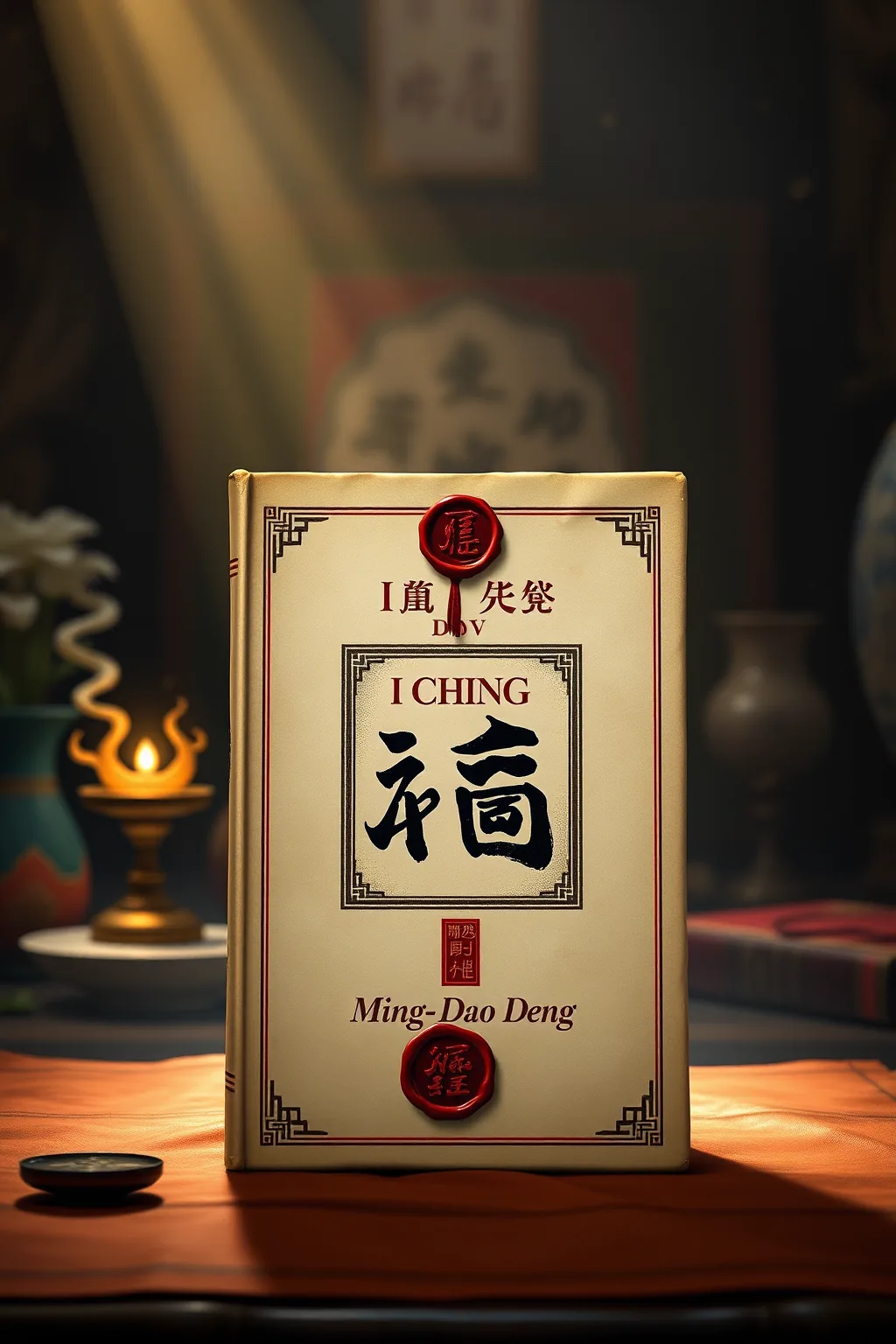
Living I Ching
 61
61

Living I Ching



By Lorelei Sage (Contemplative Literature Editor) — Ming-Dao Deng's 'Living I Ching' is a luminous guide, illuminating the venerable Yi Jing with clarity and spiritual depth. Deng's profound understanding of Taoist principles allows him to present the I Ching not as a static text, but as a vibrant, interactive dialogue with the universe. He skillfully navigates the intricate symbolism, making the ancient wisdom accessible to the modern seeker. This work is particularly potent for those who approach divination as a path to self-discovery and existential inquiry, offering profound insights into the cyclical nature of life and the art of living in alignment with the Tao. An essential addition to any serious practitioner's or scholar's collection.
📝 Description
61
Ming-Dao Deng's 2005 book presents the I Ching not just as a divination tool, but as a living system.
Ming-Dao Deng's 'Living I Ching' reinterprets the ancient Chinese text as a dynamic oracle, reflecting both the cosmos and the individual psyche. Deng moves beyond simple fortune-telling to reveal the philosophical depth of the 64 hexagrams. He connects their symbolic meanings to the practicalities of spiritual development and understanding life's changes.
The book encourages a contemplative approach, fostering a connection with the universal forces that influence human existence. It serves as a guide for those interested in the relationship between fate and personal agency. Deng provides a structured way to examine the complexities of human experience, promoting self-reflection and the development of inner balance.
This book engages with the tradition of the I Ching, a foundational text in Chinese philosophy and divination. It approaches the hexagrams not merely as static symbols but as active principles that can be applied to contemporary spiritual and psychological understanding. Deng's work is situated within esoteric interpretations that view the I Ching as a profound system for self-cultivation and cosmic awareness, going beyond its more common use as a divinatory tool.
💡 Why Read This Book?
Discover the I Ching as a living oracle, not just a fortune-telling tool. 'Living I Ching' offers profound philosophical insights into the Taoist worldview, revealing the interconnectedness of all things. Ideal for spiritual seekers, philosophers, and practitioners of Eastern wisdom who desire a deeper understanding of life's cycles and the art of mindful living. Unlock timeless guidance for personal growth and inner harmony.
⭐ Reader Reviews
Honest opinions from readers who have explored this book.
❓ Frequently Asked Questions
What is the I Ching?
The I Ching, or 'Book of Changes,' is an ancient Chinese divination text and philosophical classic. It comprises 64 hexagrams, each representing a fundamental situation or principle, used to gain insight into the past, present, and future.
How does 'Living I Ching' differ from other I Ching books?
'Living I Ching' emphasizes the dynamic, evolving nature of the I Ching, presenting it as a living oracle for spiritual guidance and philosophical reflection, rather than solely a predictive tool. Ming-Dao Deng offers a deeply integrated approach connecting it to Taoist principles.
Is this book suitable for beginners?
Yes, while it delves into profound concepts, Ming-Dao Deng's clear prose and structured approach make 'Living I Ching' accessible to beginners interested in exploring the I Ching and its philosophical underpinnings.
What philosophical concepts does the book explore?
The book delves into core Taoist concepts such as the Tao, Yin and Yang, the cyclical nature of change, balance, harmony, and the cultivation of wisdom through introspection and observation of natural patterns.
Can the I Ching be used for practical decision-making?
Absolutely. The I Ching, as presented in 'Living I Ching,' provides a framework for understanding the underlying energies and potential outcomes of situations, offering guidance for making more conscious and aligned decisions.
🔮 Key Themes & Symbolism
The Dynamic Nature of Change
This theme explores the fundamental Taoist concept that all existence is in a perpetual state of flux. The I Ching, through its hexagrams, illustrates the ceaseless transformation of energies and circumstances. Deng guides the reader to understand these shifts not as chaotic disturbances, but as predictable patterns within the grand cosmic dance. By embracing this fluidity, one learns to adapt, find balance, and navigate life's inevitable transitions with greater wisdom and resilience, fostering a deeper connection to the natural order of the universe.
The Oracle as a Mirror of the Soul
Beyond prediction, 'Living I Ching' presents the oracle as a profound tool for self-reflection and spiritual introspection. Each hexagram serves as a symbolic representation of inner states and external challenges, reflecting the reader's current situation and offering insights into their own psyche. This perspective encourages a dialogue with the deeper self, fostering self-awareness and guiding the individual towards personal growth and the rectification of inner imbalances, thus aligning one's life with greater authenticity and purpose.
Harmony through Taoist Philosophy
The book intricately ties the principles of Taoism into the interpretation of the I Ching, emphasizing the pursuit of harmony with the Tao – the fundamental, ineffable principle of the universe. Deng illustrates how understanding Yin and Yang, the balance of opposites, and the art of wu wei (non-action or effortless action) can lead to a life lived in greater flow and alignment. This philosophy offers a profound pathway to inner peace and a more integrated experience of existence.
💬 Memorable Quotes
Direct passages from the work, attributed to the author.
“To live in harmony is to live in accord with the Tao.”
— This profound statement links the practice of living harmoniously directly to the central principle of Taoism, suggesting that true peace comes from aligning oneself with the natural flow of the universe.
“The hexagrams are whispers from the universe.”
— This evocative phrase portrays the I Ching's messages as subtle yet profound guidance, encouraging the reader to listen attentively to the wisdom it offers about life's unfolding.
“The present moment is the only true oracle.”
— This emphasizes the importance of mindfulness and present awareness, suggesting that true understanding and guidance are always available within the immediate experience of life.
💡 Key Ideas
Editorial paraphrase of the work's core concepts — not direct quotes.
The I Ching is not a book of fate, but a book of change.
This quote highlights the dynamic essence of the I Ching, emphasizing its role as a guide to navigating life's transformations rather than a deterministic prophecy.
Wisdom is found not in knowing all, but in understanding the patterns.
This quote underscores the philosophical core of the I Ching, suggesting that true insight comes from recognizing the underlying principles and cyclical nature of events, rather than mere factual accumulation.
🌙 Esoteric Significance
Tradition
The I Ching is deeply rooted in Taoist and ancient Chinese esoteric traditions. It represents a sophisticated system of understanding cosmic energies and their manifestation in the human realm. Its esoteric significance lies in its portrayal of the universe as a dynamic, interconnected web of forces, where seemingly disparate events are governed by underlying principles. The text serves as a map for navigating these energies, promoting spiritual cultivation and alignment with the natural order.
Symbolism
The core symbolism of the I Ching resides in its 64 hexagrams, formed by combinations of six broken (Yin) and unbroken (Yang) lines. These lines and their arrangements represent fundamental archetypes and situations, such as creation, receptivity, struggle, and joy. The trigrams (three-line combinations) within the hexagrams further add layers of meaning, relating to elements, directions, and family roles. Decoding this rich visual language unlocks clear insights into the interplay of opposing forces and the cyclical nature of existence.
Modern Relevance
In a world often characterized by rapid change and uncertainty, the I Ching's emphasis on adaptability and understanding the flow of transformation is profoundly relevant. 'Living I Ching' bridges the ancient wisdom to contemporary challenges, offering a framework for mindful living, ethical decision-making, and spiritual growth. Its philosophical depth provides solace and guidance, encouraging introspection and a deeper connection to oneself and the universe, making it a vital tool for working through the complexities of modern life with greater wisdom and balance.
👥 Who Should Read This Book
This book is a treasure for the dedicated seeker of ancient wisdom. Beginners to the I Ching will find Ming-Dao Deng's clear exposition an accessible and profound introduction. Scholars of Eastern philosophy and comparative religion will appreciate the nuanced interpretation and historical context. Practitioners of divination and meditation will discover a rich resource for deepening their practice and understanding of the forces at play. Ultimately, anyone yearning for a more profound understanding of life's currents, seeking self-discovery, and desiring to cultivate inner harmony will find 'Living I Ching' an indispensable companion on their journey.
📜 Historical Context
The I Ching, or 'Book of Changes,' has a lineage stretching back over three millennia in Chinese history, originating as a system of divination used by royalty and scholars. Its core texts, compiled over centuries, reflect the philosophical evolution of ancient China, encompassing the wisdom of Confucianism and Taoism. During the Warring States period and the Han Dynasty, the I Ching transitioned from a purely divinatory tool to a profound philosophical and cosmological text, influencing governance, ethics, and the understanding of natural phenomena. Its enduring appeal lies in its ability to adapt and speak to successive generations, offering timeless insights into the human condition and the universal principles of change and order.
📔 Journal Prompts
Reflect on a recent situation where you experienced significant change. How might the principles of the I Ching offer a new perspective?
Consider the concept of Yin and Yang in your own life. Where do you see balance and imbalance, and how can you cultivate greater harmony?
What does 'living in accord with the Tao' mean to you in your daily life? Identify one small step you can take to align yourself more closely.
If the I Ching is a mirror to the soul, what aspect of yourself does it currently reflect most strongly?
Explore the idea of 'effortless action' (wu wei). How can you apply this principle to a task or challenge you are currently facing?
🗂️ Glossary
I Ching
An ancient Chinese text revered as a book of divination and philosophy, comprising 64 hexagrams that represent fundamental archetypes and situations.
Yi Jing
Another transliteration of the Chinese characters for the 'Book of Changes,' synonymous with I Ching.
Tao (Dao)
The fundamental, ineffable principle of the universe in Taoist philosophy; the natural order and the source of all things.
Yin and Yang
Two complementary and interconnected forces or principles that represent duality and the dynamic balance within the universe, such as dark/light, passive/active, feminine/masculine.
Hexagram
A figure composed of six stacked horizontal lines, where each line is either solid (Yang) or broken (Yin), forming one of the 64 fundamental symbols of the I Ching.
This book appears in 1 collection
🔮 Readers Also Liked
Browse all →








More by Ming-Dao Deng
All books →

From the “Divination” Collection
View all →








More Free Divination & Tarot Books
View all →