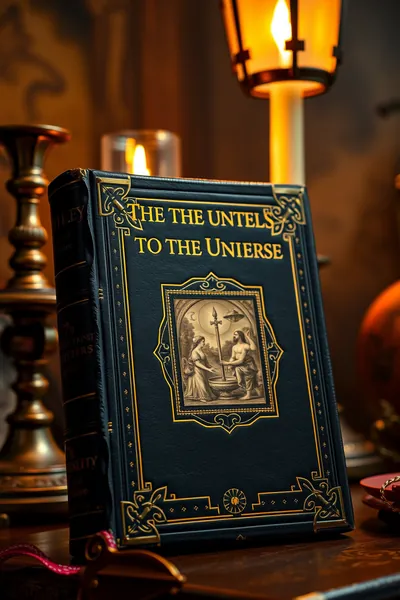
I ching Kanada

 62
62

I ching Kanada



Ophelia Vance, Mystical Literature Reviewer — Dave Godfrey's "I Ching Kanada" stands as a luminous beacon for those seeking to understand the ancient Chinese oracle. Godfrey's nuanced approach offers profound esoteric insights, moving beyond simplistic fortune-telling to reveal the I Ching as a sophisticated philosophical framework. He masterfully deciphers the complex symbolism within the hexagrams, making their potent wisdom accessible to a modern audience. This text is particularly valuable for serious students of divination and metaphysics, providing a rich, contemplative experience. Its strengths lie in its depth of interpretation and its ability to foster introspection, guiding readers toward a more profound connection with the universal energies that shape our lives. An essential read for anyone drawn to the mysteries of change.
📝 Description
62
Dave Godfrey published "I Ching Kanada" in 1987, connecting the ancient Chinese oracle to a Western context.
Dave Godfrey's 1987 book, "I Ching Kanada," examines the I Ching from a unique perspective, blending its ancient Chinese principles with a Western sensibility. Godfrey moves beyond simple fortune-telling to look at the symbolism and philosophical foundations of the hexagrams. He presents them as tools for understanding oneself and the wider cosmos. The book aims to foster contemplation and a deeper spiritual awareness.
This work is particularly noted for bridging Eastern and Western thought. It suggests the I Ching is more than a predictive device; it offers a framework for ethical considerations and existential questions. Godfrey's approach encourages a more mindful way of living, aligning the individual with natural patterns of change. The book serves as a guide for those seeking to understand life's flow and their place within it.
This book fits within the esoteric tradition by engaging with the I Ching, an ancient Chinese text long studied for its divinatory and philosophical insights. Esotericism often involves seeking hidden meanings and correspondences beyond conventional understanding. "I Ching Kanada" applies this approach by interpreting the hexagrams not just for prediction, but as a system for ethical reflection and alignment with natural principles. It represents an effort to integrate Eastern mystical traditions with Western philosophical inquiry, a common characteristic of modern esoteric movements.
💡 Why Read This Book?
Embark on a transformative journey with "I Ching Kanada." This book offers a unique synthesis of Eastern wisdom and Western interpretation, unlocking the profound symbolism of the I Ching. Ideal for seekers of spiritual depth, scholars of comparative mysticism, and practitioners of divination seeking a richer, more nuanced understanding of this ancient oracle. Discover pathways to self-awareness, navigate life's inevitable changes with grace, and align with universal truths.
⭐ Reader Reviews
Honest opinions from readers who have explored this book.
❓ Frequently Asked Questions
What is the I Ching?
The I Ching, or 'Book of Changes,' is an ancient Chinese divination text and philosophical system. It uses hexagrams—six-line figures composed of broken (yin) and unbroken (yang) lines—to represent fundamental principles of the cosmos and human experience, offering guidance on navigating life's complexities.
Is this book for beginners or advanced practitioners?
"I Ching Kanada" caters to a broad spectrum of readers. While it offers depth for experienced practitioners, its clear explanations and evocative prose make it accessible and enriching for beginners eager to explore the I Ching's wisdom.
What makes this edition unique?
Dave Godfrey's "I Ching Kanada" is distinguished by its unique cultural synthesis, blending the ancient Chinese oracle with a Western philosophical and literary sensibility, offering fresh perspectives and deeper resonance for contemporary readers.
How can the I Ching be used for divination?
The I Ching is used by casting yarrow stalks or coins to generate a hexagram, which is then interpreted using the accompanying text. This process reveals patterns and energies relevant to a specific question or situation, offering insights for decision-making and understanding.
What is the philosophical significance of the I Ching?
The I Ching's philosophy centers on the concept of constant change and balance. It teaches that all phenomena are in flux and that understanding these patterns allows for harmonious adaptation and growth, promoting wisdom and ethical living.
🔮 Key Themes & Symbolism
The Dynamics of Change
Fundamentally, the I Ching, as presented in "I Ching Kanada," is a profound exploration of the immutable principle of change that governs the universe. Godfrey illuminates how the sixty-four hexagrams represent archetypal situations and transformations, illustrating the cyclical nature of existence. This theme encourages readers to embrace flux, understand the ebb and flow of fortune, and develop resilience in the face of life's inevitable shifts. It moves beyond fatalism, presenting change as an opportunity for growth and evolution, a continuous dance between yin and yang, creation and dissolution.
Symbolic Language of the Cosmos
The hexagrams of the I Ching are a collection of symbolic language, a cosmic cipher waiting to be deciphered. "I Ching Kanada" examines the nuanced meanings embedded within the combinations of yin and yang lines, the trigrams, and the individual hexagrams. Godfrey guides the reader to understand how these symbols reflect universal archetypes, natural phenomena, and human relationships. This theme fosters a deeper appreciation for the interconnectedness of all things, inviting contemplation on how these ancient symbols offer clear insights into the human condition and the workings of the universe.
Wisdom for Harmonious Living
Beyond mere prediction, the I Ching serves as a profound ethical and philosophical guide for living in harmony with oneself and the world. Godfrey's interpretation in "I Ching Kanada" emphasizes the practical application of its wisdom in daily life. This theme focuses on the principles of balance, moderation, and timely action that emerge from the oracle's teachings. It encourages mindful decision-making, fostering a sense of agency and responsibility. By understanding the cosmic patterns, readers are empowered to cultivate inner peace, navigate interpersonal dynamics with grace, and align their lives with the Tao.
💬 Memorable Quotes
Direct passages from the work, attributed to the author.
“Within every ending, a new beginning lies dormant.”
— This highlights the cyclical nature of existence. The I Ching teaches that periods of decline or completion are not absolute but contain the seeds of future growth and renewal, offering hope and perspective.
“Seek balance in the duality of all things.”
— This points to the fundamental yin and yang principle. The I Ching encourages finding harmony by acknowledging and integrating opposing forces, rather than favoring one over the other.
“The oracle speaks not of fate, but of potential.”
— This emphasizes the I Ching's role as a guide. It reveals the energies and tendencies at play, empowering the individual to make conscious choices and shape their path, rather than passively accepting a predetermined destiny.
“Listen to the whispers of the universe; they offer guidance.”
— This suggests that subtle signs and intuitive insights are paramount. The I Ching encourages a receptive state of mind, where one can perceive the deeper currents and messages guiding their journey.
💡 Key Ideas
Editorial paraphrase of the work's core concepts — not direct quotes.
The wise man knows that change is the only constant.
This quote expresses the central tenet of the I Ching: the universe is in perpetual motion. True wisdom lies not in resisting change, but in understanding and adapting to it with foresight and equanimity.
🌙 Esoteric Significance
Tradition
The "I Ching Kanada" is deeply rooted in the Taoist and Confucian traditions of China, serving as a central to ancient Chinese esoteric thought. It functions as a cosmological map, reflecting the fundamental principles of the universe as understood through the interplay of yin and yang. Esoterically, it is viewed as a key to understanding the 'Tao'—the Way—which governs all existence. The hexagrams are not merely predictive tools but symbolic representations of universal archetypes and energetic patterns, offering a framework for spiritual cultivation and alignment with cosmic order.
Symbolism
The core symbolism of the I Ching lies in its hexagrams, formed by combinations of yin (broken) and yang (unbroken) lines, and the eight trigrams they comprise. These symbols are profoundly generative, representing everything from natural forces (heaven, earth, water, fire) to human relationships and societal structures. The interpretation of these symbols, as guided by Godfrey, reveals dynamic processes of change, balance, and transformation. The book explores how this rich visual and conceptual language serves as a bridge between the seen and unseen worlds, offering insights into the hidden currents that shape our reality.
Modern Relevance
In contemporary society, "I Ching Kanada" offers a vital antidote to the fragmentation and uncertainty of modern life. Its emphasis on understanding change, embracing balance, and cultivating mindful action resonates deeply with individuals seeking meaning and stability. The I Ching's philosophical depth provides a framework for ethical decision-making and personal growth, encouraging a more holistic and interconnected worldview. As a tool for self-reflection and insight, it empowers individuals to navigate complexity with greater wisdom and resilience, fostering a sense of agency in a world often perceived as overwhelming.
👥 Who Should Read This Book
This useful work is a treasure for a diverse range of readers. **Beginners** will find Godfrey's prose an accessible yet profound introduction to the I Ching, clarifying its complex symbolism. **Scholars** of comparative religion, philosophy, and Eastern studies will appreciate the nuanced interpretation and cultural synthesis. **Spiritual seekers** and **practitioners of divination** will discover a rich resource for self-exploration, ethical guidance, and deeper connection to universal wisdom. Anyone drawn to understanding the cyclical nature of life, seeking clarity amidst change, or yearning for a more harmonious existence will find profound value within its pages.
📜 Historical Context
Dave Godfrey's "I Ching Kanada" emerged during a period of significant cultural cross-pollination, particularly in the latter half of the 20th century, when Western intellectuals and spiritual seekers became increasingly drawn to Eastern philosophies. The I Ching, with its deep roots in ancient Chinese cosmology and philosophy dating back millennia, found new resonance as a tool for introspection and understanding in a rapidly changing world. This era saw a growing interest in existentialism, psychology, and alternative spiritual paths, all of which offered fertile ground for the I Ching's complex system of symbolism and its focus on the nature of change and human agency. Godfrey's work, by engaging with this tradition through a Canadian lens, contributed to the ongoing dialogue between Eastern mysticism and Western thought, making this profound oracle accessible and relevant to a new generation.
📔 Journal Prompts
Reflect on a recent period of significant change in your life. How did the I Ching's principles of flux apply to your experience?
Consider the core symbolism of a hexagram that has resonated with you. What archetypal energies does it represent, and how do they manifest in your life?
Explore the concept of 'balance' as presented in the I Ching. Where in your life do you currently seek greater equilibrium, and what steps can you take?
How can the wisdom of the I Ching inform your decision-making process? Journal about a current dilemma and how an I Ching consultation might offer perspective.
Contemplate the idea of 'potential' versus 'fate' in the context of the I Ching. How does this perspective empower you to shape your future?
🗂️ Glossary
Hexagram
A figure composed of six stacked horizontal lines, where each line is either solid (yang) or broken (yin). Hexagrams are the fundamental units of the I Ching's symbolic language, representing archetypal situations and transformations.
Yin
In the I Ching, yin represents the passive, receptive, dark, feminine, and yielding principle. It is symbolized by a broken line (--) in a hexagram.
Yang
In the I Ching, yang represents the active, creative, light, masculine, and assertive principle. It is symbolized by a solid line (—) in a hexagram.
Trigram
A figure composed of three lines, each either yin or yang. The eight trigrams (Pa Kua) are foundational elements, combining to form the 64 hexagrams of the I Ching.
Tao (Dao)
The fundamental principle or 'Way' of the universe in Taoist philosophy. It represents the natural order, the source of all things, and the path to living in harmony with existence.
This book appears in 3 collections
🔮 Readers Also Liked
Browse all →








From the “Tarot” Collection
View all →







More Free Divination & Tarot Books
View all →