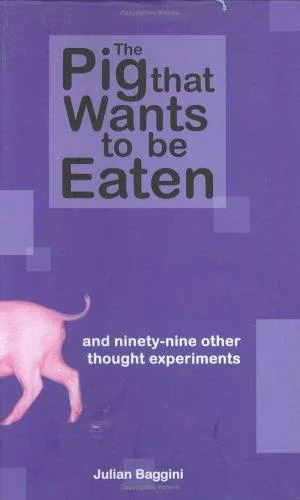
The pig that wants to be eaten
 72
72

The pig that wants to be eaten



Marcus Thorne (Esoteric Sciences Reviewer) — Julian Baggini's "The Pig That Wants to Be Eaten" is a masterful compendium of philosophical inquiries, presented with a clarity that belies its profound depth. For practitioners of esoteric arts, this work offers an invaluable framework for dissecting the axiomatic principles that often form the bedrock of mystical traditions. Baggini's exercises are akin to arcane rituals for the mind, designed to purify perception and sharpen the tools of critical introspection. It is an essential read for anyone seeking to fortify their understanding of truth, illusion, and the nature of belief itself, particularly those who appreciate the philosophical underpinnings of divination and self-transformation.
📝 Description
72
Julian Baggini's 2001 book presents fifty-five philosophical thought experiments.
Julian Baggini's "The Pig That Wants to Be Eaten" uses fifty-five short thought experiments to question common assumptions. Each experiment presents a scenario designed to highlight the paradoxes and uncertainties inherent in our understanding of the world. Baggini does not aim to provide answers but rather to stimulate critical thinking and reveal the complexity behind seemingly simple concepts.
The book is structured around these distinct philosophical puzzles, covering topics from personal identity and the nature of knowledge to ethics and consciousness. Readers are encouraged to engage with each scenario actively, examining their own intuitions and the logical consequences of different viewpoints. The work demonstrates how easily our everyday beliefs can be undermined by careful scrutiny, making the familiar seem strange and prompting a deeper consideration of what we think we know.
While not strictly esoteric in the sense of occult traditions, Baggini's work engages with the philosophical underpinnings often explored in esoteric thought. It mimics the practice of questioning fundamental reality and perception, akin to how certain mystical or contemplative traditions encourage practitioners to deconstruct their ordinary worldview. The book's focus on mental exercises and the unveiling of hidden assumptions aligns with the broader esoteric pursuit of deeper understanding beyond surface appearances.
💡 Why Read This Book?
Unearth the hidden assumptions that govern your worldview. This book is a crucible for forging intellectual resilience, equipping you with the tools to dismantle false certainties and build a more robust understanding of reality. Ideal for seekers of wisdom, contemplative scholars, and practitioners of disciplines that demand rigorous self-examination, it transforms doubt into a powerful catalyst for enlightenment.
⭐ Reader Reviews
Honest opinions from readers who have explored this book.
❓ Frequently Asked Questions
What is the core premise of "The Pig That Wants to Be Eaten"?
The book challenges the reader to question seemingly self-evident truths, exploring how fundamental assumptions can be deconstructed and re-evaluated through a series of engaging thought experiments and philosophical dilemmas.
Is this book suitable for beginners in philosophy?
Yes, while it delves into complex ideas, Baggini's accessible writing style and practical exercises make it an excellent entry point for those new to philosophical inquiry.
How does this book relate to esoteric thought?
It provides a rigorous intellectual foundation for esoteric practices by emphasizing critical thinking, the questioning of dogma, and the exploration of subjective reality, all crucial elements in many mystical traditions.
What kind of exercises are included?
The book features a variety of mental challenges, paradoxes, and structured dilemmas designed to stimulate critical thinking and encourage readers to actively engage with philosophical concepts.
Can this book help with decision-making?
By honing your ability to question assumptions and analyze situations from multiple perspectives, the book can indirectly improve your decision-making processes by leading to more informed choices.
🔮 Key Themes & Symbolism
The Alchemy of Doubt
This theme explores doubt not as an endpoint, but as a transformative force. Like an alchemist purifying base metals, Baggini guides the reader to transmute unquestioned assumptions into the gold of genuine understanding. It explores how doubt, when wielded consciously, can strip away illusion and reveal the underlying architecture of our beliefs, fostering intellectual humility and the courage to confront uncomfortable truths. This process is essential for anyone seeking to deepen their connection to deeper realities.
The Architecture of Certainty
Here, the book dissects the very structures we build to feel secure in our knowledge. Baggini examines the scaffolding of logic, evidence, and consensus that supports our beliefs, and then systematically challenges its integrity. This exploration is akin to deconstructing a sacred edifice to understand its foundational stones. For those on a spiritual path, understanding how certainty is constructed—and can be deconstructed—is vital for reading through the often ambiguous landscapes of esoteric knowledge and personal revelation.
The Labyrinth of Perception
This theme explores the subjective nature of reality and how our individual perceptions shape our world. Baggini presents scenarios that highlight the malleability of our senses and intellect, drawing parallels to the esoteric concept of Maya or illusion. The labyrinth represents the complex, often confusing, pathways of consciousness. Navigating it requires not just intellect, but an intuitive understanding of how our internal states influence our external experiences, a key skill for any practitioner of the hidden arts.
💬 Memorable Quotes
Direct passages from the work, attributed to the author.
“Is anything so self-evident that it cannot be doubted?”
— This is the core invocation of the text, a call to intellectual rigor that challenges the reader to scrutinize even the most seemingly immutable truths, setting the stage for profound self-discovery.
“What if the pig wanted to be eaten?”
— A paradoxical scenario that forces us to reconsider agency and desire, questioning assumptions about roles and motivations in even the simplest of exchanges.
“The most important questions are often the ones we stop asking.”
— This highlights the danger of intellectual complacency and encourages a lifelong pursuit of inquiry, essential for growth in any field, especially the esoteric.
“We build our worlds on foundations we rarely inspect.”
— A poignant reminder of our tendency to accept established beliefs without critical examination, urging a deeper understanding of our own cognitive architecture.
“The edge of knowledge is where curiosity is born.”
— This suggests that true learning and discovery stem from embracing the unknown and actively seeking to expand the boundaries of our understanding.
🌙 Esoteric Significance
Tradition
While not explicitly tied to a single esoteric tradition, the book's emphasis on questioning fundamental assumptions and deconstructing perceived reality resonates deeply with Gnostic thought, Skepticism, and the Zen Buddhist practice of 'beginner's mind.' It provides the intellectual tools necessary to approach any esoteric path with discernment and a critical yet open mind, essential for avoiding dogmatism.
Symbolism
The 'pig' itself can be seen as a symbol of the tangible, the mundane, or a perceived victim, whose desire to be 'eaten' inverts conventional power dynamics and expectations. This inversion is a common esoteric technique to reveal hidden truths about control, sacrifice, and the nature of intention. The act of questioning 'self-evident' truths symbolizes the stripping away of veils or illusions that obscure deeper understanding.
Modern Relevance
In an age saturated with information and often conflicting narratives, the book's call to rigorous critical thinking is more vital than ever. It empowers individuals to work through the complexities of modern life, discern truth from falsehood, and develop a more robust and authentic personal philosophy, which is foundational for genuine spiritual or metaphysical exploration.
👥 Who Should Read This Book
This book is a potent elixir for the intellectually curious and the spiritually seeking. **Beginners** will find it an accessible yet challenging introduction to critical thinking and philosophical inquiry. **Scholars** will appreciate Baggini's sharp analysis and the book's contribution to contemporary thought. **Seekers** on any path – be it philosophical, spiritual, or esoteric – will find invaluable tools for dismantling limiting beliefs and cultivating a deeper, more authentic understanding of reality. **Practitioners** of divination, meditation, or any contemplative art will benefit from the sharpened discernment and robust questioning skills this book fosters, enhancing their practice.
📜 Historical Context
Written in the early 21st century, "The Pig That Wants to Be Eaten" emerges from a cultural milieu marked by a resurgence of interest in critical thinking and a questioning of established narratives across various disciplines, including philosophy and the burgeoning field of cognitive science. It stands as a modern evidence of the enduring power of Socratic inquiry, adapted for contemporary audiences. The book reflects a broader intellectual current that seeks to explain complex philosophical concepts, making them accessible and engaging. Its structure, utilizing thought experiments and paradoxes, reflects the pedagogical methods employed by ancient philosophers and mystics alike, aiming to provoke insight through active mental engagement rather than passive reception of doctrine.
📔 Journal Prompts
What is one belief I hold as absolutely true that I have never critically examined? How can I begin to question it?
Consider a situation where you were certain of something, only to discover you were wrong. What did that experience teach you about the nature of certainty?
If the 'pig' represents a desire or a goal, what does it mean for that desire to be 'eaten' or fulfilled? Explore the nuances of desire and its satisfaction.
How do societal norms and expectations influence what I consider 'self-evident'? Identify one such influence in my own life.
What is the most significant assumption I make about myself daily? How would my day change if I questioned this assumption?
🗂️ Glossary
Axiom
A statement or proposition that is regarded as being established, accepted, or self-evidently true, forming the basis for further reasoning or argument.
Paradox
A statement or proposition that, despite sound (or apparently sound) reasoning from acceptable premises, leads to a conclusion that seems senseless, logically unacceptable, or self-contradictory.
Epistemology
The branch of philosophy concerned with the theory of knowledge, especially with its scope, methods, and validity; how we know what we know.
Skepticism
An attitude of doubt or a disposition to incredulity either in general or toward a particular object or belief. In philosophy, it refers to any questioning of claims to knowledge or certainty.
Self-Evident
Obvious without proof or argument; requiring no explanation or demonstration.
This book appears in 3 collections
🔮 Readers Also Liked
Browse all →








From the “Tarot” Collection
View all →







More Free Divination & Tarot Books
View all →