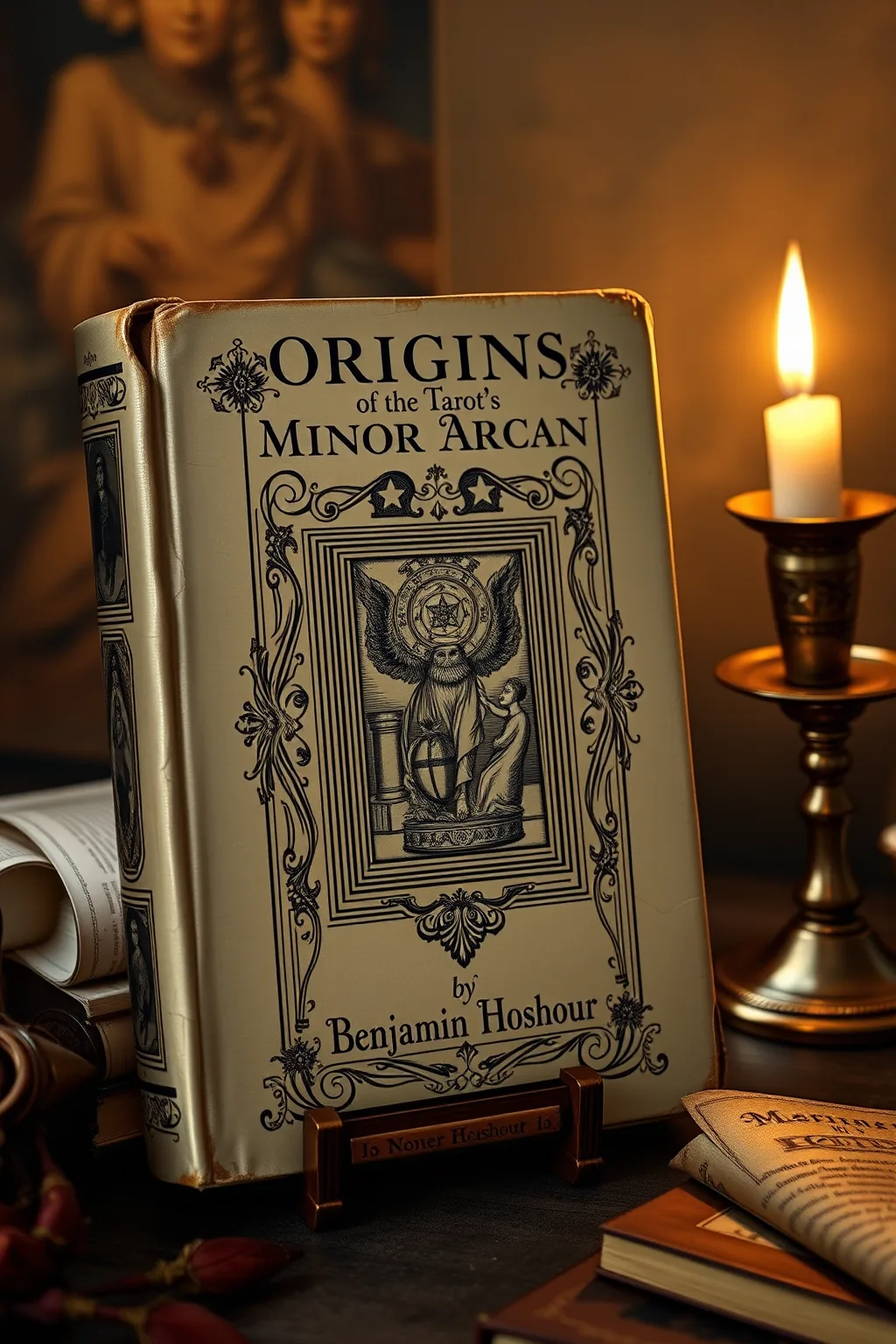
Origins of the Tarot's Minor Arcana
 61
61

Origins of the Tarot's Minor Arcana



Review by Cassian Rothmann (Senior Critic, Ancient Wisdom) — Benjamin Hoshour's 'Origins of the Tarot's Minor Arcana' is a monumental achievement in esoteric scholarship. With unparalleled depth and clarity, Hoshour excavates the forgotten roots of the pip cards, revealing their profound symbolic language and historical evolution. He masterfully connects ancient numerology, Kabbalistic principles, and alchemical symbolism to illuminate the intricate tapestry of the Minor Arcana. This is not merely a historical account; it is a revelation for practitioners seeking to deepen their understanding beyond superficial readings. Essential for serious Tarot enthusiasts and occult researchers alike, this book offers a rare glimpse into the true power and wisdom embedded within these ancient cards.
📝 Description
61
Benjamin Hoshour's 2019 book traces the Minor Arcana's development from medieval Italy.
Benjamin Hoshour's 'Origins of the Tarot's Minor Arcana' examines the historical and symbolic roots of the pip cards. The book argues that the numbered cards of the Tarot deck, often overshadowed by the Major Arcana, possess a rich history and distinct symbolic language. Hoshour investigates their lineage, suggesting their development is tied to early Italian card games and evolving symbolic systems. He details how each card, from the Ace to the Ten, functions not just for divination but as a carrier of specific meanings and energies.
The author analyzes the visual and conceptual elements of these cards, connecting them to broader cultural and esoteric currents. The work aims to illuminate the structure and philosophical underpinnings of the Minor Arcana, showing how they contribute to the Tarot's overall system of meaning. It is intended for readers interested in a detailed historical and symbolic account of these often-overlooked cards.
This study situates the Tarot's numbered cards within a tradition that views symbolic systems as keys to understanding consciousness and the cosmos. While the Major Arcana are often the focus of esoteric study, Hoshour emphasizes the unique symbolic grammar of the Minor Arcana. His work connects to traditions that see divinatory tools as codified systems of knowledge, reflecting a desire to understand the underlying order of existence. The research aligns with historical investigations into occult traditions and their reliance on visual and numerical symbolism.
💡 Why Read This Book?
Uncover the secret history and profound symbolism of the Tarot's seventy-eight pip cards. 'Origins of the Tarot's Minor Arcana' offers a deep dive into the esoteric roots of divination, making it an indispensable resource for seekers, scholars, and practitioners wishing to move beyond superficial interpretations and connect with the ancient wisdom encoded within the Tarot.
⭐ Reader Reviews
Honest opinions from readers who have explored this book.
❓ Frequently Asked Questions
What is the primary focus of this book?
The book meticulously explores the historical, symbolic, and esoteric origins of the Minor Arcana in Tarot, delving into their development and underlying mystical meanings.
Is this book suitable for beginners?
While rich in depth, it provides foundational knowledge. Beginners will gain a profound appreciation for the Tarot's structure, but a basic familiarity with Tarot concepts is beneficial.
What makes this book unique compared to other Tarot guides?
It focuses specifically on the genesis and esoteric underpinnings of the Minor Arcana, offering a specialized and deeply researched perspective often overlooked in broader Tarot literature.
What esoteric traditions are explored in relation to the Minor Arcana?
The book draws connections to Kabbalah, Gnosticism, alchemy, and ancient numerology, revealing the multi-layered symbolic framework of the cards.
Can this book enhance my Tarot readings?
Absolutely. Understanding the deeper origins and symbolism of the Minor Arcana can unlock richer interpretations and more nuanced insights during your divinatory practice.
🔮 Key Themes & Symbolism
The Unveiling of the Pip Cards
This theme explores the gradual emergence and codification of the Minor Arcana, moving beyond their utilitarian origins as playing cards to become potent vehicles for spiritual insight. It looks at the transition from simple numerical and suit-based meanings to complex symbolic narratives, highlighting how each card became a microcosm of universal forces and human experiences, offering a body of work for divination.
Numerological and Kabbalistic Resonance
The book meticulously examines the profound influence of numerology and Kabbalistic principles on the structure and meaning of the Minor Arcana. It reveals how the numbers one through ten, and the suits themselves, correspond to specific energetic vibrations, Sephiroth, and pathways on the Tree of Life, providing a deep esoteric framework for understanding the cards' predictive and transformative power.
Archetypal Narratives of the Suits
This theme focuses on the distinct archetypal energies embodied by the four suits of the Minor Arcana: Wands (Will/Spirit), Cups (Emotion/Love), Swords (Intellect/Conflict), and Pentacles (Matter/Manifestation). Hoshour illuminates how these elemental forces interact and manifest in the human journey, offering readers a powerful lens through which to understand the diverse challenges and blessings encountered in daily life.
💬 Memorable Quotes
Direct passages from the work, attributed to the author.
“In the Ace lies the seed of all possibility.”
— This highlights the foundational power of the Ace card, representing pure potential and the genesis of the suit's unique energy.
“The Ten completes a cycle, a whisper of divine completion.”
— This interpretation points to the Ten card signifying the culmination of a journey or lesson, hinting at a return to source or a state of fulfillment.
“The suits are the elemental breath of existence.”
— This frames the four suits as fundamental forces that animate and shape reality, essential components of the cosmic dance.
“To know the pip is to know the pulse of the world.”
— This emphasizes the profound connection between understanding the Minor Arcana and grasping the underlying rhythms and energies of life.
💡 Key Ideas
Editorial paraphrase of the work's core concepts — not direct quotes.
The numbered cards are not mere steps, but traces of the divine.
This quote suggests that the Minor Arcana transcend simple progression, embodying fundamental spiritual truths and resonating with the essence of the cosmos.
🌙 Esoteric Significance
Tradition
This work is deeply rooted in the Western Esoteric Tradition, drawing heavily from Hermeticism, Kabbalah, Gnosticism, and Pythagorean numerology. It posits the Tarot, particularly the Minor Arcana, not as a mere divinatory tool, but as a symbolic map of consciousness and a key to unlocking divine principles and universal laws, aligning with the tradition's aim of spiritual illumination and self-knowledge.
Symbolism
The Minor Arcana are presented as a sophisticated symbolic language. The suits represent the four elements and their respective spheres of influence (Spirit, Emotion, Intellect, Matter), while the numbers 1-10 embody the journey of manifestation and evolution, mirroring the Sephiroth of the Kabbalistic Tree of Life. Each card is a nexus of archetypal imagery, numerological resonance, and elemental energy, offering useful insights into the human condition.
Modern Relevance
In an age often perceived as fragmented and materialistic, the Minor Arcana offer a profound connection to deeper meaning and inner wisdom. Hoshour's exploration provides practitioners and seekers with a robust framework for understanding life's challenges and opportunities through the lens of ancient symbolism. This knowledge empowers individuals to navigate their paths with greater insight, resilience, and a conscious connection to universal patterns.
👥 Who Should Read This Book
This important work is essential for serious Tarot enthusiasts seeking to transcend superficial readings and grasp the profound esoteric underpinnings of the pip cards. It is important for occult scholars and historians of mysticism who wish to understand the development of Tarot symbolism. Aspiring cartomancers will find it a foundational text for building a deep, intuitive understanding. Seekers of ancient wisdom will discover a collection of interconnected esoteric principles woven into the very fabric of the Tarot's numbered cards.
📜 Historical Context
Benjamin Hoshour's 'Origins of the Tarot's Minor Arcana' emerges from a collection of esoteric revival and scholarly inquiry that flourished in the late 19th and early 20th centuries. This period saw a resurgence of interest in ancient wisdom traditions, occultism, and mystical philosophies, fueled by figures like Eliphas Lévi and the Hermetic Order of the Golden Dawn. During this era, scholars and practitioners meticulously sought to decode the hidden meanings within historical artifacts, including the Tarot. The development of the Rider-Waite-Smith deck, with its richly illustrated pips, was a significant milestone, standardizing many interpretations that Hoshour's work looks at. This book stands as a proof of that scholarly tradition, meticulously tracing the lineage of the Minor Arcana from their probable origins in playing cards to their established roles in divination and spiritual exploration, reflecting a deep engagement with the intellectual and mystical currents of its time.
📔 Journal Prompts
Reflect on the Ace of your favorite suit: What dormant potential does it represent in your current life journey?
Consider a Ten card you've recently encountered in a reading. What cycle has concluded, and what new beginning is hinted at?
How do the elemental energies of the suits (Wands, Cups, Swords, Pentacles) manifest in your daily interactions and inner world?
Choose a numbered card from a suit that feels challenging for you. What does its symbolism suggest about overcoming this obstacle?
How can understanding the numerological progression from Ace to Ten deepen your perception of personal growth and spiritual evolution?
🗂️ Glossary
Minor Arcana
The seventy-eight cards of the Tarot deck comprising the four suits (Wands, Cups, Swords, Pentacles) numbered from Ace to Ten, often representing the everyday experiences and challenges of life.
Kabbalah
A mystical tradition within Judaism that explores the divine nature and the creation of the universe through a symbolic system, most notably the Tree of Life with its ten Sephiroth.
Hermeticism
A philosophical and religious tradition based on the purported teachings of Hermes Trismegistus, emphasizing esoteric knowledge, the divine nature of humanity, and the interconnectedness of all things.
Gnosticism
A diverse set of religious ideas and systems characterized by the belief that salvation comes through esoteric knowledge (gnosis) of the divine, often involving a dualistic worldview.
Archetype
In Jungian psychology, a universal, inherited pattern of thought or imagery derived from the experience of the species, present in the collective unconscious and manifesting in myths, dreams, and symbols.
This book appears in 3 collections
🔮 Readers Also Liked
Browse all →









More by Benjamin Hoshour
All books →
From the “Tarot” Collection
View all →







More Free Divination & Tarot Books
View all →