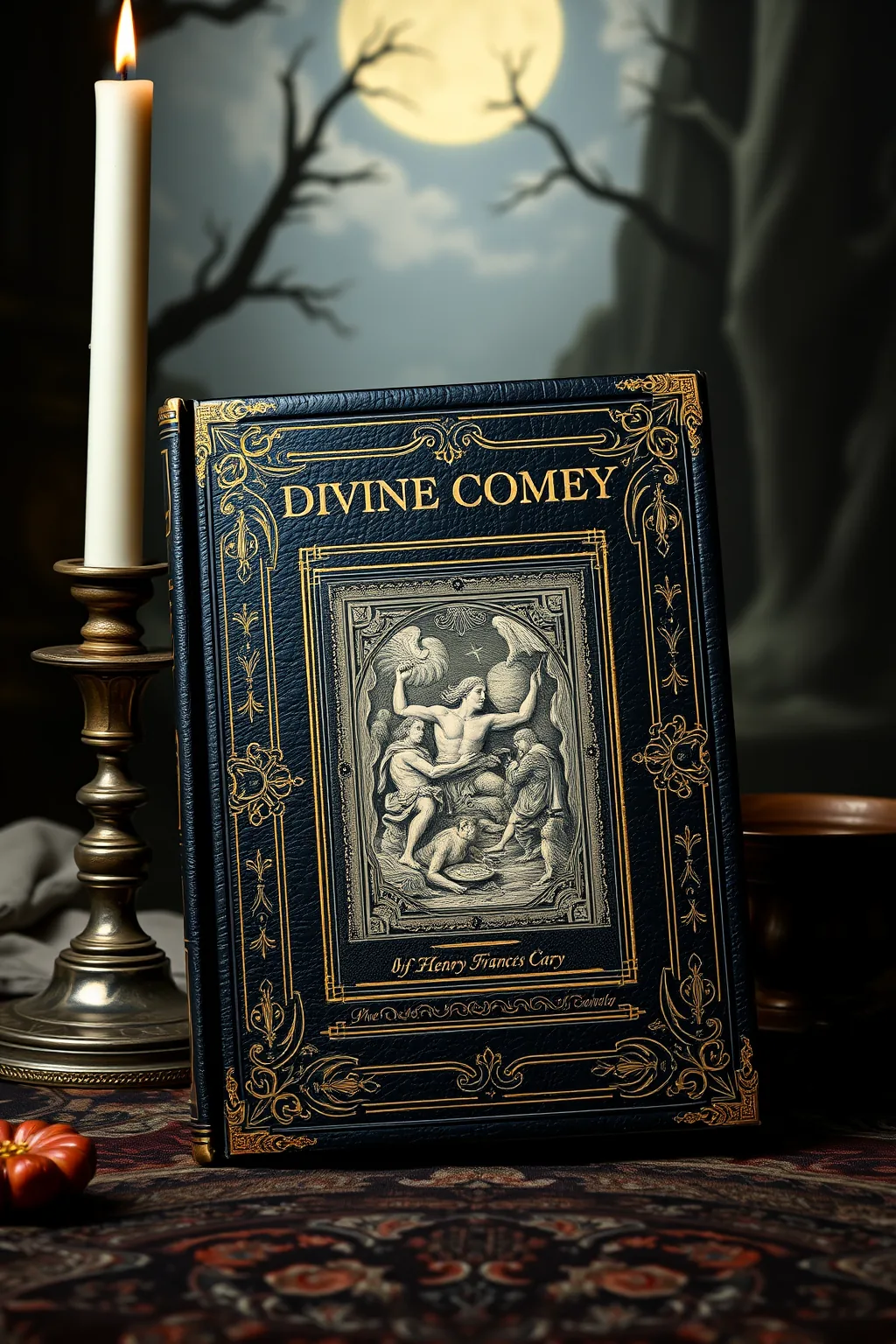
Divine Comedy
 62
62

Divine Comedy



Henry Francis Cary's translation of the *Divine Comedy* remains an indispensable cornerstone for any serious student of esoteric literature. It is not merely a linguistic rendition, but an alchemical distillation of Dante's profound spiritual vision. Cary’s meticulous attention to the theological and philosophical underpinnings allows the reader to grasp the text’s layered symbolism, revealing its potent connections to Hermeticism, Neoplatonism, and Gnostic thought. For practitioners and scholars alike, this edition offers a clear, resonant voice through which to explore the soul’s journey, the nature of divine justice, and the intricate cosmology of the medieval mind. It is a profoundly illuminating and spiritually charged work, essential for understanding the Western esoteric tradition.
📝 Description
62
Henry Francis Cary's 1814 translation brought Dante's *Divine Comedy* to English readers.
Cary's English version of Dante Alighieri's *Divine Comedy* renders the epic poem for a new audience. The work follows the soul's path from sin to divine grace, presented as an allegory. Cary's translation preserves the theological, philosophical, and visionary elements of the original Italian.
Within the poem, readers find symbolic representations of spiritual growth, ideas about the structure of the universe, and reflections on justice, love, and salvation. Cary's rendering is a significant resource for understanding the deeper, less obvious meanings within the text. It speaks to those who study spiritual traditions and seek insight into profound visions.
The text invites contemplation on fundamental questions of existence. It combines Dante's poetic vision with Cary's dedicated scholarly effort, aiming to illuminate the spiritual framework of reality.
The *Divine Comedy* has long attracted interpretations that look beyond its surface narrative. Readers have found in it symbolic maps of spiritual progress, cosmological order, and the nature of divine justice. Cary's translation facilitates access to these readings, which often connect Dante's work to Neoplatonic ideas and medieval mystical traditions. It is seen as a text that reveals spiritual truths through allegory and symbolic language, appealing to those interested in the hidden structures of reality and the soul's relationship with the divine.
💡 Why Read This Book?
This translation of the *Divine Comedy* is essential for seekers of hidden knowledge, offering a profound allegorical map of spiritual ascent and descent. Scholars will find its scholarly apparatus illuminating, while practitioners can draw deep inspiration from its rich symbolism and contemplation of divine order. It provides a foundational text for understanding Western esoteric thought and the soul’s ultimate quest for union with the divine.
⭐ Reader Reviews
Honest opinions from readers who have explored this book.
❓ Frequently Asked Questions
What is the primary allegorical meaning of the Divine Comedy?
The *Divine Comedy* allegorically represents the soul's journey from sin and despair (Inferno), through purification and penance (Purgatorio), to ultimate salvation and divine enlightenment (Paradiso).
Who is Beatrice in the Divine Comedy?
Beatrice is Dante's idealized love, who becomes his spiritual guide through Paradise, symbolizing divine grace, theology, and the path to God.
Is this translation suitable for beginners in esoteric studies?
Yes, while rich and complex, Cary's translation offers clarity and depth, making it accessible to dedicated beginners eager to explore profound spiritual and philosophical themes.
What esoteric traditions does the Divine Comedy engage with?
The work draws heavily on Christian theology, Neoplatonism, Hermeticism, and scholastic philosophy, reflecting the intellectual and mystical currents of the medieval era.
How does the Divine Comedy relate to Tarot symbolism?
The archetypal journeys and symbolic landscapes within the *Divine Comedy* resonate strongly with the Major Arcana of Tarot, offering a rich context for interpreting their spiritual significance.
🔮 Key Themes & Symbolism
The Soul's Pilgrimage and Spiritual Ascent
This theme explores the fundamental journey of the human soul from a state of spiritual darkness and entanglement in worldly sin, through a process of rigorous self-examination and purification, towards an ultimate reunion with the divine essence. The narrative acts as an allegorical roadmap, detailing the stages of spiritual growth, the challenges faced, and the transformative experiences encountered on the path to enlightenment and ultimate grace. It is a profound meditation on free will, divine justice, and the soul's inherent capacity for redemption and transcendence.
Cosmic Order and Divine Justice
The *Divine Comedy* meticulously constructs a divinely ordained cosmos, where every soul's fate is a reflection of its earthly choices, governed by an immutable and perfect justice. This theme looks at the intricate structure of Hell, Purgatory, and Paradise, illustrating the precise and often terrifying consequences of sin, the necessary process of atonement, and the ecstatic rewards of virtue. It reflects a deep belief in a rational, hierarchical universe where divine love and justice are inextricably intertwined, guiding all creation towards its appointed end.
The Nature of Love and Divine Illumination
Love, in its multifarious forms, serves as the central animating force and ultimate destination within the *Divine Comedy*. From the earthly love that can lead astray to the transcendent, divine love that guides the soul towards God, the poem explores its power as both a creative and redemptive principle. The journey culminates in Paradiso, where love is equated with the very motion of the heavens and the ultimate beatific vision, representing the soul’s complete absorption into the divine light and the profound understanding that arises from this union.
💬 Memorable Quotes
Direct passages from the work, attributed to the author.
“Abandon all hope, ye who enter here.”
— A stark warning inscribed above the Gates of Hell, symbolizing the utter absence of divine mercy and the finality of spiritual damnation for those who choose sin.
“In His will is our peace.”
— A profound statement of surrender and acceptance, expressing the ultimate state of spiritual tranquility achieved through aligning one's will with the divine will.
“There is no greater sorrow than to recall our times of joy in misery.”
— This poignant reflection from the depths of Hell highlights the torment of remembering lost happiness when plunged into eternal suffering, emphasizing the weight of regret.
“Through me you pass into the city of sorrow.”
— Spoken by the Gate of Hell, this pronounces the inevitable passage into a field of eternal suffering for all who are separated from divine grace.
💡 Key Ideas
Editorial paraphrase of the work's core concepts — not direct quotes.
The love that moves the sun and the other stars.
The ultimate revelation in Paradise, this line signifies the all-encompassing divine force that orders and animates the entire cosmos, representing God's boundless love.
🌙 Esoteric Significance
Tradition
The *Divine Comedy* is deeply rooted in Western esoteric traditions, particularly Christian Neoplatonism and Hermeticism. It presents a sophisticated allegorical framework for understanding the soul's journey, mirroring concepts found in Gnostic cosmology and medieval mystical theology. The poem's hierarchical structure of the afterlife and its emphasis on symbolic interpretation align with esoteric practices aimed at spiritual ascent and the attainment of divine knowledge. It serves as a foundational text for those exploring the mystical dimensions of Christianity and their connections to broader occult traditions.
Symbolism
The *Divine Comedy* is a veritable lexicon of esoteric symbolism. The journey itself represents the alchemical process of transformation, with each circle of Hell, terrace of Purgatory, and sphere of Paradise embodying specific spiritual states or challenges. Figures like Virgil (reason), Beatrice (divine grace), and the various mythological and biblical characters act as archetypal guides and cautionary tales. Animals, celestial bodies, and architectural imagery all carry profound symbolic weight, representing moral vices, virtues, divine attributes, and the structure of the spiritual universe.
Modern Relevance
In an age often characterized by spiritual seeking and existential questioning, the *Divine Comedy* offers enduring relevance. Its profound exploration of morality, justice, free will, and the consequences of human action continues to resonate deeply. The poem’s allegorical structure provides a powerful framework for understanding personal growth and spiritual development, offering insights into the nature of suffering, redemption, and the pursuit of ultimate meaning. For practitioners of esoteric disciplines, it remains a vital source for contemplating the architecture of consciousness and the interconnectedness of the material and spiritual realms.
👥 Who Should Read This Book
This translation is important for the dedicated spiritual seeker yearning to understand the soul’s journey through the domains of consequence and grace. Scholars of comparative religion, philosophy, and medieval literature will find its depth and scholarly rigor indispensable. Practitioners of Hermeticism, mysticism, and Tarot will discover a collection of archetypes and symbolic landscapes that inform their own studies and practices. Even the general reader with an appetite for profound, allegorical narratives will find themselves captivated by its timeless exploration of the human condition and the ultimate mysteries of existence.
📜 Historical Context
Written in the early 14th century, Dante Alighieri’s *Divine Comedy* emerged from a period of profound theological, philosophical, and political upheaval in medieval Europe. The work synthesizes the dominant scholastic thought of figures like Thomas Aquinas with the burgeoning humanism and classical influences that characterized the late Middle Ages. Its creation coincided with the Avignon Papacy and significant schisms within the Church, lending a sense of urgency and critique to Dante’s vision of divine justice and church reform. The poem reflects the medieval worldview, a complex range woven from Christian doctrine, Aristotelian logic, Neoplatonic mysticism, and contemporary Florentine politics. Henry Francis Cary’s 19th-century translation, meanwhile, positioned the *Divine Comedy* for a new audience, bridging the gap between its medieval origins and Victorian sensibilities, and solidifying its status as a central to Western literature and spiritual thought.
📔 Journal Prompts
Reflect on a personal 'Inferno' – a period of profound difficulty or moral struggle. What lessons did you learn from this experience?
Consider the concept of 'divine justice' as presented in the poem. How does this contrast with your understanding of justice in the human world?
Imagine Beatrice as a guide in your own life. What spiritual or intellectual truths would she help you uncover?
The *Divine Comedy* is a journey of transformation. Describe a significant personal transformation you have undergone or aspire to undergo.
Meditate on the 'love that moves the sun and the other stars.' How does this concept of universal love manifest in your life and the world around you?
🗂️ Glossary
Allegory
A story, poem, or picture that can be interpreted to reveal a hidden meaning, typically a moral or political one. The *Divine Comedy* is a profound allegorical narrative of the soul's journey.
Neoplatonism
A philosophical system derived from Plato's philosophy, emphasizing the spiritual, intellectual, and mystical aspects of existence, and the ultimate emanation from a divine 'One'.
Hermeticism
A religious, philosophical, and esoteric tradition based primarily upon writings attributed to Hermes Trismegistus, emphasizing spiritual knowledge, alchemy, and the interconnectedness of the cosmos.
Scholasticism
A medieval method of critical thought which dominated teaching in the major European universities from about 1100 to 1700. It was based on the use of reason to understand theological and philosophical truths.
Beatific Vision
In theology, the direct, intuitive, and immediate apprehension of God, considered the ultimate goal and reward of the soul in Paradise, leading to perfect bliss.
This book appears in 3 collections
🔮 Readers Also Liked
Browse all →









From the “Tarot” Collection
View all →








More Free Divination & Tarot Books
View all →