I Ching

 79
79

I Ching
James Legge's translation of the I Ching, first published in 1988, presents the ancient Chinese divination text with a scholarly rigor that can be both its greatest asset and its most significant hurdle. The extensive introductory material and appendices provide invaluable historical and philosophical context, situating the I Ching within the Confucian canon and detailing its complex interpretive history. Legge's meticulousness, however, sometimes results in a dense, academic prose that can feel distant from the intuitive, experiential nature of consulting the oracle. For instance, his detailed exegesis of specific lines within hexagrams, while informative, can obscure the immediate applicability for a contemporary reader seeking direct guidance. The strength lies in its comprehensive scholarship, offering a deep dive into the text's origins and its place in intellectual history. Its limitation is the potential for overwhelming the uninitiated reader. The section on the commentaries by the Ten Wings, essential for understanding the I Ching's philosophical evolution, exemplifies this duality – illuminating but demanding. Legge's I Ching is a critical academic resource, less so a readily accessible guide for casual consultation.
📝 Description
79
James Legge's 1899 translation presents the I Ching, a foundational Chinese text on divination and wisdom.
The I Ching, or Book of Changes, is an ancient Chinese text that uses 64 hexagrams to represent archetypal situations and transformations. Each hexagram, formed by stacked solid (yang) and broken (yin) lines, acts as a symbolic mirror for understanding human affairs and the natural world.
This edition features James Legge's translation, aimed at serious students of Chinese philosophy, comparative religion, and esoteric traditions. It offers a scholarly approach to the I Ching's philosophical depth and historical development, appealing to those interested in ancient divination, Eastern mysticism, and the intellectual frameworks of East Asia.
Originating in the Western Zhou Dynasty, the I Ching evolved over centuries and became a Confucian Classic. Its influence is vast, impacting Chinese cosmology and spiritual life through extensive commentaries and its systematic examination of change and cosmic order.
The I Ching is a cornerstone of Chinese esoteric thought, deeply intertwined with Taoist and Confucian philosophies. Its system of divination, based on the interplay of Yin and Yang and represented by hexagrams, was used to understand the flow of cosmic energy and align human actions with universal patterns. For centuries, it served not only as a tool for prediction but also as a guide for ethical conduct and governance, reflecting a worldview where the human realm is connected to the cosmic order.
💡 Why Read This Book?
• Gain a foundational understanding of the 64 hexagrams, the symbolic building blocks of the I Ching, and their arrangement derived from the eight trigrams. • Explore the concept of Yin and Yang as presented in this classic text, learning how these fundamental forces are depicted as dynamic and interactive in ancient Chinese philosophy. • Understand the historical significance of the I Ching as one of the Five Classics of Confucianism, grasping its intellectual roots and its influence on East Asian thought since the Western Zhou Dynasty.
⭐ Reader Reviews
Honest opinions from readers who have explored this book.
❓ Frequently Asked Questions
What is the primary purpose of the I Ching?
The I Ching serves as a system of divination and a text of wisdom literature. It offers guidance on decision-making and understanding life situations through its symbolic framework of 64 hexagrams, originating in ancient China.
Who was James Legge and why is his translation important?
James Legge was a Scottish sinologist and scholar who produced one of the earliest and most influential English translations of Chinese classics, including the I Ching, in the late 19th century. His work is valued for its scholarly depth and historical context.
How are the hexagrams in the I Ching formed?
Each of the 64 hexagrams is constructed from six stacked lines. These lines are either solid (representing Yang) or broken (representing Yin), combining in specific sequences to form the hexagrams.
What are the philosophical underpinnings of the I Ching?
The text is deeply rooted in the philosophy of change, emphasizing the dynamic interplay of Yin and Yang forces. It presents a worldview where constant transformation is the natural order, and understanding these patterns leads to harmony.
Is the I Ching still relevant today?
Yes, the I Ching remains relevant as a tool for self-reflection, philosophical inquiry, and exploring ancient wisdom traditions. Its archetypal situations and emphasis on adaptable responses continue to offer insights into contemporary challenges.
What is the role of Confucianism in the I Ching?
The I Ching was canonized as one of the Five Classics of Confucianism, significantly shaping its interpretation and its role in Chinese intellectual and ethical discourse. Confucian commentaries are integral to understanding its philosophical development.
🔮 Key Themes & Symbolism
The Dynamics of Change
Central to the I Ching is the principle that all existence is in a state of perpetual flux. The text uses the 64 hexagrams not as static representations, but as dynamic diagrams illustrating the unfolding of situations and the inevitability of transformation. It teaches that by understanding the patterns of change, one can align actions with the natural flow of the cosmos, avoiding stagnation and adapting to evolving circumstances. This perspective offers a philosophical lens through which to view personal growth and external events.
Yin and Yang Complementarity
The fundamental dualistic forces of Yin (passive, dark, feminine) and Yang (active, light, masculine) are the building blocks of the I Ching's symbolic system. The text explores their constant interaction, opposition, and interdependence. Each hexagram is a unique configuration of these forces, representing specific balances and imbalances. Understanding this interplay is crucial for interpreting the hexagrams and recognizing how complementary opposites drive the processes of creation and change in the universe.
Divination and Ethical Guidance
Beyond its philosophical content, the I Ching functions as an oracle. By casting yarrow stalks or coins, individuals consult the text for guidance on specific questions. The hexagrams and their changing lines are interpreted to reveal the underlying dynamics of a situation and suggest appropriate courses of action. This practice is intertwined with ethical considerations, encouraging wisdom, foresight, and moral conduct in alignment with cosmic principles.
The Hexagrammatic System
The 64 hexagrams, each composed of six lines (Yin or Yang), form the core structure of the I Ching. These are derived from eight fundamental trigrams (Ba Gua). Each hexagram represents a fundamental archetype or situation, from 'The Creative' (Qian) to 'The Receptive' (Kun). The interpretation of the hexagrams, often supplemented by ancient commentaries, provides a symbolic language for understanding the complexities of life and the cosmos.
💬 Memorable Quotes
Direct passages from the work, attributed to the author.
“The superior man, when he is active, understands the changes and makes them available.”
— This sentiment highlights the practical application of understanding cosmic patterns. It suggests that true wisdom lies not just in observing change, but in actively engaging with it and utilizing that knowledge for beneficial action.
“When the places of the ruler and the minister are not correctly established, there is disorder.”
— This interpretation speaks to the importance of order and proper hierarchy within a system, whether social, political, or even within the symbolic structure of the hexagrams themselves. Misplaced roles lead to chaos.
“The superior man, in accordance with the changes, takes his course.”
— This reflects the core principle of adaptability. It suggests that wise individuals do not rigidly adhere to a single plan but adjust their actions and direction based on the ever-shifting circumstances revealed by the I Ching.
💡 Key Ideas
Editorial paraphrase of the work's core concepts — not direct quotes.
The superior man, in his vigorous movement, carries all things along with him.
This passage emphasizes the power of decisive and well-aligned action. It suggests that when one acts with clarity and in harmony with underlying principles, their influence can be pervasive and transformative.
The superior man learns from the changes, and, by his example, teaches the people.
This paraphrased concept underscores the pedagogical aspect of the I Ching. It implies that understanding and embodying the principles of change allows one to serve as a model for others, guiding them through their own transformations.
🌙 Esoteric Significance
Tradition
While deeply embedded in Chinese philosophical traditions like Confucianism and Daoism, the I Ching possesses significant esoteric dimensions that have resonated within Western Hermeticism and modern occultism. Its systematic cosmology, based on the interplay of Yin and Yang and the transformation of hexagrams, offers a framework for understanding universal principles of change and balance. Esoteric practitioners often view the I Ching not just as a divination tool but as a map of consciousness and a guide to aligning one's will with cosmic forces, drawing parallels to Kabbalistic concepts of divine emanation and structure.
Symbolism
The foundational symbols are the Yin line (broken) and the Yang line (solid), representing dualistic yet complementary cosmic forces. These combine to form the eight Trigrams (Ba Gua), such as Heaven (Qian) and Earth (Kun), which symbolize primal energies. The 64 Hexagrams are built from these trigrams, each representing archetypal situations and transformations in the human and natural world. For example, Hexagram 1, Qian (The Creative), symbolizes pure Yang energy, initiation, and potent action, while Hexagram 2, Kun (The Receptive), embodies pure Yin, yielding, and nurturing.
Modern Relevance
Contemporary esotericists, psychologists, and systems thinkers continue to draw upon the I Ching's profound symbolic language. Its emphasis on cyclical change and the interconnectedness of all phenomena aligns with modern ecological and systems theory perspectives. Practices such as Jungian psychology, which explored the archetypal patterns within the hexagrams, demonstrate its enduring relevance. Modern occultists and diviners utilize it for personal insight, ethical guidance, and understanding complex energetic dynamics in rituals and personal development.
👥 Who Should Read This Book
• Students of comparative religion and ancient philosophy seeking a foundational text in East Asian thought. • Practitioners of esoteric traditions interested in divination systems and cosmological frameworks beyond the Western canon. • Scholars of Chinese history and culture looking to understand a text that has profoundly shaped East Asian intellectual and spiritual life for over two millennia.
📜 Historical Context
The I Ching's textual history spans millennia, with its earliest layers likely dating to the Western Zhou Dynasty (c. 1046–771 BCE). It evolved from a divinatory manual into a foundational philosophical text, becoming one of the Five Classics of Confucianism. This canonical status, solidified during the Han Dynasty (206 BCE – 220 CE), ensured its centrality in Chinese education and governance. The extensive commentaries, particularly the 'Ten Wings' traditionally attributed to Confucius and his disciples, are crucial for understanding its philosophical maturation. During its development, various schools of thought engaged with its principles; while Confucianism elevated it as a guide to ethical conduct and governance, Daoism found resonance in its emphasis on natural flow and transformation. The work's enduring influence is a evidence of its adaptability across different intellectual currents in Chinese history.
📔 Journal Prompts
The concept of Yin and Yang within Hexagram 1 (Qian) and Hexagram 2 (Kun).
The philosophical implications of continuous transformation as described in the text.
How the structure of the eight Trigrams (Ba Gua) might represent fundamental cosmic forces.
The relationship between ethical conduct and effective divination using the I Ching.
Interpreting a specific hexagram's message for a contemporary challenge.
🗂️ Glossary
Hexagram
A symbol composed of six stacked lines, either solid (Yang) or broken (Yin). There are 64 unique hexagrams, each representing an archetypal situation or state of transformation.
Yin
In the I Ching, Yin represents the passive, dark, yielding, and feminine principle. It is symbolized by a broken line (--).
Yang
In the I Ching, Yang represents the active, light, assertive, and masculine principle. It is symbolized by a solid line (—).
Trigram (Ba Gua)
A symbol composed of three lines (Yin or Yang). There are eight fundamental trigrams, which are the building blocks for the 64 hexagrams, each representing a core element or force.
The Ten Wings
A collection of ten commentaries traditionally attributed to Confucius and his disciples, which significantly expanded the philosophical and interpretive dimensions of the I Ching.
The Five Classics
A group of five Chinese books considered canonical in Confucianism. The I Ching is one of these classics, highlighting its immense cultural and intellectual importance.
Divination
The practice of seeking knowledge of the future or the unknown by supernatural means. The I Ching is used as a tool for divination, offering guidance through its symbolic interpretations.
🔮 Readers Also Liked
Browse all →


![[Bat i le-gani] =](/img/thumb/bat-i-le-gani-joseph-isaac-schneersohn-604811.webp)


More by James Legge
All books →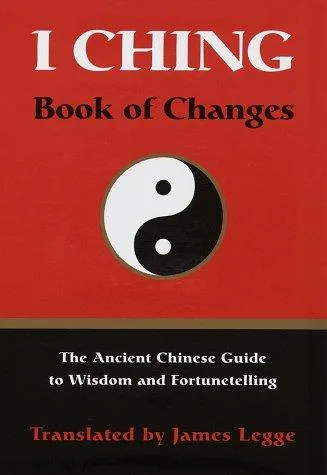




More Free Mysticism & Contemplation Books
View all →