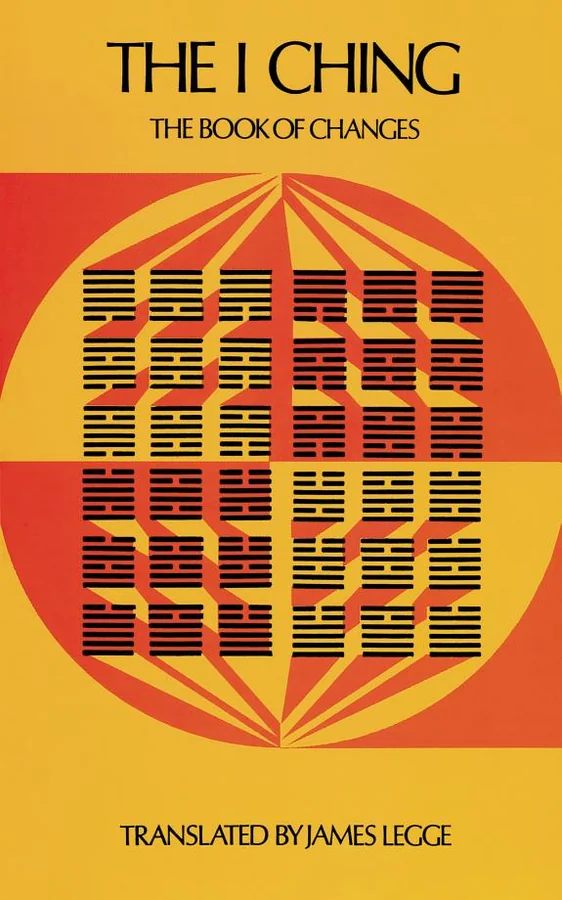
The I Ching
 80
80

The I Ching
James Legge's translation of the *I Ching* presents a monumental, if at times daunting, entry point into one of East Asia's most influential texts. The sheer volume of commentary and interpretive layers, particularly the *Ten Wings*, offers a comprehensive view of how this ancient oracle was understood and utilized. Legge’s scholarly diligence is evident, providing a foundational resource for serious study. However, the dense prose and archaic language, characteristic of 19th-century sinology, can obscure the text's inherent fluidity and predictive nature for contemporary readers. A particularly striking section, the judgment for Hexagram 1, *Qian* (The Creative), with its imagery of a dragon ascending through the heavens, powerfully illustrates the text's cosmological scope. Yet, the contextualization within Western academic frameworks of the time, while valuable historically, sometimes feels removed from the immediate, practical application the *I Ching* has historically served. The Legge translation is an indispensable scholarly tool but requires significant effort to unlock its oracular heart.
📝 Description
80
The I Ching, or *Book of Changes*, is an ancient Chinese text whose origins date to the Western Zhou Dynasty.
This classic Chinese text, attributed in part to Confucius through its *Ten Wings* commentaries, posits that the universe is in constant flux. Events, it suggests, unfold according to discernible patterns represented by 64 hexagrams. Each hexagram is built from six stacked lines, either unbroken (yang) or broken (yin). These structures carry specific meanings, offering commentary on situations and the flow of cosmic energies.
The *I Ching* comprises the hexagrams themselves, their names, judgments, and line statements. Its practical application in divination, alongside philosophical reflection, made it a living text for millennia. This differentiates it from more abstract philosophical works, as it was consulted by emperors and commoners alike throughout imperial China.
The *I Ching* is a foundational text in Chinese metaphysics and divination. It presents a system for understanding cosmic patterns and their influence on human affairs, a common characteristic of esoteric traditions. Its emphasis on cyclical change and the interplay of opposing forces (yin and yang) aligns with broader esoteric philosophies that seek to map universal principles onto earthly existence. The text's use as a tool for guidance and self-reflection further places it within a lineage of works aimed at esoteric understanding.
💡 Why Read This Book?
• Gain a structured system for understanding cyclical change, moving beyond superficial analogies to grasp the mechanics of Yin and Yang as presented in the *Ten Wings* commentaries. • Learn to interpret the 64 hexagrams, understanding how their symbolic line-changes, as detailed in the line statements, can offer guidance for specific situations. • Explore the philosophical underpinnings of Chinese thought by examining how the *I Ching* influenced concepts of fate, timing, and human action within the Confucian tradition.
⭐ Reader Reviews
Honest opinions from readers who have explored this book.
❓ Frequently Asked Questions
When was the I Ching first published in English by James Legge?
While the I Ching has ancient roots, James Legge's comprehensive translation and commentary, including the Ten Wings, was first published in 1899 as part of the Sacred Books of the East series.
What is the primary purpose of the I Ching?
The I Ching is primarily used as a text for divination, offering insights into the nature of current situations and potential future developments based on symbolic hexagrams.
How many hexagrams are there in the I Ching?
The I Ching is structured around 64 hexagrams. Each hexagram is formed by combining two trigrams, which themselves are composed of three lines, either broken (Yin) or unbroken (Yang).
What are the 'Ten Wings' in the context of the I Ching?
The Ten Wings are a collection of commentaries traditionally attributed to Confucius, which elaborate on the hexagrams, trigrams, and the philosophical and divinatory meanings of the I Ching.
Is the I Ching purely a book of divination?
While divination is a core function, the I Ching also serves as a profound philosophical and ethical text, exploring cosmology, change, human nature, and the principles of effective action.
Who traditionally used the I Ching?
Historically, the I Ching was consulted by rulers, scholars, and common people alike. Its wisdom was applied to statecraft, personal decisions, and understanding the natural world across many centuries in China.
🔮 Key Themes & Symbolism
The Dynamics of Yin and Yang
Central to the I Ching is the concept of Yin and Yang, not as opposing forces, but as complementary, interdependent energies that drive all change. The text illustrates their interplay through the broken (Yin) and unbroken (Yang) lines that form the trigrams and hexagrams. Each hexagram represents a specific configuration of these energies at a given moment, charting the natural progression from one state to another. Understanding this dynamic is key to interpreting the hexagrams' advice and grasping the book's view of reality as a perpetual flux.
The 64 Hexagrams as Cosmic States
The 64 hexagrams serve as a symbolic map of all possible situations or states of being. Each hexagram is a unique arrangement of six lines, representing a snapshot of cosmic forces at play. They are not static entities but represent moments in a larger cycle of transformation. The *I Ching* uses these figures to describe everything from the creative power of Heaven (Hexagram 1, Qian) to the receptivity of Earth (Hexagram 2, Kun), offering specific judgments and line-by-line interpretations for each.
Divination and Timely Action
The practical application of the *I Ching* lies in its divinatory function. By consulting the text with specific questions, often using methods like yarrow stalks or coins, individuals seek guidance on how to act in accordance with the prevailing cosmic energies. The advice provided is not deterministic but emphasizes the importance of understanding the present moment and taking appropriate action. The text encourages aligning oneself with the natural flow of events, rather than attempting to force outcomes against the tide of change.
The Ten Wings and Philosophical Depth
The *Ten Wings*, traditionally attributed to Confucius, elevate the *I Ching* beyond a mere oracle. These commentaries provide a philosophical framework, examining the cosmology, ethics, and wisdom embedded within the hexagrams. They explore the symbolic meaning of the trigrams, the structure of the hexagrams, and the underlying principles of the *Book of Changes*. The Wings transform the text into a profound exploration of the Tao, human conduct, and the nature of the universe, contributing significantly to its enduring legacy in Chinese thought.
💬 Memorable Quotes
Direct passages from the work, attributed to the author.
“The Creative works sublime andไม 's strength is without limit.”
— This statement from Hexagram 1 (Qian) expresses the immense, unceasing generative power attributed to Heaven. It suggests a force that is not only powerful but also operates on a cosmic scale, driving creation and transformation continuously.
“The Receptive, dark and deep, the power of earth.”
— Referring to Hexagram 2 (Kun), this highlights the complementary force to the Creative. It emphasizes the grounding, nurturing, and sustaining qualities of the Earth, representing receptivity, stability, and the potential for all things to manifest.
“Without striving, he has food in abundance.”
— This interpretation, found within the judgments for certain hexagrams, speaks to the efficacy of acting in harmony with the Tao. It suggests that when one aligns with natural principles, success and fulfillment arise organically, without forced effort.
“The superior man, in his energy, is like the thunder.”
— This simile from the judgment of Hexagram 51 (Zhen, The Arousing/Thunder) illustrates the dynamic and impactful nature of appropriate action. It suggests that when the time is right, one should act with decisive energy, like thunder shaking the heavens.
“In difficulty, perseverance is the best course.”
— This expresses a recurring theme in the *I Ching*'s advice: that enduring challenges with steadfastness is often the most effective strategy. It emphasizes resilience and the long-term perspective required to overcome obstacles.
🌙 Esoteric Significance
Tradition
The *I Ching* is foundational to Chinese Taoist and Confucian traditions but has also been adopted and adapted within various Western esoteric lineages. Its emphasis on cosmic patterns, cyclical change, and the interplay of forces aligns with Hermetic principles of correspondence and vibration. While not strictly Kabbalistic or Gnostic, its symbolic language and divinatory applications offer a parallel system for understanding universal laws and seeking gnosis through pattern recognition.
Symbolism
The primary symbols are the Yin (broken) and Yang (unbroken) lines, representing fundamental dualities like feminine/masculine, dark/light, and passive/active. These combine into trigrams (e.g., Heaven, Earth, Water, Fire), which in turn form the 64 hexagrams. Each hexagram is a symbolic representation of a specific cosmic state or situation, offering a visual and conceptual language to interpret the flow of events and human experience within the universe.
Modern Relevance
Contemporary practitioners of Jungian psychology draw heavily on the *I Ching*'s archetypal symbolism and its function as a tool for synchronicity and individuation. Modern divination systems and philosophical explorations of change and chaos theory often reference its principles. Its structured approach to understanding complex systems continues to inform thinkers interested in pattern recognition, strategic decision-making, and holistic worldviews.
👥 Who Should Read This Book
['• Students of comparative philosophy and religion seeking to understand the intellectual foundations of East Asian cultures.', '• Practitioners of divination and esoteric arts interested in ancient oracular systems and their symbolic language.', '• Individuals exploring systems of thought that emphasize cyclical change, pattern recognition, and the alignment of action with natural forces.']
📜 Historical Context
The *I Ching*'s textual history spans millennia, with its earliest strata dating to the Western Zhou Dynasty (c. 1046–771 BCE). Its integration into the classical canon, particularly through the addition of the *Ten Wings* attributed to Confucius (551–479 BCE), solidified its philosophical and ethical importance. During the Han Dynasty (206 BCE–220 CE), the *I Ching* became a core part of state ideology and scholarship, influencing figures like Dong Zhongshu. Its divinatory aspects were sometimes viewed with suspicion by later Neo-Confucian scholars, who prioritized its ethical and philosophical dimensions, leading to ongoing debates about its proper interpretation. Legge's own translation, published in 1899, occurred during a period of intense Western interest in Eastern religions and philosophies, a movement sometimes termed Orientalism, presenting these ancient texts to a European audience.
📔 Journal Prompts
The interplay of Yin and Yang as depicted in Hexagram 30 (Li, Fire).
Reflect on the concept of 'timely action' suggested by the judgment of Hexagram 11 (Tai, Peace).
The symbolism of the dragon in Hexagram 1 (Qian) and its implications for personal aspiration.
Consider the 'perseverance in difficulty' advice from Hexagram 29 (Kan, The Abysmal/Water).
Analyze the relationship between Heaven and Earth as represented by Hexagrams 1 and 2.
🗂️ Glossary
Hexagram
A symbol composed of six stacked lines, each either whole (Yang) or broken (Yin). There are 64 unique hexagrams, representing different states or situations in the cycles of change.
Trigram
A symbol composed of three lines, either whole (Yang) or broken (Yin). There are eight basic trigrams (e.g., Heaven, Earth, Fire, Water), which combine to form the 64 hexagrams.
Yin
In the I Ching, represented by a broken line (-- --). It signifies passive, receptive, dark, and feminine principles, often associated with the Earth.
Yang
In the I Ching, represented by a solid line (------). It signifies active, creative, light, and masculine principles, often associated with Heaven.
Ten Wings
A collection of commentaries traditionally attributed to Confucius, which expound upon the philosophical and divinatory meanings of the I Ching's hexagrams and lines.
Qian (乾)
The first hexagram, representing Heaven, the Creative, pure Yang energy. It symbolizes strength, persistence, and the ultimate source of action.
Kun (坤)
The second hexagram, representing Earth, the Receptive, pure Yin energy. It symbolizes devotion, yielding, and the potential for all things to be nurtured and manifest.
This book appears in 1 collection
🔮 Readers Also Liked
Browse all →







From the “I Ching” Collection
View all →







More Free Occult Philosophy Books
View all →