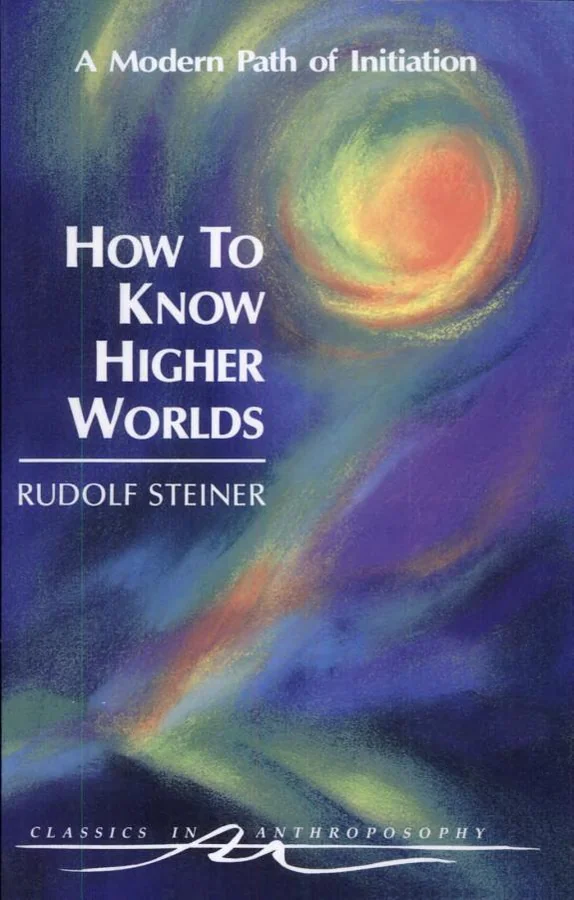
How to Know Higher Worlds
 74
74

How to Know Higher Worlds
Steiner’s 1904 treatise remains a pivotal text for serious students of Western esotericism, presenting a structured, almost scientific, methodology for spiritual attainment. Its strength lies in the precise, step-by-step guidance, demystifying the process of initiation by grounding it in observable inner states and disciplined practices. The emphasis on cultivating specific soul qualities like reverence and inner calm feels particularly vital, offering a counterbalance to more impulsive spiritual seeking. A notable passage details the development of clairvoyant perception through stages of imaginative cognition, demonstrating Steiner's systematic approach. However, the text’s dense, academic prose can present a significant barrier for newcomers, demanding considerable intellectual rigor and patience. The initial focus on moral and ethical preparation, while crucial, might feel abstract to those seeking immediate experiential results. Despite these challenges, the work is an indispensable resource for understanding the architecture of Steiner's spiritual science.
📝 Description
74
Rudolf Steiner published 'How to Know Higher Worlds' in 1904, detailing a systematic path to spiritual development.
Rudolf Steiner's 1904 work, 'How to Know Higher Worlds,' presents a structured method for cultivating spiritual perception. Steiner asserts that the capacity to apprehend supersensible realities exists within everyone. He outlines how to awaken these dormant abilities by first developing attitudes of reverence and inner quietude. The book then maps a progression through stages of preparation, illumination, and initiation, framing them as attainable through consistent inner effort rather than mere chance. Steiner provides practical exercises and meditations aimed at strengthening the inner life. These practices focus on developing faculties beyond the physical, enabling a direct experience of spiritual phenomena through the transformation of thought, feeling, and will. This text is a cornerstone for what Steiner would later develop as spiritual science, or Anthroposophy, addressing the nature of humanity, the cosmos, and consciousness evolution.
Published in 1904, 'How to Know Higher Worlds' is a key text in Western esotericism, particularly within the Theosophical and later Anthroposophical movements. Steiner's work builds upon traditions that explore consciousness beyond ordinary waking awareness, proposing a methodical training for the human spirit. It offers a Western, individualized approach to spiritual knowledge, distinct from Eastern mystical systems, emphasizing a disciplined inner process accessible to the modern individual seeking to understand the spiritual dimensions of existence.
💡 Why Read This Book?
• Understand the disciplined path to spiritual perception, learning Steiner's specific stages of preparation, illumination, and initiation, which differ from spontaneous psychic phenomena. • Gain practical methods for cultivating inner tranquility and reverence, essential soul attitudes Steiner identifies as prerequisites for higher cognition. • Grasp the foundational concepts of spiritual science as presented in 1904, including the nature of imaginative cognition and the development of supersensible faculties.
⭐ Reader Reviews
Honest opinions from readers who have explored this book.
❓ Frequently Asked Questions
What are the primary soul attitudes Rudolf Steiner emphasizes for spiritual development in this book?
Rudolf Steiner stresses the cultivation of two fundamental soul attitudes: reverence and inner tranquility. These are presented as essential groundwork for developing the inner capacities necessary to perceive higher worlds, forming the initial stage of preparation for initiation.
When was Rudolf Steiner's 'How to Know Higher Worlds' first published, and what was its original context?
The work was first published in 1904, emerging from the milieu of the Theosophical Society in Germany, where Steiner served as Secretary. It presented a public exposition of Western esoteric initiation practices.
What are the three main stages of spiritual development outlined by Steiner in this text?
Steiner outlines three principal stages: preparation, illumination, and initiation. Each stage involves specific inner disciplines and the development of particular faculties for perceiving the spiritual realm.
Does 'How to Know Higher Worlds' require specific prior knowledge of esoteric traditions?
While prior knowledge can be helpful, Steiner aims to make the path accessible. He begins with fundamental human capacities and common soul attitudes, gradually introducing more complex spiritual concepts.
How does Steiner suggest one develops the capacity to know higher worlds?
Steiner proposes a methodical inner development, starting with ethical refinement and meditation to achieve inner calm and focused attention, leading to the cultivation of specific spiritual faculties like imagination, inspiration, and intuition.
Is this book suitable for beginners in esoteric studies?
It is suitable for serious beginners committed to disciplined study. Steiner's approach is systematic, but it demands sustained effort and intellectual engagement to grasp the concepts and practices.
🔮 Key Themes & Symbolism
The Disciplined Path of Initiation
This work meticulously details the process of spiritual initiation as understood within the Western esoteric tradition, as presented by Rudolf Steiner. It moves beyond mere theoretical discussion to offer a practical, step-by-step guide. Steiner emphasizes that access to higher worlds is not arbitrary but achieved through rigorous inner discipline. He outlines distinct phases—preparation, illumination, and initiation—each requiring specific mental and moral cultivation. The book stresses the importance of developing faculties like imaginative cognition, inspiration, and intuition through dedicated practice, making the esoteric path appear systematic and attainable for the earnest seeker.
Cultivating Inner Faculties
Central to Steiner's approach is the premise that the capacities for perceiving spiritual realities lie dormant within everyone. The book functions as a manual for awakening these latent abilities. It details how to foster qualities such as reverence, inner calm, and focused attention, which form the bedrock for developing higher perception. Steiner explains the transformation of consciousness required, moving from sensory experience to a direct apprehension of supersensible phenomena. This involves refining one's thinking, feeling, and willing to align with spiritual laws and discern subtle realities.
Spiritual Science and Anthroposophy
"How to Know Higher Worlds" serves as a foundational text for what Rudolf Steiner developed as Spiritual Science, later known as Anthroposophy. Published in 1904, it predates the full formalization of Anthroposophy but lays out its core principles regarding the evolution of human consciousness and the nature of the spiritual cosmos. The book provides an esoteric interpretation of human existence and the universe, aiming to bridge the gap between scientific understanding and spiritual experience. It offers a framework for understanding the human being as a spiritual entity capable of conscious evolution.
The Role of Reverence and Tranquility
Steiner places significant emphasis on the cultivation of specific soul attitudes as prerequisites for spiritual development. Reverence, a deep respect for the spiritual and the unknown, and inner tranquility, a state of balanced and undisturbed consciousness, are presented as foundational. These are not merely passive states but active disciplines that prepare the individual to receive spiritual insights without distortion. The book argues that without this inner grounding, attempts to access higher realms can lead to delusion or imbalance, highlighting the ethical and psychological dimensions of esoteric practice.
💬 Memorable Quotes
Direct passages from the work, attributed to the author.
“The capacities by which we can gain insights into the higher worlds lie dormant within each one of us.”
— This core assertion frames the entire work, suggesting that spiritual perception is an inherent human potential rather than an exclusive gift. It shifts the focus from external dogma to internal cultivation and verifiable personal experience.
“One must first achieve a certain inner calm and self-possession.”
— This highlights the practical necessity of inner stability before attempting to access subtle realities. Steiner presents this tranquility not just as a desirable state but as a crucial prerequisite for focused spiritual perception.
“Imagination, inspiration, and intuition are the faculties through which one apprehends the spiritual world.”
— This indicates Steiner's understanding of the specific cognitive tools needed for spiritual perception. These faculties are presented as distinct from ordinary sensory perception and capable of grasping supersensible realities.
“The goal is not merely to know about the spiritual world, but to experience it directly.”
— This emphasizes the experiential nature of Steiner's path. The aim is not theoretical knowledge but a direct, conscious engagement with spiritual realities, achieved through the systematic development of inner capacities.
💡 Key Ideas
Editorial paraphrase of the work's core concepts — not direct quotes.
The path of preparation is characterized by the cultivation of virtues such as patience, humility, and perseverance.
This paraphrased concept emphasizes the moral and ethical dimension of spiritual training. Steiner connects the development of character with the ability to perceive higher truths, suggesting a holistic approach to inner growth.
🌙 Esoteric Significance
Tradition
This work is a central to modern Western esoteric thought, deeply rooted in the Hermetic and Gnostic traditions but synthesized within the framework of Rudolf Steiner's spiritual science. It departs from purely mystical or occult traditions by offering a highly structured, almost pedagogical, approach to spiritual development. While acknowledging ancient wisdom, Steiner presents initiation not as an inherited right or a mystical accident, but as a consciously achievable process based on disciplined inner work and the cultivation of specific cognitive faculties.
Symbolism
While "How to Know Higher Worlds" is less overtly symbolic than some esoteric texts, key motifs include the "threshold guardian" representing the challenges and tests faced on the spiritual path, and the concepts of "imagination," "inspiration," and "intuition" as symbolic faculties for perceiving higher realities. The stages of preparation, illumination, and initiation themselves function as symbolic markers of consciousness transformation, representing a journey from the mundane to the spiritual.
Modern Relevance
Steiner's methodical approach to developing consciousness continues to influence contemporary esoteric practitioners, spiritual psychologists, and educators. Thinkers and movements focusing on integral spirituality, consciousness studies, and the application of inner development to social issues often draw upon the principles outlined in this book. Its emphasis on verifiable inner experience and the systematic cultivation of perception finds echoes in modern mindfulness practices and contemplative traditions seeking to bridge science and spirituality.
👥 Who Should Read This Book
• Aspiring practitioners of Western esotericism seeking a structured, systematic approach to spiritual development beyond theoretical study. • Students of Rudolf Steiner and Anthroposophy looking for the foundational exposition of his path of initiation and spiritual science. • Individuals interested in understanding the historical development of modern esoteric thought and its methodologies for cultivating consciousness.
📜 Historical Context
Published in 1904, "How to Know Higher Worlds" emerged during a period of intense spiritual and philosophical ferment in Europe. Rudolf Steiner, then a prominent figure in the Theosophical Society, sought to articulate a spiritual path rooted in Western traditions but accessible to the modern intellect. This era saw renewed interest in esoteric subjects, with movements like Theosophy, Anthroposophy (which Steiner would soon found), and various Hermetic revivals gaining traction. Steiner's work was partly a response to the prevailing materialism of the age, offering a counter-narrative grounded in the potential for human spiritual development. It stood in contrast to purely mystical or devotional approaches by presenting a structured, almost scientific, methodology for spiritual cognition. Contemporaries like Annie Besant and C.W. Leadbeater were also active within Theosophy, though Steiner's approach emphasized a more rigorous, individualistic path. The reception was significant within esoteric circles, laying the groundwork for Anthroposophy's later development and influence.
📔 Journal Prompts
The cultivation of inner tranquility: How can the principles of stillness described in the "preparation" stage be integrated into daily life?
Spiritual capacities: Reflect on the description of imaginative cognition and its potential role in understanding concepts beyond the physical.
The three stages: Consider the relationship between preparation, illumination, and initiation as presented by Steiner.
Reverence as a practice: Explore how the attitude of reverence can be actively applied when encountering new ideas or challenging experiences.
The dormant capacities: Meditate on the idea that higher perception is an inherent potential awaiting development.
🗂️ Glossary
Imaginative Cognition (Vorstellungserkenntnis)
The first stage of higher cognition described by Steiner, involving the development of inner mental images that are imbued with spiritual content, distinct from ordinary sensory perception or fantasy.
Inspiration (Inspiration)
The second stage of higher cognition, where the content of spiritual realities is apprehended through direct inner experience, often perceived as an inner voice or understanding.
Intuition (Intuition)
The third and highest stage of spiritual cognition, allowing for direct grasp of spiritual truths and beings, transcending even inspired understanding.
Preparation Stage
The initial phase of spiritual development, focusing on cultivating fundamental soul attitudes like reverence, inner calm, and ethical self-discipline.
Illumination Stage
The second phase, where the individual begins to develop the faculties of imaginative cognition and inspiration, gaining initial insights into the spiritual world.
Initiation Stage
The culmination of the process, where the individual achieves full development of spiritual faculties, including intuition, and gains direct conscious access to higher realms.
Spiritual Science (Geisteswissenschaft)
A term used by Steiner to describe a form of knowledge and research based on the direct perception of spiritual realities, aiming to complement and inform natural science.
This book appears in 1 collection
🔮 Readers Also Liked
Browse all →







From the “Anthroposophy” Collection
View all →








More Free Theosophy & Anthroposophy Books
View all →