Astrology of Accidents (Astrology)
 72
72

Astrology of Accidents (Astrology)
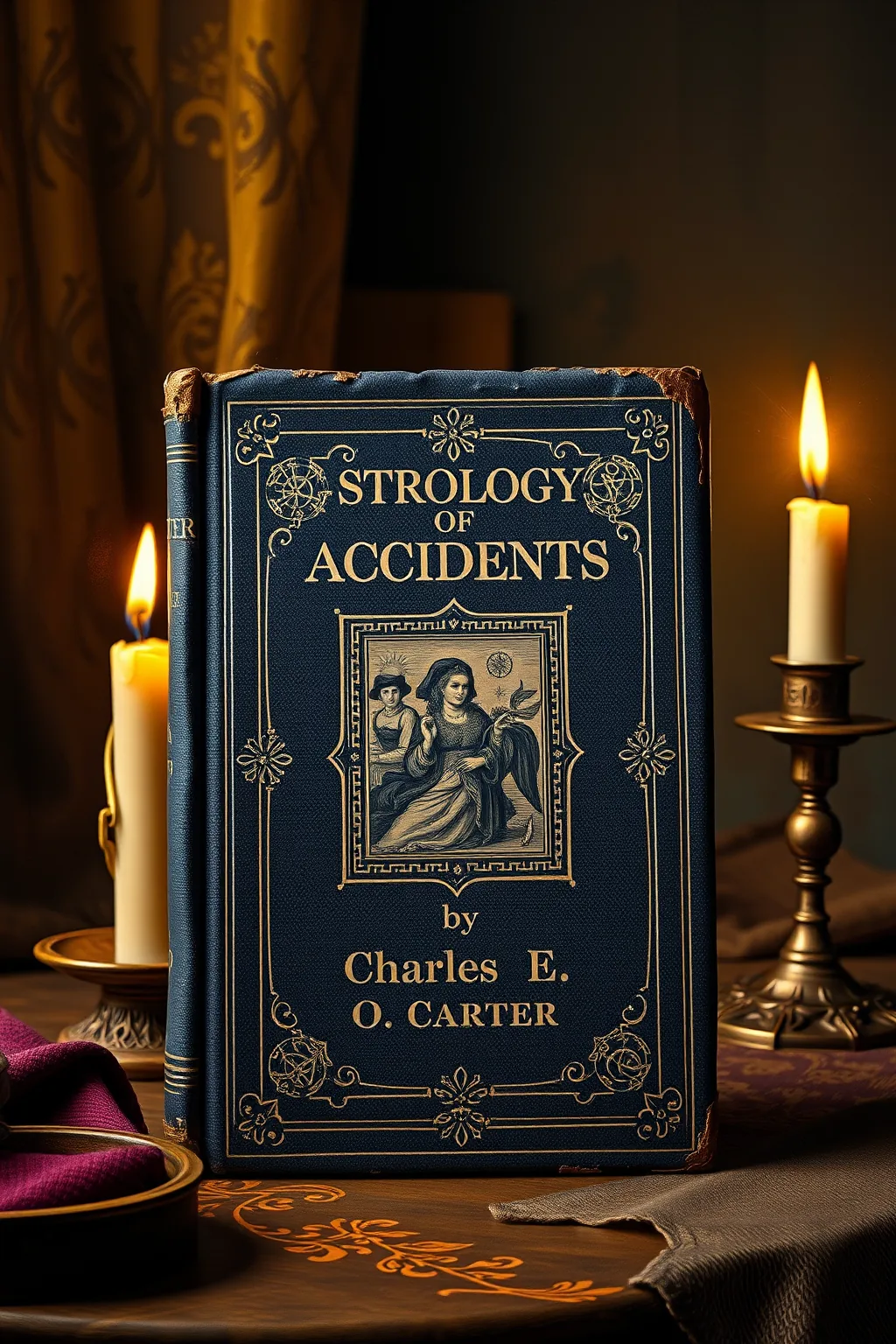
Charles E. O. Carter’s The Astrology of Accidents offers a focused examination of a specific, often avoided, area of natal interpretation. Carter’s strength lies in his systematic approach, presenting numerous chart examples and statistical considerations, a hallmark of his earlier works. He diligently compiles astrological factors that, in combination, might suggest a propensity for accidents. One notable passage details the significance of Mars’s condition and its relationship to the Ascendant or luminaries, which he links to physical injury. However, the book’s limitation is its somewhat dated presentation and its tendency towards a fatalistic tone, which may not align with contemporary psychological astrology. While the statistical data presented is intriguing, the lack of modern commentary means readers must contextualize these findings themselves. It is a valuable, albeit dense, reference for the dedicated astrologer seeking to understand the astrological language of unforeseen events.
📝 Description
72
Charles E. O. Carter's 1978 book, The Astrology of Accidents, details astrological indicators of misfortune.
Published in 1978, Charles E. O. Carter's The Astrology of Accidents addresses the astrological interpretation of accidents within a natal chart. The text meticulously examines planetary positions, aspects, and house placements that have been linked to unexpected or unfortunate events. Carter's work is intended for serious astrology students interested in predictive techniques and complex chart interpretation.
This book is not an introduction for novices. Instead, it serves practitioners seeking to understand the astrological roots of misfortune. Carter aims to equip readers with the knowledge to offer a more detailed perspective on potential life challenges. The work engages with and refines methods from earlier astrologers who also considered the astrological significance of adverse events.
The Astrology of Accidents was published in 1978, a time of renewed interest in traditional astrological methods. While some contemporary astrology focused on psychological interpretations, Carter's book continued older, more deterministic astrological traditions. These traditions sought precise mapping of life events. Carter engaged with earlier astrologers who explored the astrological significance of misfortune, refining their techniques.
💡 Why Read This Book?
• Learn to identify specific planetary aspects and house placements, such as Mars in aspect to the Ascendant, that Carter associates with accident proneness, offering a concrete predictive tool. • Understand the historical astrological context of 1978, when this book was published, providing insight into the prevailing predictive methods and concerns of that era. • Gain insight into the astrological significations of the 12th house, as explored by Carter, for a deeper understanding of hidden dangers and self-undoing patterns in a natal chart.
⭐ Reader Reviews
Honest opinions from readers who have explored this book.
❓ Frequently Asked Questions
What specific astrological factors does Charles E. O. Carter examine for accidents?
Carter meticulously analyzes the positions and aspects of planets, particularly Mars and Saturn, their relationship to the Ascendant and luminaries, and the influence of the 12th house. He also scrutinizes afflicted Sun and Moon and specific aspects like squares and oppositions.
Is 'The Astrology of Accidents' suitable for beginner astrologers?
No, this book is best suited for experienced astrologers. It assumes a strong foundation in astrological principles and terminology, focusing on advanced predictive techniques rather than introductory concepts.
What year was 'The Astrology of Accidents' first published?
The Astrology of Accidents by Charles E. O. Carter was first published in 1978.
Does the book offer methods to *prevent* accidents?
While the book identifies astrological indicators that may correlate with accidents, its primary focus is on identification rather than prevention. Understanding these indicators can, however, lead to increased awareness and caution.
What is the general tone of 'The Astrology of Accidents'?
The book generally adopts a serious and analytical tone, presenting astrological correlations with a degree of determinism. It is a technical work aimed at thorough examination of its subject matter.
Who was Charles E. O. Carter in the astrological community?
Charles E. O. Carter was a respected British astrologer and author, known for his meticulous research and systematic approach to astrological interpretation, particularly in the early to mid-20th century.
🔮 Key Themes & Symbolism
Planetary Afflictions and Accidents
This work explores how specific planetary afflictions, especially those involving Mars and Saturn, can manifest as indicators of accidents in a natal chart. Carter examines conjunctions, squares, and oppositions to critical points like the Ascendant or luminaries, suggesting that these configurations create energetic potentials for sudden, often physical, mishaps. The book provides detailed analysis and examples to support the thesis that certain astrological patterns correlate with experiences of physical trauma or unexpected disruption.
House Systems and Unforeseen Events
The book places significant emphasis on the role of specific houses in signifying accidents. The 12th house, traditionally associated with hidden enemies, self-undoing, and unseen forces, is particularly scrutinized. Carter explores how planets residing in or aspecting the 12th house, or rulers of angular houses falling into this sector, might contribute to the likelihood of encountering dangerous situations or experiencing events that are difficult to foresee or control.
Statistical Correlation in Astrology
A hallmark of Carter's approach, and evident in 'The Astrology of Accidents,' is his inclination towards statistical analysis. He often references studies and compiles data from numerous horoscopes to identify recurring patterns. This empirical methodology aims to lend scientific weight to astrological interpretations, moving beyond purely symbolic readings to demonstrate correlations between celestial configurations and earthly events like accidents.
The Role of the Luminaries
The Sun and Moon, representing core identity and emotional life respectively, are central to Carter's analysis of accident proneness. He investigates how afflictions to these luminaries, through hard aspects from malefic planets or their placement in challenging houses, can impact an individual's overall vulnerability. The condition of the Moon, in particular, is often linked to physical well-being and the body's response to stress or injury.
💬 Memorable Quotes
Direct passages from the work, attributed to the author.
“The condition of Mars is of the utmost importance when considering accidents.”
— This highlights Mars's archetypal connection to action, energy, and physical force, suggesting its state in a natal chart is a primary indicator of potential for physical harm or energetic disruption.
“A strong emphasis is placed on the significations of the 12th house.”
— This points to the book's focus on hidden dangers, self-sabotage, and subconscious patterns, indicating that events stemming from these less visible areas of life are key to understanding accident proneness.
“Aspects to the Ascendant are crucial for physical matters.”
— This emphasizes the importance of the Ascendant as the cusp of the 1st house, representing the physical body and immediate presentation, and how planetary interactions with it directly relate to bodily experiences, including injury.
“The Moon's state reveals much about an individual's physical vulnerability.”
— This interpretation underscores the Moon's connection to the body's natural rhythms, emotional well-being, and receptivity, suggesting that its astrological condition offers insight into how susceptible a person might be to physical harm.
“Statistical evidence supports certain astrological correlations.”
— This reflects Carter's empirical approach, indicating that his conclusions are often drawn from data analysis and the observed frequency of astrological patterns in relation to specific life events, lending an air of scientific rigor.
🌙 Esoteric Significance
Tradition
This work aligns with the Western esoteric tradition, particularly the lineage of natal astrology that emphasizes predictive accuracy and the mapping of potential life challenges. It draws from Hermetic principles regarding celestial influence and the intricate correspondences between the macrocosm and microcosm. Carter's meticulous approach, often employing statistical analysis, can be seen as an attempt to bring empirical rigor to these ancient symbolic systems, fitting within a broader esoteric quest to understand divine order through observable patterns.
Symbolism
Key symbols in 'The Astrology of Accidents' include Mars, representing action, force, and potential for injury; Saturn, signifying restriction, hardship, and karmic lessons; and the 12th house, symbolizing hidden dangers, subconscious patterns, and self-undoing. The malefic aspects, such as squares and oppositions, act as potent symbols of friction and challenge, indicating points of astrological tension that may manifest as accidents or unexpected disruptions in the physical and material realms.
Modern Relevance
Contemporary astrologers interested in predictive techniques and psychological resilience often revisit Carter's work. His systematic approach to identifying potential vulnerabilities through chart analysis continues to inform discussions on mitigating challenging astrological configurations. While modern interpretations may integrate psychological depth, the foundational astrological indicators he identified remain relevant for those seeking to understand the astrological language of risk and unforeseen events in natal charts.
👥 Who Should Read This Book
['• Serious students of natal astrology seeking to deepen their predictive skills by understanding astrological indicators for accidents.', '• Researchers interested in the history of astrological thought and the evolution of predictive techniques from the mid-20th century.', '• Practitioners who wish to offer a more comprehensive analysis of potential life challenges, including physical risks, to their clients.']
📜 Historical Context
First published in 1978, Charles E. O. Carter's 'The Astrology of Accidents' emerged in a vibrant period for esoteric studies. The post-war era saw a resurgence of interest in traditional astrological techniques, often contrasted with the burgeoning psychological and humanistic astrology that gained traction in the 1960s and 70s. While figures like Dane Rudhyar were popularizing a more self-development-oriented approach, Carter represented a lineage focused on more deterministic predictive methods. His work built upon earlier astrological traditions that sought to map out life events, including misfortune, through detailed chart analysis. Contemporary astrologers like John Frawley, who would later champion traditional astrology, were developing their own perspectives during this time, though their direct engagement with Carter's specific focus on accidents might have been limited to acknowledging his meticulous research. The reception of such works often involved debate between traditionalists and those favoring newer psychological interpretations.
📔 Journal Prompts
The significance of Mars's condition and its aspects to the Ascendant.
Reflecting on the 12th house's potential role in unforeseen events.
Analyzing the influence of malefic aspects on the luminaries in a natal chart.
Investigating the statistical correlations presented by Carter.
The interplay between Saturn and accident proneness.
🗂️ Glossary
Ascendant
The astrological sign and degree rising on the eastern horizon at the moment of birth, representing the physical body, outward personality, and immediate environment.
Malefic Planets
Traditionally, Mars and Saturn are considered malefic planets due to their association with challenges, obstacles, and potentially destructive forces in astrological interpretations.
Affliction
In astrology, an affliction refers to a planet experiencing difficult aspects (e.g., squares, oppositions) from other planets, particularly malefic ones, or being in a weakened essential dignity.
Aspects
The angular relationships between planets in a birth chart, such as conjunctions, oppositions, squares, trines, and sextiles, which describe how planetary energies interact.
Luminaries
The Sun and the Moon, the two brightest celestial bodies visible from Earth, holding primary significance in astrological interpretation for vitality, consciousness, and emotional nature.
Natal Chart
A snapshot of the positions of the planets and celestial bodies at the exact moment and location of a person's birth, used for astrological interpretation.
House Systems
Different methods for dividing the celestial sphere into twelve astrological houses, each representing a different area of life experience. Carter's work considers the significance of these divisions.
🔮 Readers Also Liked
Browse all →






More by Charles E. O. Carter
All books →




More Free Theosophy & Anthroposophy Books
View all →