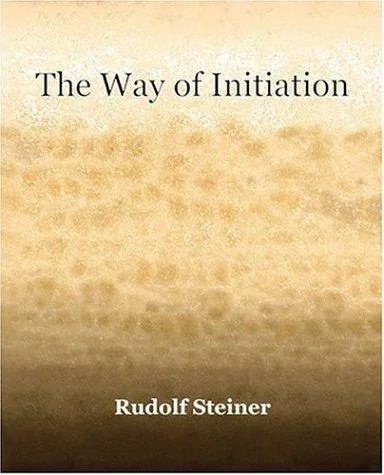
The Way of Initiation (1911)
 72
72

The Way of Initiation (1911)
Rudolf Steiner's "The Way of Initiation" offers a stark, unvarnished look at the disciplines required for genuine spiritual advancement, a refreshing departure from the often-sanitized presentations of esoteric paths. The clarity with which Steiner delineates the necessary inner work, particularly the rigorous mental and ethical training, is its signal strength. He doesn't shy away from the demanding nature of the 'path of knowledge,' presenting it as a scientific endeavor requiring utmost precision and dedication. A notable limitation, however, is the inherent difficulty of Steiner's prose, which, even in translation, demands considerable concentration and prior familiarity with his conceptual framework. The discussions surrounding the 'Guardian of the Threshold' exemplify this – a potent concept, yet one that requires significant unpacking to grasp its full implications within his system. It is a text that rewards persistence but demands it upfront.
This is a critical, demanding work for the serious aspirant.
📝 Description
72
Rudolf Steiner delivered lectures on initiation in 1911, later published as The Way of Initiation.
The Way of Initiation compiles lectures Rudolf Steiner gave in 1911, with contributions from Max Gysi. These talks focus on the principles and practices necessary for spiritual growth, rather than historical events. The book aims to guide readers through inner development, detailing the stages and difficulties encountered on the occult path.
This text is for individuals seriously committed to inner work and the study of spiritual knowledge. It is suited for those who understand basic esoteric concepts and are ready for disciplined contemplation. Readers interested in the nature of consciousness, soul evolution, and the mechanisms of spiritual perception will find substantial material here. It suits the dedicated student of Anthroposophy or related spiritual science disciplines over casual curiosity.
These lectures from 1911 emerged as Rudolf Steiner was refining Anthroposophy, his system of spiritual science. He had recently departed from leading the Theosophical Society. The era was marked by widespread fascination with spiritualism and occultism. Steiner presented Anthroposophy as a structured, intellectual approach, distinct from many contemporary movements, and rooted in a Christ-centered perspective, aiming to modernize ancient wisdom traditions.
💡 Why Read This Book?
• Gain a precise understanding of the four human bodies (physical, etheric, astral, ego) as presented by Steiner, learning how their interplay forms the basis for spiritual development. • Grasp the distinct 'paths of knowledge' and 'path of the will' as outlined in 1911, comprehending the sequential stages and exercises necessary for developing higher perception. • Understand the concept of the 'Guardian of the Threshold' and its role in the initiation process, learning how Steiner situates this challenge within a framework of karmic development.
⭐ Reader Reviews
Honest opinions from readers who have explored this book.
❓ Frequently Asked Questions
What is the primary focus of Rudolf Steiner's "The Way of Initiation"?
The book focuses on the disciplined, practical steps and inner development required for spiritual initiation, as articulated within Rudolf Steiner's spiritual science (Anthroposophy).
When were the lectures that comprise "The Way of Initiation" originally delivered?
The lectures were originally delivered by Rudolf Steiner in 1911, offering insights into the spiritual path as understood at that time.
Is "The Way of Initiation" suitable for beginners in esoteric studies?
While it offers foundational concepts, the text is quite demanding and best suited for those with some prior engagement with esoteric philosophy or Anthroposophy, due to its conceptual density.
What is the role of karma and spiritual guardians in this book?
The work explores karma as a law of spiritual development and introduces the concept of the 'Guardian of the Threshold,' a spiritual being encountered on the path of initiation.
How does Max Gysi relate to this work?
Max Gysi was a collaborator who assisted Rudolf Steiner in presenting these lectures, and the work was first published in its collected form in 2016.
Does "The Way of Initiation" discuss meditation techniques?
Yes, it describes specific exercises for developing imagination, inspiration, and intuition, which are integral to Steiner's approach to meditation and spiritual cognition.
🔮 Key Themes & Symbolism
The Fourfold Human Constitution
Steiner posits that the human being is composed of four distinct yet interconnected principles: the physical body, the etheric body (life forces), the astral body (consciousness and feeling), and the ego (spirit-self). Understanding this constitution is presented as foundational to all spiritual work. The book details how each level must be purified and spiritualized to achieve higher states of consciousness and read through the challenges of inner development. This framework distinguishes Steiner's approach from purely materialist or simpler vitalistic views of human nature.
The Path of Knowledge
This theme centers on the rigorous mental and imaginative exercises Steiner prescribes for attaining spiritual perception. It involves cultivating specific capacities like imagination ( `>`, inspiration ( `>`, and intuition ( `>` ). The lectures outline a systematic progression, emphasizing that true spiritual knowledge is not passively received but actively cultivated through disciplined thought and focused intent, moving beyond ordinary sensory experience.
Ethical Development and Karma
The work stresses that spiritual progress is inseparable from moral evolution. Steiner explains the law of karma not as fatalistic punishment but as a principle of spiritual cause and effect that shapes an individual's destiny. The aspirant must cultivate virtues like love, truthfulness, and selflessness, as these ethical qualities are essential for purifying the lower vehicles and preparing the soul for higher spiritual encounters, preventing lower impulses from hindering progress.
Spiritual Guardianship and Thresholds
A significant aspect explored is the encounter with spiritual beings, particularly the 'Guardian of the Threshold.' This entity represents the sum total of the individual's past karma and unredeemed tendencies. Crossing this threshold signifies a profound transformation, requiring the aspirant to confront and overcome their own limitations. The book describes this as a critical juncture, demanding courage and spiritual maturity to proceed safely on the path.
💬 Memorable Quotes
Direct passages from the work, attributed to the author.
“The path of knowledge must lead to the fact that man becomes his own judge.”
— This highlights the self-reflective and self-critical nature of true spiritual development. It implies that inner progress is measured by one's ability to accurately assess their own thoughts, feelings, and actions, rather than relying on external validation or judgment.
“One must learn to see the spiritual world through the senses of the spirit.”
— This expresses the core idea of developing new faculties for perception. It suggests that the spiritual realm is not an abstract concept but an observable reality, accessible once the appropriate inner organs or capacities are cultivated through dedicated practice.
“Karma is not a destiny that binds us, but a power that shapes us according to our own actions.”
— This interpretation reframes karma from a deterministic force into a dynamic principle of spiritual causality. It emphasizes personal responsibility and the potential for conscious transformation by understanding how past actions influence present circumstances and future development.
“The etheric body is the carrier of life, the astral body is the carrier of consciousness.”
— This defines two fundamental non-physical aspects of the human being as described by Steiner. It clarifies their respective roles: the etheric body sustaining life processes and the astral body enabling feeling, thought, and sentience.
“Imagination, Inspiration, and Intuition are the stages of true spiritual cognition.”
— This statement outlines Steiner's hierarchy of spiritual perception. It presents a structured method for accessing higher knowledge, moving from imaginative faculty to inspired understanding and finally to direct intuitive grasp of spiritual realities.
🌙 Esoteric Significance
Tradition
This work is a foundational text within Anthroposophy, Rudolf Steiner's comprehensive spiritual philosophy. It draws upon and reinterprets elements from various esoteric traditions, including Hermeticism, Gnosticism, and Kabbalah, but synthesizes them into a unique, coherent system. Steiner presents his teachings as a modern 'spiritual science,' distinct from earlier esoteric movements and aimed at providing a verifiable path for contemporary individuals seeking spiritual knowledge through inner development.
Symbolism
Key symbols include the 'Guardian of the Threshold,' representing the karmic self-judgment and the challenges of confronting one's own shadow to achieve spiritual rebirth. The concept of the four human bodies (physical, etheric, astral, ego) functions symbolically, delineating the stages of human evolution and the vehicles through which spiritual development occurs. The 'path of knowledge' itself is a symbolic representation of a structured inner journey, akin to ancient initiatory rites.
Modern Relevance
Contemporary practitioners of Anthroposophy continue to study and apply these teachings in fields like Waldorf education and biodynamic agriculture. Thinkers exploring consciousness studies and integral spirituality often engage with Steiner's model of human development and his detailed cosmology. His emphasis on the ethical underpinnings of spiritual progress and the cultivation of specific cognitive faculties remains relevant for modern seekers of a holistic, scientifically-grounded path.
👥 Who Should Read This Book
• Students of Anthroposophy: Those seeking a deeper understanding of Rudolf Steiner's core teachings on spiritual development, karma, and the nature of the human being. • Aspiring Initiates: Individuals committed to rigorous self-discipline and inner work who are looking for a structured, albeit demanding, guide to cultivating higher consciousness. • Comparative Esotericism Researchers: Scholars and practitioners interested in how Steiner's system integrates and diverges from earlier Western esoteric traditions like Theosophy and Hermeticism.
📜 Historical Context
Delivered in 1911, Rudolf Steiner's lectures forming "The Way of Initiation" emerged during a vibrant period of esoteric inquiry in Europe. Steiner himself had recently broken with the Theosophical Society, seeking to establish his own distinct spiritual science, Anthroposophy. This era saw figures like Annie Besant and C.W. Leadbeater continuing to shape Theosophy, while movements like the Hermetic Order of the Golden Dawn had already laid groundwork in Western ceremonial magic. Steiner's approach, however, offered a unique synthesis, emphasizing a rigorous, Christ-centered spiritual science grounded in a detailed understanding of human evolution and consciousness. His lectures in 1911 were part of a broader public discourse on the spiritual possibilities of humankind, positioning Anthroposophy as a modern continuation of ancient wisdom, distinct from both theosophical and purely materialistic worldviews.
📔 Journal Prompts
The four human bodies: Consider the distinct qualities of the physical, etheric, astral, and ego bodies in your daily experience.
The path of knowledge: How can the cultivation of imagination, inspiration, and intuition be practically applied in your current life circumstances?
The Guardian of the Threshold: Reflect on the inner challenges or obstacles that might represent your personal threshold.
Ethical development: Identify one specific virtue that, if strengthened, would aid your inner progress.
Spiritual cognition: What are the limitations of ordinary sense perception in grasping deeper realities?
🗂️ Glossary
Anthroposophy
A spiritual philosophy founded by Rudolf Steiner, seeking to understand the human being and the cosmos through spiritual scientific research and inner development.
Etheric Body
The vital or life body, responsible for organic processes, growth, and regeneration; considered the carrier of life forces.
Astral Body
The body of soul-life, consciousness, feeling, and desire; the carrier of subjective experience and motion.
Ego
The spiritual self or 'I', the principle of individuality, self-awareness, and spiritual development.
Karma
The spiritual law of cause and effect governing the evolution of the individual soul and the cosmos.
Guardian of the Threshold
A spiritual being representing the sum of an individual's karmic tendencies, encountered as a challenge on the path of initiation.
Spiritual Science
Steiner's term for the systematic, disciplined investigation of the spiritual world, analogous to natural science.
🔮 Readers Also Liked
Browse all →






More by Rudolf Steiner, Max Gysi
All books →


More Free Theosophy & Anthroposophy Books
View all →