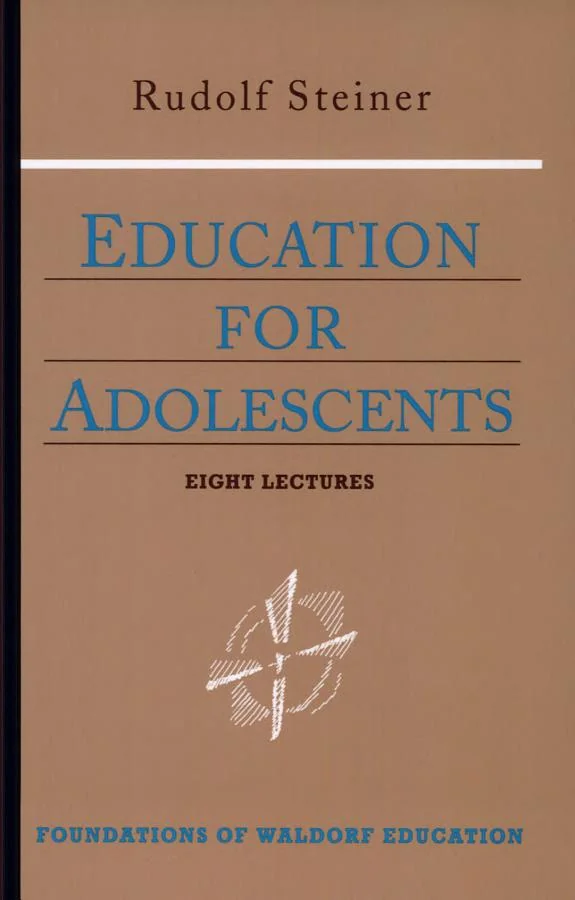
Education for Adolescents
 74
74

Education for Adolescents
Steiner's "Education for Adolescents" offers a starkly contrasting view to modern educational psychology, grounded firmly in his spiritual-scientific research. Delivered to the nascent Waldorf teaching staff in 1921, these lectures tackle the profound inner shifts of adolescence with a unique, holistic lens. A key strength lies in Steiner's detailed description of the adolescent's inner world, particularly his view of the developing ego and the need for intellectual rigor alongside artistic and moral development. However, the esoteric underpinnings, while central to the work, may present a significant barrier for educators unfamiliar with Anthroposophy. The passage discussing the physiological and spiritual changes around puberty, linking them to cosmic influences, exemplifies both the book's distinctive approach and its potential challenge for a secular audience. Ultimately, this work is an indispensable, albeit demanding, resource for those committed to the Waldorf pedagogical path or exploring esoteric approaches to child development.
📝 Description
74
Rudolf Steiner delivered eight lectures on adolescent education in Stuttgart in 1921.
Rudolf Steiner's "Education for Adolescents" addresses the unique challenges of educating teenagers. Delivered in 1921, these lectures were intended for educators at the nascent Waldorf school. Steiner posits that adolescent development requires a pedagogical approach distinct from that for younger children. He stresses the importance of educating the whole person—spirit, soul, and body—not just the intellect.
He outlines how the intense inner changes of adolescence, including strong emotions and emerging critical thought, necessitate a tailored curriculum. Teachers, he explains, must respond to teenagers' search for meaning and their growing ability to think independently. The goal is to foster a connection to both the spiritual and material worlds, preparing students for their future roles and personal growth.
These lectures offer practical guidance for developing a high school curriculum within the Waldorf system. Steiner aimed to give educators a clear understanding of adolescent needs, allowing them to cultivate learning environments that support academic achievement, character development, and individuality. The emphasis is on a balanced education that prepares young people for life and their own spiritual path.
This work stems from Rudolf Steiner's anthroposophical worldview, which views human development through a spiritual lens. Anthroposophy posits that human beings consist of physical, etheric, astral, and ego bodies, each with distinct developmental phases. Steiner applied these concepts to education, believing that understanding these spiritual components is crucial for guiding children through their life stages. "Education for Adolescents" specifically interprets the intense physical and psychological changes of the teenage years as a manifestation of these deeper spiritual processes, requiring a corresponding educational response.
💡 Why Read This Book?
• Gain an understanding of the spiritual-scientific perspective on adolescent development, a core tenet of the first Waldorf school, differentiating it from purely materialistic educational theories. • Learn Steiner's specific pedagogical suggestions for high school subjects and teaching methods as presented in 1921, directly applicable to Waldorf-inspired curricula. • Explore the concept of the developing ego in adolescence and its connection to the teachers' role in fostering inner freedom, as detailed in these foundational lectures.
⭐ Reader Reviews
Honest opinions from readers who have explored this book.
❓ Frequently Asked Questions
When were Rudolf Steiner's lectures on adolescent education first published?
The lectures compiled in "Education for Adolescents" were delivered in June 1921 and were first published in 1996, posthumously collecting Steiner's insights for Waldorf educators.
What is the spiritual science basis for Steiner's educational theories?
Steiner's spiritual science, also known as Anthroposophy, posits that human beings have a spiritual nature beyond the physical and psychological, which informs his view of child development and education.
Who was the intended audience for these lectures?
The primary audience was the teachers of the first Waldorf school, established in Stuttgart in 1919, who were seeking guidance on establishing a high school curriculum.
What period of development does "Education for Adolescents" focus on?
The book specifically addresses the adolescent period, roughly from the onset of puberty through the late teens, focusing on the physical, emotional, and spiritual transformations characteristic of these years.
How does Steiner's approach to adolescent education differ from conventional methods?
Steiner emphasizes the spiritual development of the adolescent, alongside intellectual and artistic growth, viewing education as a means to foster inner freedom and a conscious connection to the world.
What is CW 302 in relation to Rudolf Steiner's works?
CW 302 refers to the 'Collected Works' (Gesamtausgabe) volume number for Rudolf Steiner's lectures and writings, specifically the lectures on education given in Stuttgart in 1921.
🔮 Key Themes & Symbolism
Adolescent Inner Transformation
Steiner views adolescence as a period of profound inner upheaval, marked by the awakening of critical thought and strong emotional currents. He connects these changes to the development of the 'ego' or 'I' and the soul's engagement with the material world. This perspective guides the Waldorf approach to understanding teenage behavior and learning needs, moving beyond purely psychological or biological explanations to incorporate spiritual dimensions of human becoming.
Spiritual Science in Pedagogy
The core of Steiner's educational philosophy lies in the application of spiritual science (Anthroposophy) to understand the human being. For adolescents, this means recognizing their evolving spiritual constitution and its relationship to cosmic forces. Teachers are encouraged to cultivate a conscious awareness of these spiritual realities to support the student's development into free, thinking individuals capable of contributing meaningfully to the world.
Curriculum for High School
These lectures, delivered in 1921, provided foundational guidance for establishing a Waldorf high school. Steiner outlines the necessity for a curriculum that meets the adolescent's growing capacity for abstract thought and critical inquiry, while also nurturing their artistic and moral sensibilities. The aim is to present subjects in a way that awakens inner life and fosters a connection to the underlying spiritual order of existence.
The Role of the Teacher
Steiner describes the teacher's role as one of deep spiritual insight and empathetic guidance. For adolescents, this involves understanding the intense inner processes they are undergoing and creating an educational environment that respects their burgeoning individuality and quest for truth. Teachers are called to be guides who can connect students to the world through knowledge that also nourishes the soul and spirit.
💬 Memorable Quotes
Direct passages from the work, attributed to the author.
“The adolescent needs to be brought to the point where they can develop a judgment of their own.”
— This highlights Steiner's emphasis on fostering independent thinking and critical discernment in teenagers, a crucial step in their development towards inner freedom and self-determination.
“The teacher must be able to see the spiritual development behind the physical changes.”
— This points to the core Anthroposophical view that physical maturation in adolescence is accompanied by significant spiritual and soul development, which educators should be attuned to.
“We must provide an education that meets the adolescent's need for truth and reality.”
— Steiner suggests that teenagers possess an innate drive for genuine understanding and a connection to authentic realities, necessitating a curriculum that addresses this deep-seated quest.
“The curriculum should awaken the student's interest through the living presentation of knowledge.”
— This emphasizes a pedagogical approach focused on engaging the student's inner life and curiosity, rather than rote memorization, by presenting subjects in a dynamic and meaningful way.
“Adolescence is a time when the human being becomes aware of their own individuality.”
— This concept underscores the developmental significance of this stage, where the self begins to assert its unique identity and the individual's relationship to the world takes on new dimensions.
🌙 Esoteric Significance
Tradition
Steiner's work belongs to the Western Esoteric tradition, particularly drawing from Gnosticism, Hermeticism, and Theosophy, while forging a unique path through Anthroposophy. "Education for Adolescents" fits within this lineage by seeking to reveal the spiritual underpinnings of human development and consciousness. It departs from some earlier traditions by offering a systematic, scientific (albeit spiritual science) method for understanding and guiding these processes, intended for practical application in daily life and education.
Symbolism
While not overtly symbolic in the manner of alchemical texts, Steiner's work implies symbolic meaning in the developmental stages themselves. The 'awakening of the ego' in adolescence can be seen as a symbolic representation of the individual's conscious entry into the world of spirit and free will. The transition from childhood's imaginative perception to adolescent intellectual rigor mirrors a symbolic journey from outer perception to inner comprehension, preparing the soul for spiritual insight.
Modern Relevance
Contemporary educators and parents involved with Waldorf education continue to draw directly from these lectures. Beyond that, thinkers in integral psychology and developmental spirituality explore Steiner's models of consciousness and human evolution. His emphasis on the holistic development of the individual—spirit, soul, and body—finds echoes in modern transpersonal psychology and holistic health movements seeking to integrate inner life with outer experience.
👥 Who Should Read This Book
• Waldorf teachers and parents seeking to deepen their understanding of adolescent development from a spiritual-scientific perspective. • Students of esoteric philosophy and Anthroposophy interested in the practical application of spiritual insights to education. • Educators and researchers exploring alternative pedagogical approaches that integrate the spiritual, soul, and physical dimensions of the human being.
📜 Historical Context
Delivered in Stuttgart in June 1921, Rudolf Steiner's "Education for Adolescents" emerged during a period of intense intellectual and social upheaval in post-World War I Europe. The first Waldorf school, founded just two years prior in 1919, was a radical experiment, seeking an alternative to prevailing materialistic educational philosophies. Steiner's work was contemporary with movements like Montessori education, which also emphasized child-centered learning, but Steiner's approach was distinctly rooted in his spiritual science (Anthroposophy). This esoteric framework offered a comprehensive view of human development, positing spiritual realities alongside physical ones. While Steiner's ideas gained traction among a dedicated following, they also faced skepticism and were often considered outside mainstream educational discourse due to their metaphysical underpinnings. The period saw widespread interest in new social and educational paradigms, making Steiner's lectures a significant contribution to the nascent Waldorf movement.
📔 Journal Prompts
The adolescent's struggle for truth and reality: How does this manifest in contemporary teenagers?
Steiner's concept of the developing ego: How can educators foster its healthy emergence?
The need for an intellectual yet soul-nourishing curriculum: What subjects best serve this goal for adolescents?
The teacher's role in perceiving spiritual development: What practices support this awareness?
Connecting adolescent learning to the cosmos: What are contemporary interpretations of this idea?
🗂️ Glossary
Spiritual Science
Rudolf Steiner's term for Anthroposophy, a philosophical and spiritual approach that investigates the spiritual dimensions of the human being and the universe through specific methods of consciousness development.
Ego (I)
In Anthroposophy, the 'I' or ego represents the core individuality and spiritual selfhood of a human being, which develops significantly during adolescence.
Waldorf School
An educational institution based on Rudolf Steiner's pedagogical principles, emphasizing a holistic approach to learning that integrates intellectual, artistic, and practical skills.
CW 302
The catalogue number for the collected works (Gesamtausgabe) volume containing Rudolf Steiner's lectures on education given in Stuttgart in June 1921.
Soul
In Steiner's cosmology, the soul encompasses the feelings, emotions, and sentient life of the human being, distinct from the physical body and the higher spiritual 'I'.
Adolescence
The transitional phase of development between childhood and adulthood, characterized by significant physical, psychological, and spiritual changes, particularly the awakening of self-awareness and critical thought.
Pedagogy
The theory and practice of education; the methods and principles used in teaching, particularly concerning the development and upbringing of children and adolescents.
This book appears in 1 collection
🔮 Readers Also Liked
Browse all →






From the “Anthroposophy” Collection
View all →









More Free Theosophy & Anthroposophy Books
View all →