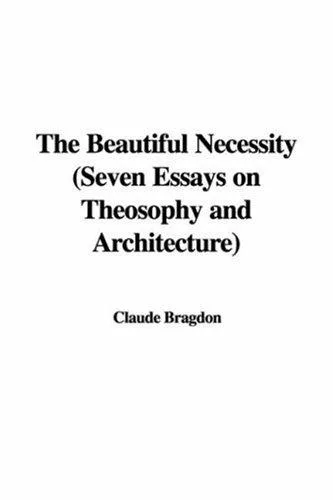
The Beautiful Necessity
 71
71

The Beautiful Necessity
Claude Bragdon's "The Beautiful Necessity" offers a compelling argument for the inherent spiritual order underlying physical form, a perspective particularly potent in its original 1917 publication. The strength of the book lies in Bragdon's ability to articulate complex geometric and philosophical ideas with accessible prose, demonstrating how fundamental shapes are not arbitrary but expressions of cosmic law. His exploration of how these principles manifest in art and architecture provides a unique lens through which to view the built environment and the creative process. A notable limitation, however, is the occasional reliance on analogies that, while illustrative for his time, may feel somewhat dated or less convincing to a contemporary reader without significant contextualization. The passage discussing the "fourth dimension" as a means to comprehend spiritual realities, while visionary, requires careful unpacking to align with modern scientific and philosophical discourse. Bragdon's work is a valuable, if occasionally challenging, invitation to see the sacred in structure. It serves as a critical reminder of the profound connections between the rational and the mystical.
📝 Description
71
Claude Bragdon published "The Beautiful Necessity" in 1917, arguing beauty is a universal order.
Claude Bragdon's "The Beautiful Necessity," first published in 1917, proposes that beauty is not merely aesthetic but an inherent quality of universal order, discoverable through geometry. Bragdon presents a unified vision of the cosmos as an expression of divine mathematical principles. He contends that necessity in art and architecture acts as a divine blueprint, illustrated by fundamental geometric shapes like the cube, sphere, and spiral embodying universal laws. The book engages with emerging ideas in dimensional geometry and crystallography, offering a counterpoint to materialistic views and seeking a holistic understanding of existence.
This work is suited for readers interested in the philosophical underpinnings of design, architecture, and the arts, particularly those seeking a spiritual or metaphysical dimension. It will appeal to students of sacred geometry and esoteric philosophy, as well as anyone curious about how abstract mathematical concepts can inform our perception of reality and beauty. Bragdon introduces concepts like "four-dimensional" thinking as a means to perceive deeper structures.
Emerging during a period of intense interest in scientific discovery and spiritual exploration, Bragdon's work drew from older traditions of symbolic interpretation. It aimed to bridge the gap between the visible and the invisible, the material and the spiritual, finding fertile ground in the connections between abstract form and spiritual expression.
Published in 1917, "The Beautiful Necessity" emerged during a fertile period for esoteric thought, bridging the gap between occult traditions and emerging scientific ideas. Bragdon's work aligns with the broader Theosophical interest in sacred geometry and the idea that underlying mathematical structures reveal spiritual truths. It shares common ground with movements that sought to find universal laws and divine order through symbolic representation and the exploration of higher dimensions. The book reflects a desire to synthesize scientific understanding with spiritual insight, a characteristic of many esoteric philosophies of the early 20th century.
💡 Why Read This Book?
• Understand how fundamental geometric forms like the cube and sphere are presented not just as shapes, but as manifestations of universal spiritual laws, offering a new framework for appreciating art and design. • Grasp Bragdon's concept of "four-dimensional" perception as a tool for spiritual insight, providing a unique method for exploring realities beyond the immediately tangible. • Discover how architectural proportions and elements are interpreted as symbolic expressions of cosmic order, enriching your view of built spaces and their deeper meanings.
⭐ Reader Reviews
Honest opinions from readers who have explored this book.
❓ Frequently Asked Questions
When was Claude Bragdon's 'The Beautiful Necessity' originally published?
Claude Bragdon's 'The Beautiful Necessity' was first published in 1917, not 1997 as sometimes misattributed. This original publication date places it firmly within the early 20th-century intellectual landscape.
What is the central thesis of 'The Beautiful Necessity'?
The book's central thesis is that beauty is an inherent, mathematical, and spiritual necessity, discoverable through understanding the geometric order of the universe. Bragdon posits that divine principles are expressed through form.
How does Bragdon relate geometry to spirituality?
Bragdon relates geometry to spirituality by arguing that fundamental geometric shapes and proportions are not arbitrary but are divine blueprints. He sees them as keys to understanding the underlying order and beauty of creation.
What is the significance of the 'fourth dimension' in Bragdon's work?
In Bragdon's work, the 'fourth dimension' serves as a conceptual tool to perceive spiritual realities and deeper levels of order that transcend our everyday three-dimensional experience. It's a way to access hidden truths.
What kind of reader would most appreciate 'The Beautiful Necessity'?
Readers interested in sacred geometry, architectural theory, esoteric philosophy, and the intersection of art, science, and spirituality will find 'The Beautiful Necessity' particularly rewarding.
Does the book offer practical applications for artists or architects?
Yes, Bragdon's work offers practical applications by suggesting a return to fundamental geometric principles as a basis for design, advocating for beauty rooted in universal order rather than fleeting trends.
🔮 Key Themes & Symbolism
Geometric Spirituality
Bragdon posits that geometric forms are not mere abstract concepts but direct manifestations of divine will and cosmic order. He explores how shapes like the cube, sphere, and spiral embody fundamental truths about existence. This theme suggests that by understanding geometry, one can gain insight into the spiritual architecture of the universe, moving beyond superficial appearances to perceive an underlying, necessary beauty that governs all things. The book argues for a direct correlation between mathematical purity and spiritual realization.
The Fourth Dimension as Insight
Central to Bragdon's vision is the concept of the 'fourth dimension,' not strictly in a scientific sense as later understood, but as a mode of perception capable of grasping higher realities. He uses this idea to explain how seemingly disparate elements can be unified by an unseen order. This theme invites readers to expand their consciousness beyond the limitations of everyday sensory experience, suggesting that true understanding requires a dimensional shift in perspective to apprehend the spiritual scaffolding of the material world.
Beauty as Necessity
This theme challenges the notion of beauty as subjective or purely aesthetic. Bragdon argues that beauty is an objective, inherent quality derived from adherence to universal principles and geometric necessity. What is truly beautiful is also fundamentally true and necessary for the structure of reality. The book seeks to re-establish a connection between art, architecture, and a profound sense of purpose, where design becomes an act of revealing divine law rather than arbitrary creation.
Symbolism in Architecture
Bragdon interprets architectural forms and proportions not just for their function or aesthetic appeal, but for their deeper symbolic meanings. He examines how elements like arches, domes, and the arrangement of spaces can reflect cosmic truths and spiritual aspirations. This theme encourages a re-evaluation of the built environment as a text revealing the spiritual beliefs and understanding of its creators, linking human structures to universal patterns.
💬 Memorable Quotes
Direct passages from the work, attributed to the author.
“Beauty is the signature of God upon the world.”
— This statement expresses Bragdon's core belief: that true beauty is not a human invention but a divine imprint. It suggests that by recognizing beauty, we are encountering evidence of a higher intelligence and order that pervades creation.
“The cube is the symbol of earthly manifestation.”
— This highlights Bragdon's use of geometric forms as symbolic language. The cube, with its stable, contained structure, is presented as representing the material world and its inherent order, a foundational element in his system.
“Necessity in art is not limitation, but liberation.”
— This challenges conventional thinking about artistic constraints. Bragdon argues that adhering to fundamental, universal principles (necessity) actually frees the artist to tap into a profound, inherent beauty and order.
“The architect is a revealer of cosmic law.”
— This elevates the role of the architect beyond mere builder. It frames them as a spiritual interpreter, whose work translates universal geometric and divine principles into tangible structures for humanity to inhabit.
💡 Key Ideas
Editorial paraphrase of the work's core concepts — not direct quotes.
We perceive the world through a glass, darkly.
This paraphrase reflects Bragdon's view that our ordinary perception is limited. He implies that a deeper, more spiritual insight, perhaps akin to understanding the fourth dimension, is needed to see reality more clearly.
🌙 Esoteric Significance
Tradition
Bragdon's work draws heavily from Pythagorean and Platonic traditions, which emphasize the mathematical structure of the cosmos. It aligns with Hermetic principles concerning the correspondence between the macrocosm and the microcosm, seeing geometric order as a divine language. While not strictly Kabbalistic or Theosophical, it shares their aim of revealing hidden spiritual truths through symbolic interpretation and a belief in an underlying, ordered reality accessible to the prepared mind.
Symbolism
Key symbols include the cube, representing earthly manifestation and stability; the sphere, symbolizing unity and the divine; and the spiral, denoting growth and cosmic evolution. Bragdon also imbues architectural elements like arches and domes with symbolic meaning, viewing them as expressions of spiritual aspiration and cosmic principles, linking human structures to universal patterns.
Modern Relevance
Bragdon's ideas continue to influence contemporary practitioners of sacred geometry, architectural theorists, and designers seeking a deeper, more meaningful approach to form. His work is referenced in discussions on biomimicry, fractal geometry in nature, and the psychological impact of space. Thinkers exploring the intersection of consciousness, physics, and art often find his holistic vision prescient.
👥 Who Should Read This Book
• Students of sacred geometry and architectural history seeking to understand the philosophical roots of design beyond functionalism. • Esoteric practitioners interested in how universal principles and symbolism manifest in the material world and artistic expression. • Architects, designers, and artists looking for a conceptual framework that connects aesthetic creation with spiritual order and cosmic law.
📜 Historical Context
Claude Bragdon's "The Beautiful Necessity," first published in 1917, emerged during a fertile period for esoteric thought and avant-garde art. The early 20th century saw a surge of interest in dimensional theories, spiritualism, and theosophy, influenced by thinkers like Helena Blavatsky and Rudolf Steiner. Bragdon's work, with its focus on sacred geometry and the spiritual underpinnings of design, resonated with this broader cultural current. It offered a metaphysical counterpoint to the increasing materialism and functionalism that would come to dominate architecture and design. While distinct from the purely abstract explorations of Cubism or Futurism, Bragdon's ideas about form and perception shared a kinship with artists like Wassily Kandinsky, who sought to express spiritual truths through abstract visual language. The book's reception was likely within niche intellectual and artistic circles, appealing to those seeking a unified worldview that integrated science, art, and mysticism.
📔 Journal Prompts
The concept of "necessity" as liberation in design.
Bragdon's interpretation of the cube as earthly manifestation.
The role of "four-dimensional" perception in spiritual insight.
The connection between geometric form and divine order.
Reflecting on beauty as an inherent universal principle.
🗂️ Glossary
Four-Dimensional Perception
Bragdon's conceptualization of a higher mode of awareness that transcends ordinary three-dimensional experience, allowing for the perception of underlying spiritual realities and interconnectedness.
Sacred Geometry
The study and use of geometric shapes, proportions, and patterns believed to possess divine or mystical significance, reflecting the underlying order of the universe.
Cosmic Order
The belief in an inherent, intelligent structure and harmony governing the universe, often understood through mathematical and geometric principles.
Architectural Necessity
Bragdon's term for the idea that true beauty and effective design in architecture arise from adherence to fundamental, universal principles and divine geometric laws.
Symbolic Proportion
The use of specific mathematical ratios and measurements in design that are believed to carry deeper spiritual or cosmic meaning, linking the physical form to abstract truths.
Manifestation
In Bragdon's context, the process by which spiritual or cosmic principles are expressed or made apparent in the physical world, particularly through form and structure.
Divine Blueprint
The idea that the universe and its creations are designed according to a perfect, underlying pattern or plan originating from a divine source, often expressed geometrically.
🔮 Readers Also Liked
Browse all →








More by Claude Bragdon
All books →
More Free Theosophy & Anthroposophy Books
View all →