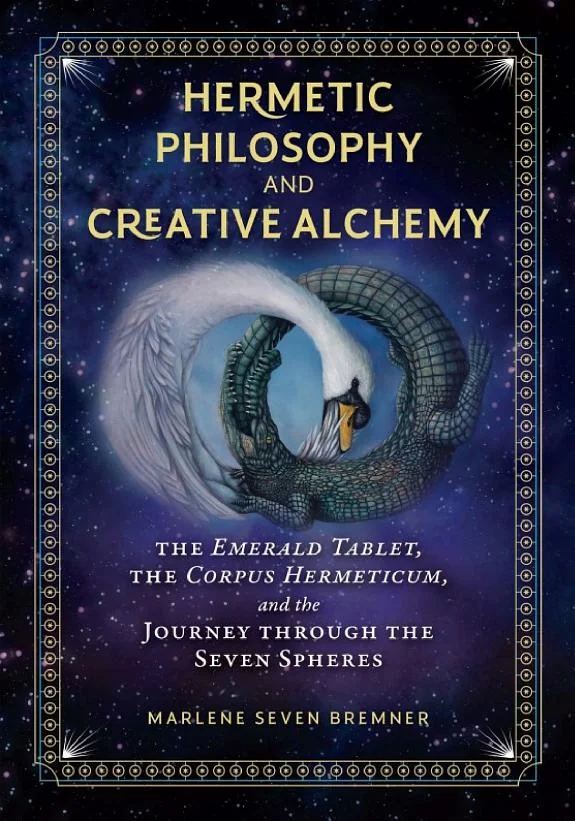
Hermetic Philosophy and Creative Alchemy
 73
73

Hermetic Philosophy and Creative Alchemy
Marlene Seven Bremner's "Hermetic Philosophy and Creative Alchemy" offers a compelling synthesis of ancient wisdom and contemporary creative practice. Its strength lies in the detailed mapping of Hermetic principles onto the seven classical planets, providing a structured, almost initiatory, path for the reader. The integration of alchemical symbolism with personal creative endeavors is particularly well-executed. However, the book occasionally leans towards dense academic prose, which may present a slight barrier for readers seeking purely practical application without a strong theoretical background. A particularly striking passage is the exploration of Mercury's influence on communication and thought, framed through an alchemical lens that illuminates the process of intellectual transmutation. Bremner's original esoteric paintings, used to illustrate concepts, are a unique and valuable addition. The work effectively bridges historical esoteric traditions with modern self-development.
📝 Description
73
Marlene Seven Bremner's 2017 book connects Hermetic teachings to modern creative practice.
Hermetic Philosophy and Creative Alchemy examines the links between classical Hermeticism, alchemical traditions, and contemporary creative and spiritual work. Bremner analyzes key Hermetic texts and alchemical ideas, showing how they can inform personal and artistic growth. The book follows a structure based on the seven classical planets, with each chapter aiming to deepen understanding and personal connection through meditative exercises. This approach encourages intuitive insight and direct engagement with the self.
The volume is suited for those studying esoteric subjects, especially Hermeticism and alchemy. Artists, writers, and other creators may find it useful for adding spiritual depth to their projects. Academics interested in comparative religion, Western esotericism, or the history of magic will appreciate the textual analysis and historical context. Individuals pursuing personal spiritual development, particularly those blending psychological insight with ancient knowledge, will likely find the meditative aspects beneficial.
This work is rooted in the Hermetic tradition, which traces its origins to ancient Egypt and Greece. It engages directly with foundational texts such as the Corpus Hermeticum and the Emerald Tablet. Bremner places her analysis within the historical scope of alchemy, a discipline that historically sought both material transmutation and spiritual refinement. The book considers alchemical symbolism as a means of soul expression, a concept recognized by practitioners and thinkers from the Middle Ages through the Renaissance.
💡 Why Read This Book?
• Learn how the seven traditional planets function as archetypal stages for psycho-spiritual transformation, a core concept directly addressed in the book's planetary progression. • Discover alchemical symbolism not just as historical art, but as a practical language for understanding and refining your own creative and inner processes, as demonstrated through Bremner's analysis of alchemical art. • Gain a framework for a personal creative practice rooted in ancient Hermetic philosophy, offering a distinct approach to self-discovery that is detailed through the book's meditative discourses.
⭐ Reader Reviews
Honest opinions from readers who have explored this book.
❓ Frequently Asked Questions
What specific Hermetic texts does Marlene Seven Bremner reference in "Hermetic Philosophy and Creative Alchemy"?
The book draws heavily on foundational Hermetic texts such as the Corpus Hermeticum and the Emerald Tablet, examining their core principles and cosmogonies to establish a link with alchemical traditions.
How does the book connect alchemy to creative practice?
It presents alchemy as a metaphor for psycho-spiritual transformation, suggesting that the alchemical process of transmutation can be applied to one's creative endeavors and personal growth, using symbolic language and meditative techniques.
What is the significance of the seven planets in this work?
The seven traditional planets serve as archetypal guides through a Hermetic journey, with each chapter dedicated to a planet and its associated energies, offering meditative discourses for intuitive soul engagement.
Who would benefit most from reading "Hermetic Philosophy and Creative Alchemy"?
Individuals interested in Hermeticism, alchemy, esoteric studies, comparative religion, and those seeking to deepen their creative practices with spiritual and psychological frameworks will find this book valuable.
When was "Hermetic Philosophy and Creative Alchemy" first published?
The book was first published on June 14, 2022, making it a contemporary exploration of ancient esoteric traditions.
Does the book include visual elements related to alchemy?
Yes, the book incorporates examples from traditional alchemical art and features the author's own intricate esoteric paintings, illustrating the concepts discussed.
🔮 Key Themes & Symbolism
Planetary Archetypes in Alchemy
The work systematically explores the seven classical planets (Sun, Moon, Mercury, Venus, Mars, Jupiter, Saturn) as symbolic conduits for psycho-spiritual development. Each planet represents a distinct energetic principle and stage in the alchemical process, mirroring stages of personal transformation. Bremner guides the reader through meditations and discourses tailored to the specific qualities of each planetary influence, connecting them to both ancient Hermetic philosophy and the transformative potential within creative acts.
Alchemy as Creative Transmutation
Bremner reinterprets alchemy not solely as a metallurgical pursuit but as a profound metaphor for the transmutation of consciousness and creative energy. The book posits that the alchemical 'Great Work' (Major work) is achievable through creative practice, where raw psychic material is refined and spiritualized. This perspective draws on historical alchemical art and texts to illuminate how artists and seekers can engage in inner transformation through their expressive work.
Hermetic Foundations of Esotericism
The book grounds its exploration in the foundational texts and principles of Hermeticism, tracing lineage back to ancient Egyptian and Greek cosmogonies. It emphasizes the Hermetic axiom 'As Above, So Below,' applying it to the relationship between the macrocosm (the universe) and the microcosm (the individual psyche and creative output). This establishes a philosophical bedrock for understanding the interconnectedness of spiritual laws and their manifestation in the material and creative realms.
The Soulful Journey of Creation
"Hermetic Philosophy and Creative Alchemy" positions the creative process as an intuitive, soul-led endeavor. Through meditative discourses and symbolic interpretation, the book aims to speak directly to the reader's inner being, fostering a deeper connection to their authentic self. It encourages a practice where art becomes a vehicle for spiritual realization, transforming the mundane aspects of life into sacred expressions of higher consciousness.
💬 Memorable Quotes
Direct passages from the work, attributed to the author.
“The seven planets offer a map for psycho-spiritual transformation.”
— This statement expresses the book's core thesis: that the celestial bodies, as understood in ancient Hermeticism, correspond to distinct energetic principles within the human psyche and serve as guides for inner development and creative alchemy.
“Alchemy is the art of refining consciousness through creative work.”
— This highlights the book's central argument that the historical practice of alchemy provides a potent symbolic framework for understanding and engaging in personal growth and artistic expression, focusing on inner purification.
“Meditative discourses connect the intuitive soul to Hermetic principles.”
— This points to the book's method of engaging readers, suggesting that direct, soul-level understanding of Hermetic concepts is achieved through specific meditative practices designed to bypass purely intellectual comprehension.
“Ancient cosmogonies provide a foundation for modern creative practice.”
— This emphasizes the book's approach of drawing upon ancient wisdom, specifically Egyptian and Greek cosmogonies, to offer a robust and historically informed basis for contemporary artistic and spiritual endeavors.
“Artistic expression mirrors the alchemical Major work.”
— This interpretation suggests that the grand transformative process known as the Great Work in alchemy can be mirrored and enacted through the artist's act of creation, turning raw inspiration into refined expression.
🌙 Esoteric Significance
Tradition
This work firmly resides within the Western Esoteric Tradition, specifically drawing from Hermeticism and traditional Western Alchemy. It interprets these ancient systems not as defunct historical practices but as living frameworks for psycho-spiritual development and creative expression. Bremner builds upon centuries of esoteric interpretation, offering a contemporary lens that connects classical cosmology and alchemical symbolism to the inner field of the modern individual.
Symbolism
Key symbols include the seven classical planets, each representing distinct archetypal energies and stages of transformation. The Emerald Tablet, a foundational alchemical text, is central, embodying principles of unity and cosmic correspondence. The concept of the Major work, or Great Work, symbolizes the ultimate goal of spiritual purification and creative actualization, presented as achievable through dedicated practice and inner transmutation.
Modern Relevance
Contemporary thinkers and practitioners in fields ranging from depth psychology and transpersonal studies to contemporary art and creative coaching find value in Bremner's synthesis. The book's approach to alchemy as a metaphor for psychological integration and creative actualization appeals to modern therapeutic modalities and artistic movements seeking deeper meaning and spiritual grounding in their work.
👥 Who Should Read This Book
• Aspiring and established artists seeking to infuse their creative work with deeper philosophical and spiritual dimensions, moving beyond surface-level aesthetics. • Students of Western Esotericism, Hermeticism, and Alchemy looking for a contemporary interpretation that bridges historical texts with practical application. • Individuals engaged in personal development and psycho-spiritual growth who are drawn to archetypal symbolism and meditative practices rooted in ancient wisdom traditions.
📜 Historical Context
Published in 2022, Marlene Seven Bremner's "Hermetic Philosophy and Creative Alchemy" emerges in an era of renewed interest in esoteric traditions and their application to modern life. The work engages with a lineage tracing back to Hellenistic Egypt and the foundational texts of Hermeticism, such as the Corpus Hermeticum, which experienced significant revival during the Renaissance. Alchemy itself, beyond its metallurgical associations, was understood by figures like Paracelsus in the 16th century as a spiritual discipline. Bremner's approach situates this historical practice within contemporary psychology and creative theory, offering a distinct synthesis. While figures like Carl Jung extensively explored alchemical symbolism in relation to the psyche, Bremner focuses specifically on its direct application to creative practice, differentiating her work from purely analytical or historical treatments.
📔 Journal Prompts
The Sun's archetype in creative expression and personal radiance.
Reflecting on the Mercurial transmutation of thought into inspired communication.
How does the Venusian principle manifest in your aesthetic choices and relationships?
Meditating on Mars: transforming raw creative energy into focused action.
The Jovial expansion of consciousness through your current creative projects.
🗂️ Glossary
Hermeticism
A religious, philosophical, and esoteric tradition based primarily upon writings attributed to Hermes Trismegistus. It emphasizes spiritual transformation, the principle of 'As Above, So Below,' and the pursuit of divine knowledge.
Alchemy
An ancient tradition that sought the transmutation of base metals into gold, but more profoundly, aimed at the spiritual purification and transformation of the practitioner (the Major work).
Major work
Latin for 'Great Work,' referring to the process of creating the Philosopher's Stone in alchemy. Esoterically, it signifies the process of spiritual perfection and self-realization.
Corpus Hermeticum
A collection of twenty-one philosophical and religious treatises attributed to Hermes Trismegistus, forming a core text of Hermetic philosophy, likely compiled in the 2nd or 3rd century CE.
Emerald Tablet
A short, cryptic text considered one of the most important works in the history of alchemy, reputedly containing the secret of the prima materia and the transmutation of metals.
Psycho-spiritual
Relating to or affecting both the mind and the spirit; integrating psychological and spiritual dimensions of human experience and development.
Cosmogony
A theory concerning the origin and development of the universe, often found in mythological or religious contexts.
This book appears in 1 collection
🔮 Readers Also Liked
Browse all →








From the “Hermetic Alchemy” Collection
View all →






More Free Alchemy & Hermeticism Books
View all →