Goddess Spirituality for the 21st Century

 81
81

Goddess Spirituality for the 21st Century
Judith Laura's "Goddess Spirituality for the 21st Century" attempts to bridge the gap between ancient divine feminine archetypes and the realities of modern existence. The book’s strength lies in its direct approach to recontextualizing these concepts for contemporary practitioners, moving past purely academic or historical discussions. Laura’s interpretation of the Great Mother as an immanent, rather than solely transcendent, force offers a compelling angle for those seeking a tangible spiritual connection. However, the work occasionally feels more like a manifesto than a deep exploration. While the 2008 publication date situates it within a specific moment of Pagan and feminist thought, some arguments might benefit from further engagement with more recent scholarship in ecofeminism and comparative mythology. A notable passage discusses the necessity of personal sovereignty in one's spiritual path, a principle that underscores the book's overall ethos. Ultimately, it serves as a practical guide for those ready to engage with the Goddess in their everyday lives.
📝 Description
81
Published in 2008, Judith Laura's book asks how ancient Goddess concepts fit into the 21st century.
This book considers how to practice Goddess spirituality today. It looks at ancient ideas about the divine feminine and suggests ways to use them in modern life, going beyond just academic study. Laura connects these ideas to spiritual evolution and practical application for personal growth and social change.
Readers interested in ecofeminism, contemporary Paganism, and traditions honoring the Goddess will find this work relevant. It is for those who want to understand or strengthen their connection to the divine feminine as a present force. The book appeals to individuals questioning patriarchal religion and seeking different spiritual paths.
Laura engages with discussions about recovering and reinterpreting pre-patriarchal goddesses. Her work addresses the challenges and possibilities of practicing Goddess spirituality in secular and modern societies. It examines the concept of an immanent divine, the cyclical nature of existence, and the links between people and the natural world.
Emerging from the Neopagan resurgence and feminist theology of the late 20th century, this book participates in the ongoing reevaluation of pre-patriarchal religious traditions. It builds upon scholarly and practical work that sought to recover and reinterpret goddess figures and feminine divine principles, influenced by figures like Marija Gimbutas and Merlin Stone. Laura’s work situates itself within this lineage, considering its relevance for contemporary practitioners in the new millennium.
💡 Why Read This Book?
• You will learn how to apply ancient Goddess archetypes to modern challenges, moving beyond historical reverence to practical spiritual engagement, as detailed in discussions concerning the immanent divine. • You will gain a framework for understanding the divine feminine as a force of nature and personal empowerment, informed by the cyclical themes of life, death, and rebirth explored throughout the book. • You will discover methods for integrating Earth-centered spirituality into a secular or technologically driven life, drawing from the book's focus on interconnectedness and the contemporary practice of Goddess traditions.
⭐ Reader Reviews
Honest opinions from readers who have explored this book.
❓ Frequently Asked Questions
When was "Goddess Spirituality for the 21st Century" first published?
The book was first published in 2008, reflecting a specific moment in the development of contemporary Pagan and feminist spiritual thought.
What is the primary focus of Judith Laura's book?
The book focuses on reinterpreting and applying ancient Goddess spirituality concepts to the practical realities and challenges of the 21st century.
Does the book discuss specific goddesses?
While not a catalog of goddesses, the work explores universal archetypes and concepts associated with the divine feminine, such as the Great Mother, and their relevance today.
Is this book suitable for beginners in spirituality?
Yes, it is accessible to beginners interested in exploring alternative spiritual paths and understanding the divine feminine outside of traditional patriarchal structures.
What is the author's perspective on the divine?
Laura emphasizes an immanent view of the divine, seeing it as present within nature and individuals, rather than solely a transcendent, external force.
How does the book relate to ecological concerns?
The book strongly connects Goddess spirituality with ecological awareness, highlighting the interconnectedness of humanity and the natural world through divine feminine principles.
🔮 Key Themes & Symbolism
Immanent Divine Feminine
This theme centers on understanding the divine not as a distant, transcendent entity, but as an immanent force present within the natural world and human experience. Laura posits that the Goddess is accessible through earthly manifestations and personal embodiment, challenging patriarchal views of a solely male, external deity. This concept encourages practitioners to find the sacred in everyday life, nature, and within themselves, fostering a direct and personal connection to the divine feminine.
Cyclical Nature of Existence
The book emphasizes the cyclical patterns of birth, life, death, and rebirth, drawing parallels with the phases of the moon and the seasons. This understanding, often associated with ancient Goddess myths, provides a framework for accepting change and transformation as natural and sacred processes. It encourages a worldview that embraces endings as beginnings, fostering resilience and a deeper appreciation for the ongoing cycles of creation and dissolution.
Ecofeminist Spirituality
A core theme is the intrinsic link between the Goddess, the Earth, and the liberation of women. The work advocates for an ecological spirituality that honors the planet as a sacred entity, often personified as the Great Mother. It critiques the destructive tendencies of patriarchal systems that exploit both women and nature, proposing Goddess spirituality as a pathway toward healing and sustainable coexistence.
Personal Sovereignty and Practice
Laura stresses the importance of individual spiritual authority and the development of personal practice. Rather than adhering to rigid dogma, the book encourages readers to forge their own unique relationship with the divine feminine, guided by intuition and personal experience. This empowers individuals to create meaningful spiritual lives relevant to their contemporary circumstances.
💬 Memorable Quotes
Direct passages from the work, attributed to the author.
“The Goddess is not an abstract concept but a living presence in the world.”
— This statement expresses the book's central thesis: spirituality, particularly Goddess worship, should be experienced as an active, tangible force interwoven with earthly existence, not merely as a historical or theoretical idea.
“Embracing the cycles means accepting both creation and destruction as sacred.”
— This highlights the book's perspective on life's natural rhythms. It suggests that true spiritual understanding involves honoring all phases, including endings and decay, as integral parts of the continuous process of existence.
“Our connection to the Earth is fundamental to our spiritual well-being.”
— This emphasizes the ecofeminist underpinnings of the work, asserting that human spirituality is inextricably linked to the health and sanctity of the planet, framing environmentalism as a spiritual imperative.
“Spiritual authority resides within the individual.”
— This interpretation points to the book's focus on personal empowerment and self-discovery, encouraging readers to trust their inner guidance rather than relying solely on external religious structures or doctrines.
“Reclaiming the feminine divine is an act of personal and societal liberation.”
— This suggests that the exploration and embodiment of Goddess spirituality are not just personal choices but also carry a transformative potential for challenging oppressive societal norms and structures.
🌙 Esoteric Significance
Tradition
This work aligns with modern Pagan and Goddess-centered spiritual traditions, which draw inspiration from pre-Christian European religions, ancient Near Eastern cults, and feminist spirituality movements. It departs from strictly historical reconstruction, focusing instead on the psychological and practical application of divine feminine archetypes for contemporary practitioners. It shares lineage with the broader 'Goddess movement' that gained momentum in the latter half of the 20th century.
Symbolism
Key symbols often invoked include the Triple Goddess (Maiden, Mother, Crone), representing life's cycles of creation, nurturing, and wisdom; the Earth itself, embodying immanence and fertility; and the Moon, symbolizing intuition, the subconscious, and the cyclical nature of existence. These symbols serve not merely as representations but as focal points for direct experience and connection with divine feminine energies.
Modern Relevance
Contemporary thinkers and practitioners in ecofeminism, ecopsychology, and various branches of modern Paganism and Wicca continue to engage with the principles outlined in this book. Its emphasis on immanence, personal sovereignty, and the sacredness of the Earth appeals to current discussions on climate change, social justice, and the search for embodied, nature-based spiritualities outside of mainstream religious institutions.
👥 Who Should Read This Book
['• Individuals exploring feminist theology and alternative spiritual paths seeking to understand the divine feminine beyond patriarchal frameworks.', '• Contemporary Pagans and practitioners of earth-centered traditions looking for ways to apply ancient Goddess concepts to modern life and challenges.', '• Readers interested in ecofeminism and the intersection of spirituality, nature, and social change who seek practical guidance.']
📜 Historical Context
Published in 2008, "Goddess Spirituality for the 21st Century" emerged during a period where feminist theology and Neopaganism had gained significant traction since the late 20th century. The work engages with intellectual currents spurred by scholars like Marija Gimbutas, whose theories on Old European cultures and matriarchal societies, though debated, influenced many spiritual seekers. Laura's book positions itself within this ongoing conversation, seeking to make these ideas relevant to contemporary life beyond the academic or counter-cultural circles of the 1970s and 80s. It addressed a spiritual landscape increasingly populated by diverse Goddess traditions, while also existing alongside more established figures like Starhawk, who had been writing and practicing for decades. The early 21st century saw a continued expansion of online communities and a broader public awareness of alternative spiritualities, providing a receptive audience for works aiming to update ancient concepts for a modern, often secularized, world.
📔 Journal Prompts
Reflect on the concept of the immanent divine feminine in relation to your daily environment.
How does the symbol of the Triple Goddess (Maiden, Mother, Crone) manifest in your life's journey?
Consider the Earth as a sacred entity; what responsibilities does this perspective suggest?
Explore personal sovereignty in your spiritual practice: where do you find your authority?
Analyze the cyclical patterns in your own life through the lens of creation and dissolution.
🗂️ Glossary
Immanent Divine
The belief that the divine is present within the world and its inhabitants, rather than being external or transcendent. In Goddess spirituality, this often refers to the divine feminine being found in nature, within individuals, and in everyday life.
Divine Feminine
The archetypal feminine aspects of the divine, encompassing qualities such as creation, nurturing, intuition, wisdom, and transformation. It is often associated with goddesses and the life-giving principles of the universe.
Triple Goddess
A deity or archetypal symbol often represented as three distinct but interconnected figures, typically Maiden, Mother, and Crone. These phases represent the cyclical journey of life: birth and youth, maturity and creation, and wisdom and endings.
Ecofeminism
A philosophical and social movement that links feminism with ecology. It posits that the domination of women and the domination of nature are interconnected and seeks to create a more sustainable and equitable world through understanding these connections.
Personal Sovereignty
The concept of an individual's right and ability to be the ultimate authority over their own life, beliefs, and spiritual path. It emphasizes self-determination and direct experience over dogma or external control.
Neopaganism
A contemporary religious movement that draws inspiration from pre-Christian European religions. It is diverse and often includes nature-based practices, polytheism, and reverence for the Earth.
Archetype
A universal, inherited pattern of thought or imagery derived from the experiences of the human species, often appearing in myths, dreams, and art. In Goddess spirituality, archetypes represent fundamental aspects of the divine feminine.
🔮 Readers Also Liked
Browse all →





More by Judith Laura
All books →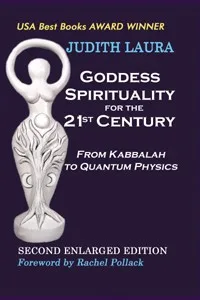

More Free Kabbalah & Jewish Mysticism Books
View all →