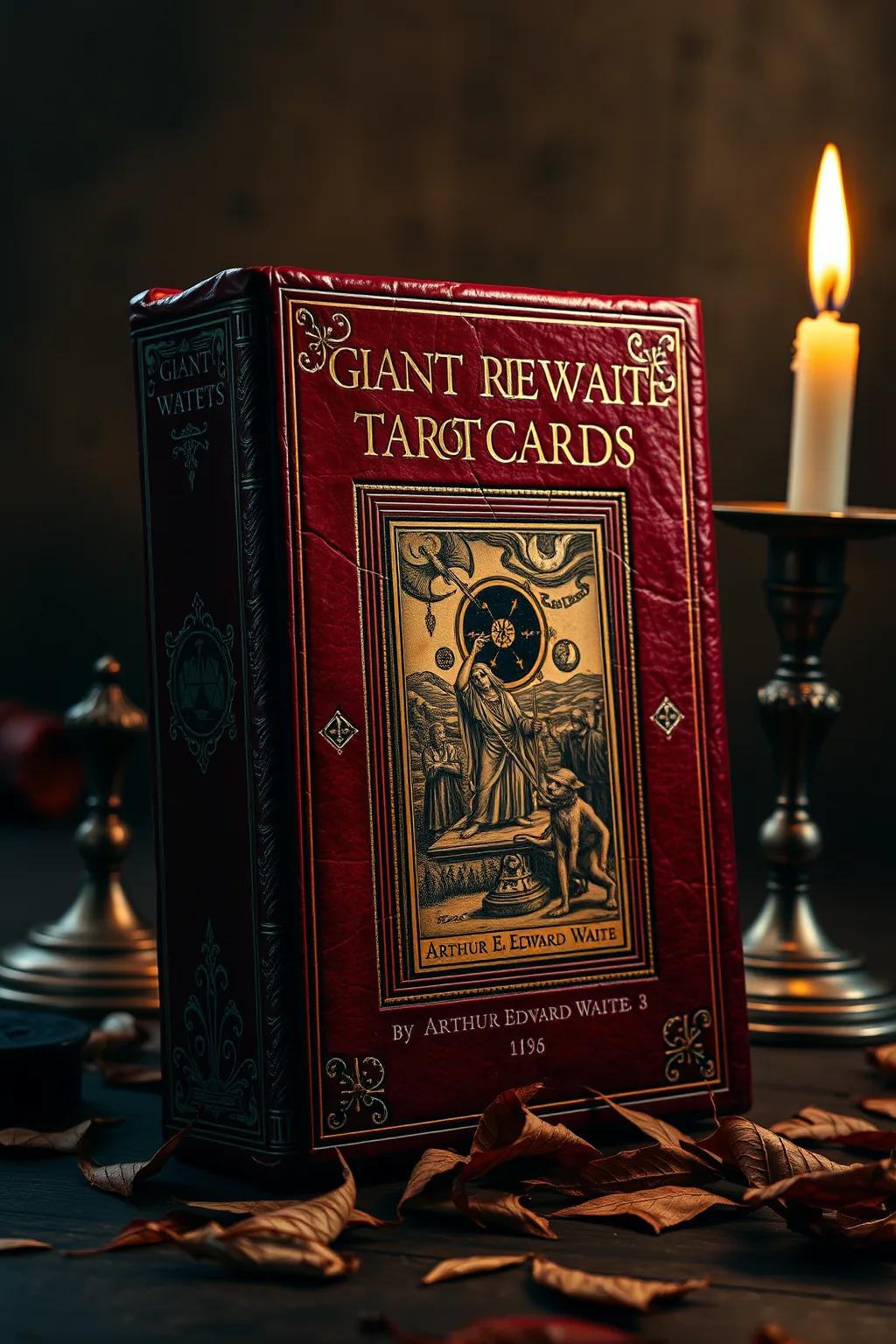
Giant Rider Waite Tarot Cards
 61
61

Giant Rider Waite Tarot Cards



Arthur Edward Waite's Giant Rider Waite Tarot Cards offer an unparalleled deep dive into one of divination's most foundational tools. This edition, presented with impressive detail, serves not just as a deck but as a comprehensive esoteric treatise. Waite's meticulous approach to symbolism, rooted in occult traditions, provides practitioners with a robust framework for interpretation beyond superficial readings. The sheer scale enhances the appreciation of Pamela Colman Smith's evocative artistry and Waite's visionary design. Essential for serious Tarot students and occult scholars, this collection promises to deepen one's connection to the archetypal language of the Tarot and unlock profound layers of hidden knowledge.
📝 Description
61
Published in 1909, Arthur Edward Waite's Giant Rider Waite Tarot Cards is a significant visual interpretation of the tarot.
This edition presents Arthur Edward Waite's influential Rider-Waite tarot deck in a larger format, intended for closer study. Waite, a prominent figure in occult circles, collaborated with artist Pamela Colman Smith to create a deck that moved beyond traditional imagery. The cards feature detailed scenes rather than simple symbolic arrangements, making them more accessible for interpretation and personal reflection. Waite designed the deck with specific esoteric meanings in mind, drawing from Kabbalah, Hermeticism, and Freemasonry. This publication aims to facilitate a deeper understanding of these symbols and their potential applications in divination and self-awareness. The larger size allows for a more detailed examination of the artwork and its symbolic layers.
Waite's intention was to create a tarot system that was both aesthetically pleasing and rich in layered meaning. The deck's imagery is meant to evoke specific correspondences, guiding the user toward insights about personal psychology and universal forces. It is a tool for introspection, encouraging a dialogue with the subconscious through its visual language. The deck's enduring popularity stems from its balance of symbolic depth and practical usability for those interested in tarot as a method of self-discovery.
Arthur Edward Waite was a prolific author and occultist active in the late 19th and early 20th centuries. He was a member of the Hermetic Order of the Golden Dawn, a major influence on Western esotericism. The Rider-Waite deck, first published in 1909, was a departure from earlier tarot decks, incorporating Waite's extensive knowledge of occult traditions. It integrated symbolism drawn from Kabbalah, Christian mysticism, and Hermeticism into the visual design of the cards, particularly the Minor Arcana, which had previously been depicted with simpler designs. This deck became a foundational text for many subsequent tarot systems and interpreters.
💡 Why Read This Book?
Uncover the rich tapestry of occult symbolism and archetypal wisdom embedded within the Rider-Waite Tarot. This collection is essential for seekers of hidden knowledge, students of esoteric traditions, and practitioners aiming to deepen their divinatory practice with a visually stunning and deeply resonant tool. Explore the profound philosophical underpinnings of the Tarot and its power for personal transformation.
⭐ Reader Reviews
Honest opinions from readers who have explored this book.
❓ Frequently Asked Questions
What makes the Rider-Waite Tarot so influential?
Its revolutionary approach to the Minor Arcana, depicting scenes with figures and narratives, rather than just symbolic arrangements, made the Tarot accessible and deeply symbolic for a wider audience, bridging esoteric knowledge with practical application.
Who was Arthur Edward Waite?
A prominent occultist, historian, and author of the late 19th and early 20th centuries, Waite was a leading figure in the Hermetic Order of the Golden Dawn and a prolific writer on Tarot, Rosicrucianism, and other mystical subjects.
What is the significance of the 'Giant' format?
The larger size of these cards allows for a more detailed examination of the intricate artwork and symbolism, enhancing comprehension and appreciation for both novice and experienced practitioners.
Are these cards suitable for beginners?
While the depth of symbolism can be profound, the Rider-Waite deck is often considered an excellent starting point due to its widely available interpretations and clear visual narratives.
What esoteric traditions influenced this deck?
The deck draws heavily from Hermeticism, Kabbalah, Western esotericism, and Christian mysticism, weaving these complex philosophies into a cohesive visual system.
🔮 Key Themes & Symbolism
Arcane Symbolism and Hermetic Philosophy
The Rider-Waite Tarot is a profound repository of arcane symbolism, meticulously designed to encapsulate Hermetic principles and esoteric wisdom. Each card acts as a hieroglyphic key, unlocking layers of meaning rooted in ancient traditions like Kabbalah and Western esotericism. Waite's intent was to create a divinatory system that not only predicted but also illuminated the soul's journey, offering a visual map of the cosmic order and the individual's place within it. The intricate details and archetypal imagery serve as a constant reminder of the hidden connections between the macrocosm and the microcosm, inviting practitioners to engage with a deeper, more philosophical understanding of reality.
The Archetypal Language of the Tarot
This collection looks at the archetypal language of the Tarot, a universal grammar of the human psyche and the cosmos. The Rider-Waite deck, through its evocative imagery, taps into primal forces and fundamental human experiences. From the fiery passion of the Wands to the emotional depths of the Cups, and the intellectual clarity of the Swords to the material realities of the Pentacles, each suit and card represents a distinct facet of existence. These archetypes, when understood, offer useful insights into personal challenges, relationships, and life's grand narrative, serving as a mirror to the soul and a guide for reading through the complexities of life.
Divination as a Tool for Self-Mastery
Beyond mere fortune-telling, the Giant Rider Waite Tarot is presented as a potent instrument for self-mastery and spiritual growth. Waite envisioned the Tarot not just as a predictive tool but as a catalyst for introspection and personal transformation. By engaging with the symbolic narratives of the cards, individuals can confront their inner shadows, understand their motivations, and gain clarity on their life path. The act of reading and interpreting the Tarot becomes a meditative practice, fostering intuition, cultivating wisdom, and ultimately empowering the user to consciously shape their destiny through informed choices and a deeper connection to their inner knowing.
💬 Memorable Quotes
Direct passages from the work, attributed to the author.
“Every card is a word in a divine alphabet.”
— This highlights the interconnectedness and symbolic richness of each Tarot card, suggesting they form a complex language through which cosmic truths can be communicated.
“The symbols are keys to unlock the mysteries of the soul.”
— This underscores the Tarot's role as an introspective tool, with its imagery serving as a guide to understanding the deeper aspects of the human psyche and its hidden potentials.
“Wisdom is not found, but is realized.”
— This philosophical statement suggests that true understanding comes through personal experience and inner realization, a process that the Tarot can facilitate.
“The path of the Fool is the beginning of all wisdom.”
— This references the iconic first card of the Tarot, emphasizing that embracing the unknown and venturing forth with an open heart is foundational to acquiring useful insights.
💡 Key Ideas
Editorial paraphrase of the work's core concepts — not direct quotes.
The Tarot is not a game, but a sacred book.
This quote emphasizes the profound spiritual and intellectual depth of the Tarot, positioning it as a source of sacred knowledge rather than mere entertainment or simple prediction.
🌙 Esoteric Significance
Tradition
The Giant Rider Waite Tarot is deeply rooted in the Western Esoteric Tradition, drawing heavily from Hermeticism, Kabbalah, and Christian mysticism. Arthur Edward Waite, a key figure in the Hermetic Order of the Golden Dawn, infused the deck with complex philosophical and spiritual concepts, aiming to create a visual compendium of occult knowledge. It serves as a bridge between arcane lore and practical application, offering insights into the spiritual journey and the underlying order of the cosmos.
Symbolism
The deck's symbolism is a wide range woven from ancient archetypes, alchemical processes, and Kabbalistic numerology. Each card, from the Majors to the Minors, is imbued with layers of meaning that speak to the human condition, spiritual evolution, and the forces that shape reality. The use of color, imagery, and composition is deliberate, intended to resonate with the subconscious and unlock deeper levels of understanding for the practitioner.
Modern Relevance
In contemporary times, the Giant Rider Waite Tarot continues to be an indispensable tool for seekers of wisdom and self-discovery. Its enduring relevance lies in its ability to provide a framework for navigating modern complexities through timeless archetypal narratives. The deck's visual language transcends cultural and temporal boundaries, offering useful insights into personal growth, psychological well-being, and spiritual exploration in an increasingly fragmented world. It remains a powerful conduit for intuition and a guide for conscious living.
👥 Who Should Read This Book
This comprehensive collection is important for a diverse audience. **Beginners** in Tarot will find the detailed imagery and widely accepted symbolism an excellent foundation for learning. **Scholars** of esotericism will appreciate the historical context and the depth of Waite's philosophical underpinnings. **Seekers** of spiritual insight and personal growth will discover a potent tool for introspection and self-discovery. **Practitioners** of divination will enhance their readings with the strong symbolism and nuanced interpretations offered by this seminal deck, making it an indispensable addition to any serious Tarot library.
📜 Historical Context
The Rider-Waite Tarot emerged from the vibrant occult revival of late Victorian and Edwardian England, a period characterized by a profound fascination with ancient mysteries, spiritualism, and esoteric philosophies. Arthur Edward Waite, a prominent member of the Hermetic Order of the Golden Dawn, collaborated with artist Pamela Colman Smith to create a deck that was both accessible and deeply symbolic. This era saw a surge in interest in Kabbalah, Hermeticism, and ancient Egyptian mysteries, all of which heavily influenced the deck's iconography. The Rider-Waite deck was revolutionary for its time, particularly in its detailed depictions of the Minor Arcana, which moved beyond simple pips to illustrate narrative scenes, making the Tarot more intuitive and easier to interpret for a wider audience, thus embedding it firmly within the Western esoteric tradition.
📔 Journal Prompts
Reflect on the journey of The Fool: what 'leap of faith' are you currently contemplating?
Choose a card from the suit of Swords and write a narrative about a mental battle or intellectual challenge.
How does the imagery of The High Priestess speak to your intuition and inner knowing?
Consider the symbolism of The World card; what does 'completion' or 'fulfillment' mean in your current life context?
Draw a card from the Pentacles suit and explore its connection to your material well-being or practical endeavors.
🗂️ Glossary
Arcanum
A term referring to the secret or mystery, commonly used to denote the cards of the Tarot, particularly the Major Arcana.
Kabbalah
An esoteric system of Jewish mysticism that deals with the divine nature and the creation and structure of the universe, often represented by the Tree of Life.
Hermeticism
A philosophical and religious tradition based on the teachings attributed to Hermes Trismegistus, emphasizing the interconnectedness of all things and the principle of 'as above, so below'.
Archetype
A universal, inherited pattern of thought or imagery derived from the experience of the human race, often found in mythology and dreams, which is believed to influence behavior and perception.
Divination
The practice of seeking knowledge of the future or the unknown by supernatural means, often through the interpretation of omens, signs, or symbolic systems like the Tarot.
This book appears in 3 collections
🔮 Readers Also Liked
Browse all →









More by Arthur Edward Waite
All books →


From the “Tarot” Collection
View all →







More Free Divination & Tarot Books
View all →