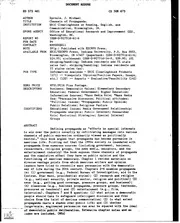
ERIC ED392645: Science or Pseudoscience: Does Science Education Demarcate? The Case of Chemistry and Alchemy in Teaching.

 80
80

ERIC ED392645: Science or Pseudoscience: Does Science Education Demarcate? The Case of Chemistry and Alchemy in Teaching.


As the Alchemy & Hermeticism Editor, I find ERIC ED392645 to be a remarkably insightful examination of the demarcation problem, viewed through the illuminating prism of chemistry and its alchemical forebears. The author skillfully navigates the complex philosophical terrain, offering a compelling argument for the pedagogical value of historical and philosophical inquiry in science education. This work is particularly valuable for its ability to bridge the gap between abstract philosophical concepts and practical classroom application, demonstrating how the demarcation criteria can serve as a guiding light. It’s a must-read for educators and those fascinated by the esoteric roots of scientific disciplines.
📝 Description
80
This 1999 paper questions if chemistry education truly separates science from alchemy.
This work examines the historical and philosophical divide between science and alchemy, using chemistry education as a case study. It investigates how the definition of science developed, particularly in contrast to alchemical practices. The author seeks to illuminate the historical discussions that influenced our understanding of what constitutes knowledge.
The book considers the connections between material and metaphysical pursuits, tracing the lineage of scientific thought from alchemical symbolism to modern chemistry's methods. It aims to show the importance of demarcation in shaping our search for understanding. The text invites a reevaluation of the fundamental principles of knowing and discovering.
While not strictly an esoteric text, this paper engages with the historical roots of Western esotericism by examining alchemy. Alchemy, often considered an esoteric tradition blending proto-scientific, philosophical, and mystical elements, serves as a point of comparison to modern science. The work analyzes how the boundaries were drawn between these systems, touching upon how seemingly mystical pursuits contributed to the formation of empirical disciplines. It highlights a period where the material and the metaphysical were not always rigidly separated.
💡 Why Read This Book?
This exploration is crucial for anyone seeking to understand the soul of science, not just its mechanics. It reveals how historical debates, particularly those involving alchemy, forged the very boundaries of empirical knowledge. Ideal for scholars of hermeticism, educators, and seekers who wish to grasp the philosophical underpinnings of scientific discovery and its evolution from ancient mysticism.
⭐ Reader Reviews
Honest opinions from readers who have explored this book.
❓ Frequently Asked Questions
What is demarcationism in the context of this paper?
Demarcationism, in this context, refers to the philosophical task of distinguishing science from non-science, particularly exploring how the historical lines between alchemy and chemistry were drawn and how this process can inform modern science education.
How does alchemy relate to modern chemistry according to this text?
The paper argues that understanding alchemy's historical role, its methods, and its philosophical underpinnings provides a crucial contrast for defining modern chemistry, highlighting the evolution of scientific thought and practice.
What is the main argument regarding science education?
The central argument is that incorporating historical and philosophical aspects of chemistry, including its demarcation from alchemy, can enrich science education by providing a deeper understanding of scientific concepts and the nature of scientific inquiry.
Who is the intended audience for this paper?
The intended audience includes educators in elementary and secondary education, philosophers of science, historians of chemistry, and anyone interested in the demarcation problem and the historical development of scientific disciplines.
Can this paper help in understanding scientific misconceptions?
Yes, by exploring historical shifts in understanding and practice, such as the transition from alchemy to chemistry, the paper offers insights into how scientific concepts have been understood and misunderstood over time.
🔮 Key Themes & Symbolism
The Alchemical Legacy
This theme explores the body of alchemical thought, exploring its symbolic language, its pursuit of transformation, and its philosophical quest for universal truths. It examines how alchemical practices, often shrouded in mystery and allegory, laid foundational groundwork for later scientific inquiry, revealing the hidden currents of knowledge that flowed from ancient traditions into the nascent fields of chemistry. The exploration highlights the continuous human endeavor to understand and manipulate the material world, bridging the gap between the spiritual and the corporeal.
Demarcationism as a Pedagogical Tool
This theme focuses on the critical role of demarcationism in defining the boundaries of scientific knowledge. It posits that understanding what distinguishes science from non-science, particularly through historical examples like the alchemy-chemistry divide, is essential for effective science education. By providing clear criteria for scientific validity and methodology, demarcationism can guide students toward a more robust comprehension of scientific concepts, fostering critical thinking and an appreciation for the rigorous evolution of scientific disciplines.
Philosophy and History in Chemistry Education
This theme underscores the vital importance of integrating the philosophical and historical dimensions of chemistry into the learning environment. It argues that a purely empirical approach neglects the rich intellectual heritage that shaped modern chemistry. By engaging with the historical context and philosophical debates surrounding chemical discoveries and transformations, students can gain a more nuanced and profound understanding of scientific principles, their origins, and their ongoing development, thereby clarifying the scientific process.
💬 Memorable Quotes
Direct passages from the work, attributed to the author.
“Themes from history and philosophy of chemistry have traditionally been absent in chemistry education.”
— This poignant observation highlights a critical gap in conventional science pedagogy, advocating for the inclusion of richer, more contextualized learning experiences that connect students to the intellectual evolution of their subject.
“This paper targets the problem of demarcationism within the context of chemistry and alchemy.”
— This statement clearly defines the paper's core focus: using the specific historical relationship between alchemy and chemistry to explore the broader philosophical challenge of distinguishing scientific disciplines.
“Demarcation criteria can guide structured knowledge with respect to demarcationism and inform science instruction.”
— This suggests that the philosophical tools used to define science are not merely academic exercises but practical instruments that can organize learning and enhance the effectiveness of teaching scientific concepts.
“The case of chemistry and alchemy in teaching.”
— This phrase expresses the paper's chosen methodology, indicating that the historical and philosophical examination of the transition from alchemy to chemistry serves as a concrete example to illustrate the principles of demarcationism in an educational setting.
💡 Key Ideas
Editorial paraphrase of the work's core concepts — not direct quotes.
Demarcationism can be an appropriate base for bringing the historical and philosophical aspects of the discipline of chemistry into the learning environment.
This quote emphasizes the practical utility of philosophical distinctions in enriching the teaching of science, suggesting that defining what science is helps illuminate its historical journey and intellectual depth.
🌙 Esoteric Significance
Tradition
This work resonates deeply with the Hermetic tradition, which historically sought to unify the spiritual and material realms through the pursuit of hidden knowledge and transformative processes. Alchemy, as the alchemical arts, is a direct manifestation of this tradition, aiming for not only material transmutation but also spiritual enlightenment. The paper's exploration of demarcationism can be seen as an attempt to understand the structured, rational pathways that emerged from these more esoteric beginnings.
Symbolism
Alchemy is replete with potent symbolism: the Ouroboros representing cycles of creation and destruction, the Philosopher's Stone as the ultimate goal of perfection, and the four elements as foundational principles. This paper implicitly engages with this symbolic language by examining the conceptual shifts that moved the discipline away from such allegorical interpretations towards empirical observation and quantifiable results, thereby interpreting the evolution of symbolic understanding within scientific progress.
Modern Relevance
In an age saturated with information and diverse belief systems, understanding the historical process of demarcation is more crucial than ever. This work offers a framework for critically evaluating claims, distinguishing evidence-based knowledge from speculation, and appreciating the rigorous methodologies that underpin scientific advancement. For those interested in the esoteric, it provides a unique perspective on how ancient wisdom traditions evolved and contributed to the very foundations of modern scientific inquiry, fostering a more nuanced understanding of knowledge itself.
👥 Who Should Read This Book
This paper is an invaluable resource for educators at all levels, from elementary to secondary, seeking to enrich their science curricula with historical and philosophical depth. Scholars of the history and philosophy of science will find it a compelling case study on demarcationism. Seekers interested in the esoteric roots of modern disciplines, particularly alchemy and hermeticism, will discover a nuanced exploration of knowledge evolution. Practitioners in fields related to chemistry or science education can gain a broader perspective on the foundational principles that shape their work and the historical context of their disciplines.
📜 Historical Context
This paper emerges from an era where the philosophy of science was actively grappling with the problem of demarcation – the challenge of distinguishing genuine scientific theories from pseudoscience or non-science. Thinkers like Karl Popper were prominent, advocating for falsifiability as a key criterion. In the field of education, there was a growing awareness of the need to move beyond rote memorization towards a more conceptual and historically grounded understanding of scientific disciplines. The specific juxtaposition of chemistry and alchemy provides a rich historical case study, as alchemy, with its mystical elements and often non-empirical methods, represents a significant precursor to modern chemistry, highlighting the evolving criteria for scientific acceptance and practice. This context underscores the paper's relevance in understanding how scientific disciplines are shaped by their past and how those lessons can inform present educational strategies.
📔 Journal Prompts
How did the alchemical pursuit of transformation differ from the goals of early chemistry, and what philosophical shifts enabled this divergence?
Reflect on a time you encountered a scientific concept that initially seemed mysterious or symbolic. How did learning its scientific explanation change your understanding?
Consider the concept of 'hidden knowledge' in alchemy. How does this compare to the pursuit of knowledge in contemporary science, and where do you see parallels or contrasts?
Discuss the importance of defining what constitutes 'science.' What are the potential benefits and drawbacks of drawing clear boundaries between scientific and non-scientific inquiry in education?
How can understanding the historical relationship between alchemy and chemistry help students develop a more critical and nuanced perspective on scientific progress and the nature of scientific discovery?
🗂️ Glossary
Demarcationism
The philosophical problem of distinguishing science from non-science and pseudoscience, seeking criteria to delineate the boundaries of scientific knowledge and practice.
Alchemy
An ancient proto-scientific and philosophical tradition that sought to understand and transmute matter, often incorporating mystical, astrological, and spiritual elements.
Chemistry
The scientific discipline that studies the composition, structure, properties, and reactions of matter, relying on empirical observation and experimentation.
Epistemology
The branch of philosophy concerned with the theory of knowledge, investigating its nature, scope, and methods.
Pedagogy
The method and practice of teaching, especially as an academic subject or theoretical concept.
This book appears in 3 collections
🔮 Readers Also Liked
Browse all →





More by ERIC
All books →


From the “Hermeticism” Collection
View all →








More Free Alchemy & Hermeticism Books
View all →


![Mythomystes [1632]](/img/thumb/mythomystes-1632-reynolds-henry.webp)