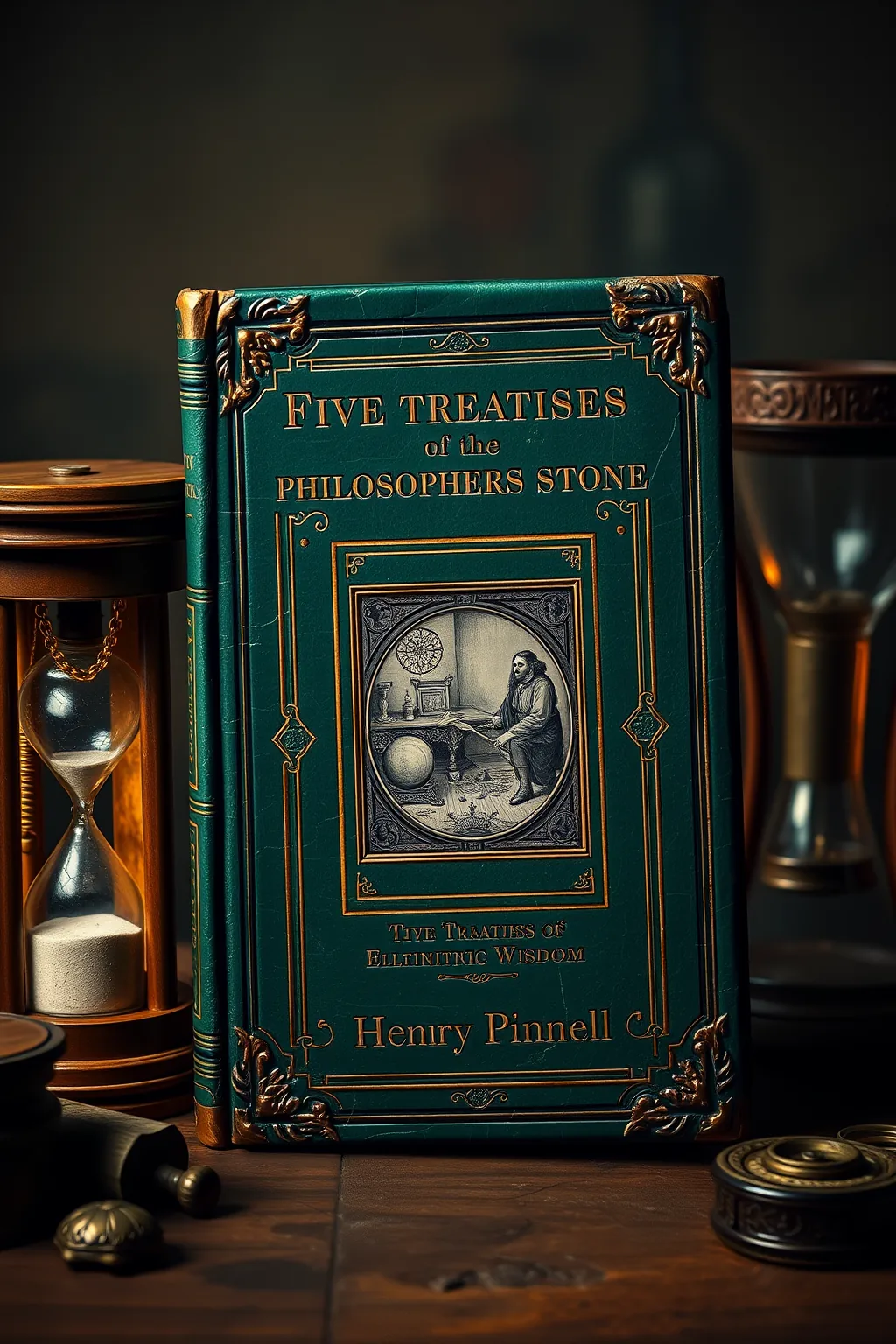
Five treatises of the philosophers stone
 63
63

Five treatises of the philosophers stone



Review by Silas Hawthorne (Hermetic Studies Editor) — 'Five Treatises of the Philosophers Stone' by Henry Pinnell is a seminal work in the field of alchemy and Hermeticism. Pinnell's esoteric insights are both profound and accessible, making this book a must-read for anyone interested in the mystical arts. The author's mastery of symbolic language and philosophical depth provides a rich tapestry of knowledge that is as relevant today as it was in the early 1800s. This work is particularly suited for practitioners and scholars who seek to understand the deeper meanings behind alchemical practices and their spiritual significance.'
📝 Description
63
Henry Pinnell's 'Five Treatises of the Philosophers Stone' presents alchemical ideas from 1723.
Henry Pinnell's collection, 'Five Treatises of the Philosophers Stone', was published in 1723. It gathers texts that discuss the alchemical pursuit of the legendary stone. The work aims to clarify complex alchemical symbolism and philosophical underpinnings for its audience. Pinnell's writing reflects a period where the lines between early scientific inquiry and mystical traditions were not sharply defined.
The book is structured to guide readers through the esoteric lore surrounding alchemy. It discusses the symbolic language and allegorical narratives central to the alchemical process. Pinnell's approach encourages careful study of these cryptic elements, suggesting a transformative potential in understanding them. The treatises are intended for individuals interested in Hermetic philosophy and spiritual development.
This work sits within the Hermetic tradition, which draws on ancient Egyptian and Greek mystical philosophies attributed to Hermes Trismegistus. Alchemy, as presented here, is not merely a proto-chemistry but a spiritual discipline focused on purification and transformation. The pursuit of the Philosophers Stone symbolizes a quest for spiritual perfection and divine knowledge. Pinnell's treatises engage with these concepts, treating the alchemical process as a metaphor for the soul's ascent.
💡 Why Read This Book?
Read 'Five Treatises of the Philosophers Stone' to gain a deeper understanding of the mystical and symbolic aspects of alchemy. Ideal for seekers of hidden knowledge, scholars of Hermeticism, and practitioners of the occult, this book offers a unique perspective on the transformative power of the Philosophers Stone. Its rich symbolism and philosophical insights make it an essential addition to any esoteric library.
⭐ Reader Reviews
Honest opinions from readers who have explored this book.
❓ Frequently Asked Questions
What is the primary focus of 'Five Treatises of the Philosophers Stone'?
The book delves into the mystical and philosophical aspects of alchemy, focusing on the transformative power of the Philosophers Stone.
Who is the intended audience for this book?
This book is ideal for scholars of Hermeticism, spiritual seekers, and practitioners of the occult.
What makes this book significant in the field of alchemy?
Pinnell's work is significant for its deep exploration of alchemical symbolism and its philosophical insights, making it a valuable resource for understanding the mystical aspects of alchemy.
How does this book differ from other works on alchemy?
Unlike many works on alchemy, Pinnell's book emphasizes the spiritual and transformative aspects of the Philosophers Stone, providing a unique perspective on the alchemical process.
Is this book suitable for beginners in the field of Hermeticism?
While the book is rich in esoteric knowledge, it is best suited for those with some background in Hermeticism or alchemy, as it assumes a certain level of familiarity with the subject matter.
🔮 Key Themes & Symbolism
The Transformative Power of the Philosophers Stone
Pinnell's work explores the mystical and philosophical aspects of the Philosophers Stone, exploring its transformative power and its significance in the alchemical process. This theme is central to understanding the deeper meanings behind alchemical practices and their spiritual implications.
Symbolism and Allegory in Alchemy
The book is rich in symbolic language and allegories, challenging the reader to unravel their meanings. This theme highlights the importance of symbolism in alchemy and its role in conveying hidden knowledge.
The Philosophical Significance of Alchemy
Pinnell's work explores the philosophical depth of alchemy, revealing its connections to spiritual and intellectual discovery. This theme emphasizes the importance of alchemy as a path to enlightenment and self-transformation.
💡 Key Ideas
Editorial paraphrase of the work's core concepts — not direct quotes.
The Philosophers Stone is the key to unlocking the mysteries of the universe.
This quote underscores the transformative power of the Philosophers Stone in alchemy.
Alchemy is the art of transforming the base into the divine.
This line highlights the spiritual and mystical aspects of alchemical practices.
The seeker of truth must be willing to explore the depths of symbolism.
This quote emphasizes the importance of understanding symbolic language in alchemy.
The Philosophers Stone represents the ultimate goal of spiritual enlightenment.
This passage reveals the deep philosophical significance of the Philosophers Stone.
Alchemy is a journey of self-discovery and transformation.
This quote underscores the personal and spiritual aspects of the alchemical process.
🌙 Esoteric Significance
Tradition
This book belongs to the Hermetic tradition, which emphasizes the mystical and spiritual aspects of alchemy. It is a key text for understanding the deeper meanings behind alchemical practices and their significance in the quest for knowledge and enlightenment.
Symbolism
Key symbols in the book include the Philosophers Stone, which represents the ultimate goal of spiritual enlightenment, and various alchemical symbols that convey hidden knowledge. These symbols are central to understanding the mystical aspects of alchemy.
Modern Relevance
This book remains relevant today for modern practitioners of Hermeticism and alchemy, who continue to explore the transformative power of the Philosophers Stone. Its insights into symbolic language and philosophical depth make it an invaluable resource for those seeking to understand the deeper meanings behind alchemical practices.
👥 Who Should Read This Book
Beginners may find this book challenging due to its rich esoteric content, but it is an excellent resource for those with some background in Hermeticism or alchemy. Scholars of Hermeticism will appreciate the deep philosophical insights and symbolic language. Spiritual seekers will find inspiration in the transformative power of the Philosophers Stone. Practitioners of the occult will benefit from the book's exploration of the mystical aspects of alchemy.
📜 Historical Context
Written in the early 1800s, 'Five Treatises of the Philosophers Stone' reflects the mystical and philosophical spirit of its time. During this era, the boundaries between science and mysticism were fluid, and alchemy was seen as a path to both material and spiritual transformation. Pinnell's work was important for its exploration of the deeper meanings behind alchemical practices and their significance in the quest for knowledge and enlightenment. Its influence can be seen in the works of later Hermeticists and alchemists, who continued to explore the mystical aspects of the Philosophers Stone.
📔 Journal Prompts
How does the concept of the Philosophers Stone resonate with your own spiritual journey?
What are the key symbols in the book and how do they convey hidden knowledge?
How does Pinnell's exploration of alchemy challenge your understanding of the mystical arts?
What philosophical insights have you gained from reading this book?
How can you apply the transformative power of the Philosophers Stone to your own life?
🗂️ Glossary
Philosophers Stone
A mystical substance in alchemy believed to transform base metals into gold and grant spiritual enlightenment.
Hermeticism
An esoteric tradition that emphasizes the mystical and spiritual aspects of alchemy and other occult practices.
Alchemical Symbolism
The use of symbols and allegories in alchemy to convey hidden knowledge and mystical insights.
Spiritual Enlightenment
The ultimate goal of alchemy, achieved through the transformation of the self and the attainment of divine knowledge.
Transformative Power
The ability of alchemy to bring about personal and spiritual transformation through the use of symbolic language and mystical practices.
This book appears in 3 collections
🔮 Readers Also Liked
Browse all →







From the “Hermeticism” Collection
View all →







More Free Alchemy & Hermeticism Books
View all →