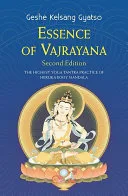
Essence of Vajrayana
 79
79

Essence of Vajrayana
Geshe Kelsang Gyatso's "Essence of Vajrayana" presents a rigorous exposition of the Heruka body mandala practices. The text's strength lies in its systematic breakdown of complex meditations, aiming to guide practitioners toward transforming ordinary perceptions into those of a Buddha. Gyatso Rinpoche's approach is direct, focusing on the completion stage practices that promise swift enlightenment. However, the sheer density of the material may present a significant hurdle for those uninitiated in Tibetan Buddhist tantric systems. The detailed instructions on visualizing the mandala and its deities, while precise, demand considerable dedication and prior grounding. The work explores how these practices function as a vehicle for rapid spiritual attainment. It's a demanding text, but for the committed student, it offers a clear map to the highest yogic practices within the Gelug school.
📝 Description
79
### What It Is ### Who It's For ### Historical Context ### Key Concepts
💡 Why Read This Book?
• Gain access to detailed instructions for the Heruka body mandala meditations, a specific advanced practice within Tibetan Buddhism, offering a direct path to enlightenment as outlined in the text. • Understand the completion stage practices of Vajrayana as presented by Geshe Kelsang Gyatso, providing a framework for rapid spiritual development unique to this tradition. • Learn how to systematically transform ordinary experiences into those of a Buddha through the specific yogic techniques described, a core objective of the Vajrayana path.
⭐ Reader Reviews
Honest opinions from readers who have explored this book.
❓ Frequently Asked Questions
What is the Heruka body mandala?
The Heruka body mandala is a complex visualization used in advanced Vajrayana Buddhist practice. It involves meditating on a specific deity, Heruka, and perceiving one's own body and environment as a pure mandala of this enlightened being.
When was "Essence of Vajrayana" first published?
The book "Essence of Vajrayana" by Geshe Kelsang Gyatso was first published on January 1, 2017.
What are completion stage practices in Vajrayana?
Completion stage (Dzogrim) practices are the advanced yogic techniques in Vajrayana Buddhism, focusing on the subtle body and energy channels to achieve enlightenment, often contrasting with the generation stage (Utpatti-krama) which involves visualization.
Who is Geshe Kelsang Gyatso?
Geshe Kelsang Gyatso is a renowned contemporary Buddhist master and scholar who founded the New Kadampa Tradition (NKT) and has written extensively on Kadampa Buddhism.
What is the goal of practicing the Heruka body mandala?
The primary goal is to transform one's ordinary mind and body into those of a fully enlightened Buddha, achieving supreme bliss and the highest state of realization within a single lifetime.
Does this book require prior knowledge of Buddhism?
While the book is precise, it is intended for those with some familiarity with Buddhist philosophy and practice, particularly Vajrayana. It details advanced meditations requiring a solid foundation.
🔮 Key Themes & Symbolism
Heruka Body Mandala
The text meticulously details the practice of the Heruka body mandala, a core tantric meditation. It explains how to visualize the deity Heruka and perceive the practitioner's own body as a pure divine form, a sacred mandala. This process is designed to purify ordinary perceptions and reveal the innate Buddha-nature, transforming the practitioner's psycho-physical aggregates into those of an enlightened being. The emphasis is on direct experience and the integration of the visualized deity with one's own consciousness.
Completion Stage Practices
Central to "Essence of Vajrayana" are the completion stage (Dzogrim) practices. These advanced yogic techniques focus on the subtle energies and channels of the body, aiming to directly realize the nature of mind and achieve enlightenment rapidly. The book provides specific instructions for these practices, which are considered the swift path to Buddhahood, requiring significant preparation and commitment from the practitioner.
Transformation of Experience
A primary theme is the radical transformation of one's everyday reality. By engaging with the Heruka body mandala and completion stage meditations, practitioners are guided to perceive their world not as inherently impure but as the pure display of a Buddha's enlightened mind. This shift in perception is not merely conceptual but is cultivated through deep meditative practice, leading to a profound realization of emptiness and bliss.
Path to Full Enlightenment
The work outlines the ultimate goal of Vajrayana Buddhism: achieving full enlightenment, or Buddhahood, in this very lifetime. It presents the specific methods within the Gelug tradition, particularly through the practice of Highest Yoga Tantra, as a powerful and efficient means to attain this supreme state. The book serves as a guide to understanding the stages and requirements for this profound spiritual accomplishment.
💬 Memorable Quotes
Direct passages from the work, attributed to the author.
“transform our ordinary world and experiences into those of a Buddha”
— This statement captures the core aim of the advanced practices described: to purify perception and realize the inherent purity and enlightened nature of reality and oneself.
“definitive instructions on the completion stage practices”
— Highlights the practical and specific nature of the teachings, focusing on the advanced yogic methods intended for rapid spiritual attainment within the Vajrayana path.
“supreme bliss of full enlightenment in this one lifetime”
— Emphasizes the potential for profound realization and liberation through dedicated practice, underscoring the swiftness and efficacy of the Vajrayana path as presented.
“practice the sublime meditations of Heruka body mandala”
— Points to a specific, powerful tantric meditation system central to the book, involving the visualization and embodiment of a divine form.
“gradually transform our ordinary world”
— Suggests a progressive, yet profound, internal and external shift in how reality is perceived, moving from mundane experience to enlightened awareness.
🌙 Esoteric Significance
Tradition
This work is firmly rooted in the Tibetan Buddhist Vajrayana tradition, specifically the Gelug school, as transmitted by Geshe Kelsang Gyatso. It represents a modern exposition of Highest Yoga Tantra, a branch of esoteric Buddhism that utilizes advanced yogic techniques, visualizations, and deity practices to achieve enlightenment. While originating from ancient Indian Mahayana Buddhism, its development and systematization within Tibet make it a distinct esoteric lineage.
Symbolism
The central symbol is the Heruka body mandala, representing the practitioner's transformed psycho-physical being as a pure abode of enlightenment. Heruka himself is a wrathful deity, symbolizing the powerful methods needed to cut through ignorance and attachment. The mandala structure signifies the interconnectedness of all phenomena and the unified nature of the enlightened mind.
Modern Relevance
Contemporary practitioners of Tibetan Buddhism, particularly those affiliated with the NKT, draw directly from this text for their advanced meditation practices. Its clear, step-by-step approach also appeals to scholars and practitioners of comparative religion interested in the specifics of tantric yogic methods and their potential for psychological transformation.
👥 Who Should Read This Book
['• Dedicated practitioners of Vajrayana Buddhism seeking detailed instructions on Heruka body mandala and completion stage meditations, particularly those following the Gelug tradition.', '• Students of esoteric Buddhism interested in the practical application of tantric yogic techniques for rapid spiritual development and realization.', '• Advanced meditators looking for a systematic guide to transforming ordinary perception into the pure vision of a Buddha as outlined in Tibetan tantric systems.']
📜 Historical Context
Published in 2017, "Essence of Vajrayana" emerges from the contemporary resurgence and dissemination of Tibetan Buddhist teachings globally, particularly within the New Kadampa Tradition (NKT) founded by Geshe Kelsang Gyatso. This era, the late 20th and early 21st centuries, saw a significant increase in Western engagement with Mahayana and Vajrayana Buddhism, often presented through accessible translations and systematic commentaries. Gyatso's work follows in the lineage of highly respected Tibetan Lamas who brought these traditions to the West, such as the Dalai Lama and Chögyam Trungpa. Unlike earlier periods where such teachings might have been considered esoteric and restricted, works like this aim to make them available to a wider audience. The NKT itself emerged in the 1990s and has since established centers worldwide, often focusing on the Gelugpa tradition's tantric practices, sometimes drawing critique from other Buddhist schools regarding doctrinal interpretations or organizational practices.
📔 Journal Prompts
The Heruka body mandala as a vehicle for transforming ordinary experience.
Analysis of the completion stage practices for achieving enlightenment.
Meditative visualization of Heruka and its implications.
The concept of "supreme bliss" in Vajrayana attainment.
Perceiving the ordinary world as a Buddha's pure land.
🗂️ Glossary
Vajrayana
A branch of Mahayana Buddhism, often referred to as Tantric Buddhism, that emphasizes swift methods for achieving enlightenment through specialized yogic practices, visualizations, and meditations.
Heruka
A class of wrathful deities in Tibetan Buddhism, often visualized in advanced tantric practice. Heruka symbolizes the power to overcome obstacles and transform negative emotions into wisdom.
Body Mandala
A tantric meditation technique where the practitioner visualizes their own body as a pure, divine palace or mandala, inhabited by specific enlightened beings or deities.
Completion Stage
The advanced stage of Vajrayana practice (Dzogrim) that focuses on the subtle energies, channels, and winds of the body to achieve profound realization and enlightenment.
Buddha
An enlightened being who has fully awakened to the nature of reality, free from all suffering and delusion, and possesses the capacity to guide others to liberation.
Mandala
A symbolic representation of the universe or a divine palace, used in tantric Buddhism for meditation and visualization, representing wholeness and cosmic order.
Geshe
An honorific title awarded to a Buddhist monk who has completed extensive study and rigorous examinations in Buddhist philosophy and practice, equivalent to a doctorate.