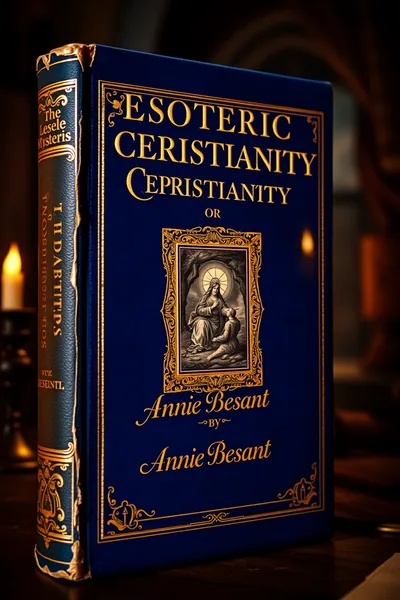
Esoteric Christianity Or the Lesser Mysteries (Classic Reprint)

 80
80

Esoteric Christianity Or the Lesser Mysteries (Classic Reprint)
Annie Besant's "Esoteric Christianity" offers a compelling, albeit dense, exploration of Christian symbolism through a distinctly Theosophical lens. Her assertion that the Gospels are primarily allegorical accounts of spiritual evolution, rather than solely historical records, is a bold reinterpretation. The strength lies in her systematic approach to decoding biblical narratives, particularly her explanation of the Christ as an inner, divine principle rather than solely an external figure. However, the prose can be archaic, and the sheer volume of symbolic interpretation may overwhelm readers unfamiliar with Theosophical terminology. A particularly striking passage details the resurrection not as a physical event, but as the liberated soul's triumph over the limitations of the lower self, a concept that requires careful consideration. While challenging, the work provides a unique perspective for those disillusioned with conventional dogma.
📝 Description
80
Annie Besant's 1901 book, Esoteric Christianity, argues Christian doctrine holds hidden spiritual truths.
Annie Besant's Esoteric Christianity Or the Lesser Mysteries, published in 1901, examines the hidden spiritual meanings within Christian teachings. Besant suggests that the public, or exoteric, presentation of Christianity often obscures a deeper, esoteric layer of truth. She proposes that the narratives and dogma of Christianity function as allegories, symbolizing occult principles and the stages of individual spiritual development.
The book is intended for those who feel traditional Christian interpretations are insufficient and seek a more mystical understanding. It will appeal to students of comparative religion, occultism, and Theosophy. Readers should be open to symbolic readings of scripture and interested in the connections between philosophy, science, and spirituality. Besant's work aims to reveal the symbolic language and esoteric foundations of Western spiritual traditions.
Besant viewed the life of Jesus as an allegory for the soul's spiritual journey. Her interpretation includes the symbolic meaning of miracles and parables as representations of occult laws and the path of initiation.
Published in 1901, this work emerged during a period of growing interest in spiritualism and alternative religious thought, particularly within the Theosophical movement. Annie Besant, a leading figure in the Theosophical Society, sought to present esoteric traditions as rational systems. Her interpretation of Christianity aimed to synthesize Eastern and Western mystical thought, following in the vein of Helena Blavatsky's earlier foundational texts. The book positions itself within a lineage that looks beyond literal religious dogma to uncover universal spiritual laws.
💡 Why Read This Book?
• Understand the Christ principle as a universal, inner divinity, moving beyond a solely historical figure, as detailed in the book's interpretation of the Gospels. • Learn to decode the symbolic language of Christian scripture, viewing parables and miracles as allegories for spiritual development, a key method presented. • Explore the Theosophical perspective on human evolution and consciousness, connecting the teachings to broader esoteric traditions as Besant does throughout.
⭐ Reader Reviews
Honest opinions from readers who have explored this book.
❓ Frequently Asked Questions
What is the primary goal of Annie Besant's 'Esoteric Christianity'?
The book aims to reveal the hidden spiritual and occult truths underlying Christian teachings, interpreting biblical narratives and dogma as allegories for individual spiritual evolution and cosmic laws.
When was 'Esoteric Christianity Or the Lesser Mysteries' first published?
The original publication date for Annie Besant's 'Esoteric Christianity Or the Lesser Mysteries' was 1901.
Who is Annie Besant and what was her connection to Theosophy?
Annie Besant was a prominent British socialist, Theosophist, and women's rights activist. She became a leading figure in the Theosophical Society, serving as its president from 1907 to 1933, and authored numerous works on esoteric subjects.
What does Besant mean by 'Lesser Mysteries'?
In esoteric traditions, 'mysteries' refer to sacred teachings. The 'Lesser Mysteries' typically denote introductory or preparatory stages of spiritual knowledge, focusing on the individual's inner transformation, as opposed to the 'Greater Mysteries' which deal with cosmic principles.
How does this book differ from standard Christian theology?
It diverges significantly by interpreting Christian events and figures allegorically, focusing on occult principles and the evolution of consciousness rather than historical or dogmatic literalism.
Is this book suitable for beginners in esoteric studies?
While foundational, the book assumes some familiarity with esoteric concepts and uses specific terminology. Beginners may find it beneficial to approach with supplementary resources on Theosophy or comparative mysticism.
🔮 Key Themes & Symbolism
Christ as Inner Principle
Besant reinterprets the Christ figure not solely as the historical Jesus, but as the divine spark or 'Higher Self' within every individual. The narrative of Jesus's life becomes an allegory for the awakening and realization of this inner Christ consciousness, a process of spiritual evolution that transcends ordinary human limitations. This internal divine principle is presented as the true object of devotion and the ultimate goal of spiritual practice.
Biblical Allegory and Symbolism
The work meticulously decodes biblical stories, miracles, and parables as symbolic representations of occult laws and stages of spiritual development. For instance, the resurrection is not merely a historical event but signifies the soul's liberation from the bonds of ignorance and the material world. This approach aims to unveil a deeper, universal wisdom hidden within the exoteric Christian tradition, accessible through esoteric study.
The Lesser Mysteries
The title refers to the initiatory path of spiritual awakening focused on the individual's transformation and understanding of the 'Great Sacrifice' – the descent of spirit into matter and its subsequent redemption. Besant suggests that the core teachings of Christianity embody these Lesser Mysteries, guiding the aspirant through trials and purification towards union with the divine, a process mirroring the stages of occult development.
Theosophical Synthesis
Besant's work is a prime example of Theosophical thought, aiming to synthesize Western esoteric traditions with Eastern philosophies. It places Christianity within a broader cosmic evolutionary scheme, aligning its teachings with concepts found in Hinduism and Buddhism, such as karma, reincarnation, and the seven planes of existence, offering a universalist perspective.
💬 Memorable Quotes
Direct passages from the work, attributed to the author.
“The object of this book is to suggest certain lines of thought as to the deep truths underlying Christianity, truths generally overlooked, and only too often denied.”
— This opening statement clearly articulates Besant's intent: to bring to light the hidden, esoteric meanings of Christianity that she believes have been obscured by conventional interpretation and societal acceptance.
“The Gospels are not merely history, but allegory.”
— This concise interpretation captures Besant's fundamental approach, asserting that the narratives of Jesus's life should be understood primarily as symbolic representations of spiritual truths and the journey of the soul.
“Every human soul is a Christ in the making.”
— This statement underscores the potential for divinity within all individuals, framing human existence as a process of spiritual unfolding towards the realization of one's own inner Christ nature.
“The resurrection is the triumph of the Spirit over the limitations of matter.”
— This interpretation of a key Christian event emphasizes its esoteric meaning, portraying the resurrection not as a physical resuscitation but as the soul's liberation and spiritual victory over material constraints.
💡 Key Ideas
Editorial paraphrase of the work's core concepts — not direct quotes.
The Christ within is the true Light, the true Life, the true Way.
This paraphrase highlights Besant's core concept of the Christ not just as an external savior but as an internal divine presence, the individualized expression of universal consciousness within each person.
🌙 Esoteric Significance
Tradition
This work is firmly rooted in the Theosophical tradition, synthesizing Western esoteric concepts with Eastern philosophies. It interprets Christianity through the lens of universal spiritual laws, occult science, and the evolutionary journey of consciousness, as articulated by Helena Blavatsky. Besant's approach positions Christian symbolism within a larger cosmological framework, emphasizing the Christ principle as a universal manifestation of divine consciousness rather than a solely historical figure.
Symbolism
Key symbols like the Cross are interpreted not just as instruments of torture but as representations of the descent of spirit into matter and the union of divine and human. The Resurrection is viewed as the soul's liberation from the material plane and the attainment of spiritual mastery. The sacraments, such as Baptism and the Eucharist, are described as symbolic enactments of inner spiritual processes, signifying purification and the assimilation of divine energy.
Modern Relevance
Besant's work continues to influence contemporary esoteric practitioners and spiritual seekers interested in a non-dogmatic, symbolic understanding of Christianity. Modern New Age and spiritual movements that explore the 'Christ Consciousness' or the divine potential within humanity often draw upon the interpretations laid out in this book. Thinkers and groups focused on comparative mysticism and the integration of Eastern and Western spiritual traditions still find value in its allegorical approach to scripture.
👥 Who Should Read This Book
• Students of Theosophy seeking to understand Annie Besant's specific interpretation of Christian teachings and their place within the broader Theosophical system. • Comparative religion scholars interested in esoteric interpretations of major world religions and the historical development of mystical thought. • Individuals questioning or dissatisfied with literalist interpretations of Christianity, looking for a symbolic, allegorical, or mystical framework to understand its core messages.
📜 Historical Context
Annie Besant's "Esoteric Christianity Or the Lesser Mysteries," first published in 1901, emerged during a vibrant period of occult revival in the West. The late Victorian and Edwardian eras saw a surge of interest in spiritualism, Theosophy, and alternative spiritual paths, partly as a reaction against the perceived materialism of the age. Besant, a leading figure in the Theosophical Society following Helena Blavatsky, aimed to present a mystical interpretation of Christianity that aligned with Theosophical tenets. This work sought to reconcile Christian doctrine with concepts of karma, reincarnation, and spiritual evolution, placing it within a broader esoteric framework. It existed alongside other esoteric interpretations of Christianity, such as those explored by G.R.S. Mead, who also sought hidden meanings in early Christian texts, and was part of a wider intellectual milieu influenced by figures like Rudolf Steiner, who would later diverge from Theosophy. Besant's accessible yet profound style made complex esoteric ideas available to a growing readership.
📔 Journal Prompts
The concept of the Christ as an inner principle: How does this differ from traditional views, and what are its implications for personal spiritual practice?
The allegorical interpretation of biblical events: Select one parable or miracle and explore its potential esoteric meaning as suggested by Besant.
The symbolism of the Cross: Reflect on its representation of the union of spirit and matter and its relevance to your own life's challenges.
Spiritual evolution as a journey: How does Besant's view of the 'Lesser Mysteries' inform your understanding of personal growth and transformation?
The relationship between exoteric and esoteric knowledge: Consider why some truths might be hidden and the purpose of veiled teachings.
🗂️ Glossary
Exoteric
Pertaining to teachings or doctrines intended for the general public, often presented in a literal or simplified manner, as opposed to esoteric or hidden meanings.
Esoteric
Intended for or likely to be understood by only a small number of people with a specialized knowledge or interest; inner, hidden teachings.
Theosophy
A spiritual philosophy originating in the 19th century, particularly associated with Helena Blavatsky and Annie Besant, seeking to synthesize Eastern and Western religious and philosophical traditions and to uncover the universal truths underlying them.
Christ Principle
In Theosophy, this refers to the divine consciousness or 'Higher Self' within every individual, representing the potential for spiritual realization and union with the divine.
Allegory
A story, poem, or picture that can be interpreted to reveal a hidden meaning, typically a moral or political one, often used in esoteric traditions to convey spiritual truths.
Initiation
A ritual or process marking a significant transition or advancement in spiritual knowledge or attainment within esoteric traditions; often involves symbolic death and rebirth.
Lesser Mysteries
The initial stages of esoteric instruction, focusing on the purification of the personality and the understanding of the individual's spiritual path and inner transformation.
This book appears in 1 collection
🔮 Readers Also Liked
Browse all →








From the “Esoteric Christianity” Collection
View all →

More Free Occult Philosophy Books
View all →