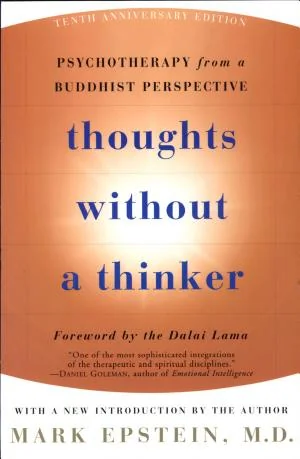
Thoughts Without a Thinker
 82
82

Thoughts Without a Thinker
Mark Epstein’s "Thoughts Without a Thinker" presents a sophisticated argument for the psychological utility of Buddhist contemplative practices, a perspective that feels even more relevant today than it did upon its initial 2004 release. Epstein, a psychiatrist and Buddhist practitioner, excels at drawing parallels between the insights gleaned from meditation and the therapeutic process. His analysis of how the concept of 'no-self' (anatta) can alleviate ego-driven anxieties is particularly striking. The work’s strength lies in its clear articulation of complex ideas, making them accessible without oversimplifying. A potential limitation, however, is that some readers might find the theoretical discussions occasionally lack concrete, experiential guidance. The passage discussing the therapeutic potential of recognizing the mind's tendency to construct narratives about the self, mirroring the Buddhist understanding of impermanence, is a prime example of the book's insightful yet demanding nature. Ultimately, "Thoughts Without a Thinker" offers a valuable bridge for those seeking to understand the mind through both contemplative and clinical lenses.
📝 Description
82
Mark Epstein published "Thoughts Without a Thinker" in 2004, examining Buddhist meditation and Western psychotherapy.
Mark Epstein's "Thoughts Without a Thinker" explores the connections between Buddhist meditation and Western psychotherapy. Published in 2004, the book argues that ancient contemplative practices can inform our modern understanding of the mind, consciousness, and the self. It is not a manual for meditation but a philosophical inquiry that draws parallels between insights from mindfulness and the process of self-discovery in therapy. Epstein suggests that the ego, or the constant internal dialogue, can obscure a more direct experience of reality. He proposes that meditation helps to quiet this internal noise, leading to a state of 'thoughtless awareness' that offers both calm and clarity. This perspective aligns with therapeutic aims to understand and manage the self.
The book is for anyone interested in the deeper aspects of mindfulness and meditation, going beyond simple stress relief. Psychotherapists looking to incorporate contemplative ideas into their work will find it relevant, as will spiritual seekers interested in the psychological roots of their path. While no prior expertise in psychology or Eastern philosophy is required, readers familiar with either field will find ample material for contemplation. The work emerged during a time of growing interest in meditation's effects on the brain and well-being, contributing to a broader conversation bridging Eastern experiential wisdom and Western analytical psychology.
This work is situated within the confluence of Buddhist contemplative traditions and Western depth psychology. It engages with concepts central to Mahayana Buddhism, particularly the idea of no-self and the nature of consciousness, and interprets them through the lens of psychoanalytic theory. Epstein bridges the gap between the experiential insights of Buddhist practice and the analytical frameworks of psychotherapy, a dialogue that gained traction in the late 20th and early 21st centuries. His approach reflects an increasing openness in Western thought to explore non-dualistic perspectives and altered states of consciousness as pathways to psychological integration.
💡 Why Read This Book?
• Gain a nuanced understanding of how Buddhist concepts, like the recognition of 'no-self,' can directly address psychological suffering, as explored in relation to ego defenses discussed in the book. • Discover practical applications for contemplative practices in psychological healing, moving beyond mere relaxation techniques by referencing Epstein's 2004 publication. • Explore the profound connection between a 'thoughtless awareness' and therapeutic insight, as articulated through Epstein's synthesis of Buddhist philosophy and psychotherapy.
⭐ Reader Reviews
Honest opinions from readers who have explored this book.
❓ Frequently Asked Questions
What is the core concept of 'thoughts without a thinker' in Mark Epstein's book?
The core concept suggests that our sense of self and experience is often obscured by the constant internal dialogue of the 'thinker' or ego. By quieting this mental chatter through practices like meditation, one can access a state of 'thoughtless awareness' and a more direct experience of reality, as explored in the book's 2004 edition.
How does Mark Epstein integrate Buddhist philosophy with Western psychotherapy in 'Thoughts Without a Thinker'?
Epstein, a psychiatrist, bridges these disciplines by showing how Buddhist insights into consciousness, suffering, and the self can inform and enhance psychotherapeutic approaches, offering a contemplative lens on psychological healing.
What does the book suggest about the nature of the self?
The book explores the Buddhist concept of 'no-self' (anatta), suggesting that the ego-driven, fixed sense of self is an illusion. Recognizing this impermanence can be a path to alleviating psychological distress and attachment.
Who would benefit most from reading 'Thoughts Without a Thinker'?
Psychotherapists, mindfulness practitioners, individuals interested in the intersection of spirituality and psychology, and anyone seeking a deeper understanding of consciousness and the mind would find value in this work.
When was 'Thoughts Without a Thinker' first published?
The book was first published on November 23, 2004, reflecting the growing academic and popular interest in the psychological study of meditation during that period.
Does the book offer practical meditation techniques?
While it draws heavily on meditation principles, 'Thoughts Without a Thinker' is primarily a philosophical and theoretical exploration rather than a step-by-step meditation manual. It focuses more on the conceptual understanding derived from practice.
🔮 Key Themes & Symbolism
The Ego and Thoughtless Awareness
The central theme revolves around the distinction between the egoic 'thinker' and a state of pure awareness. Epstein argues that our identification with the constant stream of thoughts creates a sense of a solid, separate self, which is a primary source of psychological suffering. He posits that contemplative practices, by allowing the mind to settle, can reveal an underlying 'thoughtless awareness' – a state of being that is not defined by conceptualization. This appeals to Buddhist teachings on impermanence and the illusory nature of the self, offering a path to liberation from ego-driven anxieties.
Buddhist Philosophy in Psychotherapy
Epstein meticulously integrates core Buddhist concepts, such as anatta (no-self) and dukkha (suffering), into the framework of Western psychotherapy. He demonstrates how the understanding of these principles, often gained through direct meditative experience, can offer useful insights into the mechanisms of psychological distress. The work posits that the therapeutic process itself can be viewed through a contemplative lens, encouraging a similar non-judgmental observation of mental phenomena and a release from attachment to fixed ideas about oneself.
Consciousness and the Nature of Reality
The book probes the nature of consciousness and how our perception of reality is shaped by our mental processes. Epstein suggests that the 'thinker' acts as a filter, often distorting or obscuring a more direct, unmediated experience. By cultivating awareness of these filtering processes, as facilitated by practices like Vipassanā meditation, individuals can begin to perceive reality more clearly, leading to a reduction in existential anxiety and a greater sense of presence and interconnectedness.
The Therapeutic Value of 'No-Self'
A significant focus is placed on the therapeutic implications of understanding and experiencing 'no-self.' This concept, central to Buddhist philosophy, challenges the Western notion of a permanent, independent ego. Epstein argues that clinging to this illusory self leads to fear, attachment, and suffering. By contrast, recognizing the fluid, impermanent nature of the self, as explored through contemplative practice, can dissolve the basis for many psychological problems, fostering a sense of freedom and acceptance.
💬 Memorable Quotes
Direct passages from the work, attributed to the author.
“The mind is like a river, constantly flowing, and we try to grasp at the water, thinking it is a solid thing.”
— This metaphorical interpretation highlights the Buddhist understanding of impermanence. It suggests our attempts to hold onto thoughts, feelings, or a fixed sense of self are futile, as they are transient phenomena, much like the ever-changing water in a river.
“We are afraid of our own minds, of the thoughts and feelings that arise within them.”
— This reflects a common human tendency to resist or suppress uncomfortable internal experiences. The quote points to how this fear can create psychological tension, and how acknowledging these inner states, rather than avoiding them, is crucial for healing.
“Meditation is not about stopping thoughts, but about observing them without judgment.”
— This succinctly captures a key principle of mindfulness meditation. It reframes the practice from an act of suppression to one of detached observation, promoting a healthier relationship with one's internal mental landscape.
“The 'I' that thinks is not the same as the 'I' that is aware.”
— This statement probes the distinction between the conceptual self (the thinker) and the fundamental awareness that underlies experience. It suggests a deeper, more expansive sense of self beyond the ego's narrative.
“Therapy can help us understand the patterns of our minds, while meditation helps us experience them directly.”
— This synthesis emphasizes the complementary roles of psychotherapy and contemplative practice. While therapy offers intellectual understanding, meditation provides experiential realization, together leading to profound transformation.
🌙 Esoteric Significance
Tradition
While not strictly adhering to a single lineage, Epstein's work is deeply rooted in Buddhist philosophy, particularly Mahayana and Vipassanā traditions. It bridges these contemplative practices with Western depth psychology, particularly psychoanalytic thought. This integration represents a modern esoteric endeavor to synthesize ancient wisdom with contemporary psychological understanding, moving beyond purely religious or spiritual dogma to explore the universal mechanisms of consciousness and suffering.
Symbolism
The primary 'symbol' explored is the concept of the 'thinker' itself, representing the ego or the conceptual mind, which obscures a deeper awareness. The 'river' is a recurring motif for the flowing, impermanent nature of thoughts and experience, contrasting with our tendency to grasp for solidity. 'Thoughtless awareness' functions as a symbolic state of pure, unmediated presence, a goal of both meditation and certain esoteric contemplative paths.
Modern Relevance
Epstein's work remains highly relevant for contemporary mindfulness-based therapies (MBCT, ACT), transpersonal psychology, and even secular contemplative movements. Thinkers and practitioners in fields exploring consciousness, non-duality, and the psychological benefits of meditation frequently cite his ability to articulate the subtle interplay between mind, self, and reality in accessible terms, making Buddhist insights applicable to modern psychological challenges.
👥 Who Should Read This Book
• Psychotherapists and counselors seeking to deepen their understanding of contemplative practices and their application in treating psychological distress. • Individuals engaged in mindfulness or Buddhist meditation seeking a more profound conceptual framework for their experiences and the nature of the self. • Students and researchers of comparative religion, psychology, and consciousness studies interested in the cross-pollination of Eastern philosophy and Western scientific thought.
📜 Historical Context
Mark Epstein's "Thoughts Without a Thinker" emerged in 2004, a period when the integration of Buddhist principles into Western psychology was gaining significant traction. The early 2000s saw a proliferation of mindfulness-based therapies, such as Mindfulness-Based Stress Reduction (MBSR) developed by Jon Kabat-Zinn in the late 1970s, and a growing body of scientific research validating their efficacy. Epstein's work distinguished itself by offering a more philosophical and deeply psychological exploration, drawing parallels between the concept of 'no-self' and the therapeutic dissolution of ego defenses, rather than focusing solely on empirical outcomes. He was engaging in a dialogue that had precursors in thinkers like Erich Fromm and Alan Watts, who had explored Eastern philosophies from a Western perspective decades earlier. While not facing overt censorship, Epstein's work contributed to a shift in how mental health professionals viewed consciousness and the efficacy of contemplative traditions, challenging purely materialistic or behaviorist models dominant in earlier parts of the 20th century.
📔 Journal Prompts
The nature of the 'thinker' versus 'awareness': What arises when you observe the observer?
Reflect on the Buddhist concept of anatta and its potential impact on ego-driven anxieties.
How does the metaphor of a 'river' illuminate your understanding of impermanence?
Consider the relationship between 'grasping' at thoughts and psychological suffering.
Explore the 'thoughtless awareness' state: What qualities does it possess when you encounter it?
🗂️ Glossary
Anatta
A core Buddhist doctrine signifying 'no-self' or 'non-ego.' It posits that there is no permanent, unchanging, independent self or soul, challenging the conventional understanding of a fixed personal identity.
Dukkha
Often translated as 'suffering,' 'dissatisfaction,' or 'stress.' It refers to the inherent unsatisfactoriness of conditioned existence, arising from impermanence, attachment, and the illusion of a permanent self.
Vipassanā
A type of Buddhist meditation practice, often translated as 'insight meditation.' It involves cultivating mindful awareness of the present moment, observing bodily sensations, feelings, and mental states without judgment to gain insight into their true nature.
Ego
In this context, referring to the psychological construct of the 'self' or 'I' that is associated with personal identity, self-importance, and the sense of being a separate, enduring entity. It is often seen as the source of attachment and aversion.
Thoughtless Awareness
A state of consciousness characterized by deep presence and clarity, where the mind is not dominated by discursive thought or conceptualization. It is an awareness that is observant but not actively 'thinking' in the usual sense.
Impermanence
The Buddhist concept (Anicca) that all conditioned phenomena are in a constant state of flux and change. Nothing is static; all things arise, persist, and cease.
Attachment
In Buddhist psychology, attachment refers to the clinging or craving for pleasant experiences, things, or states of being, and aversion to unpleasant ones. It is seen as a primary cause of suffering (dukkha).
This book appears in 1 collection
🔮 Readers Also Liked
Browse all →









From the “Meditation” Collection
View all →









More Free Occult Philosophy Books
View all →